
Level Design & World-Building
On Monday 19th October, guest speaker Oguz Orkun Doma delivered a lecture on the topic of Level Design.
During this session, we re-evaluated our understanding of what level design actually is, moving beyond the assumption that it is simply about creating visually appealing environments.
Firstly, the lecture clearly distinguished the differences between three related but distinct roles:
- Level Design
Focuses on structuring space, pacing, challenge, and the player’s path through the game. - Environment Art
Is concerned with making spaces visually polished and aesthetically coherent. - Narrative Design
Is primarily about storytelling, rather than the design of playable space itself.Understanding this distinction helped clarify the specific role and responsibility of level design within the game development pipeline.

The lecture then introduced the core principles of level design. These included:
Flow
Refers to the pacing of the player experience and how tension is introduced, developed, and resolved over time.- Affordances
Describe how environments communicate possible interactions without relying on explicit text or instructions. - Guidance
Focuses on directing players through the use of lighting, composition, colour, and sound. - Gating and Keys
Are used to structure progression through elements such as locked doors, keys, or newly unlocked abilities. - Difficulty Curves
Emphasise that challenge is not linear, but carefully designed to support player engagement and learning over time.
Level Design Exercise
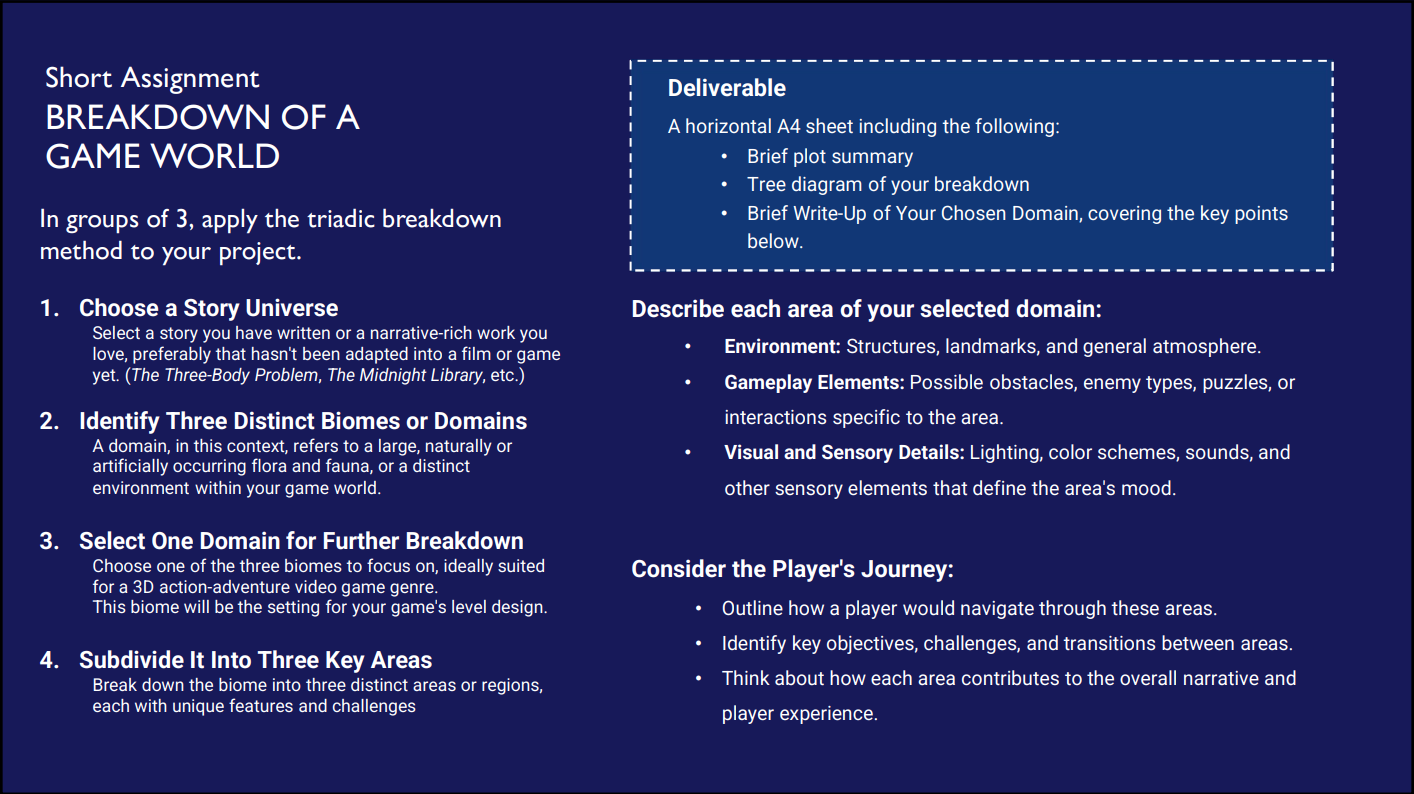
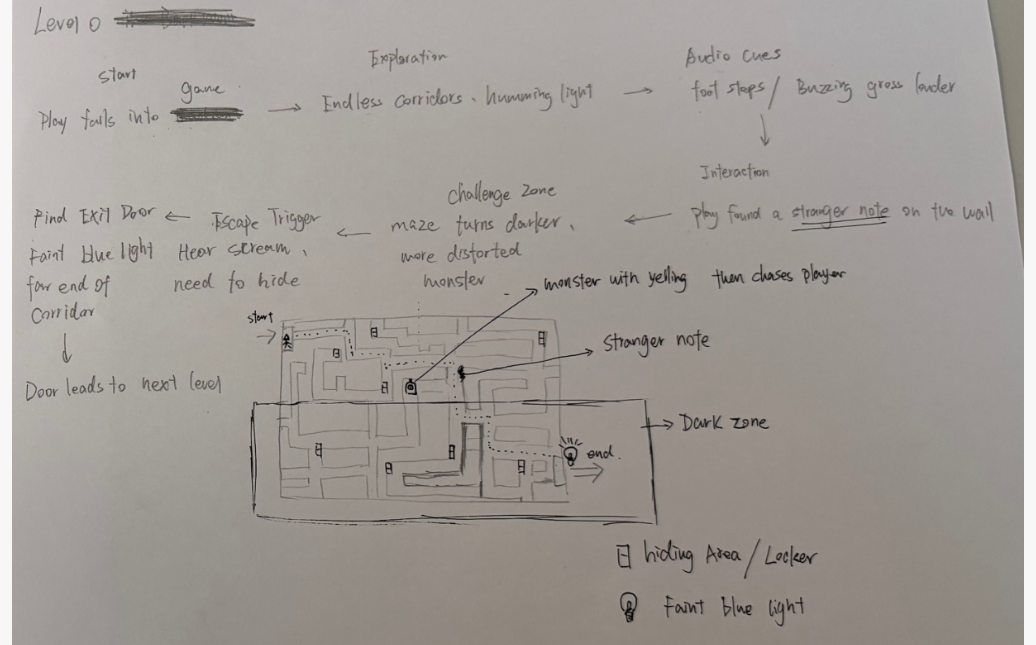
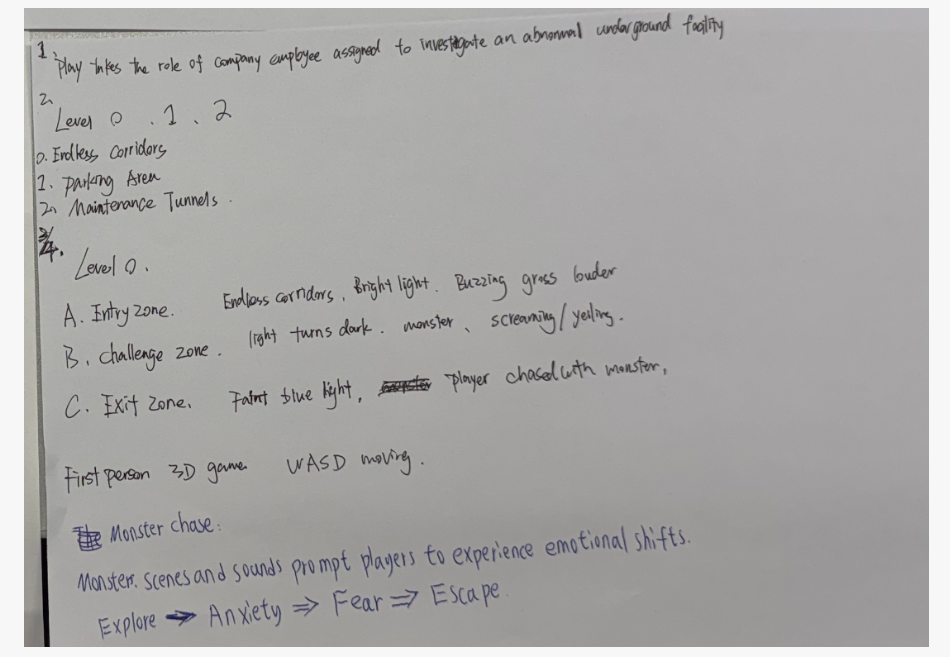
In the level design practice, our group chose the first level of “The Backroom” as the focus of analysis. First, we drew an overview map to show the overall structure of the scene and the spatial layout of the environment.
Then, we break down the levels into a series of action bubbles to identify different game segments. In each action bubble, we define the player’s actions and goals, and clarify how the game progress and tension are constructed throughout the level.
Finally, we marked the map to highlight key spatial functions, interactive elements and sensory elements, such as atmosphere and environmental cues. This process helps us better understand how level design conveys gameplay and emotions through space rather than relying on explicit instructions.
Further details regarding level design development and supporting documentation can be found in Environment & Asset Production and Narrative & World & Character.