This section covers the technical systems and visual effects developed to support the atmosphere and functionality of Through Ash. My work focused on bridging art and implementation, using shaders, particle systems, and post-processing to enhance both visual quality and player experience.
Shader Development:
Toon Shader & Visual Style
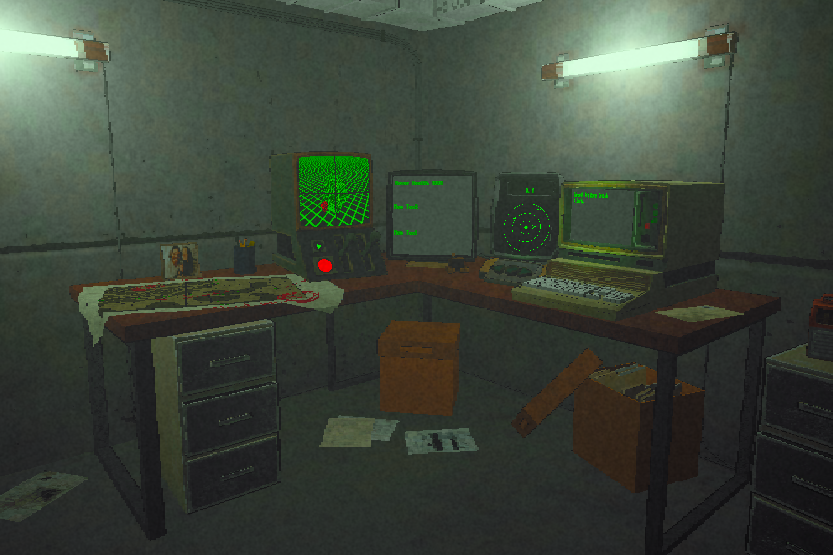
The game’s visual identity was reinforced through a custom toon shader applied to environment assets. This reduced reliance on traditional world lighting, allowing textures to remain prominent while maintaining a stylised, high-contrast look.
This approach worked in conjunction with the asset pipeline, transforming realistically textured models into a cohesive stylised environment with strong readability and visual consistency.

Pixelation & Post-Processing
To further support the darker tone, a pixelation filter was implemented through post-processing, combined with dithering and colour grading.
Global adjustments such as vignette and colour correction were used to introduce a subtle green tint, contributing to a “sickly” atmosphere and reinforcing the environmental narrative.
Specialised Shaders
Additional shaders were developed to enhance specific elements within the game, including:
- a heat distortion shader used in the main menu to create environmental movement
- an RCT-style shader applied to screen elements, adding animated scan-line detail to reinforce the interface aesthetic
These smaller details contributed to overall immersion and visual polish.
Particle Systems & Environmental Effects:
Particle systems were used extensively to bring motion and life into Particle systems were used extensively to introduce motion and environmental feedback within otherwise static scenes.
These systems were designed not only for visual enhancement but also to support atmosphere and gameplay readability.
Examples include:
- ambient dust simulation in the main menu, creating a sense of wind and environmental movement
- timed dust particles within the bunker environment, adding subtle environmental storytelling and reinforcing the sense of decay
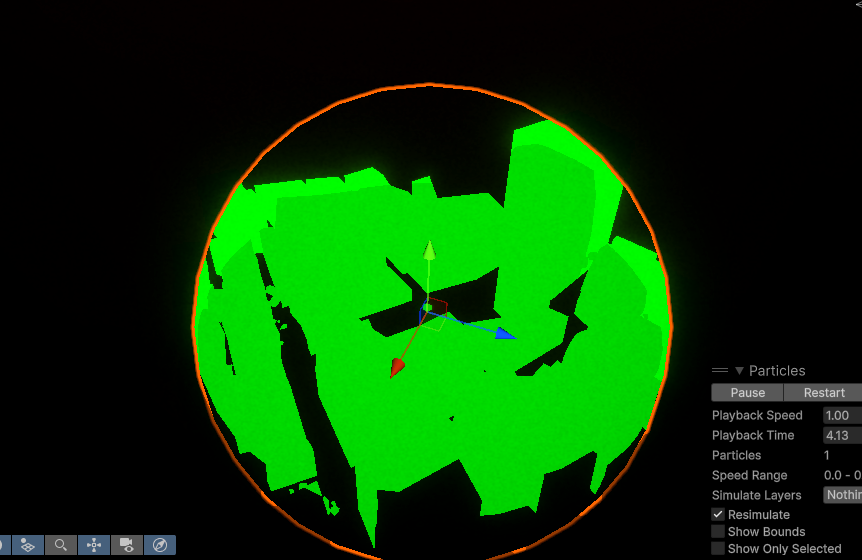
- a radar/sonar system developed to provide spatial awareness within a visually restricted environment
The radar system was achieved using an expanding particle combined with a shader that highlights geometry upon contact, creating a sonar-like effect. This system integrates gameplay functionality with visual design, allowing the player to navigate and interpret the environment through a stylised mechanic.

UI & Visual Implementation:
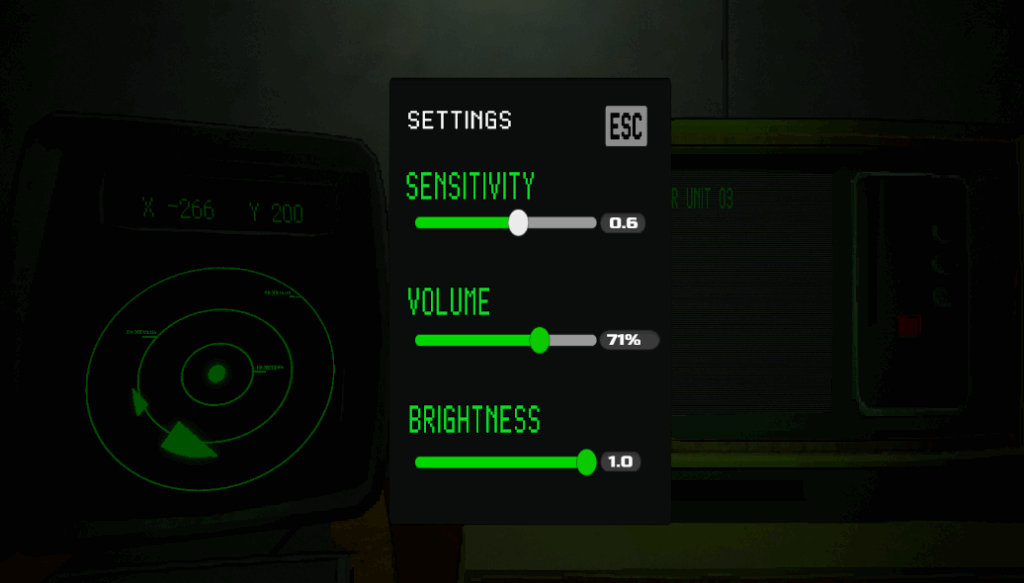
I was responsible for the visual implementation of the game’s interface, including:
- main menu
- pause menu
- settings menu
Within the settings, I integrated adjustable parameters such as sensitivity, brightness, and volume, building on systems developed by my teammate.
This required aligning UI visuals with underlying systems, ensuring both clarity and consistency with the overall aesthetic.

Audio Integration & Systems Collaboration:
Working alongside my teammate’s narrative system, I integrated voice lines and implemented 3D spatial audio to enhance immersion.
This included:
- radio-based audio playback
- environmental sound placement
This process required adapting existing systems to support both narrative delivery and atmospheric design.
Gameplay Interaction & Iteration:
Based on playtesting feedback, I made adjustments to interaction systems to improve engagement and responsiveness.
For example:
- a mini-game interaction was redesigned from a passive hold mechanic to an active tapping system, where progress decreases if input stops, increasing tension
- environmental interactions, such as lever animations, were refined to improve visual feedback
These changes reflect an iterative approach to improving player experience through both design and implementation.
Lighting, Atmosphere & Effects:
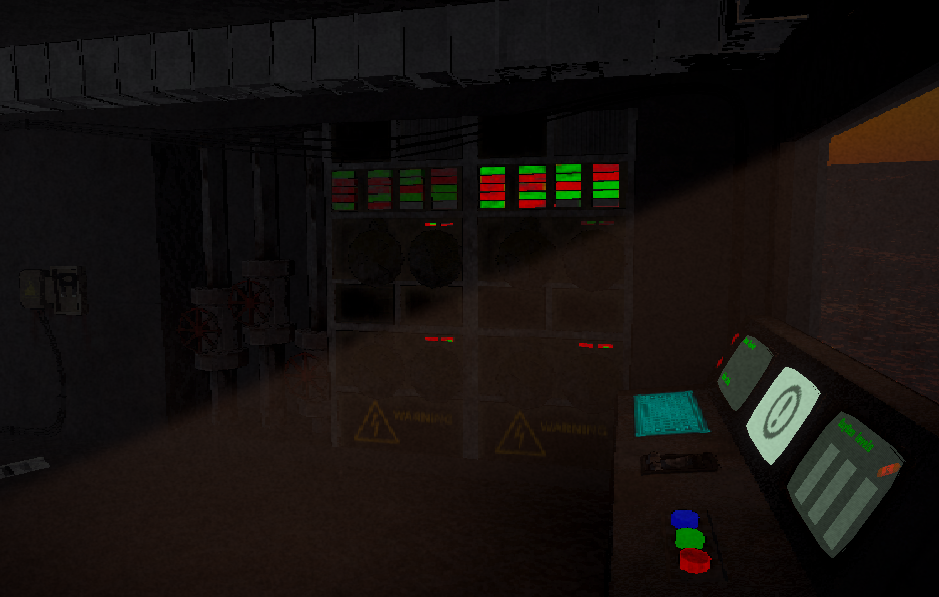
Atmospheric depth was enhanced through the implementation of volumetric fog, contributing to the overall sense of scale and environmental density.
This was carefully balanced with lighting and post-processing to maintain visual clarity while preserving the intended tone. The combination of these elements allowed for a controlled atmosphere that supports both gameplay and narrative.
Optimisation:
Towards the final stages of development, optimisation was carried Towards the final stages of development, optimisation was carried out to ensure stable performance without compromising visual quality.
This included:
- preventing multiple cameras from rendering simultaneously
- reducing texture resolutions where appropriate
- compressing audio for improved memory efficiency
- adjusting volumetric fog settings to balance performance and visual fidelity
These optimisations ensured the game remained performant and suitable for public showcase while maintaining its intended visual standard.