

Definition of “Paradox”
Paradoxes are contradictory statements that lead to a logically conflicting resolution; they reveal fascinating flaws in the way we view and puzzle out the world. It comes from the Greek, “paradoxos”, literally meaning “aside belief”, as the Greeks were by and large the foremost thinkers of paradoxes in the West.
CATEGORIES OF A PARADOX:
As classified by W.V.O. Quine, a Harvard philosopher and mathematician:
Veridical Paradoxes (True Paradoxes)
Paradoxes that appear to be contradictory, but resolving in a truth, revealing internal bias in intiution.
- Example: The Birthday Problem.
- In a small group (like 23 people), there’s a >50% chance two share a birthday! This contradicts the feeling that it should take many more people.
Falsidical Paradoxes (False Paradoxes)
The opposite of Veridical Paradoxes, these paradoxes seem logical, but contain false assumptions that lead to a flawed conclusion.
- Example: The Achilles Paradoxes
- Achilles can never catch up to the tortoise in a race if the tortoise has a head start, because the space between them can be infinitely divided, therefore Achilles would have to take an infinite number of steps
Antinomies (Genuine Contradictions)
Real paradoxes in which two seemingly true statements conflict, showing issues in logic and language.
- Example: The Liar Paradox
- “This sentence is false” – the sentence can now neither be true nor false, as it contradicts itself.
The First Paradox
The Chicken or the Egg?
Finding out what was the first paradox was almost a paradox itself, because logical fallacies are as old as humans have had the cognition to develop logic. That being said, the first recorded paradox was from Anaximander, a pre-Socratic Greek philosopher (c. 610 – c. 546 BC) that postrated the following question:
Does each thing have an origin?
The concept of infinity and particularly negative infinity was not something regularly contended with at the time, and philosophers then were grappling with the true origin of man. Some philosophers thought there could be an infinite sequence of finite things, in which each negative integer is finitely far from 0 and “comes from” a predecessor that itself is only finitely far from 0: -1 preceded by -2 preceded by -3… etc. Every member of that sequence has an origin (its predecessor), and is also only finitely far from the present (0), even though there is no starting point for the sequence.
This favoured Anaximander’s view, although Anaximander’s exact reasoning was based on an infinite thing, rather than an infinite relationship between finite things. That way, each species is infinitely old.
In other words, which came first – the chicken or the egg?
(One and a half thousand years later, Charles Darwin’s theory of evolution would vindicate Anaximander’s belief. Chickens and eggs have only been around for a finite amount of time, therefore one must have come before the other. The same logic applies to man, and to the origin of all things that are finite.)

Ancient Greece
Zeno of Elea (c. 490–430 BCE), commonly attributed by modern academics to be the founder of paradoxes as we know them, started studying paradoxical arguments to support Parmenides’ philosophy on monism (which is a school of thought that believes there is no true distinction between the mind and reality), by challenging preconceptions about space, time, and motion. Of these original texts, again many have been lost, only referred to through second-hand accounts such as Plato and Aristotle. Three of the most well-known paradoxes come from Zeno of Elea.
Achilles and the Tortoise
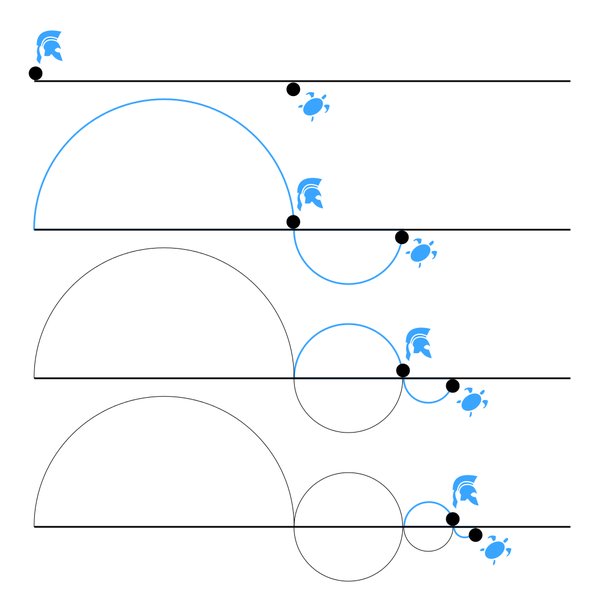
One of the most famous paradoxes in the West, the paradox argues that in a race between Achilles (a Greek God heralded for his amazing athletic ability) and a tortoise (a famously slow animal), the tortoise would be able to win. The paradox goes thus:
Achilles and a tortoise agree to a race.
Confident in his superior athleticism, Achilles gives the tortoise a 100 metre head start.
However, once he has crossed the 100 metres, the tortoise has moved another three.
When Achilles crosses this, the tortoise has moved another one.
Whenever Achilles reaches somewhere the tortoise has been, he still has farther to go to catch him.
This creates an infinite cycle where Achilles will never catch up to the tortoise.
This contradicts logic, as a faster runner will always overtake a slower runner. However when presented in this way, it seems impossible that Achilles could ever catch up.
Dichotomy Paradox
This paradox, very similar to Achilles and the tortoise, also makes its paradox by infinitely dividing space. Its logic is frequently also confused with the Achilles paradox.
Atalanta, a Greek huntress, wishes to walk towards the end of a path.
Before she can get halfway there, she must get a quarter of the way there.
Before she can get a quarter of the way there, she must get an eighth of the way there.
This repeats infinitely; Atalanta can never get to the end of her path, because she cannot even take the first step.
One argument against this paradox is that, supposing Atalanta can take her first step, then all her subsequent steps can be added up in the formula below:
½ + ¼ + ⅛… = 1
While some mathematicians believe this solves the paradox, it is based on the modification to the paradox that assumes Atalanta can take her first step (and not have to travel another infinite amount of space to do so). Therefore, most decry this paradox to be unsolvable.
The Arrow Paradox
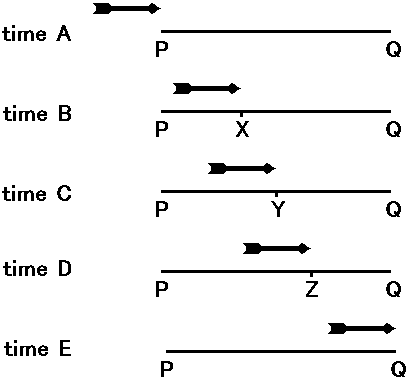
Another famous, surviving paradox that Zeno proposed was the arrow paradox, which argues that an arrow is motionless the entire time it’s heading towards its target.
An archer fires an arrow towards a target.
As the arrow flies, it occupies one position in space in one moment, and is therefore motionless.
In the next moment, it occupies another position, and is therefore motionless.
At every point in time, the arrow is motionless.
Therefore, the arrow never moved.
Instead of the previous two paradoxes, which divided space infinitely, this paradox divides time infinitely.
Chinese Paradox Philosophies
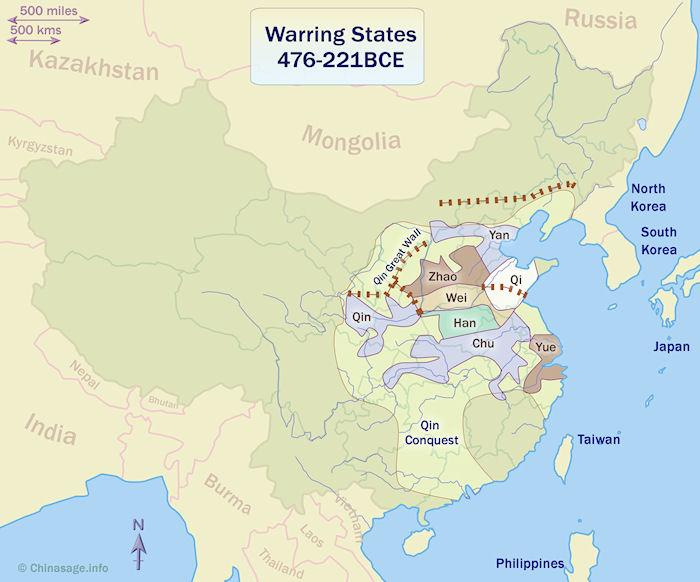
The Ancient Greek philosophers parallel thinking that was also being done during the Warring States period of China (c. 476-221 BCE), when an informal group of logicians associated with the “School of Names and Forms” – which was a school of thought developed from Mohism – began to explore the complexities between reality, language, and the subtleties of semantic relations between the words and things. They came up with statements such as,
“Today go to Yue but arrive yesterday.”
“White horses are not horses.”
“Mountains and gorges are level.”
The text “Han History” (漢書) associates eight with the School of Names, but of which only four of them have surviving records of their doctrines, only known through quotations and citations of other text – one of which being Hui Shi (惠施). His most famous surviving work was his “Ten Theses” or “Ten Paradoxes”, which consist of contradictory statements mainly centred around the relativity of time and space. While the ten paradoxes survive via the final chapter of Zhuangzi, Tian Xia (天下), one of the two foundational texts for the philosophy of Taoism, the arguments for the paradoxes have been lost.
- The largest thing has nothing beyond it; it is called the one of largeness. The smallest thing has nothing within it; it is called the one of smallness.
- That which has no thickness cannot be piled up; yet it is a thousand li in dimension.
- Heaven is as low as earth; mountains and marshes are on the same level.
- The sun at noon is the sun setting. The thing born is the thing dying.
- Great similarities are different from little similarities; these are called the little similarities and differences. The ten thousand things are all similar and are all different; these are called the great similarities and differences.
- The southern region has no limit and yet has a limit.
- I set off for Yue today and came there yesterday.
- Linked rings can be separated.
- I know the center of the world: it is north of Yen and south of Yue.
- Let love embrace the ten thousand things; Heaven and earth are a single body.
Hui Shi also had a paradox incredibly similar to the Atalanta Paradox, known as the Stick Paradox. It again deals with dividing space infinitely:
“If from a stick a foot long you every day take the half of it, in a myriad ages it will not be exhausted.”
The logic here being that you can halve a finite object an infinite number of times, similar to that of the Achilles and Atalanta paradoxes.
Fraser, C. (2020). School of Names. Winter 2020 ed. [online] Stanford Encyclopedia of Philosophy. Available at: https://plato.stanford.edu/entries/school-names/.
Leave a Reply