

In the original plan, the game would have been functioning by this point, and only would need iterating on – plus given anemities like sound, UI, and nice lighting.
But plans never survive contact with the enemy, and my plans never survive contacts with me. I revised another timetable.
My Tasks:
- Fetch Quests
- Bring bandages
- Bring food
- Create cutscenes
- Basic House 3D Model / UV / Textures
Josh’s Tasks:
- House 3D Model
- Textures
Weekly Schedule
| Week | Indiana | Josh |
Easter Break | 3D Model, UV, and texture house | |
| 27th April – 3rd May | – Fetch Quest | – 3D Model House |
| 4th May – 10th May | – Fetch Quest | – 3D Model and Texture House |
| 11th May – 17th May | – Cutscenes | – 3D Model and Texture House |
| 18th May – 21st May | Write-Ups, Trailers, & Websites | – 3D Model and Texture House |
3D MODELLING / LEVEL DESIGN
Instead of having an Easter break, I spent time creating the environment and level design. These were originally Josh’s responsibility, but after two months he was still rigging the human character (the very first task I gave him), and I didn’t exactly feel comfortable entrusting him with this anymore.
However, I did have a lot of fun coming up with ideas for the level. Now instead of three rooms all leading directly into each other, I had four, with a long corridor with a bend. The corridor would signal players into using the arrow keys (as the camera wouldn’t track with them). There’s also an extra utility room now!
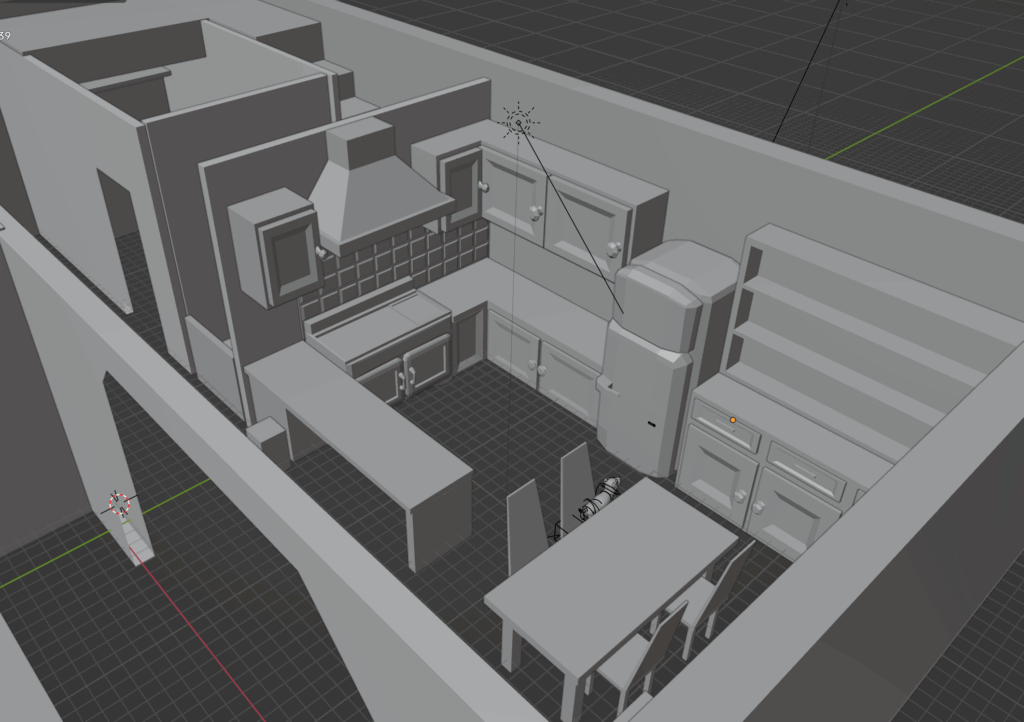


Another task was the textures. The original intent was hand-painted textures to give a creepy but artistic touch, but with the timescale now, this wasn’t possible. However, just using a base, simple texture from Substance Painter looked too bland. I decided to go half-and-half — using base textures from Substance Painter, I would handpaint some of the shadows to give it a grimy look. It turned out much better than I could have hoped for!
FETCH QUEST PROGRAMMING
The original plan was 3 fetch quests. Now with 3 weeks left, this felt like a ludicrous luxury.
Having 1, very good fetch quest was more in scope. I focused on that instead. I quickly textured and implemented the kid using Mixamo, and gave them a short dialogue to introduce the quest. Bandages were set on a high shelf in the bathroom, so the player would need to first navigate to that area, and then spot them on the high shelf. It makes use of the cameras, first forcing the player to switch to discover the bathroom, then switch again to find them. Once found, it’s a short parkour trail to get to them, before taking it back to the kid.
All in all, it was relatively simple to code, and I finished it within a few days. As it was a simple fetch quest, I decided to make another.
Fetch Quest 2
I decided to be ambitious, and implement a second fetch quest. It wasn’t much different from the first, except this time there were options. It also tied more into the game’s narrative better. The kid claims to be hungry. I put a jar of cookies on the fridge, and a basket of apples on the table. But these will both be refused by the kid. Instead, the player must find the severed zombie hand in the bathroom, and bring that instead. Once eaten, the kid turns full zombie. It’s more grotesque and compelling than the first task, and leads directly into the short narrative.
CUTSCENES
The last thing I required for the game to be fully complete were cutscenes. Using more Mixamo animations, I made a short intro and outro sequence — one of the kid coming into the house, bent double and injured, followed shortly by the dog — and one of them leaving, shambling as a zombie, the dog following none the wiser.
The cutscenes were actually fairly difficult to make. It took a while to figure out how to even make a keyframe in Unity, and then I had trouble between the intro and outro sequences — anytime I made one, it rewrote the other, despite being in two completely different scenes using completely different meshes with completely different timelines. But it was well worth it! I think it adds so much to the narrative, and makes the overall experience much more satisfying. It was always within the plan to make cutscenes, as the game wouldn’t be complete or a satisfying narrative without them, but I’m glad I could dedicate the time I did to them, despite the time crunch.
COMMUNICATION ISSUES
It would be remiss not to mention the frequent, troubling communication issues I had with my teammate, Josh, which is part of the reason some of the game has suffered. During development, he rarely came into class, frequently would take weeks or even months to respond, and didn’t update on his progress very much, leaving me wondering what exactly he was up to, and what would get done. While I acknowledge I could have pressed him more, I was also worried that coming across too harshly or being too pushy would push him away and cause him to ignore me more. Whenever he did respond, I always made sure to keep a friendly or joking/light tone, and encourage the work he had done, and let him know what he needed to be doing next with an exact date so he knew my expectations. I had also left plenty of resources on our schedules for him, even when I changed course multiple times to adapt to contengencies, such as Trello — but when he persistently ignored this I abandoned it. This caused me a lot of anxiety, and eventually led me to taking over a lot of his role in level design.
FINAL REFLECTION
Reflecting on this project as a whole, I believe I have experienced significant growth both creatively and professionally. At the beginning of production, I primarily saw myself as a 3D artist and level designer, focusing heavily on telling stories through spaces. My role has now expanded far beyond this, which gave me a much broader understanding of how all areas of development work together to create an immersive player experience, particularly on the programming side.
One of the defining aspects of this project was the amount of responsibility I took on during production. Although this was a team project, much of the practical development work was completed independently, which required me to become highly adaptable and self-sufficient. Managing programming, gameplay systems, puzzle implementation, level flow, environmental design, and animation simultaneously was extremely demanding, especially within the limited timeframe we had available. However, this pressure ultimately strengthened my ability to work efficiently, prioritise tasks, adapt plans, and remain focused when facing difficult challenges.
Throughout development, I learned that creating a successful game experience relies on much more than technical functionality alone. Designing environments and puzzles taught me the importance of pacing, atmosphere, player guidance, and tension building. I wanted each environment to feel unsettling while still encouraging exploration and progression. This required careful consideration of lighting, environmental storytelling, and how players would naturally navigate through each space. A core game loop is one of the most important aspects, and iterating on puzzles and level layouts also helped me understand how small gameplay adjustments can dramatically improve player engagement and readability.
Another major area of growth for me was animation. Entering this project, animation was not an area I felt particularly confident in. Over time, I became far more comfortable with creating animations that supported gameplay. This process improved both my technical understanding and my confidence as a developer capable of working across multiple disciplines.
One of the most valuable lessons was the importance of adaptability. The project constantly evolved due to time constraints, technical limitations, and production challenges, meaning I frequently had to rethink systems and redesign ideas in order to keep development moving forward — learning how to problem solve under pressure became one of the most important skills I gained during this experience. Rather than becoming discouraged by setbacks, I learned how to adjust my workflow and prioritise achievable goals, becoming incredibly resiliant to setbacks and obstacles.
Looking back on the project, I believe it has been the most challenging and rewarding experience of my time at university. It pushed me to develop a far wider skillset than I initially expected and gave me valuable insight into the realities of independent game development. More importantly, it reinforced my passion for creating interactive experiences and showed me how much I enjoy combining technical systems with atmosphere, storytelling, and player immersion, which was something I hadn’t previously delved into. Despite the pressures and challenges involved, this project has left me far more confident in my abilities as both a programmer and a game developer overall.
Leave a Reply