Bioluminescence is the natural production of light by living organisms. It occurs when certain chemicals inside an organism react with oxygen, creating a visible glow. This process is most common in marine animals, such as jellyfish, squid, and deep-sea fish, although some insects, fungi, and bacteria on land can also produce light. Unlike the light produced by fire or electricity, bioluminescent light does not give off heat, which makes it highly efficient. The colour of the light can vary depending on the species, but in the ocean, it is most often blue or green, as these wavelengths travel the farthest through water.
In the deep sea, where sunlight cannot reach, bioluminescence plays a vital role in survival. Many creatures use it to attract prey, communicate, or confuse predators. The Anglerfish, for example, uses a glowing lure to draw in smaller animals, while some squid release a burst of glowing ink to distract attackers and escape. Other animals use bioluminescence to blend in with their surroundings through a method called counter-illumination, producing light on their undersides to match the faint glow from above, making them nearly invisible to predators below.

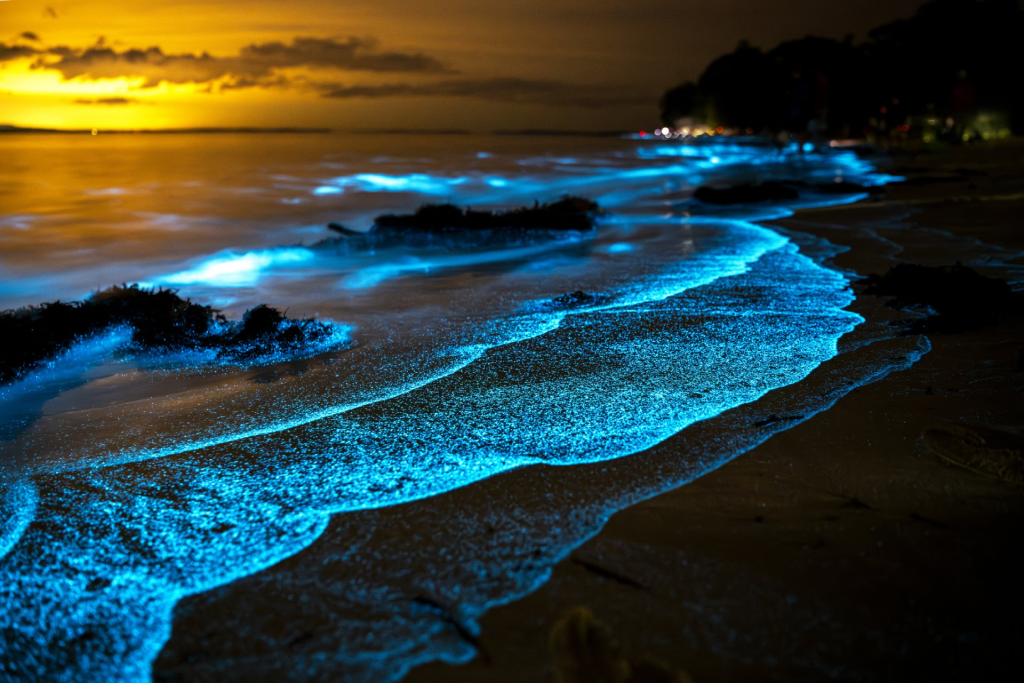
Bioluminescence is not only helpful but also visually striking. Entire regions of the ocean can sometimes light up with glowing plankton, creating waves and wakes that shimmer in the dark. These displays can even be seen from space. On land, fireflies use bioluminescence to find mates, flashing distinct light patterns that differ between species. Scientists continue to study this natural light, not only to understand how it evolved but also to apply it in modern technology, such as medical imaging and environmental monitoring.
Bioluminescence shows how life adapts in extraordinary ways to its environment. It is both a survival tool and a natural wonder, a reminder that even in the darkest places on Earth, life finds a way to shine.
Britannica, T. E. (2025) Marine bioluminescence. Encyclopaedia Britannica. Available at: https://www.britannica.com/science/marine-bioluminescence (Accessed: 20 October 2025).
National Geographic Education (2023) Bioluminescence 101: Marine animals that glow. National Geographic Education. Available at: https://education.nationalgeographic.org/resource/bioluminescence/ (Accessed: 20 October 2025).
NOAA Ocean Exploration (n.d.) ‘‘What is bioluminescence?’’ NOAA Ocean Explorer. Available at: https://oceanexplorer.noaa.gov/facts/bioluminescence.html (Accessed: 20 October 2025).
Smithsonian Ocean (n.d.) ‘‘Bioluminescence’’. Smithsonian Ocean. Available at: https://ocean.si.edu/ocean-life/fish/bioluminescence (Accessed: 20 October 2025).
Ocean Generation (2024) ‘‘Interesting animals that use bioluminescence in the deep ocean’’. Ocean Generation. Available at: https://oceangeneration.org/bioluminescence-in-the-deep-ocean/ (Accessed: 20 October 2025).
Haddock, S. H. D., Moline, M. A. & Case, J. F. (2010) ‘Bioluminescence in the sea’, Annual Review of Marine Science, 2, pp. 443-493.
Leave a Reply