Understanding “Movement”
In my case, movement is the psychological change: the stagnation and unwillingness to move, but eventually being forced by external factors. The lesson of this week was that the inspiration of games can be based not only on storyline but also on individual experiences that one undergoes in life and their mental state. The mere extension of the term movement prompted me to correlate it with such a phenomenon as the change of emotions, which resulted in coming up with a game. It was something that was new to me.
Image Selection and Interpretation for “Movement”
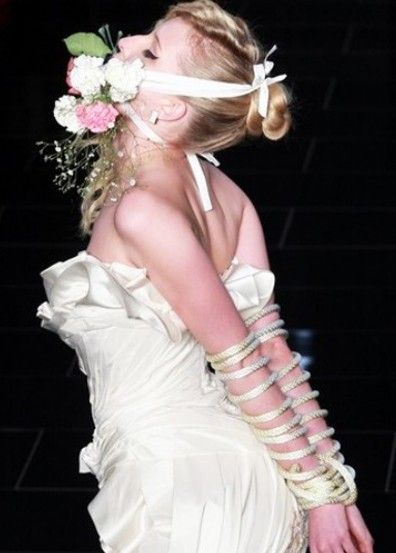
I spent a long time deliberating what image to pick that would bring out “movement.” Finally, I have chosen one of the photos of the spring 2012 Bridal Collection runway show by Brazilian designer Samuel Cirnansck: a bride who has her hands tightly tied by a rope and her mouth packed with flowers. Her body is twisted, her hands are bound and cannot move. This picture evoked some social phenomenon I have witnessed in China e.g. domestic violence against women or the psychological pressure of husbands. Such women do not run away, thinking that divorce will destroy their lives and everything they gain is provided by their husbands; so, they have to tolerate any kind of abuse. It is the feeling of helplessness, being lost, and being confused, and it is what I wanted to express. It also taught me that emotional stasis can be inexplicable to others–and that is what I would like to convey in my game.
Game Inspiration from “Movement”
The game idea was born of these thoughts, as a pixel-art interactive game where the player is forced to survive repeated, disempowering failures. The hints are retrieved in terms of unsuccessful results, which finally results in the comprehension of the background story, finding major objects, and a secret escape route that opens the real denouement.