Game Design Project Proposal
1. Project Overview
Project Title
Through Ash
Team Members & Roles
Hugo – 3D Artist / Technical Artist
Joseph – Programmer / Gameplay Systems
Shared – Game Design, UX, Audio Direction, Narrative Design, Marketing & Communication
Project Type
Group Project – Being designed in Unity and Blender
2. Abstract (High-Level Summary) (HUGO)
‘Through Ash’ is a short, 3D narrative driven sci-fi tragedy in which the player remotely operates a long-range transport rover across a nuclear-devastated colony. From within a failing bunker/outpost, the player guides the last active transport unit back from the ruins of City 103, carrying a package marked as critical.
The experience unfolds entirely through terminals, monitors, and automated systems. The bunker itself shows signs of recent shared workstations, overlapping logs and unfinished tasks, implying the player is maintaining an operation once run by more than one person. As the rover progresses, environmental hazards worsen and the burden of managing multiple systems alone becomes increasingly apparent.
Fragments of narrative are delivered through radio communications, system alerts, and environmental data. The true nature of the package is deliberately obscured until the final moments, reframing the player’s actions and delivering an emotional conclusion. The game lasts approximately 20–30 minutes and is designed to evoke isolation, grief, and reflection on humanity’s repeated self-destruction.
3. Design Intent & Goals (HUGO)
Our Goals
The intent of this project is to explore tragedy through limited player agency. We want the game to place the player in a foreign environment with only the knowledge of technical mechanics and a vague mission directive.This allows them to perform satisfying and technical mechanics but also puts them in helpless situations, as they unravel more of the horrors which are taking place on their planet.
Rather than portraying heroism or survival, the experience focuses on continuation, performing tasks as they were designed to be done, even after their original purpose has collapsed. By keeping the player physically removed from the world and dependent on information, the game emphasises distance, denial, and quiet grief.
We aim to create emotional impact in the game without relying on dialogue or narration assistance, instead allowing meaning to emerge through environmental detail, system behaviour, and delayed narrative revelation.
Project Goals
Our primary goal for this project is to deliver a complete and polished short narrative experience lasting approximately 20–30 minutes.
The game must present a clear beginning, middle, and end, with controlled systematic events that will give flow throughout the game. The end will reveal the truth of the package you are delivering, allowing the player to fully piece everything together, making an impactful and emotional ending.
Key goals include:
- Communicating story primarily through gameplay systems and environment
- Maintaining consistent tone and atmosphere throughout
- Ensuring all core mechanics are functional, readable, and narratively justified
- Delivering a stable build suitable for portfolio and assessment submission
- Achieving an impactful story twist that makes sense
4. Game Identity (HUGO)
Genre
Primary: Narrative Exploration, Sci-fi, First Person
Secondary: Psychological Storytelling, Anti Nuclear, Tragedy
Target Platform
PC (Windows)
Target Playtime
Estimated length of a single playthrough: 20 – 30 mins
5. Core Concept (HUGO)
The Hook
You remotely operate a logistics rover across a nuclear wasteland, issuing commands through imperfect systems while trapped in a bunker. The player never sees the world directly, only fragments of images and broken transmissions. The bunker itself is rich in environmental details, allowing the player to uncover more about the handler they are playing as, as well as more crucial information which could impact the narrative.
The Anchor
At its core the game explores loss within a nuclear devastated world where hope is presented as an illusion. The package is framed as a means of salvation, giving the player forward, only for its reveal to expose that this hope was rooted in desperation and denial.The final realisation reframes the entire experience as a response of grief rather than survival.
The Appeal
The appeal comes from the limited and gradual uncovering of information. By restricting the vision and relying on fragmented data, the game creates tension and curiosity. The player will also remain engaged by piecing together the environmental clues, transmissions and system feedback slowly revealing the world and narrative.
The Fun (or Engagement)
The engagement comes from operating the rover whilst maintaining the bunker operational, making decisions under uncertainty and interacting with the environment to uncover the story. The mechanical challenge and unfolding narrative is enough to keep the player invested.
6. Narrative & Themes (HUGO)
Narrative Overview
The game takes place during the immediate aftermath of a nuclear holocaust on a distant planet. The player assumes the role of a rover handler stationed in a collapsed bunker, whose job before the disaster was to remotely transport essential packages between cities across hazardous terrain.
Using the same rover and systems, the handler makes a desperate, personal decision to retrieve a single package from the ruins of City 103. As the world outside becomes increasingly dangerous, the player must operate the rover remotely while piecing together what happened through fragmented transmissions, failing systems, and environmental clues inside the bunker.
Themes
The core themes of this game include loss and helplessness in the face of nuclear devastation.
Loss will be covered not only through death but also through absence, environmental details will show implications that a crewmate was also stationed in the bunker with the player.
Helplessness will be shown mostly through the information of the outside, information of the outside will be shown by photographs and radio transmissions. The feeling of helplessness will derive from the scale of things, making the player feel small and helpless. The final reveal is also designed to remove the last remaining sense of hope the player had been holding onto, reframing the journey as an act of denial rather than salvation.
The game also reflects on humanity’s repeated self destruction, presenting nuclear war not as spectacle, but as a repetition of a past mistake.
Narrative Mechanics
The story is going to be delivered through systems and environmental design within the bunker.
Environmental storytelling within the bunker will reveal the handler’s personal life and suggest the presence of another person who is now gone. The absence of a crewmate will help give that eerie atmosphere and will justify the difficulty and pressure of the gameplay, since the player will be doing the job of two people.
The rover’s photography mechanic allows the player to see snippets of the scorched world outside the bunker, revealing the aftermath of nuclear destruction without ever granting full visibility. This is reinforced by the radio mechanic, which delivers fragmented transmissions from across the wasteland. Together, these systems gradually feed the player information about the outside world, building narrative context and emotional weight over time, and carefully guiding the player toward the final reveal.
The rover’s health bar acts as a narrative misdirection, appearing to represent mechanical damage while secretly tracking the condition of the package. This hidden function determines the game’s two endings and reframes the player’s previous actions.
7. Player Experience (UX & Emotional Journey) (Joseph)
Intended Player Experience:
The intended emotional arc is:
Immediate Stress → Escalating Overload Tasks → Hope & Dread → Shock & Reflection
From the start the player is dropped into an ongoing operation as a rover handler where there are alarms sounding, the rover is already on the move, and there is a backlog of tasks that need attention. We want the player to feel stressed from the get go, having to rush tasks, make mistakes. As the game progresses, the workload increases: new leaks appear, hazard warnings, weather warnings, the reliable 2D sonar becomes unreliable forcing the player to use different mechanical systems. During this, the game’s narrative will highlight the ‘package’ the rover is carrying which brings a sense of hope, which implies that if the player perseveres they may survive the impending radiation leak. When the rover successfully docks the rover, the player is confronted with the emotional weight of their earlier actions as for every collision or shortcut they may have chosen they have harmed a person rather than a machine. The only way to perfect the emotional arc is to adjust it iteratively, we can adjust the event timings, alarms, and other systems based on how our playtesters feel and look whilst playtesting. We want to ensure they are feeling pressured but aren’t losing clarity of what’s going on.
Tone & Atmosphere:
We want the tone to be claustrophobic and industrial drawing inspiration from one-room thrillers like Iron Lung and the medical-industrial feel of Carbon Steel. Visually, the bunker will be built from cold metal, worn out plastics and retro-futuristic 1950s-80s control equipment: CRT monitors, analogue switches and military hardware that has been patched and rewired over the years. There are clear design references to oil rigs and submarines to create a sense of cramped and utilitarian workplace. The audio reinforces this atmosphere through constant hums, fan noises and structural creeks, with alarms and radio static constantly sounding.
8. Core Gameplay Systems (Joseph)
Player role & Perspective
The player takes on the role of rover handler whose job is to maneuver rovers in long-range transport and occasionally has to manually control them when the automated system goes down. The player experiences the game entirely in first-person and will be confined to a single control bunker, this means the player never steps outside of the bunker and all gameworld knowledge comes through the terminals, photos, and data sent from the rover. With this limited knowledge it keeps the player physically removed from the rover and the surrounding area whilst making them responsible for what is happening to the rover and area.
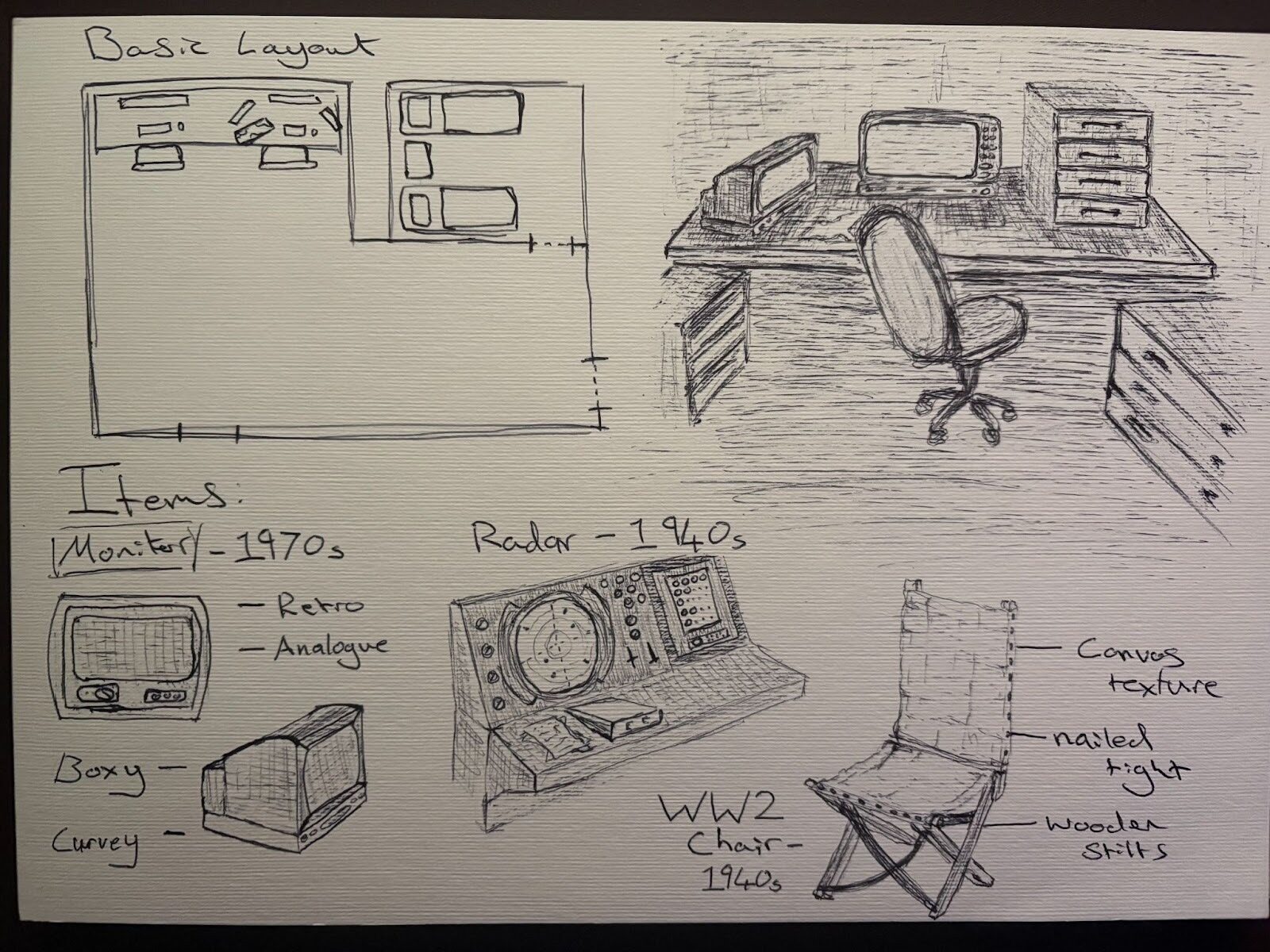
(Room layout + Key Items + Work Station)
Core Mechanics
The core gameplay mechanic revolves around the player operating the rover under pressure whilst keeping the bunker functioning. The player has to navigate the rover across the hazardous wasteland using a combination of text input commands, 2D sonar and 3D map scanner, whilst being supported by a physical map that shows the entire wasteland area. In the early phase of the game the 2D sonar will provide a relatively straightforward indicator of nearby obstacles and route options, but as the game progresses this system will continuously fail forcing the player to utilise other systems and rely on the 3D scanner and the manual map reading to maneuver the wasteland, and whilst this is going on the system strain causes more issues inside the bunker such as increased radiation leaks, equipment overheats, and panels malfunctioning, this then causes the player to start prioritizing their time on their tasks. This in turn forces the player to make a decision on whether to minimize damages to the rover or rush to fix the immediate threats happening in the bunker, creating the rushed, stressed environment which is then recontextualised by the final reveal.
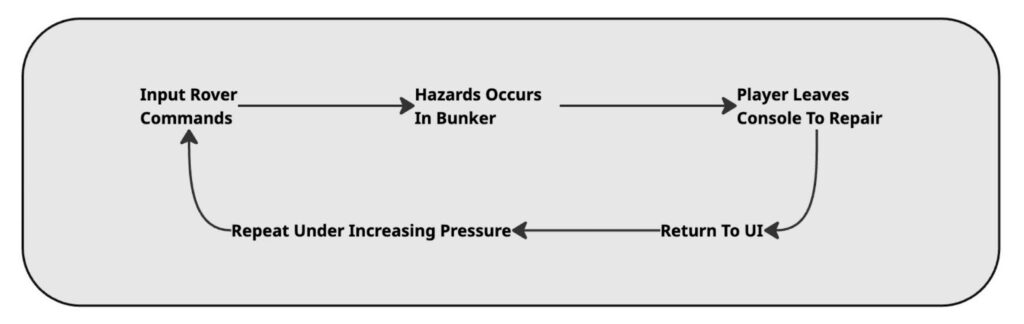
Player controlled systems
The handler has direct control over numerous key systems within the bunker:
- Communication radio: This is used to revise transmission about the state of the world, the mission purpose, and information about gameworld.
- Text input terminal: Used to inform the rover when to start and stop or to send coordinate based instruction, similar to how the mars rover interacted and turning this into a small puzzle.
- 2D sonar screen: Shows the zoomed in, top down area around the rover to see nearby surroundings and its current position relative to hazards.
- 3D map scanner: Displays the wireframes 360 view of the rover and the immediate environment allowing the player to see a more detailed look at the terrain and structures when the 2D sonar is being unreliable.
- Physical map: A large printed overview map of the entire wasteland without the live rover location. It is a coordinate based map and used to help players determine coordinate inputs for the rover.
- Repair tools: Used to help fix all issues around the bunker such as seal radiation leaks, fix falling panels, repair which force the player to leave the desk.
By spreading these systems around the bunker, it ensures that controlling the rover is not a simple press of a button and wait, instead, it’s a series of movements, observations and inputs.
Automated systems
Some of the systems are automated and operate separately to maintain story progression and help to increase tension:
- Photographs: The rover automatically sends through images throughout the game showing things like tragic scenes, environmental damage, and nearby structures. The player cannot choose when these get sent.
- Weather hazards: An automated system that periodically reports on the weather outside, from radiation spikes, storms, or acid rain which can prevent the movement of the rover.
- Rover diagnostics: A constant health bar that shows the rover system status, but it actually represents the child’s condition. The bar goes down when the player causes too much damage to the rover.
- Warning system: visual and audio warnings that signal when the player needs to take manual controls and respond to urgent events / avoid obstacles.
- Event triggers: Scripted events that will trigger leaks, system failures, weather changes, keeping the player always on the move.
These automated systems means even when the player is not interacting with the instruments the world continues to change and progress which increases the pressure over the course of the game.
9. Interface & Information Design (Joseph)
UI systems
The entire interface is diegetic, it’s built from the bunkers physical devices rather than a separate HUD this could be achieved through in-world canvases or meshes to ensure a smooth gameplay. Currently, these are the core UI systems:
- 2D radar/sonar
- Shows a zoomed in section of the rover’s surroundings and its position.
- Intentionally limited range and fidelity to keep navigation ambiguous
- 3D map scanner
- Wireframmed 360-degree representation of the rover and nearby structures
- Used predominantly when the rover crashes or needs to maneuver tight spaces
- Physical map
- Physical map that is sprawled out along the desk with coordinate grid
- Does not show live rover positions, the player must infer it using coordinates, sonar, and photos sent from the rover
- Diagnostics CRT monitor
- Displays the rover health, but it is actually tracks the babies health
By combining these systems it should keep the player fully informed but never relaxed.
Communication Systems
Both story and context are delivered through a series of communication systems:
- Communication radio
- This is how players receive mission updates, news about the world’s situation, and hints about the handlers past
- Rover photo feed
- At certain points across the map images that show the devastated wasteland, and the handlers past will be sent through
- These photos build upon the mood and foreshadow the personal nature of this mission
- Alerts and warnings
- Combination of flashing lights, on screen text, and alarm sounds indicate when the player needs to either take manual control or fix bunker related issues
- Environmental feedback
- Bunker lighting, sound levels, and visual cues change depending on issues that occur
- Supports the UI system without adding more text clutter to the screen
10. Win / Fail States (Joseph)
Win Conditions
The game is considered complete when:
- The player guides the rover back to the bunker without allowing the health bar to drop below a critical threshold.
- The rover docks and when the hatch opens, the handler’s child is alive in the pod.
This “good” ending is intentionally bittersweet: the child survived the journey yet the handler and baby remain trapped in a militarised bunker that faces constant radiation leaks. The player should feel a sense of relief that their cautious approach to driving mattered and that they can spend their final moment together.
Fail conditions
There are two ways to fail, both designed to be emotionally meaningful:
- Damaged package
- Reckless shortcuts, excessive collisions, and ignoring key warnings cause the package health to drop too low before the arrival at the bunker
- If this is the case, although the rover may still make it to the bunker, the child would be dead on arrival
- This links the players behaviour using the movement mechanics to the narrative outcome
- Rover/Bunker loss
- Poor navigation errors can destroy the rover in the wasteland and cut the mission short
- Additionally, failing to repair leaks and other issues in the bunker causes the system to break making it impossible to control the rover
Both options of failing reinforce the responsibility and the consequences of rushing and neglect. The purpose of this is for the player to be able to reflect and question themselves as to how they could have avoided this, and taken more care rather than following the traditional fail methods of restarting the level.
Technically, these win and fail conditions will predominantly be controlled by a single diagnostic variable updated from rover collisions and time. At the end of the journey, this value generated will determine which ending sequence is shown. This keeps the branching logic simple whilst still tying the outcomes to the player behaviour.
11. Audience & Sensitivity (Hugo)
Target Audience
The target audience will be aimed at mature audiences (17+) this is due to graphic details and the coverage of sensitive topics such as war and loss.
The game will also be difficult in a mechanical sense and will require us to do various playtests so that we get the perfect difficulty without ruining the gameplay experience.
This game is intended for people who enjoy psychological, narrative driven experiences that explore heavy scenes through atmosphere and environmental story telling.
Content Warnings
The game includes themes of nuclear devastation, mass loss of life, parental grief and child endangerment.
Content warning will be clearly communicated before the player begins to play.
12. Context & Inspiration (Hugo)
Influences
This game draws inspiration from narrative driven games that use restricted perspective and environmental storytelling to convey their narratives.
- Iron Lung:
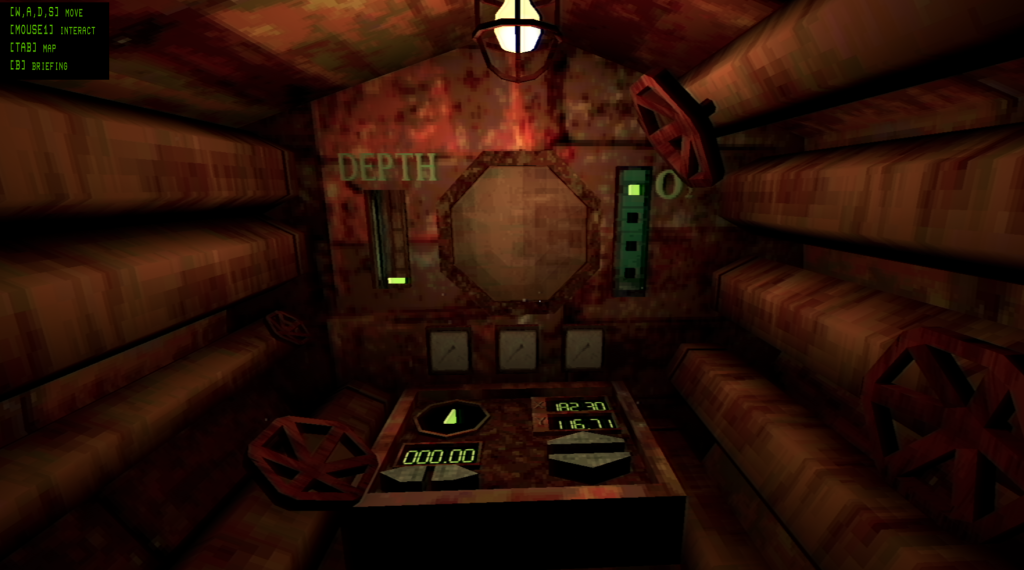
The game is originally inspired by Iron Lung, it was recommended to me by a peer in class after a presentation. I really enjoyed the fact that you were moving blind with only systems to guide you, ‘Through Ash’ will be similar in that aspect using the various systematic mechanics to move the rover. One aspect that our game will be different from Iron Lung is the fact that you are not moving yourself, you will be moving the rover towards yourself.
- Carbon Steel:
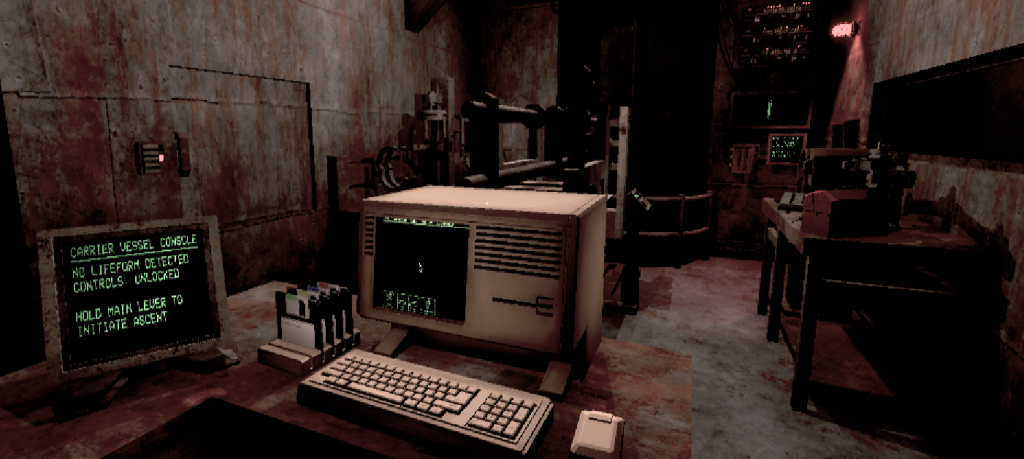
Carbon Steel is a small 30 minute itch.io game by Mike Klubnika who creates amazing short horror experiences. I happened to come across this and loved the use of all mechanics. You play as a volunteer lab assistant, conducting several experiments on monsters which get directed your way through an elevator. This game uses its small environment packed with several different mechanics that work together as the gameplay. This creates an intense gaming experience that has you moving around this small environment going back and forth from each instrument. I want our game to have this same experience by spreading out the mechanics and subtly forcing the player around the room to do tasks. Our game will have a stronger emotional impact since we are covering more sensitive themes but the duration of the game should be similar, roughly 20-30 minutes.
- What Remains of Edith Finch:

What Remains of Edith Finch is a narrative-focused walking simulator that heavily relies on environmental storytelling to communicate its themes. The player explores a single location while uncovering fragments of personal stories through interaction rather than traditional gameplay mechanics. What stood out to me most was how the game handles loss, allowing the player to slowly piece together meaning through the environment instead of being directly told what to feel. The game recontextualises earlier moments as the narrative unfolds, which gives the final realisations more emotional weight. Our game will be taking a similar approach by using the bunker space to tell the handler’s story and hint at personal connections without obvious explanation.
13. Competitor & Comparative Analysis (Joseph)
Comparable Games –
| Title | Similarities | Key Differences |
| Iron Lung | First-person perspective game in a confined small space where the player has to navigate a submarine blind using instruments and only receiving limited feedback. The tension is built through having to maneuver through a hostile environment without any visual contact | In iron lung the player is directly controlling their own vessel towards an inevitable doom with no chance of saving the vessel. In Through Ash the handler remotely controls the rover towards themselves with the package it’s carrying being their child and can survive or die depending on the player’s actions. |
| Carbon Steel | Short horror experience set in a small room with numerous mechanics. The player has to move around a compact environment whilst juggling different instruments and completing tasks under pressure which creates an intense back and forth gameplay loop | Carbon Steel focuses on conducting experiments on monsters and focuses on creating shock and tension. Whereas, Through Ash uses a similar idea on utilizing a small room, multiple systems however, we aim for a slower, more tragic emotional impact focusing around a nuclear devastation with more reliance on narrative twist over jumpscares. |
| What remains of Edith Finch | A narrative focused experience that uses environmental storytelling and one main location to explore themes of family and loss. Emotions and meaning emerges from interaction with objects and | Edith Finch is a walking simulator with relatively low mechanical pressure. Through Ash is more system driven with stress and time pressure from rover controls, hazards, and repairs, with failure occurring through a single continuous scenario in the bunker rather than multiple scenarios. |
14. Critical Analysis (Joseph)
Design Challenges –
One of the major challenges we face is balancing clarity and overload. As the game aims to make the player stress, rush, juggle the rover commands, fix leaks, alarms, and fail systems it must still feel like every failure is the result of poor decision making and not random unfairness. Making sure that the 2D sonar, 3D scanner and map is simple and intuitive in a time pressured environment to avoid feeling confused and making constant errors will require constant tweaks and changes over numerous playtests. Another challenge we need to consider is pacing, from repairs, system breakdowns, weather events, and manual controls to make sure that the player doesn’t get too overwhelmed early on but also not leaving them idle. Alongside these challenges we have to input narrative pieces of information like the photos or diagnostic changes which needs to be given to the player at the correct times in the playthrough otherwise the structure of the game starts to fall apart.
Ethical Considerations –
Having the major plot twist being tied to the child’s survival raises ethical questions about blame and to an extent emotional manipulation. The game specifically blames the player for rushing, crashing the rover or taking shortcuts, and only at the end reveal these actions have harmed a baby rather than a piece of equipment. This is a bold design choice, but we do need to handle this with care so that players genuinely reflect on their behavior rather than being simply punished or shamed for failing. Alongside this, the narrative focuses on a nuclear holocaust, implied throughout the gameplay which will require us to present this in a sensitive manner. The idea is to use implication and environmental story telling rather than constant graphic depictions that will allow the player to engage with the themes sincerely.
Narrative risks –
One of the major risks with the games concept is the narrative twist, the package being the handler’s child may be predictable if we foreshadow it too heavily or feel unearned if the foreshadowing is too subtle. As we have laid out the concept already, we know that future playtesters (peers & friends) may know the twist ahead of time both changing how they play the game and reducing the surprise which puts more focus on the game’s mechanics rather than the sequence of events that tells the story. Because the game focuses on tragedy, stress and despair rather than a thriller style of gameplay this may not appeal to players due to the game being so emotionally heavy. To avoid this risk as best as possible, our proposal needs to be clear that this is intentional so players’ expectations are set before playing the game.
Player agency vs designed control –
Through Ash is predominantly authored. The player cannot leave the room, cannot refuse missions, and cannot avoid the final cutscene with the package. The player’s agency is expressed within tight boundaries, such as choosing routes, how to carefully navigate, whether to take risks under time pressures rather than it being a branching storyline or alternative tasks. This limited agency is a deliberate choice and it actually reflects the Handlers situation with lack of options being in a militarized, post nuclear system. The two endings of the child surviving and when the child does not provide a situation where player behaviour materially affects the outcome, whilst the rest of the experience is about completing a rover handler role. A critical aim is to showcase that constrained agency can be a powerful tool when mechanical consequences and narrative meaning are interconnected.
15. Technical Scope (Joseph)
Components –
For this final major project, the project is going to be scoped around a detailed room and a hidden rover area in the same unity scene. Unity will be used for all implementations with the addition of 3d models created in Blender.
Environment & Art
- 3D Control room: walls, ceiling, desks, chairs, reinforced doors, pipes, panels, cabling, rover docking hatch, and other military assets
- Hidden rover area – the “wasteland” area positioned outside the players intractable bunker where the rover has to be navigated through
Rover Representation
- The rover is going to be represented as a moving camera in the hidden area, in-game it won’t be a fully rendered vehicle model
- This camera feeds data to the UI mechanics (2D sonar, 3D scanner, photo system, diagnostics) whilst always remaining invisible to the player, this follows the same design principle from iron lung where the submarine exists and moves in the same scene but the player never directly sees it.
- We will still establish a rover mesh for external shots and cutscenes however, moment to moment gameplay will only utilise a camera position and state.
Core Systems
- Input system for the text and/or coordinate commands connected to the movement of the rover in the gameworld
- 2D sonar for visualisation of nearby colliders/triggers events around the rovers camera
- 3D scanner visualises the surrounding wireframe around the rover
- Event systems that use trigger volumes and timers in the map to upload hazard warnings, photos and when the rover enters certain quadrants
- Diagnostics system that tacks the damage and time based rover interactions like collisions and hazard zones
Audio
- SFX – alarms, hums, UI bleeps, footsteps, repair action sounds
- Min Orchestral cues like piano and violin used key narrative points
How we will implement these –
- The control room and the rovers area will be built in the same unity scene to avoid the issue of multi scene syncing. The players camera will be confined to the bunker room whilst the second camera rover is in the hidden area and triggers all trigger event systems
- All movement commands from the player will update the rover cameras transform and all other UI systems will read this information from a shared state instead of them all being separated
- Hazards and story events will be a set of reusable trigger types such as weather zones, damage zones or photo zones that will be placed in certain areas in the map so that content can be added by arranging these triggers
Functional Specifications (Priorities) –
- Player can move around in the control room and interact with all the key UI systems and issue movement commands
- Rover camera can effectively move through the hidden map according to the player inputs
- All UI systems correctly reflect the “rovers’ state such as position, nearby hazards, timing and then this will update the diagnostic UI
- All trigger events such as photos, warnings, damage, and weather should pop up on the monitors in the bunker
- The full game loop from start to fail or win should successfully work and the different ending scenes should trigger depending on the rovers values
16. Production Plan (Joseph)
Phases & Milestones –
| Phase | Timeframe | Focus | Key Deliverables |
| Phase 1 – Pre-Production & Grey Boxing | 21 January – Mid February | Finalised the narrative outline and core mechanic design (Rover movement mechanics). Greyboxed the bunker and rover map in the same scene. | -Greyboxed bunker room-Greyboxed / outlined the terrain for rovers map-basic rover movement functionality-rough UI sketches for sonar, scanner, diagnostics and warning screen |
| Phase 2 -Core Systems | Mid February – 16th March | Implement the core mechanics, rover movement, event systems in place, basic sonar & scanner. Playable game from start to finish in a rough first prototype. | -Core mechanics finished-Prototype where the player can move in the room, interact with the system, move the rover, trigger the event systems, and reach an end point. |
| Phase 3 -Content & World Building | 16 March – End of April | Start development on rest of mechanics, photo system, radio, cutscene triggers. Polish off and finish 3D models for the bunker, and all UI art. | -All mechanics finished-Finalised narrative structure with both endings functioning-All art & models finalised and implemented into the bunker-All other required coding warped up and debugged ready for testing |
| Phase 4 – Testing, Bug Fixing & Polish | End of April – Early May | All focus on stability, clarity and polish. Running constant playtests to help adjust pacing of events, find and fix bugs, tidy up any polish that needs to be done. | -Final build finalised-Short clips taken for a teaser video-Final reflection document completed |
Why These Phases –
- Core mechanics are a priority to ensure that the hardest / riskiest parts of the rover control and event based triggers are able to be tested early and leave me time to fix or simplify if needed.
- By ensuring the content is finished by phase 3 it forces us to stop adding new and extra features to the game and allows us to focus in the core features and ensure they work properly and are enjoyable
- This allows for the last two weeks to be reserved for playtesting and focusing on polishing which is essential for games that require UI clarity, pacing, and reliable diagnostics that determine endings.