What I Did This Week
Throughout the week’s work, I started refining the game world’s narrative. Using my last ecosystem design as a basis, I wanted to create a much clearer relation between the story and the visuals. Most importantly, the world lore should back up the gameplay that the game offers such as exploration, and interaction. Rather than emphasising dramatic conflict or intense survival pressure, this week’s narrative direction leans more towards a quieter, slowly unfolding atmosphere, the aim is for the overall tone to remain consistent with the ecological world itself. And has mainly been spent refining the narrative structure based on the existing world-building, and attempting to establish a clearer link between the ecosystem design and the story direction.
Process & Narrative Development
This week’s narrative design work doesn’t involve a full story rewrite for Soul Keeper but further development based on the existing world-building. I have established a narrative framework as an anchor for our game world. Therefore, this week, I was looking to create a more complete world-building with new conceptual designs that would also closely link with the ecosystem designs of the game.
In this narrative iteration, I primarily introduced two new conceptual layers.
The first concept is ‘ecological fading as forgetting rather than destruction’. As an alternative, the ecosystem is progressively ‘forgetting’ its original functioning. For example, plants will not grow according to the requirements but can stray towards another wrong path, animals will move away from their habitats, and the relations between the elements of the environment will weaken gradually. We are witnessing a gradual, almost imperceptible, transformation, not a cataclysm. The game’s primarily tranquil and dream-like atmosphere, and the gradual revelations of the new world through exploration, are sustained by this setting.
The second concept is the Keeper’s conditional existence sustained by relational trust.The Forest Keeper in this context is not a perpetual being; her existence is conditioned to the stability of ecological relations. As the bonds of trust begin to fray between animals, the Keeper becomes unstable. On the other hand, as players assist the animals and reestablish links in the environment, the Keeper’s form becomes clearer. The participation of players in the game can influence the world of the game. This lets players’ actions have a direct bearing on the world.
After having determined the world narrative structure, I then worked on the start text of the game as this is the very first narrative the player sees when they join.To explore different modes of expression, I initially wrote three distinct versions.
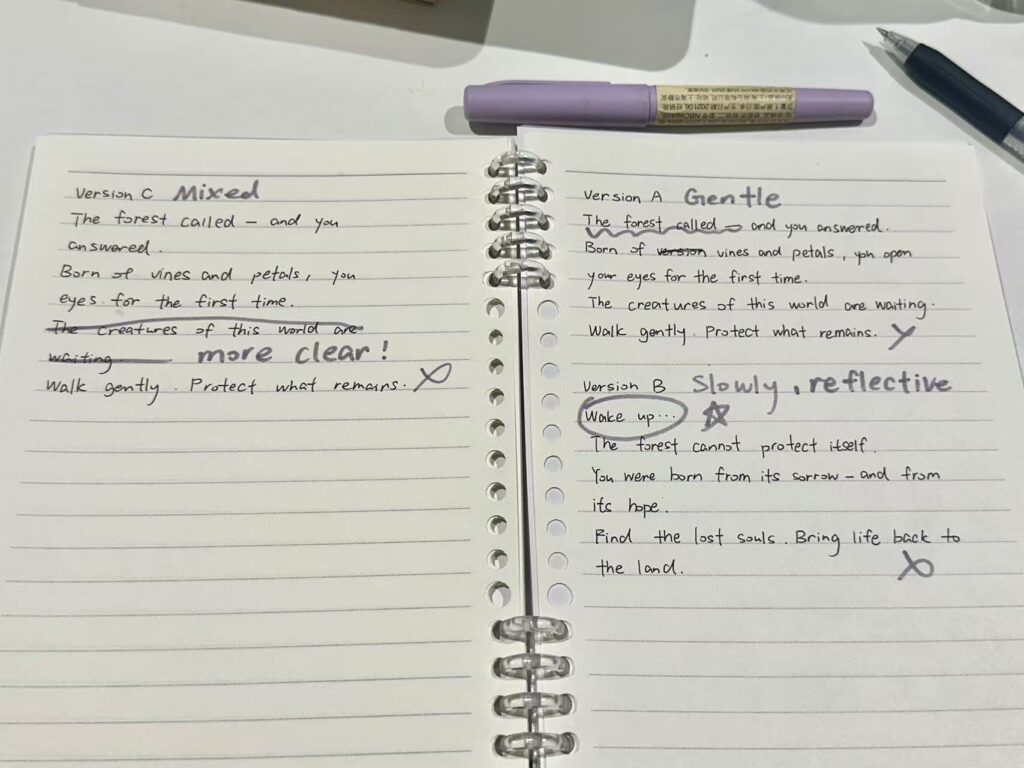
Version C is essentially a blend of the atmospheres found in the first two versions (a combination of A and B). It retains the gentler tone of Version A whilst also attempting to incorporate the more subdued rhythm of Version B. Of these versions, I ultimately lean towards Version C, as it retains the softer atmosphere of Version A without being as heavy as Version B; overall, it is closer to the currently subdued tone of Soul Keeper.
I subsequently discussed these versions with Misty, the team member responsible for game mechanics design. She had some important feedback; while we achieve a sense of place, the information might not be clear enough for someone playing the game for the first time. First, players must quickly realise two key things: who they are and what they need to do next. If the intro text is too far off then player will feel lost in the very early stage of the game.
Based on this feedback, I rewrote a set of opening versions that were more direct and better aligned with the game’s objectives. During the revision process, I also noticed that the opening line of Version B, ‘Wake up…’, was actually very well suited as a new opening line. Compared to ‘The forest called’, this phrasing is simpler and more direct, and is better at capturing the player’s attention, whilst still maintaining the game’s atmospheric feel. I therefore decided to retain this opening and reorganise the subsequent content around it.
I subsequently wrote two new versions:
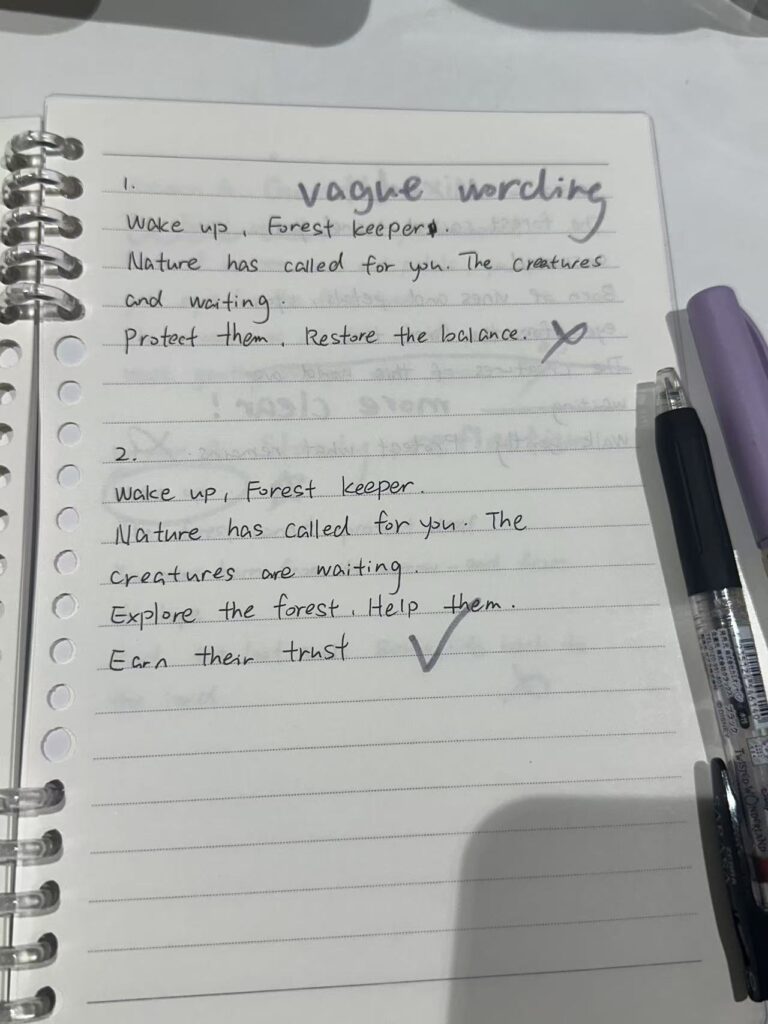
Following further discussions with Misty, we ultimately chose Option 2 as the opening text for the current version. The second version clarifies better the role of the player than the earlier version but opens more than closes things. The primary actions undertaken by the player are exploring the forest, helping animals, and building the relationship of mutual trust.
Reflection & Learning
Through this week’s narrative design sessions, I’ve begun to realise that a game’s story doesn’t necessarily need to be driven by intense conflict or combat.
In Soul Keeper, the story is more like an atmosphere that players gradually come to sense. Through changes in the environment, the behaviour of animals, and the process of exploration, players gradually come to understand what is happening in this world.
“Wake up, Forest Keeper.
Nature has called for you. The creatures are waiting.
Explore the forest. Help them. Earn their trust.”
This text is not a traditional ‘call to arms’, but rather an invitation. Players do not enter this world to defeat enemies, but to reconnect with the forest through exploration, helping the animals, and restoring ecological balance.
The discussion with Misty made me realise that narrative design requires less concern for atmospheric tone of the language and more for whether the information is clear and comprehensible to the player. By hashing things out with the developers, we can come to a more balanced and unified approach that harmonises narrative atmosphere with game mechanics.
Leave a Reply