Pillar 1: Environmental Narratives and Mutation Guilt
Every detail of the world (objects, environmental text) is a narrative vector and will change subtly as the game progresses/player behavior, directly reflecting and evoking “guilt” feelings in the player.
Pillar 2: Unguided observation and self-discovery
Players must advance through the experience through active, meticulous observation, and the game never provides task lists, objective markers, or explicit “puzzle solved” feedback. The discovery of the truth depends entirely on the player’s curiosity and associative ability.
Pillar 3: The system is the story, and the interface is the world
Every system element, menu, save and load file, or error — must mean something. It belongs to the game world, not outside it.
Pillar 4: Daily Routine as Denial
Players repeat seemingly normal behaviors: going to school, going home, working—only to feel strange in the slightest changes.
Every cycle has a little change, tram delays, people taking time off, different news, school safety alert emails…… “Daily routine”It becomes a shell of denial, and the repetition itself maintains a false calm. Players will find that the “familiar scene” went a little bit wrong every round. This does not make them bored, but they start to fear the next day.
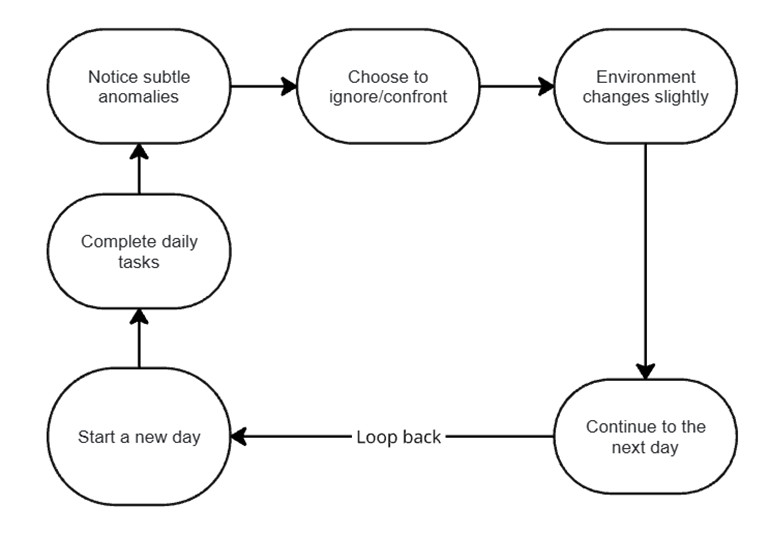
The whole game progresses in “days”, and players need to do some daily tasks every day: get up, go to school, get out of school, choose to go to a store or other place on the way home from school, or go straight home.
Players can choose to go to school and go home without interacting with any scenes, and everything will end in its simplest form: the days go by and nothing happens.
Players can also choose to interact with the scene, but each interaction will bring new information to the character you control, which will make the player more and more uneasy, corresponding to the increasing number of “crazy” options. And this also increases the number of people the player interacts with, which also means that the system (i.e., the world) has more opportunities to “misunderstand” what the player is doing. The more you do, the more complicated things may become, but doing nothing doesn’t mean it’s easy.
Players will occasionally encounter some simple puzzles when interacting with the scene, which are not important, but may be a prerequisite for some special plots, but if you don’t do it, it will not affect the level clearance, but you will lose the “most complete” plot experience.
Leave a Reply