This week in class we talked about character design. We were asked to work in pairs, one to draw the characters and the other to provide the pillars and character background.
To be honest, we hardly had any clear direction at first. All we can think of is “we want to make a character”, but we don’t know why it exists, what to express, or even where to start listing pillars, always having too many ideas and not knowing which one to choose. So we took a more stupid but effective approach: start with two very specific elements and use them as constraints to force ourselves to start production. Cindy came up with two key words: penguins and dogs
Cindy’s perfected character settings are as follows:
“A very elegant cream Samoyed, always wearing a penguin hat and penguin clothes, lives in Penguin Town in Antarctica. Penguin Town is only allowed to enter by animals wearing penguin hats, and it is not full of penguins, but other animals dressed as penguins. It helps out at a bakery in Penguintown and is very helpful. Its special scarf is knitted from magic dough by Granny Penguin at the Warm Snow Town bakery. Whenever winter comes, the bread pattern on the scarf will exude the aroma and warmth of freshly baked bread, keeping Ye Ye warm in the bitter cold. ”
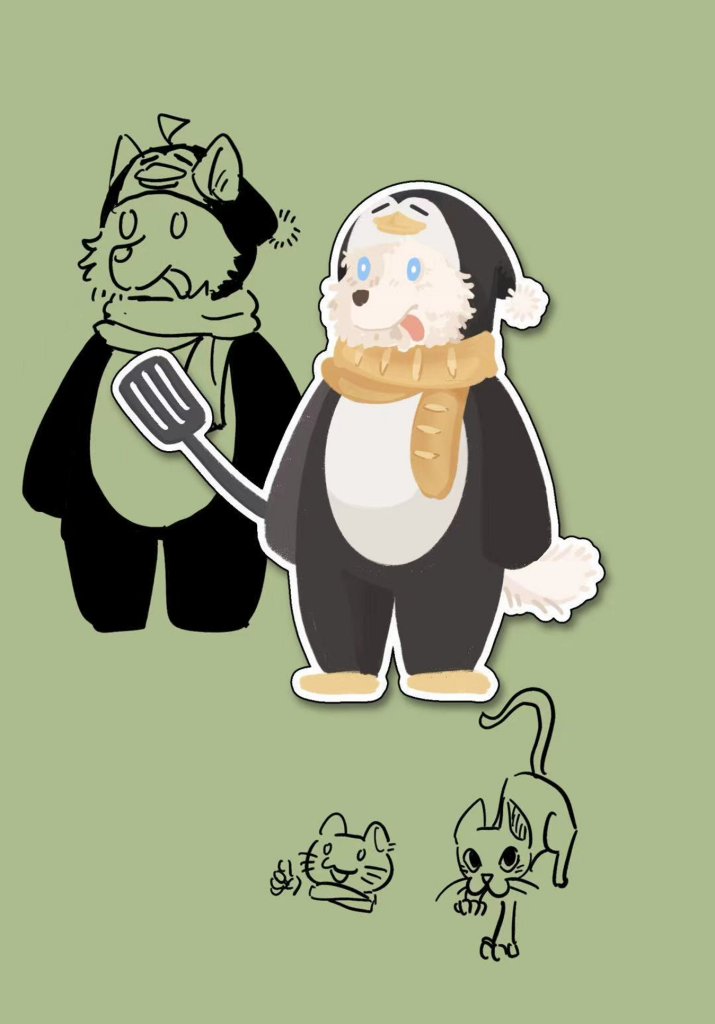
I started by sketching a “penguin dog” – not for the sake of completion, but to turn abstract keywords into objects that can be discussed. After the sketch came out, we quickly discovered that simply mixing a penguin and a dog does not automatically generate a character, it can only generate an image that “looks cute but has no reason”. So our second step is not to continue with the pile of settings, but to ask the most basic question: why does it dress as a penguin? Where does it live? What is it doing for the sake of it?
In this round of discussion, we gradually changed “dressing” from decoration to rule. Cindy proposed the concept of “Penguin Town”: Penguin Town is not inhabited only by penguins, but only animals wearing penguin hats can enter. This setting suddenly gives the character a social structure and thematic direction – dressing up is no longer just good-looking, but a ritual to enter the community, and also implies the motivation of “gaining belonging through imitation”.
Then we need to let the characters have their daily lives, not stay in the worldview. We discussed what it could do in Penguin Town and finally chose the bakery: because in the extremely cold environment of Antarctica, the aroma and temperature of bread is a very specific “warmth”, and it is also very suitable for putting the elegance, friendliness and helpfulness of the characters into action.
Finally, we added the setting of the scarf: it is not to make the character more gorgeous, but to give the character an emotional anchor – the scarf comes from Grandma Penguin at the Warm Snow Town Bakery, woven with magic dough, and will give off the aroma and warmth of freshly baked bread in winter. In this way, the scarf is not only functional, but also becomes evidence of “acceptance/blessing”, allowing the character to change from “an interesting combination” to “a being that will be remembered”.
Looking back, we didn’t think about the pillars first and then draw the characters, but gradually discovered the pillars through repeated modifications: the warm daily life in the bitter cold, the belonging through dressing up and rituals, and the small kindness in the community. This process was important to us because it made me realize that when there is no inspiration, iteration is a method in itself.
Leave a Reply