In games, sound is not simply about being “played”. For exploration and survival games, where a sound comes from, how far it is from the player, whether it is blocked by the environment, and whether it changes as the player moves can all affect how the player understands space. Therefore, Spatial Audio is not only a technical 3D sound setting, but also an important design method for helping players build a sense of direction, danger, and environmental relationships.
In this project, the player needs to explore different areas such as Meadow, Forest, and Salmon Run, while also avoiding enemies such as wolves and bears. Therefore, the position of sounds should help the player understand their current environment and where potential threats may come from. For example, if a distant wolf howl comes from deep inside the forest, the player may naturally understand that the area could be dangerous. If the sound of flowing water becomes clearer as the player approaches Salmon Run, the player can sense that they are getting close to the river area even before seeing it.
The key point of Spatial Audio is not to make every sound 3D. Instead, different types of sounds should use different spatial treatments according to their function. For example, UI sounds usually do not need to come from a specific position in the game world, because their main function is to provide feedback for player actions. By contrast, enemy sounds, footsteps, river sounds, and forest ambience require spatial positioning more strongly, because they are connected to how the player judges the environment. Collins (2008) emphasises interactivity as a key feature of game sound, where player actions can trigger dialogue, sound effects, ambience, and music. This supports my view that spatial audio should respond to player movement and position, rather than being treated as a fixed background layer.
Therefore, I need to distinguish between sounds that should be diegetic, meaning sounds that come from inside the game world, and sounds that are non-diegetic, such as UI feedback or some parts of the music. For sounds that come from inside the game world, I need to consider their sound source, distance attenuation, spread range, and priority. For non-diegetic sounds, I need to make sure that they remain clear and stable, so that spatial positioning does not affect the player’s understanding.
Spatial Audio is a part of the sound design in this project that needs to be considered separately, because during exploration and survival, players do not only need to hear sounds; they also need to understand where those sounds come from. The position, distance, and direction of sounds can affect how players judge space. For example, distant wolf howls can suggest that there is danger deep in the forest, gradually increasing river sounds can imply that the player is approaching Salmon Run, and different ground or area ambiences can help the player confirm where they are.
In this project, Spatial Audio mainly has three functions: area recognition, danger judgement, and interaction feedback. Firstly, different areas need to establish different spatial sound identities. Meadow can use more open wind sounds, grass sounds, and lake sounds to create a sense of open space. Forest can use colder, denser leaf rustling and distant animal sounds to create a more oppressive and uneasy atmosphere. Salmon Run can make flowing water the dominant sound source, allowing the player to sense the presence and direction of the river through sound.
Secondly, enemy sounds need to provide spatial information. The wolves and bears in the game have different threat patterns: wolves are fast and move in groups, while bears act alone but have a large detection range and are more dangerous. Therefore, wolf sounds can use howls or growls from multiple directions to create a sense of being surrounded. Bear sounds can be lower, heavier, and audible even from a greater distance, warning the player to stay away from dangerous areas. In this way, sound does not only create tension, but also helps the player make survival decisions before they actually see the enemy.
However, not every sound should be strongly spatialised. UI sounds, backpack interactions, item pickups, and dialogue choices mainly confirm player actions, so they need to be clear and stable, rather than affected by spatial position. By contrast, enemies, rivers, forest ambience, and world-based sounds such as the flare gun are more suitable for spatial treatment, because they are connected to the player’s judgement of location, distance, and direction.
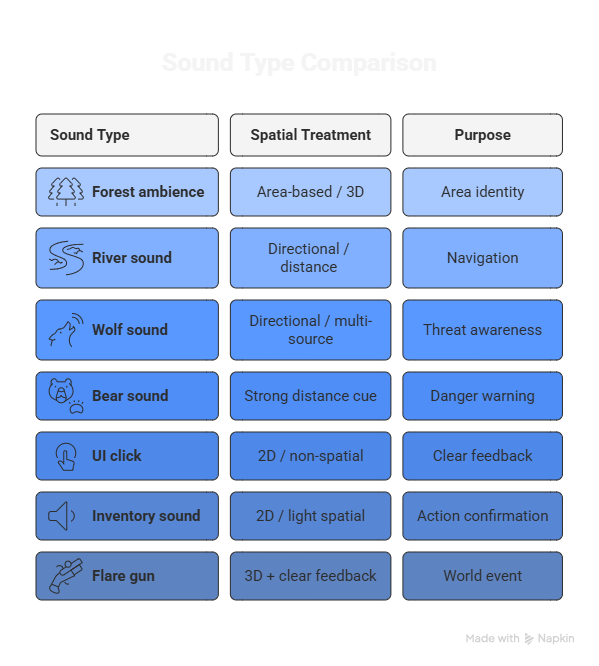
Therefore, I believe the focus of Spatial Audio is not simply to set every sound to 3D, but to decide whether a sound needs spatial information according to its function. For this project, spatial audio can help the player understand areas, judge danger, and connect sound feedback with the exploration and survival mechanics.
Resource:
Collins, K. (2008) Game Sound: An Introduction to the History, Theory, and Practice of Video Game Music and Sound Design. Cambridge, MA: MIT Press.
Leave a Reply