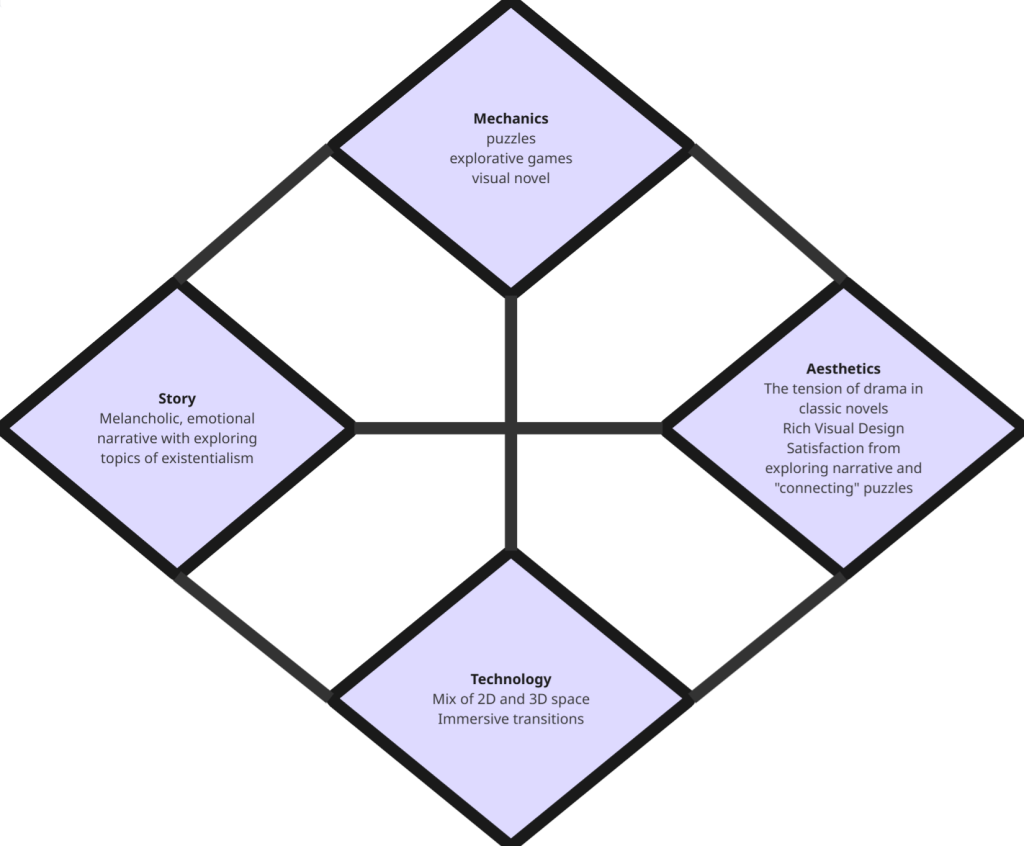
These modules were combined into one post because, during this period, I was more focused on outlining the Story Structure and Progression, which is already available on this website. As the weeks of work concluded, I was left to think about the next steps in creating my GDD.
— What do I want to see in the story?
Since the game doesn’t have a standard “level progression” or progression, the main focus of the story becomes the narrative and the essence of the plot itself. To some extent, this is an attempt to simply tell a story, only with the subsequent introduction of mechanics that would make the visual novel a much more complete character.
To be honest, at this stage, I began to have my first doubts—had I chosen the wrong genre? I’ve always had prejudices against visual novels, as I perceived them more as literary works than full-fledged games. And now, working on something similar myself evoked mixed feelings in me.
Still, I also want to emphasize exploration and painting restoration mechanics to better complement the very limited interactivity, and combining 2D and 3D spaces (as well as scenes) sounded like an opportunity to experiment and go beyond the boundaries of standard visual novels, which is exactly what I’m aiming for. All that remained was to address the controls and menu issues.
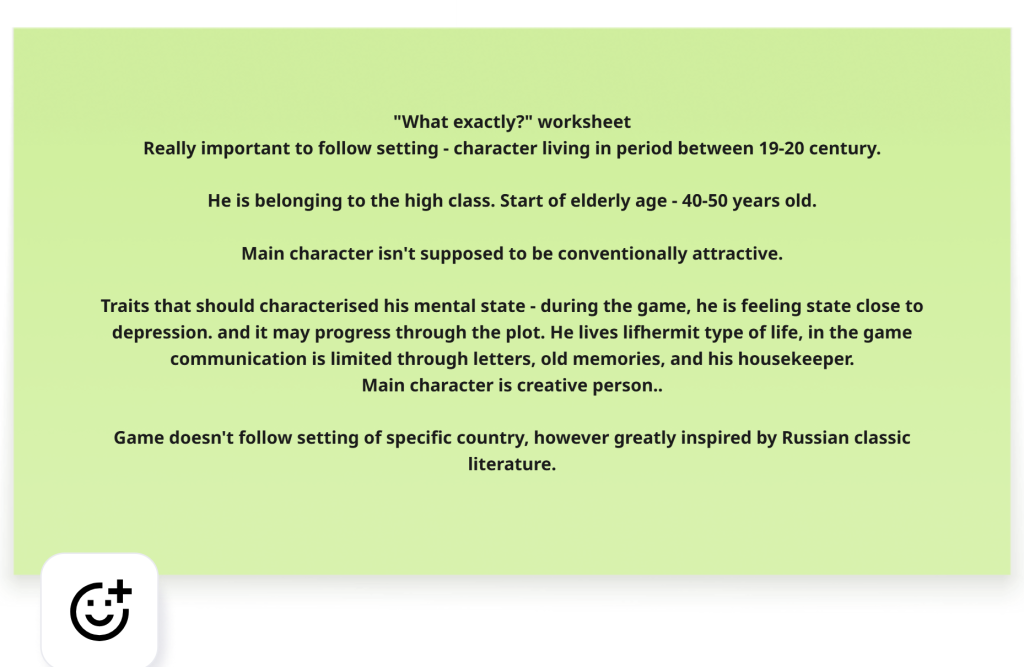
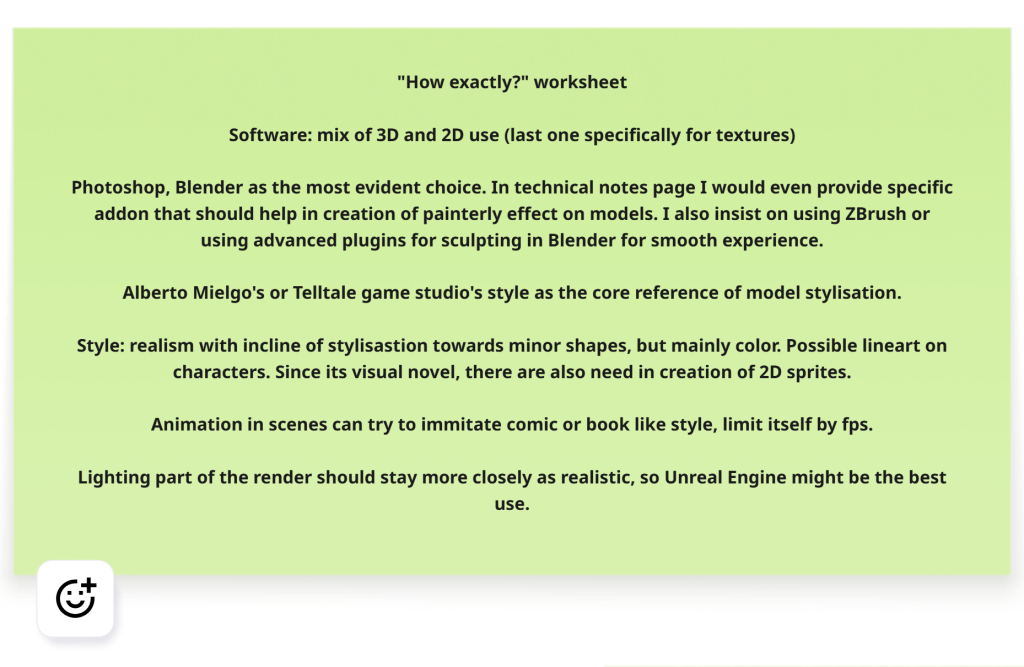
While working on the characters this week, I was faced with the difficulty of working in 3D software, and wanting to apply a more realistic style, I do not have the opportunity ( exact time) for detailed creation of all physical examples of works.
For this reason, I have fully focused on creating a worksheet that should help in the future for more detailed work. The questions provided by the lecturer helped a lot in the progress.
I also divided the approach into two parts. Firstly, the perspective of “how exactly to work” on the creation of character software, possible style references, and possible color palettes. Seconds – “what exactly to show” – the more defined traits of character or the setting that must be portrayed
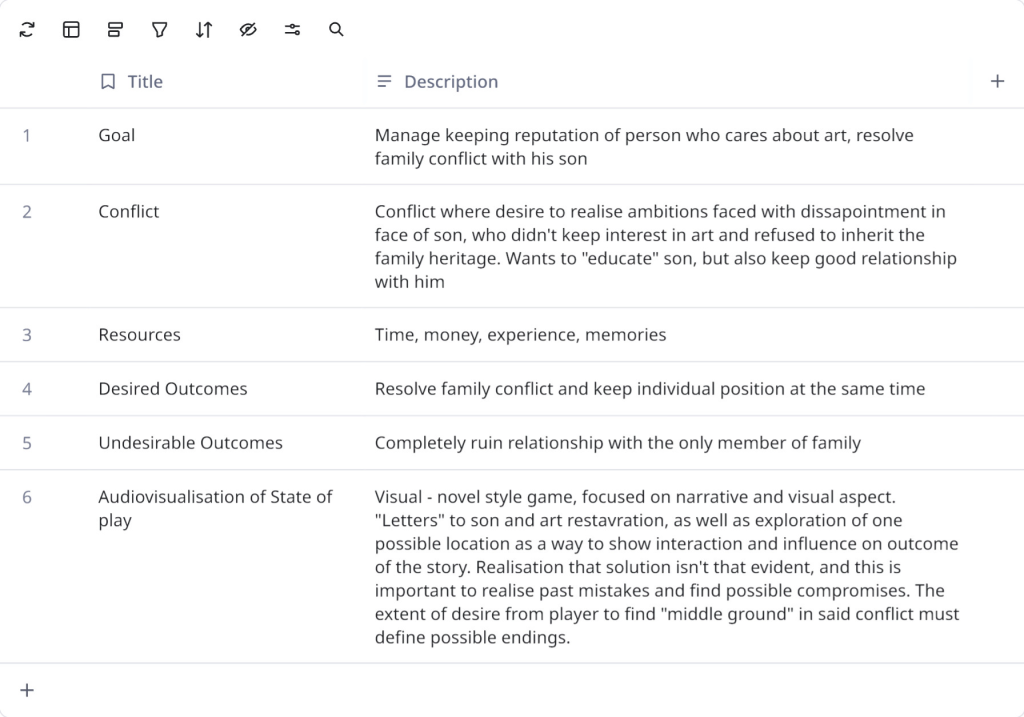
This week, we studied the principles of worldbuilding. Creating a common narrative, moodboards, and the first steps in building a world in which the characters must participate. An example of my work with Doris Rusch’s framework, which I plan to apply to my main character:
We also met one of my favorite guests, who introduced us to the principles of building a world and the responsibilities of working as a Level Designer. Oguz Orkun Doma introduced us to the step-by-step mapping system, grey boxing principles for the initial stage of work with the creation.
Working on a group task, I faced a personal difficulty: the problem with my own story was that the player was “locked” in a pretty limited space; I couldn’t really progress in the development of the narrative ( at least, I thought like this). He proposed a solution in not trying to show progression of the player through a journey between locations, but using time stamps. This greatly helped me in building one of the main game pillars related to mechanics, while the concept of memories/flashbacks greatly overlapped with the whole story concept and became its main part.
I want players to thinkabout the topic of generational relationship by showing local story of one family.
I want players to experience melancholy, loneliness and isolation by exploring limited space with focus on concerned theme.
I want to show relation of art and memories by navigating through topic of art conservation/restoration.
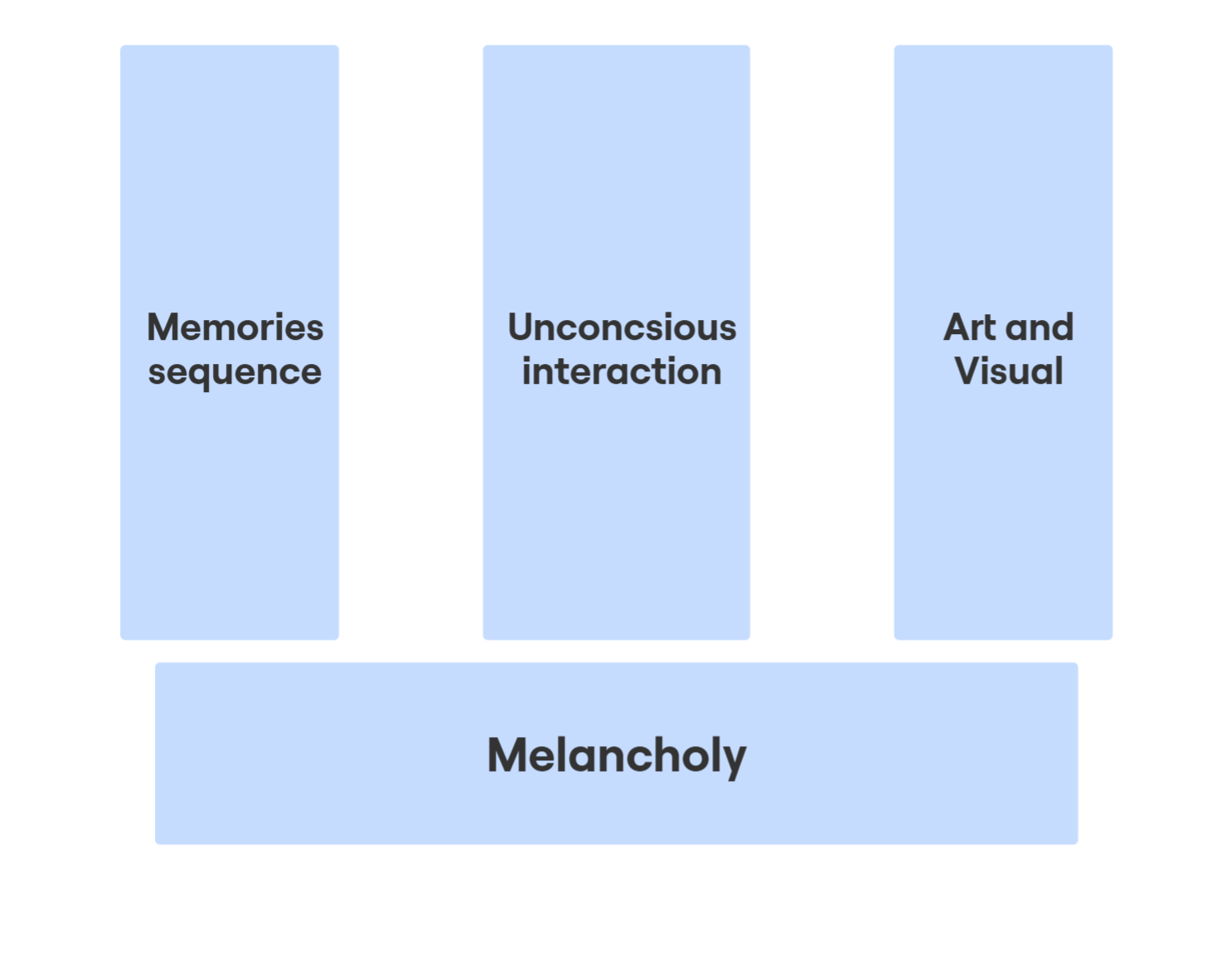
Identify the Essential Experience and build pillars
What emotion or behaviour is essential to that experience?
Melancholy, deep reflection state, theraupetic experience about generational conflict trauma .
How might the player encounter it during play?
Letting player feel connection between them and player – aka memories recall from main character; finding a link between main character and audience (his son can be a possible self interpretation for player that can build emotional attachement), provoke strong feelings (possibly negative) to revert perspective in the middle of story. Providing agency to “fix” main character or let player reflect about personal experience.
What does this emotion look like in your world (colour, tone, sound, movement)?
I want to describe three main feeling by three ways
Melancholy – locations in the game are fixed, the character often returns to the same location but in different time stamps. The current time – more calm, cool subdued colors, promoting “neutral” or apathetic feelings. The past is warm, rich colors, but in places has a burnt effect to convey the loss of time. The elements connecting the two time segments should be strongly contrasted in both time segments.
Loneliness and Isolation – Both these states are synonymous. Achieve this feeling by having the main character surrounded by a minimum number of other characters, or talking to them he must through certain barriers. Communication with clients as an artist is limited, through letters (for example). The only second character the main character will talk to must contrast strongly with his image in order to evoke a feeling of alienation in the communication, and the most important moments of the story actually develop in the hero’s head, his memories
The design of space should also be important. I still can’t decide whether to use large and even empty spaces in the game or vice versa, resort to Hoarding disorder phenomenon in real life, which is characteristic for elderly and lonely people. An attempt to convey the general mood through the aesthetics of the golden age of Russian literature is the most important solution that sets the tone of the game.
“Why?”
I want players to thinkabout topic of generational relationship because this is theme common for every person, and it provoke empathy in the player.
I want player to experience melancholy, loneliness and isolation, because these states complement each other’s emotional background well, enhancing the perception of each of them individually.
I want to show relation of art and memories, because the beauty of art is in the way how it tell story about history and personalities. Visual language is the easiest to comprehend, feel, and it is one of the main communication in games. Metaphor of art and memory relation is a great way to show the story, not to tell.
Using poetry for games has inspired me to seek sources for my own play among literature.
By myself I’m not a fan of lyrics, prefering novels because they aren’t overloaded with metaphors and allegories, still provide enough freedon of interpretation, yet define the main structure (or message) of the author’s point of view. Making my own game related to format of visual novels was also partially influenced by my love to classic Russian literature.
And since I decided to be inspired by the literature based on the theme of generations and movement (aka changes), the best option for me was the novel “Fathers and Children” written by Turgenev. This work well reflects my own, general view of the world, change and psychological relationships between family members.
«Of course, you can’t understand me; we belong to two different generations.» She was terribly offended, but I thought to myself, “The pill must have been a bitter one, but she needed to swallow it.” And now our turn has come; now is it for us to be told by our heirs: “You don’t belong to our generation — swallow the pill.”»
This quote in my presentation has always sounded very poetic – and try to build a whole concept of the game, when such topic within this media quite limitely presented becomes a unique opportunity…
I haven’t worked on a project related to the Bitsy Engine, but at the same time, I didn’t want to give up using poetry in the game.
Patterns and rhythms in the lyrics – a necessary way to set accents. Pauses are necessary to give the reader time to stop and “live in the moment”. Because the game’s narrative can be set into visual and mechanical elements, these patterns can be more clearly expressed, and rhythm hyperbolizes in the form of transitions between scenes and game mechanics, linking them together like a “book cover”.
So, the main idea of game having such rhytm – is making a properly working sequence between game scenes. Player should have agency to partially influence them, and at the same time being an “observant” to gain this poetic-related experience.
This week’s main focus was on defining our major and minor focuses, which should help in the development of the first game concepts.
Major focus – Narrative & Visual
Minor focus – Mechanics
In my own experience, I tried my interests in different ways – from drawing to 3D and coding. My strongest parts I always considered the ability to determine the “direction” of the game’s story and base it, and in the case of visualization, the most experience I had was 3D. Coding and mechanics are still my weakest side.
After that, we moved on to the direction we were most interested in, as well as further searching for ideas for the project. We were offered exercises with the search for association and metaphor.
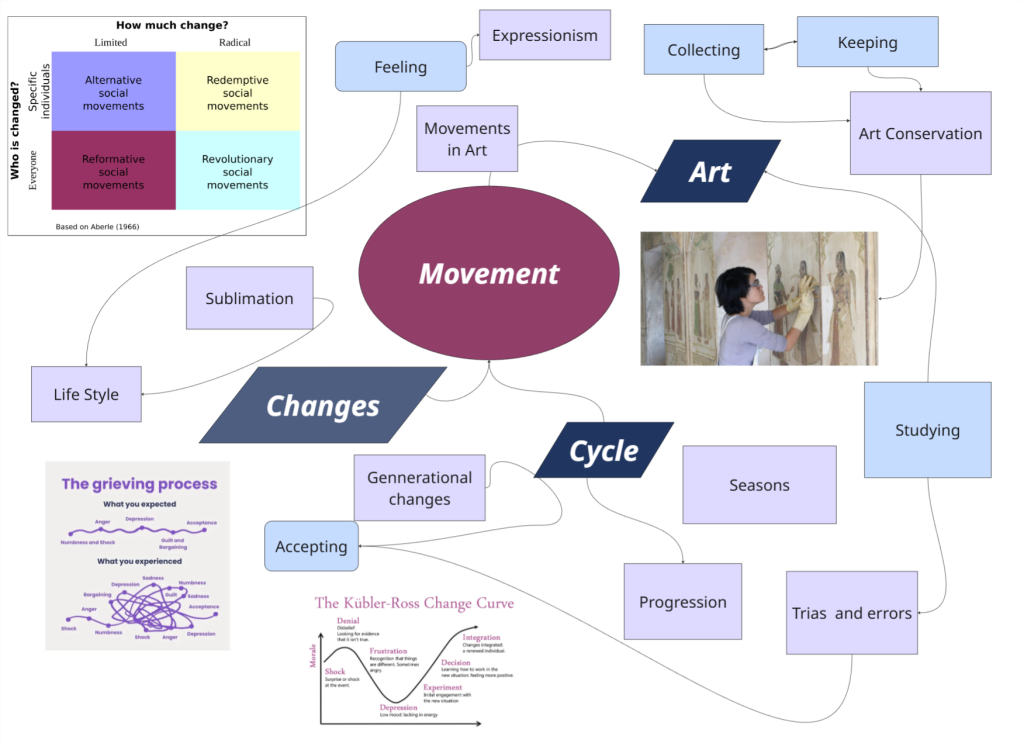
The mindmapping we did in a group didn’t reflect my desire for what I wanted to see in my personal project, so I made another version later.
The first idea related to “movement” in my mind was art movements and their variability. Different questions appeared in mind – “What is common between different movements?” “How is the memory and expression of art moved between generations?” “Can changes between generations be called ‘movement’?”, “Are emotions drive personality to reflection and change of their personality after a period of time”, “What can be called ‘movement’?”. Organising these spontaneous questions, I achieved this:
I also tried possible metaphors or experiences that can be in the game, which helped develop a major focus for the game.
Metaphors and Experience:
Memories translated through objects.
Relationship between making (something) and future experience, aka “reap the benefits” or “face with consequences.”
Actions stayed and were kept by our mind
Art keeps memories
So the main goal is a relation of
art and the way people reflect;
propose art as “conservation” of memory and emotions.
provide specific experience of deep considerations, and let the player feel “melancholy” related to something they unlike experience in real life yet.