Greater detail is available within the formal design document which can be found either throuh the home page navigation or by clicking here
Goals:
Personal:
My personal goals for the project are to greatly improve my technical ability, specifically programming, texturing and level design. I want to gain greater familiarity with Unreal Engine and be able to utilise it as a tool for creating visuals for my future projects.
Professional:
- Build a strong collection of portfolio components during the development process.
- Produce a full game suitable for release that can be accessed by others in a games marketplace such as Steam or Itch.io.
- Develop the skills necessary to apply for jobs in the games industry and determine what rolls are right for me.
Project:
Working title: Flux Logic – Light the Way
Dev Team: Ryan Gunther-Leece Game Developer
Abstract:
Flux Logic is a 1st person puzzle game with a linear narrative that progresses as the player completes levels. The player must manipulate beams of light by moving around different optical components in order to create a path to the next level. The game’s purpose is to introduce players to novel light physics in a unique and highly visual manner, with the focus being on entertainment and visual fidelity over fully realistic simulation.
Title:
Flux Logic
The game’s title ‘Flux Logic’ is derived from its two core components, Light, and Puzzles.
Flux is a term that describes any effect that appears to pass or travel through a surface or substance. In this context flux refers to the propagation of light. Luminous flux and is a measure of the perceived power of a light source and there are several other examples of flux being used in regard to light e.g. radiant flux or spectral flux.
Logic is simply a broad term for the type of puzzle the player must solve
Genre:
Puzzle Game
Hook:
Explore an abandoned laboratory and escape by wielding high powered laser beams.
The hook of the game is playing with the novel puzzle elements that differ form other games. These are visually appealing and feature prominently throughout.
Anchor:
The goal to progress through a linear game by completing separate puzzles is the fundamental framework for games such as the Portal and Portal 2. On a broader level the gameplay loop of overcome obstacle, progress, repeat is fundamental to a lot of games. The obstacle maybe defeating enemies but often there is a puzzle element such as: defeat enemy to collect key, unlock door, access code, escape/progress to next level.
The familiar goal in combination with introducing components slowly means the player is not overwhelmed.
Appeal:
The main appeal of the game is the visually striking lasers and the ability to interact with them. What makes the game unique is what makes it appealing, being able to redirect and manipulate these beams more directly and in ways that other games don’t allow.
Fun:
What makes playing Flux Logic enjoyable is the satisfaction of completing the game’s complex puzzles. Learning what different components do and becoming able to predict how they will affect the light before the player moves them, offers a sense of accomplishment.
Inspiration from Previous Titles:
The game builds on mechanics of titles such as Portal 2 [1] and The Talos Principle [2] by adding more advanced light manipulation elements and having all elements grounded in real physics. Visual inspiration is taken from Portal as well as the darkness and interior of the pyramid ships from Destiny 2 [3] particularly those from the Witch Queen expansion and the Vow of the Disciple raid.
[1] Valve Corporation (2011) Portal 2. PC, PlayStation 3, Xbox 360. Bellevue, Washington
[2] Croteam (2023) The Talos Principle 2. [Game]. Zagreb: Devolver Digital.
[3] BUNGIE, 2022. Destiny 2. Bellevue, Washington, USA: Bungie.
UX:
The game is designed with Mouse and Keyboard as the default controls.
During gameplay there is typically no HUD but hovering over an interactable object will display icons that show what actions are available to the player.
When controls are first introduced to the player a graphic popup will display the relevant control key binds.
The menu system consists of a title screen that plays a long but looped animation which displays the games title, new game option, load game menu and settings menus.
Load game gives the option to continue, or level select if available.
Mechanics:
Please refer to the formal design document for a full description of the mechanics. In summary the primary mechanics feature components that mimic those you may find in a photonics experiment on an optical breadboard. The components affect light beams in a manner that resembles the real world. Directing the beams to the specified targets activates them and allows progression to the next area.
Win/Fail state:
Wins are self-evident, unlocking the exit of a given level is seen as a win state, solving all puzzles and escaping is seen as winning/completing the game.
Fail states are those that result in a soft lock – the player is alive, but the necessary components can no longer be moved in a way that completes the puzzle or hard fail – the player dies and is reset to the beginning of the level.
Puzzle design aims to limit the possibility of soft locks, ideally entirely, leaving death as the only failure metric.
Audience:
The target audience for the game is teen and adult PC gamers who enjoy problem solving games that rely on skill-based mechanics over reflex-based ones. The game is designed to appeal both to casual players and more serious hardcore players who may challenge themselves to complete the game as fast as possible.
The game can be played through either entirely in one go or in multiple sessions from save points. This lends itself to casual play as there are regular breaks where the player can pick up from (every level) and by resetting the level during loads, components return to their designed start layout along with the player spawn location helping to reduce the brief confusion you may otherwise experience when loading a save part way through a level. This is especially relevant if you haven’t played a game for a week or more.
Competitors:
Flux Logic is a linear game which competes with other titles in the same category. One of the benefits to this category of game is that there is no major battle between titles for playtime in the same way as multiplayer or more exploration focused games. Completing the game once results in experiencing the entire main story and this is true of most games in this category, replaying a game is usually incentivised by achievements, secrets or collectibles that you may miss on a first playthrough. This means that players of these games typically play many different titles rather than focusing their time on a select few.
Nevertheless, there are certainly still competitors in this space. Notably the games on which inspiration is drawn from i.e. the Portal and Talos Principal games. Flux Logic offers effective competition with such titles by adding unique interesting new mechanics and a differing visual style.
Functional Specification:
Engine: Unreal Engine 5.7
Developed on PC with mouse and keyboard, for mouse and keyboard, if additional control support is added the matching hardware will also be utilised for validation and testing.
Distribution via games marketplaces tbd (Steam/Itch.io)
Development Schedule
Task management is performed in Atlassian Jira, the overarching structure is laid out on a roadmap timeline. Below is a timeline view of the different tasks that must be completed to finish the game and roughly when they will be worked on.
Below that is a list view of these tasks along with specific dates, followed by an explanation of each.
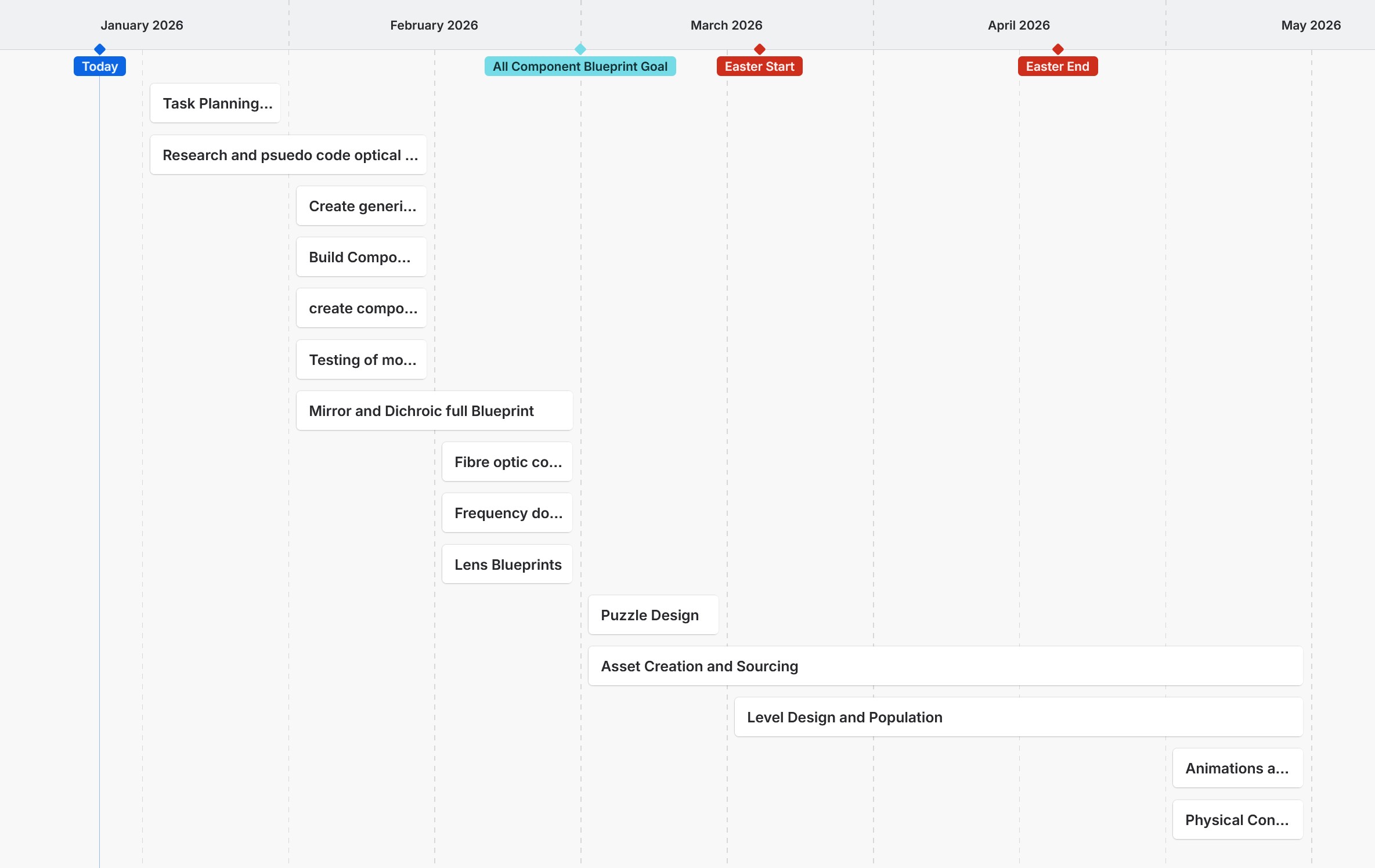
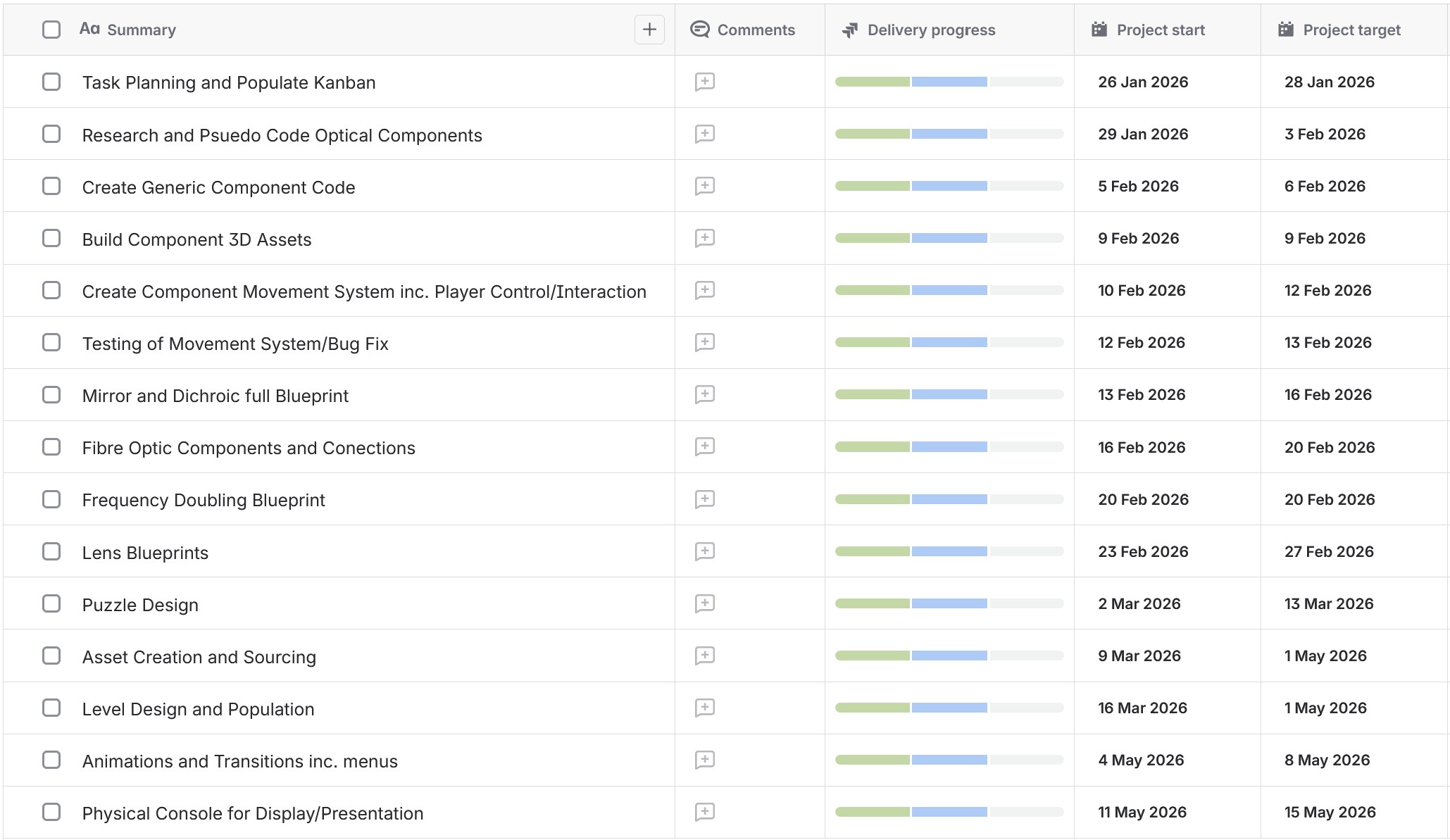
Task Planning and Populate Kanban
Breakdown and list all separate tasks within each of these roadmap sections for example specific assets or textures to be produced. Upload tasks to Jira Kanban board for progress tracking.
Research and Pseudo Code Optical Components
Determine the best method for making the optical system function and pseudo code the blueprint for each of the components.
Create Generic Component Code
Create the blueprint code shared by all components, this is the required parameters that the system needs such as propagation vector for a beam.Top of Form
Build Component 3D Assets
Build sets of 3D assets for the optical components so the blueprints can be tested during development.Top of Form
Create Component Movement System inc. Player Control/Interaction
The system that governs the movement of puzzle elements and allows the player to interact with these elements.
Testing of Movement System/Bug Fix
Testing of Movement System including player control sensitivity and speed, testing performed by both developer and others not working on the project.Top of Form
Mirror and Dichroic full Blueprint
Full blueprints for the most basic components.
Fibre Optic Components and Connections
Full blueprints for the fibre optic system that allows linking between areas.
Frequency Doubling Blueprint
Full blueprint for a frequency doubling crystal.
Lens Blueprints
Full blueprints for the most complex components, will make any issues with the optics system extremely obvious.
Puzzle Design
Designing the layout of each puzzle outside of actual levels, rapid prototyping facilitated by the now complete optical components
Asset Creation and Sourcing
Utilising asset libraries to source the majority of background scenery and creating any extra required assets from scratch.
Level Design and Population
Laying out the levels and connections between them and populating with assets.
Animations and Transitions inc. menus
Adding animations for objects such as doors and scenic elements.
Physical Console for Display/Presentation
Painting and preparing the physical housing used during exhibitions for the game.