Mentioned in my second presentation, the self/personal awareness is the first phase of The Fool’s Journey in the Major Arcana.
It starts with The Fool and progresses with:
- The Magician
- The High Priestess
- The Empress
- The Emperor
- The Heirophant
- The Lovers
- The Chariot
Each character, apart from the Fool, will have a puzzle or room in which the player can interact with them. Below are short descriptions of each card and starting points for each archetype’s potential puzzle. I based the characters’ appearances, puzzles, and rooms on the meanings and symbolism in their respective cards.
Tarot has links to Freud and Jung’s theories as well as Hindu mythology, which I will touch upon briefly in some descriptions. For the illustrations, I’ll mainly be looking at the most well-known and recognised deck: the Rider-Waite tarot deck created by A.E. Waite and illustrated by Pamela Colman Smith. For more in-depth analysis, character designs, and puzzles for the archetypes, see Phase 4.
The Fool

The Fool tarot card is full of symbolism. From the red feather, their clothes, the white flower, and the white dog, the Fool’s card is about new beginnings, spontaneity, innocence, and action. ‘The Fool stands somewhat outside the rest of the Major Arcana. Zero is an unusual number. It rests in the exact middle of the number system – poised between the positive and negative. At birth, the Fool is set in the middle of his own individual universe. He is strangely empty (as is zero), but imbued with a desire to go forth and learn.’ (Bunning, 2024). Despite the connotations of the term ‘fool’, the Fool is far from it. They are free from expectations and move forward with courage, although some decisions – like jumping off a cliff – seem foolish.
The Fool is both the protagonist in the Major Arcana and will be in my game. When the Fool collects the archetype cards from phase 1 of the Major Arcana, they gain a skill/lesson alongside the card itself (e.g. Collect the Magician’s card as well as gain resourcefulness).
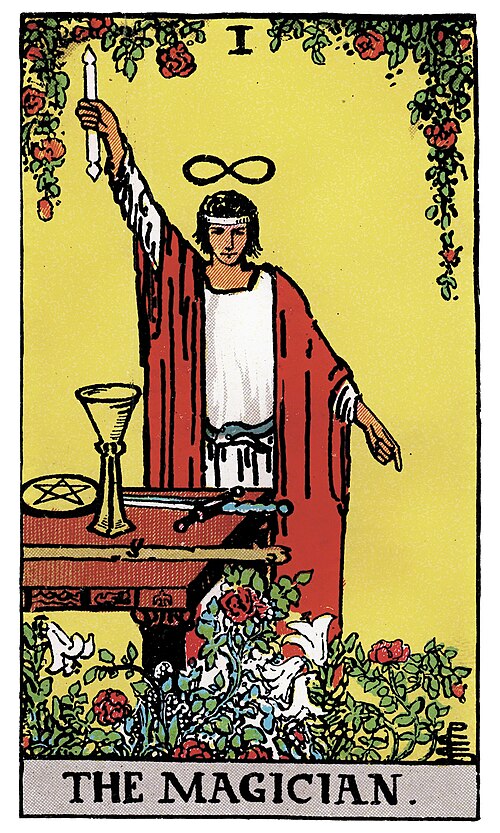
The Magician
Sometimes referred to as the trickster, the magician is all about tapping into your full potential. The Magician, like the trickster archetype, can create illusions and manipulate reality to their own ends. It’s achieved through knowledge, skill, and mastery (conscious mind) and used to entertain an audience (e.g. card tricks), also see how he is outdoors in his card – bringing ideas from within into something tangible in reality. The Magician tarot card signifies manifestation, resourcefulness, power, and inspired action. All 4 suits: wands, cups, swords, and pentacles are included in the card, which symbolise that we have everything we need to achieve our goals. His puzzle would be about resourcefulness.
When the player enters the magician’s room, they have the opportunity to explore first, clicking on various items around the room and finding hidden tarot cards, before interacting with the magician and playing a minigame.
The High Priestess

The Magician and The High Priestess, by many, are considered a pair. While the Magician represents the conscious mind, the High Priestess represents the sub/unconscious mind, rather than or beyond the physical body and language. Her card is about trusting your intuition and accessing your inner wisdom. Often associated with the Greek goddesses Persephone, Artemis, and Isis (she wears the crown of Isis), as well as femininity, the pomegranates, a recurring motif in other cards, behind her represent abundance and fertility.
She is usually quiet and contained, but much more established compared to the Magician, as she seems to be part of a religious system. The High Priestess sits between the two pillars of Solomon’s temple: Boaz and Jachin. However, instead of implementing the biblical meaning, the pillars in modern tarot depict the duality of nature:
- Masculine and feminine
- Good and evil
- Severity and mercy
- Night and day
The crescent moon at her feet and the water behind the pomegranate-patterned veil represent the subconscious mind and emotions. Her card urges us to trust gut feelings and explore hidden knowledge as opposed to seeking external answers. Rather than presenting a puzzle, the High Priestess prompts the Fool to engage in introspection about why they’re on this journey (e.g. asking rhetorical questions or showing an image (stages of metamorphosis?) which allows the player to begin thinking about the purpose of the journey).
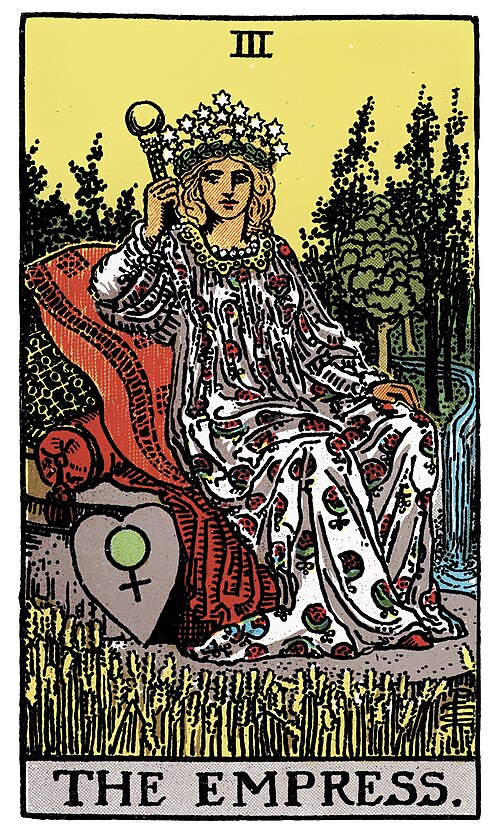
The Empress
The Empress is the embodiment of womanhood and ‘unlike the High Priestess, the Empress embodies her material self: the good, the bad, the beautiful, and the ugly’ (Blog: Musings — Hermit’s Mirror, 2019). She is linked to Venus and Mother Nature, evident in her pomegranate-patterned dress, crown of stars and the lush landscape – trees, a river, and wheat – that surrounds her. In many other tarot decks, the Empress is pregnant, signalling the birth of new beginnings. The main themes of her card are fertility, nurturing, and abundance. Other than the obvious name of this card, the Empress holds a sceptre: she is an authority figure and rules over the natural world alongside her counterpart, the Emperor.
Tarot uses gendered terms (e.g. The Empress and The Emperor), but not all identities or dynamics fit into that narrow binary. Typically, in a reading, the archetypes in each card refer to energies or stereotypical masculine and feminine traits that we embody (e.g. action-oriented or receptive).
Her lesson is about embracing growth through self-care and patience, connecting with nature, and being nurturing to those around you. For her puzzle, it’ll likely involve a wild animal (a horse or a tiger), helping it, and in turn, it helps the player progress.
The Emperor
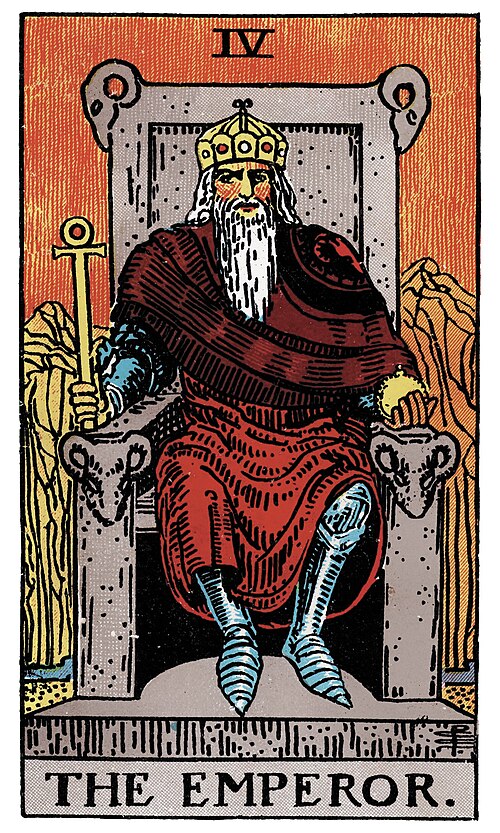
The Emperor is about stability, leadership, discipline, and long-game thinking. Since the Empress is the maternal archetype, the Emperor is the paternal figure.’We can see these two figures as ruling side by side, working in tandem to create something that neither one can quite do alone. Whereas the Empress is creation and the chaos that allows for creation, the Emperor structures and organizes in order to produce something that lasts beyond the initial creative impulse’ (Blog: Musings — Hermit’s Mirror, 2019).
He sits on a throne adorned by the heads of 4 rams, linking him to the zodiac sign Aries and the god Ares. He holds both an ankh, the Egyptian symbol for life, as well as an orb that represents the world in which he and the Empress rule. Behind him is a mountain range, representing having a solid foundation but being resistant to change unless deemed necessary. The armour under his red robes signifies protection from external threats as well as emotional vulnerability, as his card is rooted in logic. However, at the foot of the mountain is a small river; despite his tough exterior, there is tenderness and vulnerability.
His puzzle would be about organisation, practicality, or leadership. Possibly a minigame in which the player must make it down the river while avoiding rocks and boulders to get to the next area, or make it over the mountain, or choose one over the other (this may be too ambitious). After making it through, they’ll find a crumpled Emperor card in their inventory.
The Hierophant
The Hierophant is the masculine counterpart to the High Priestess, as he is also a religious figure sitting between two pillars in a temple. Like the Emperor, ‘both are traditionally masculine figures of order and control, but their control is different: the Hierophant typically “rules” over a religion or school or other organisation where there is a willing population who has consented to the organisation… the Hierophant is elected based on relevant qualifications, such as education and experience’ (Tarot.com, n.d.).
Although the image is religious, his card refers to initiations and doctrines of all kinds. Before we discover our own belief system, we are encouraged to learn the fundamentals from a trusted source. This card is tied to community and mentorship, unlike the High Priestess, whose wisdom must be accessed individually.
The Hierophant is seen as the public transmitter of knowledge, while this is true, he is often seen with crossed keys at his feet, which represent the balance between the conscious and subconscious or the keys to heaven and earth. It also suggests there is something locked away that only he can unlock through his teachings, as his wisdom is also a divine secret.
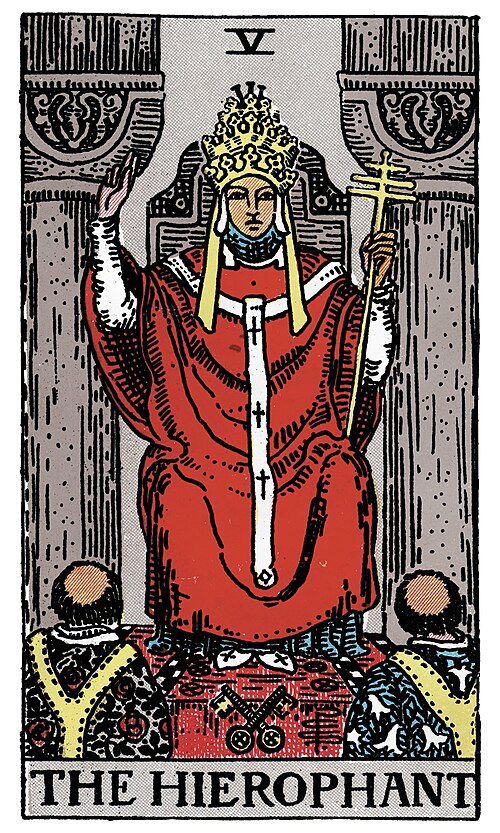
To add to this, he wears 3 robes – red, blue, and white – which represent the 3 worlds he rules over (the conscious, subconscious, and the super-conscious). The Hierophant’s puzzle would be about knowledge. Rather than an actual person, the character may be represented by an orb of light or a tree with a cryptic message that will lead them to the next area. Or a small puzzle that, once completed, rewards the player with an item that can be used in the next area.
The Lovers
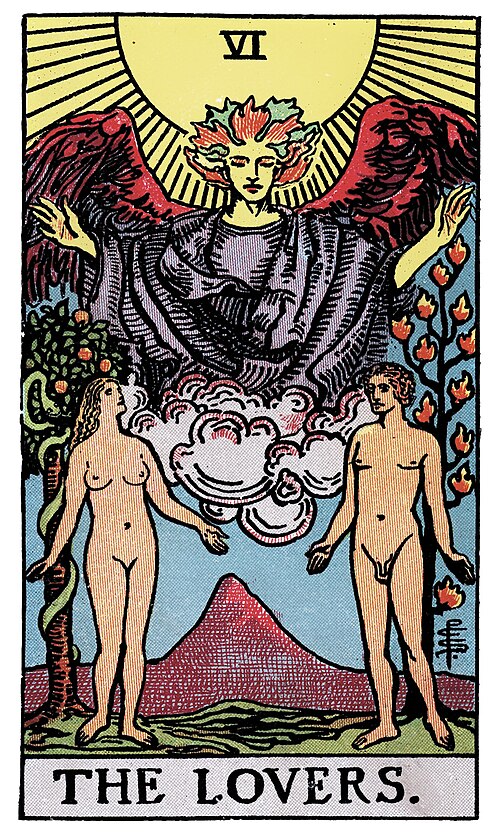
What first comes to mind when we see the Lovers card is relationships, and although the card touches upon this, it is also about alignment and integrity. A naked couple stands in a beautiful garden, reminiscent of the Garden of Eden, under Archangel Raphael, the angel of air. He is both a physical and emotional healer and a guide. The zodiac element of air links to intellect and communication, which is key to healthy relationships. The man looks to the woman, who watches the angel. This represents the path from the conscious to the subconscious, and then to the super-conscious (linking to the Hierophant).
The card can sometimes indicate choices, such as duty or desire, or your values and beliefs. Behind the woman is the tree of knowledge, and behind the man is a fiery tree of life. The former symbolises temptation and the latter passion. Other decks show a lush garden without the biblical reference.
‘The Lovers card is often a sign that you are facing a moral dilemma and must consider all consequences before acting.
Your values system is being challenged, and you are being called to take the higher path, even if it is difficult…You can bring together two parts that are seemingly in opposition to one another and create something that is ‘whole’, unified and harmonious.’ (Biddy Tarot, n.d.).
The Lover’s puzzle will likely follow on from the Hierophant. The player could be rewarded a key alongside their card and must choose which of the correct gates the key can unlock.
The Chariot
The final card of the first phase, The Chariot, is about success, willpower, action, and determination. It represents a turning point and the vehicle which brings an individual to a new realm. The card depicts a warrior standing inside a chariot under a blue canopy adorned with stars. Magic signs adorn his clothes: crescent moons on his shoulders and astrological symbols on his belt.
He holds no reins, instead a wand like the Magician. However, he does not raise it above his head to heaven, as he can control the sphinxes and chariot through sheer will. This is also apparent as his chariot looms larger than the town; his will is more powerful than the rules of society. ‘However, the fact that his chariot is not in motion indicates that he is not a rebel. The wheels of the chariot rest on water, showing that he draws energy from the unconscious, though the chariot itself, resting on land, separates him from a direct contact with that great force’ (Author: Rachel Pollack, 2007).
In relation to the Lovers card, the Chariot indicates forming a stronger identity, steering your life with purpose. The Chariot references all the cards before him:
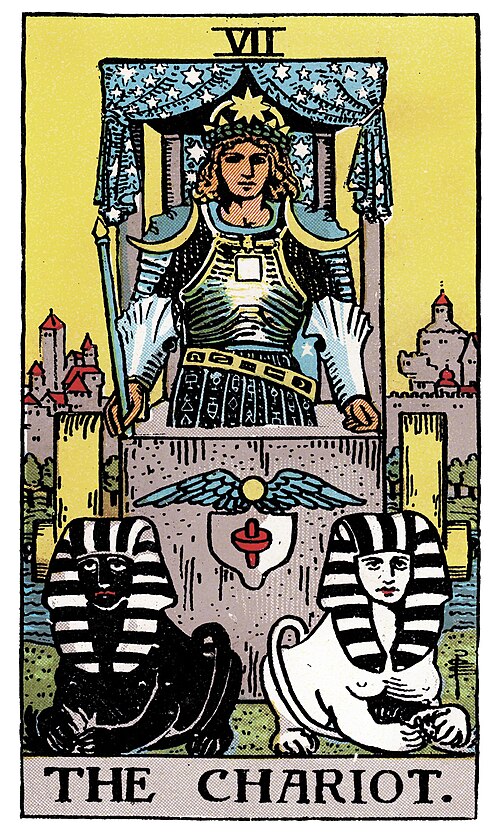
‘The wand and symbols indicate the Magician, the water, sphinxes, and veil symbolize the High Priestess, the square and green earth symbolize the Empress, the city symbolizes the Emperor, the shoulder plates symbolize the Hierophant, and the lingam and yoni (symbol on the front of the chariot) symbolize the Lovers’ (Author: Rachel Pollack, 2007).
Opening the correct gate will lead the player to the Chariot. The Chariot’s puzzle
References
Author: Rachel Pollack (2007). SEVENTY-EIGHT DEGREES OF WISDOM: a tarot journey to self-awareness. Weiser.
Biddy Tarot. (n.d.). The Magician Tarot Card Meanings. [online] Available at: https://biddytarot.com/tarot-card-meanings/major-arcana/magician/.
Blog: Musings — Hermit’s Mirror (2019). Hermit’s Mirror. [online] Hermit’s Mirror. Available at: https://www.hermitsmirror.com/musings.
Bunning, J. (2024). The Fool’s Journey. [online] Learntarot.com. Available at: https://www.learntarot.com/journey.htm.
Labyrinthos. (2019). Tarot Card Meanings List – 78 Cards By Suit, Element, and Zodiac. [online] Available at: https://labyrinthos.co/blogs/tarot-card-meanings-list.
Mister Tarot (2013). Symbols of The High Priestess of the Tarot. [online] Mister Tarot. Available at: https://www.mistertarot.com/notes-about-the-high-priestess/.
Tarot.com. (n.d.). Tarot Cards – Tarot.com List. [online] Available at: https://www.tarot.com/tarot/cards.
Wikipedia Contributors (2020). Major Arcana. [online] Wikipedia. Available at: https://en.wikipedia.org/wiki/Major_Arcana.
Reply