Stealth as a Systemic Mechanism
1.From Tactical Stealth to Systemic Stealth
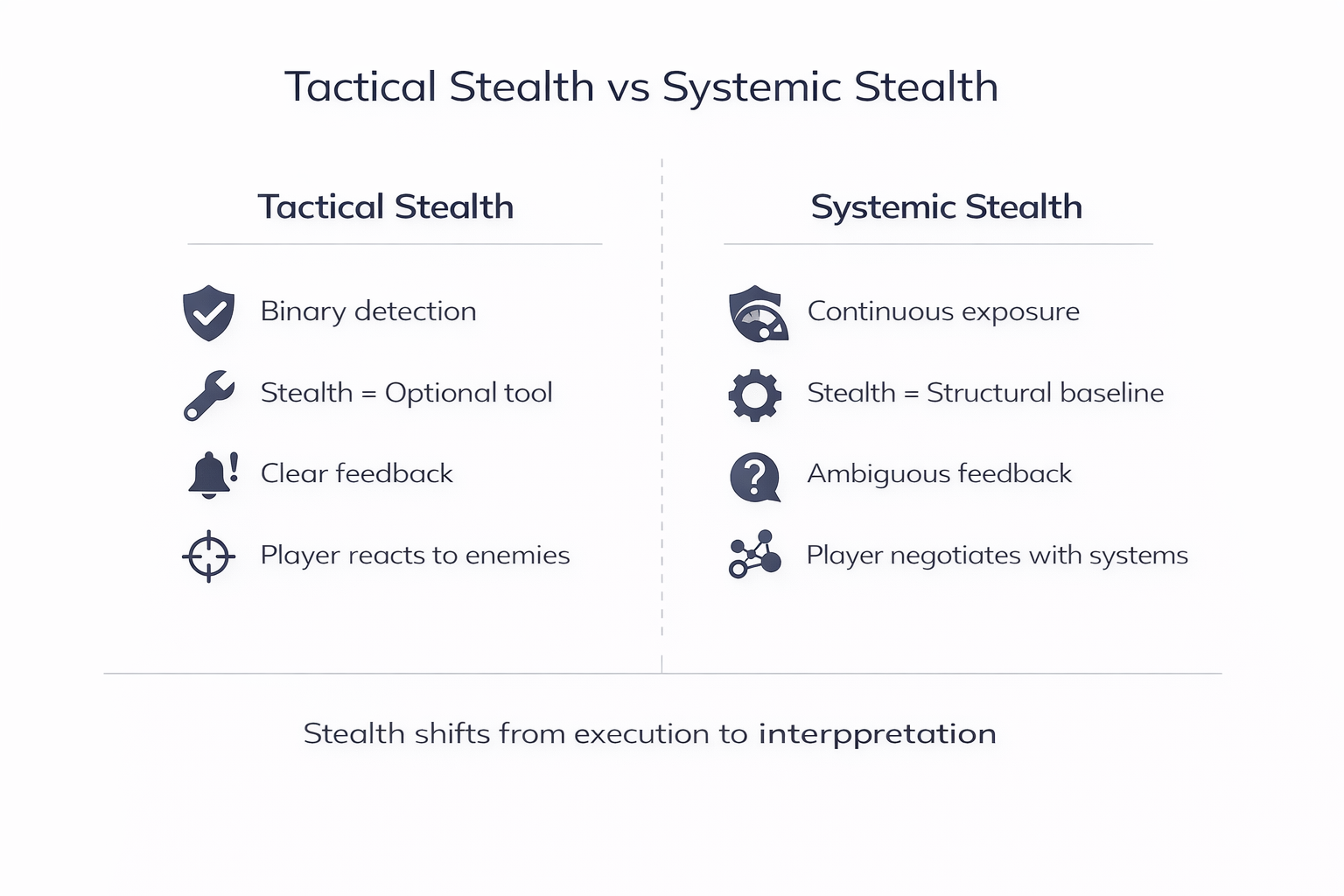
In traditional game design, stealth is often regarded as a tactical option to avoid combat or reduce immediate risks. However, in the systematic stealth design, stealth is not a secondary gameplay, but a core structural mechanism that directly shapes the player’s perception, rhythm control and decision-making process.The goal of players is no longer just to “keep it undetected”, but to continuously manage the degree of exposure, uncertainty and behavioural consequences. As a result, stealth has changed from a mechanical skill that focusses on execution efficiency to a process with cognition as the core – meaning does not come from the fastest or optimal operation, but is gradually generated by interpreting the environment, judging the state of the system and taking risks.
2.Shared Logic in Systemic Stealth Case Studies
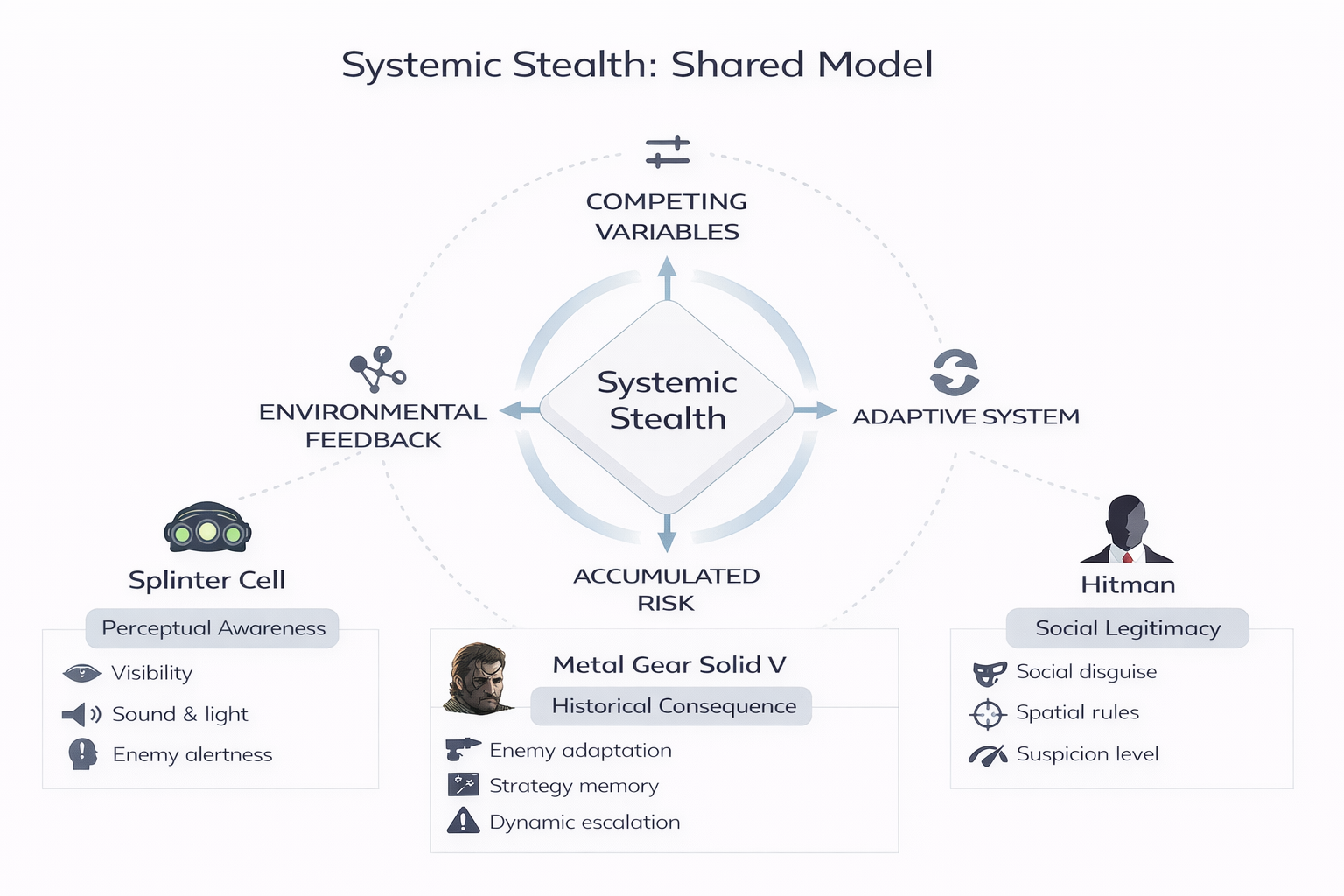
Shared Logic in Systemic Stealth Case StudiesGames such as Tom Clancy’s Splinter Cell, Metal Gear Solid V: The Phantom Pain, and Hitman: World of Assassination demonstrate how stealth can operate as a system rather than a singular mechanic. Splinter Cell establishes visibility, sound, and enemy alertness as continuous variables, placing responsibility directly on player perception.
Tom Clancy’s Splinter Cell
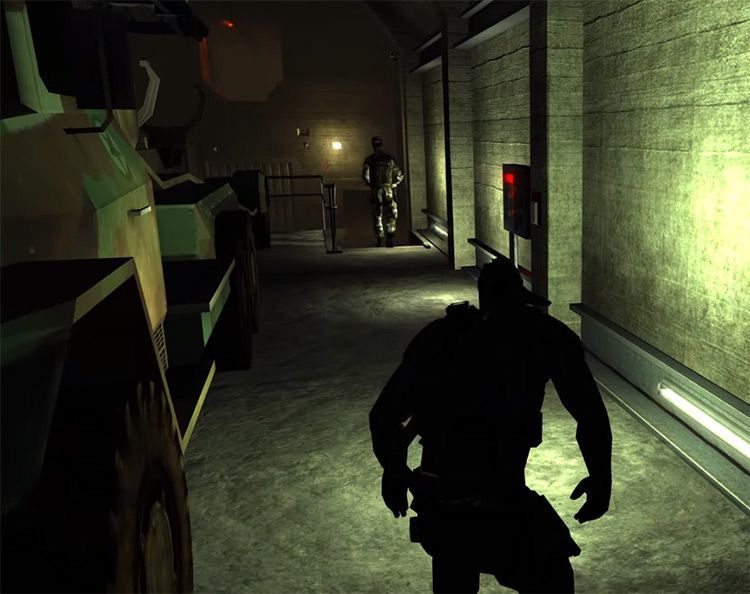
Splinter Cell establishes sneaking as a continuous system governed by a combination of visibility, sound transmission and enemy alertness.Rather than a simple ‘hide / be found’ dichotomy.The player’s success depends on perceptual level judgements of light intensity, movement speed and spatial positioning thus placing cognitive interpretation at the heart of the gameplay.Under this framework, sneaking is no longer a discrete mechanic triggered on demand, the Rather, it is a process of continuous negotiation with environmental variables that players need to constantly weigh and adjust to dynamic changes in the state of the system.
Metal Gear Solid V: The Phantom Pain
Metal Gear Solid V: The Phantom Pain extends stealth into a long-term systematic feedback loop by introducing the enemy’s adaptive behaviour. The strategies repeatedly adopted by players – such as frequent head blasting or favouring night infiltration – will reshape the enemy’s equipment configuration and patrol mode in time dimension.
As a result, stealth is placed in a historical context: past actions will have a substantial impact on future conditions. This reinforces Subterfuge’s position as an evolving system rather than a static collection of rules.so that players must continually adjust their judgement and strategy to cope with a world that has been changed by its own behaviour.

Hitman: World of Assassination
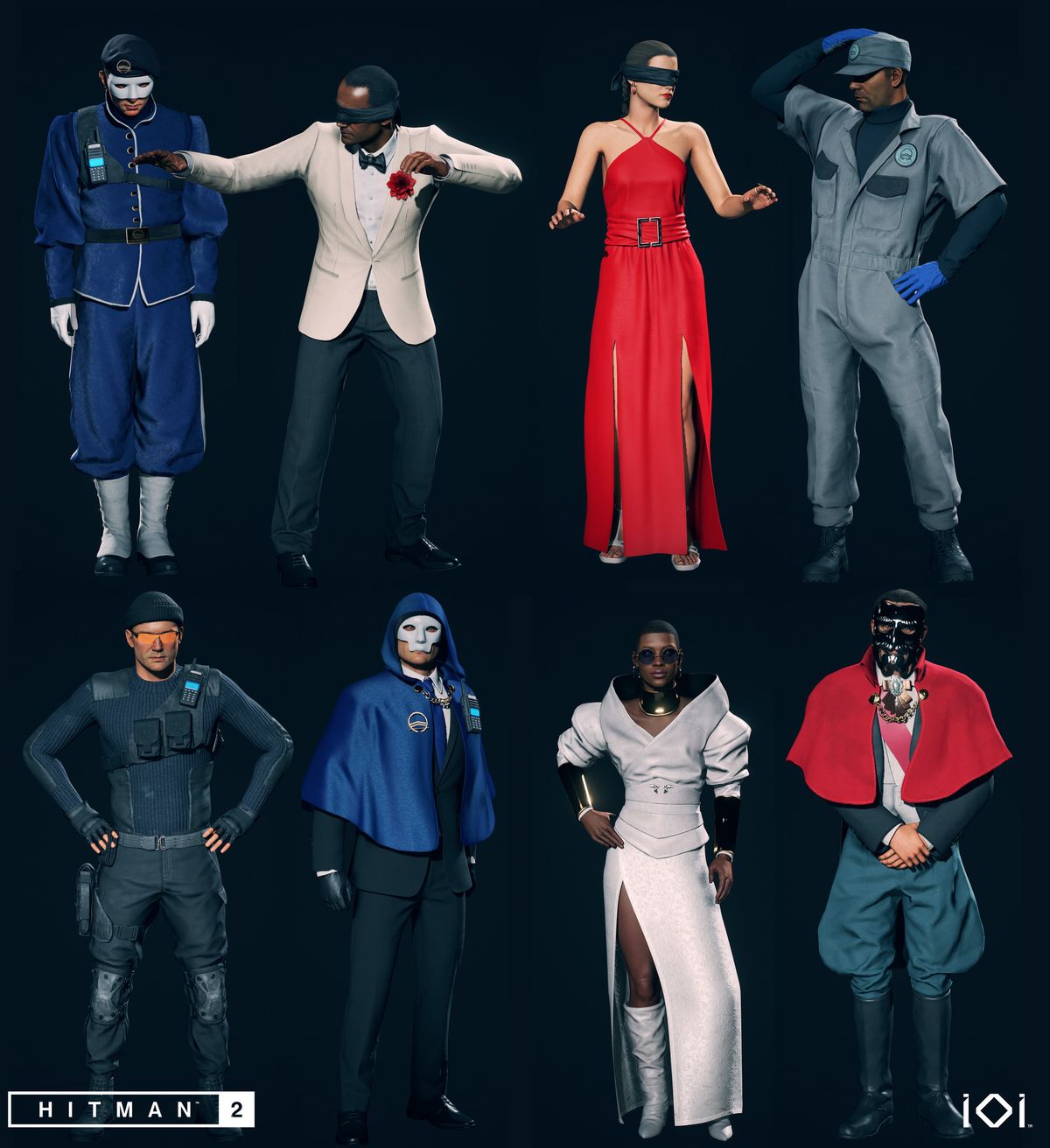
Hitman: World of Assassination redefines sneaking as a social and spatial system. Instead of relying solely on physical invisibility, the game requires players to manage legality, role-playing, and spatial context in order to remain unrecognisable.Together, camouflage, social rules and environmental availability define the boundaries of “exposure”, transforming sneaking into a negotiation of social systems rather than a mere exploitation of cover and shadow. In this way, stalking becomes a dynamic trade-off between social norms and spatial conditions.
Shared Systemic Logic
Based on these cases, it can be seen that stealth always operates as a system composed of continuous variables, feedback cycles and risk accumulation, rather than a simple success/fail binary mechanism. The dymomism of players comes from the interpretation of the state of the system, the prediction of risks and the adaptation to environmental changes, thus establishing stealth as a cognitive and strategic process embedded in the logic of the world.
3.Research Implications of Systemic Stealth
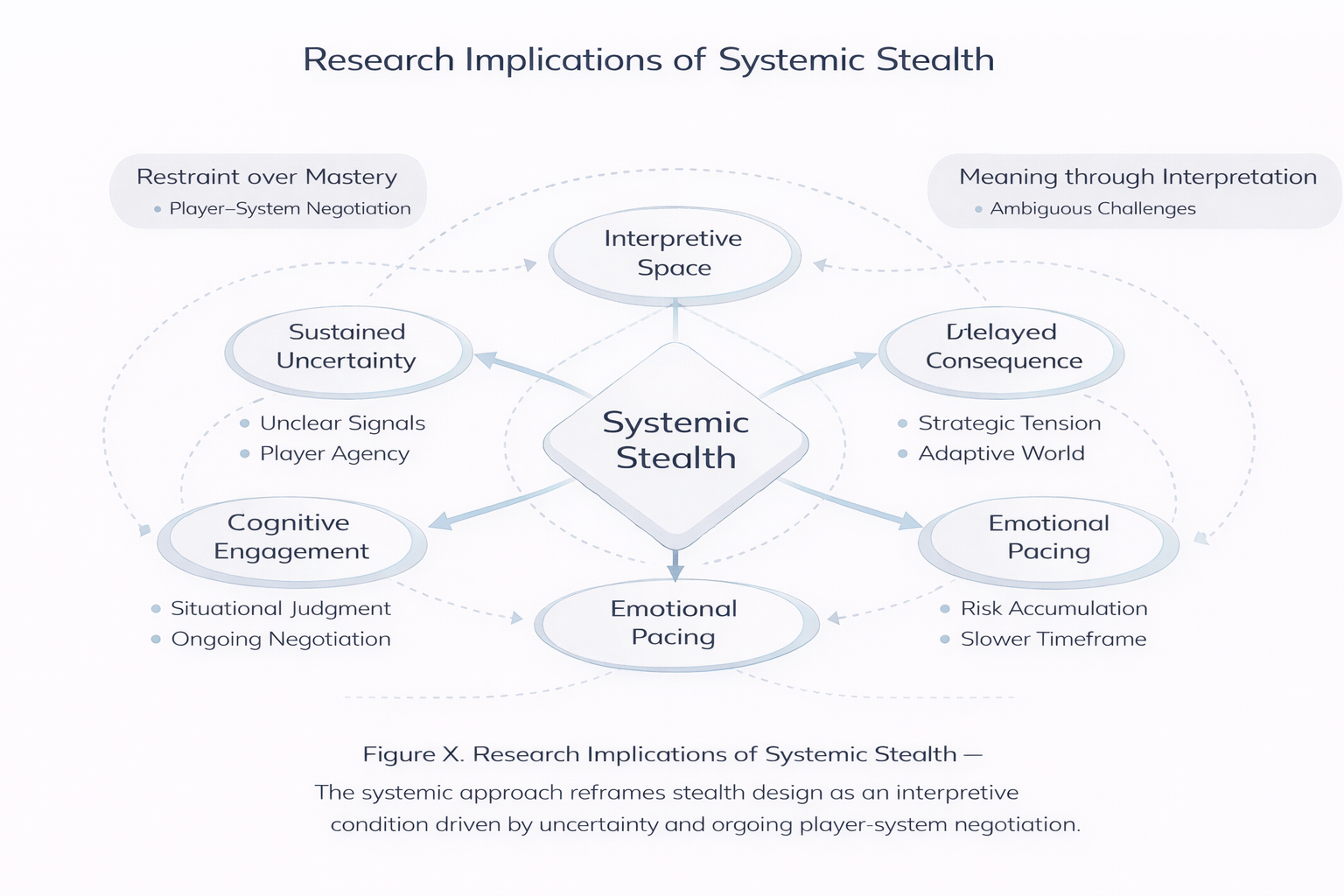
Taken together, these cases suggest that the core advantage of systematic subterfuge lies not in empowering the player through ‘mastery’, but in maintaining the space of instability and interpretability. Tension does not come from numerical increases in difficulty, but rather from incomplete information, delayed consequences, and the persistence of the world’s response to player behaviour.From a design research perspective, systematic sneaking establishes restraint, decipherability and situational judgement as key experiential values. Instead of being merely an adversarial mechanism, subterfuge becomes a tool for shaping cognitive engagement and emotional rhythms, keeping the player in a constant state of negotiation with the system rather than in head-to-head confrontation with it.