GAME OVERVIEW
THRESHOLD: SIGNAL AT THE EDGE
Overview
THRESHOLD: SIGNAL AT THE EDGE is a narrative-focused tactical infiltration and post-industrial exploration game designed around infiltration operations, spatial awareness and environmental narrative. The game is set in an abandoned signalling infrastructure left behind after a global communications meltdown. Players need to navigate through a hostile industrial environment by observing enemy patrol patterns, manipulating light and sound, and navigating multi-layered vertical paths of judgement and puzzle solving. Unlike gameplay that relies on head-on combat, this game emphasises restraint, planning and gradual progression.
At the heart of the experience is the idea that the player, as the only executor still able to act within the ‘dead system,’ is moving forward with a clear intent. Along the way, architectural structures, residual signals, and an ever-accumulating sense of environmental oppression shape the game’s pacing and narrative.
The player’s goal is to infiltrate the various signalling infrastructures, reach key nodes, and ultimately determine the fate of the remaining signalling systems.

Design Summary
Genre: Narrative-Driven · Tactical Stealth · Post-Industrial Exploration
Platform: PC (Primary) · Console (Exploratory)
Perspective: Third-Person Cinematic Stealth
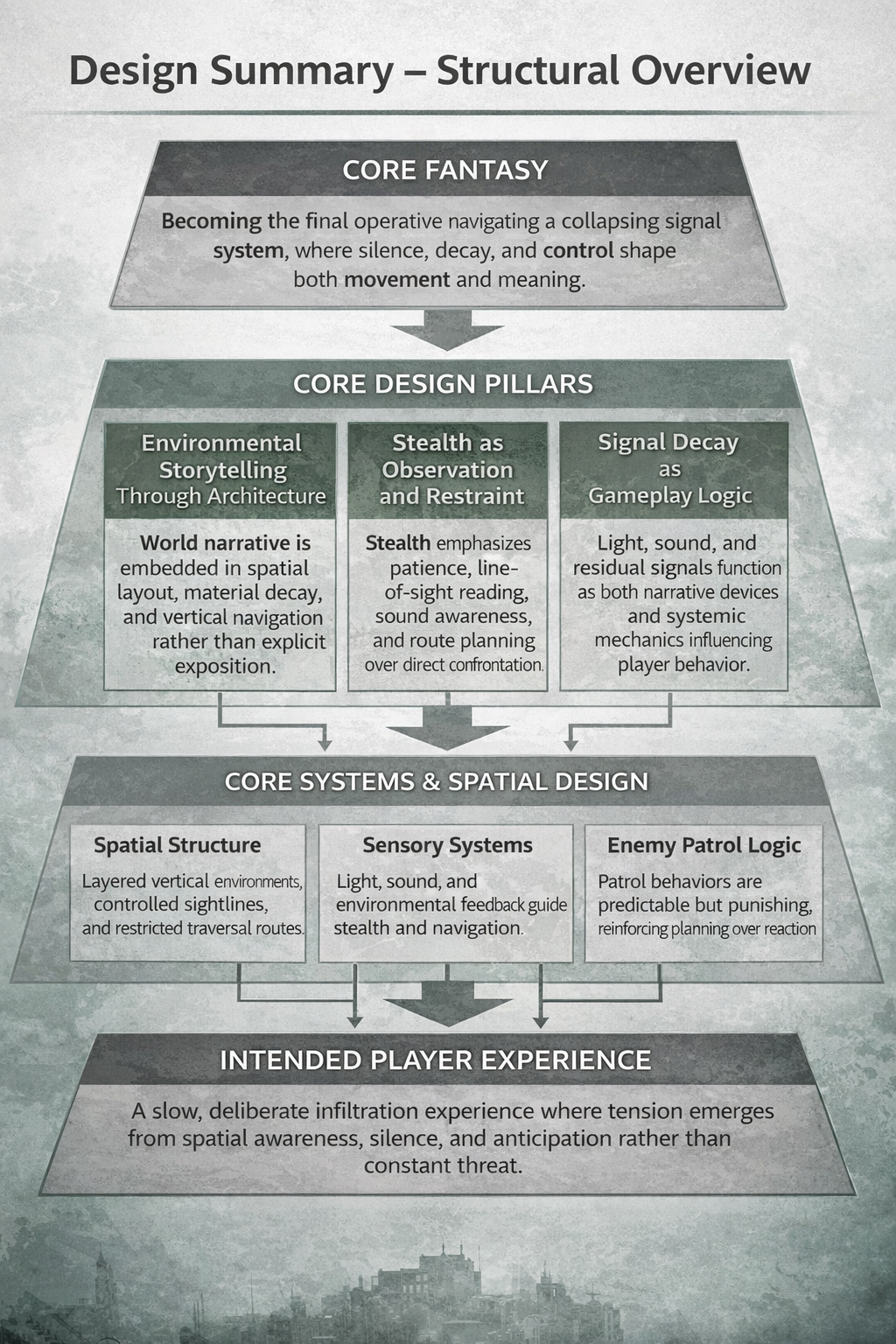
Core Fantasy: Becoming the final operative navigating a collapsing system
Primary Themes: Signal decay, isolation, control versus entropy Gameplay Structure: Self-contained infiltration spaces built around observation, route planning, and stealth execution
THRESHOLD: SIGNAL AT THE EDGE is a narrative-driven tactical sneaking and post-industrial exploration game developed primarily for PC platforms, with the possibility of exploratory adaptations for console platforms maintained. The game is played from a third-person cinematic sneaking perspective and puts the player in the role of a final enforcer capable of operating in a progressively collapsing signalling system.
Each playable area is designed as a relatively independent infiltration space, guiding the player through the process of observing enemy behavioural patterns, planning a course of action, and completing sneak moves through a multi-layered, vertically structured environment. Rather than emphasising head-on conflict, the game focuses the experience on restraint, spatial awareness and a rhythmic, deliberate approach to advancement.
The core objective revolves around infiltrating abandoned signalling infrastructure, reaching key system nodes, and determining the ultimate fate of the remnant signalling network – whether to restore it, track it down, or cut it off and eliminate it altogether. Core themes that run throughout the game experience include the attenuation of signals, states of isolation, and the tension between control and entropy. These concepts are continually reinforced through the overall unity of the environmental narrative, the design of the architectural scale, and the synergistic expression of the audio-visual dimension, thus ensuring that the game system as a whole remains highly coherent and always tightly aligned with the narrative intent.

Positioning
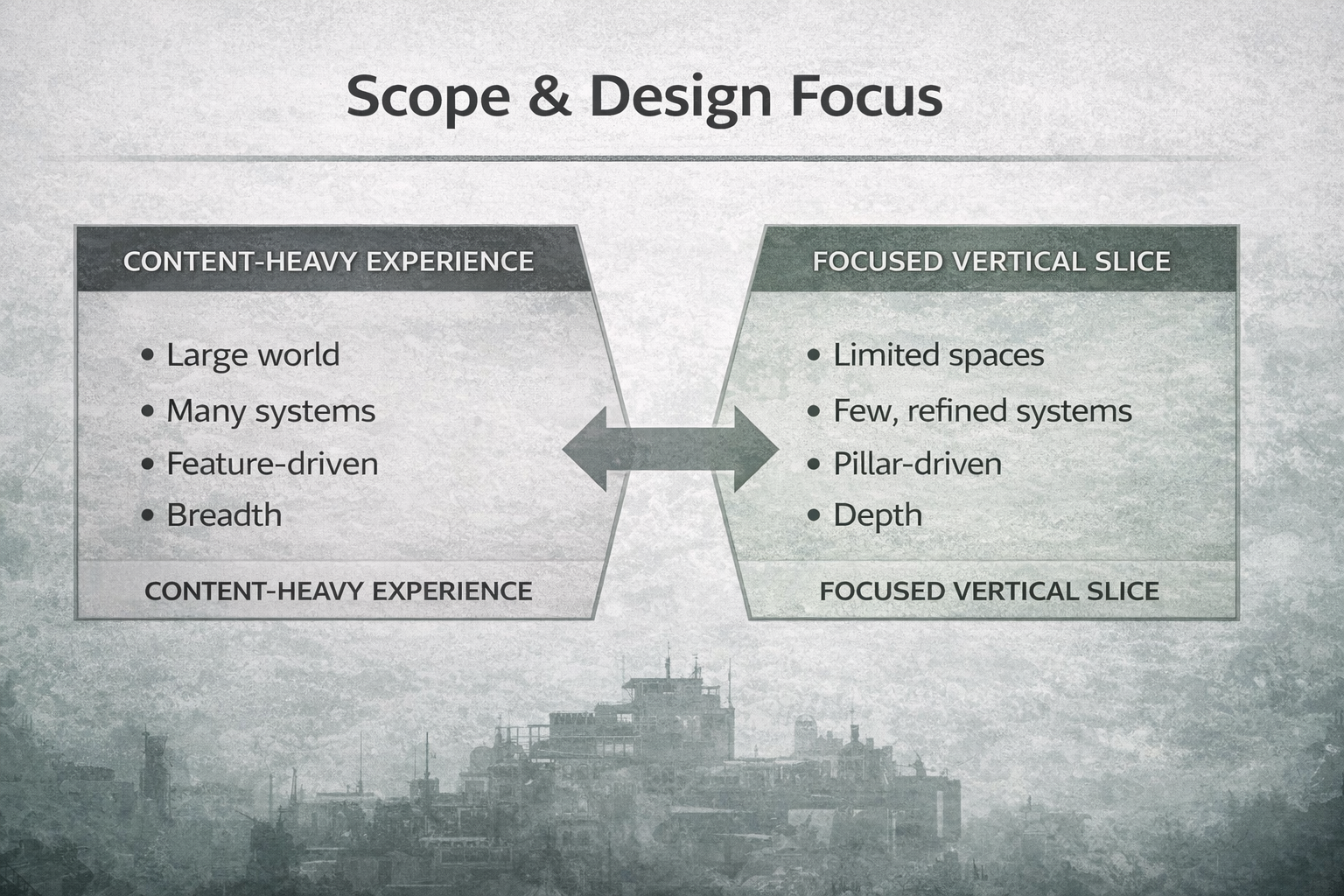
THRESHOLD: SIGNAL AT THE EDGE was not constructed as a complete experience with a huge volume of content, but rather developed as a highly focused vertical slice. The project emphasises the clarity of design intent, the strength of the environmental narrative, and the overall coherence of the systemic level rather than the scale of the expansion itself, with a limited but highly integrated set of submerged mechanisms, spatial design principles, and audio-visual systems underpinning the overall experience.This design strategy allows each environment to exist as a spatial unit with a clear narrative, where the architecture, the logic of signalling, and the movement of the players all serve a unified design vision. All design decisions were guided by a small set of Game Pillars, ensuring that the gameplay, narrative and presentation dimensions remained aligned and purposeful throughout the development process, while avoiding Feature Creep.