CORE GAME PILLARS
Design Pillars Overview
The core game pillars of THRESHOLD: SIGNAL AT THE EDGE establish a unified design logic that connects environment, gameplay, and narrative into a cohesive system.
Rather than functioning as isolated concepts, each pillar directly informs spatial construction, player behavior, and mechanical constraints within the game world.
Together, these pillars ensure that architectural form, stealth mechanics, signal systems, and vertical navigation operate in alignment, reinforcing a focused and intentional player experience built around restraint, observation, and systemic tension.
Pillar 01 — Environmental Storytelling Through Architecture
In THRESHOLD: SIGNAL AT THE EDGE, architecture functions not merely as a backdrop for gameplay, but as the primary narrative system through which world history, power structures, and systemic collapse are communicated. Rather than relying on explicit exposition, the game embeds narrative meaning into spatial hierarchy, material decay, and infrastructural logic.
Architecture communicates narrative through form rather than exposition.
Monumental interior halls, exposed signal frameworks, and fragmented industrial remnants are deliberately designed to communicate scale, authority, and technological failure through spatial composition alone.
Spatial hierarchy establishes a readable relationship between function and collapse.
Elevated control structures suggest former dominance and surveillance, while lower, compressed spaces emphasize concealment, abandonment, and residual human presence.
Player movement becomes an act of interpretation rather than traversal.
In travelling through these spaces, the player progressively reconstructs the operational history of the place through spatial clues, structural availability and environmental constraints, allowing narrative understanding to emerge naturally from the exploration.
Architecture actively constrains gameplay and decision-making.
Architectural forms are no longer passive scenarios, but directly influence player behaviour by restricting movement, controlling sightlines and guiding choices, transforming the ability to interpret the environment into a core gaming skill.

Architectural structure establishes narrative context, while player traversal completes the storytelling through spatial interpretation.
Pillar 02 — Stealth as Observation and Restraint
In THRESHOLD, sneaking is not portrayed as a power fantasy or an alternative to combat, but rather as a disciplined process centred on observation, anticipation and self-restraint. Advancement in the game depends on the player’s ability to interpret environmental signals – including patrol tempo, line-of-sight coverage, sound propagation, and spatial availability – rather than on mechanistic suppression or speed of action. Stalking encounters are intentionally designed to reward patience and situational awareness, rather than encouraging an aggressive approach to intervention.
Stealth encounters are structured around readable patrol rhythms and spatial affordances, encouraging players to pause, observe, and commit only when conditions align.
More crucially, stalking in THRESHOLD is not a mechanistic shortcut, but a cyclical process centred on cognition.The game encourages players to pause, observe, and make action decisions only when environmental conditions truly fit, thus reinforcing a rhythm of play defined by hesitation and deliberate movement.Failure often stems from overconfidence or premature action, making restraint itself a core mechanism.In THRESHOLD, head-on conflict is deliberately designed to be an inefficient and destructive option.Aggressive or poorly timed actions tend to rapidly raise enemy alert levels, exacerbate signal exposure, and cause otherwise safe movement paths to collapse – thus further establishing that sneaking is not an optional style of play, but rather the most viable and sustainable method of advancement in the overall system design.
Pillar 03 — Signal Decay as Gameplay Logic
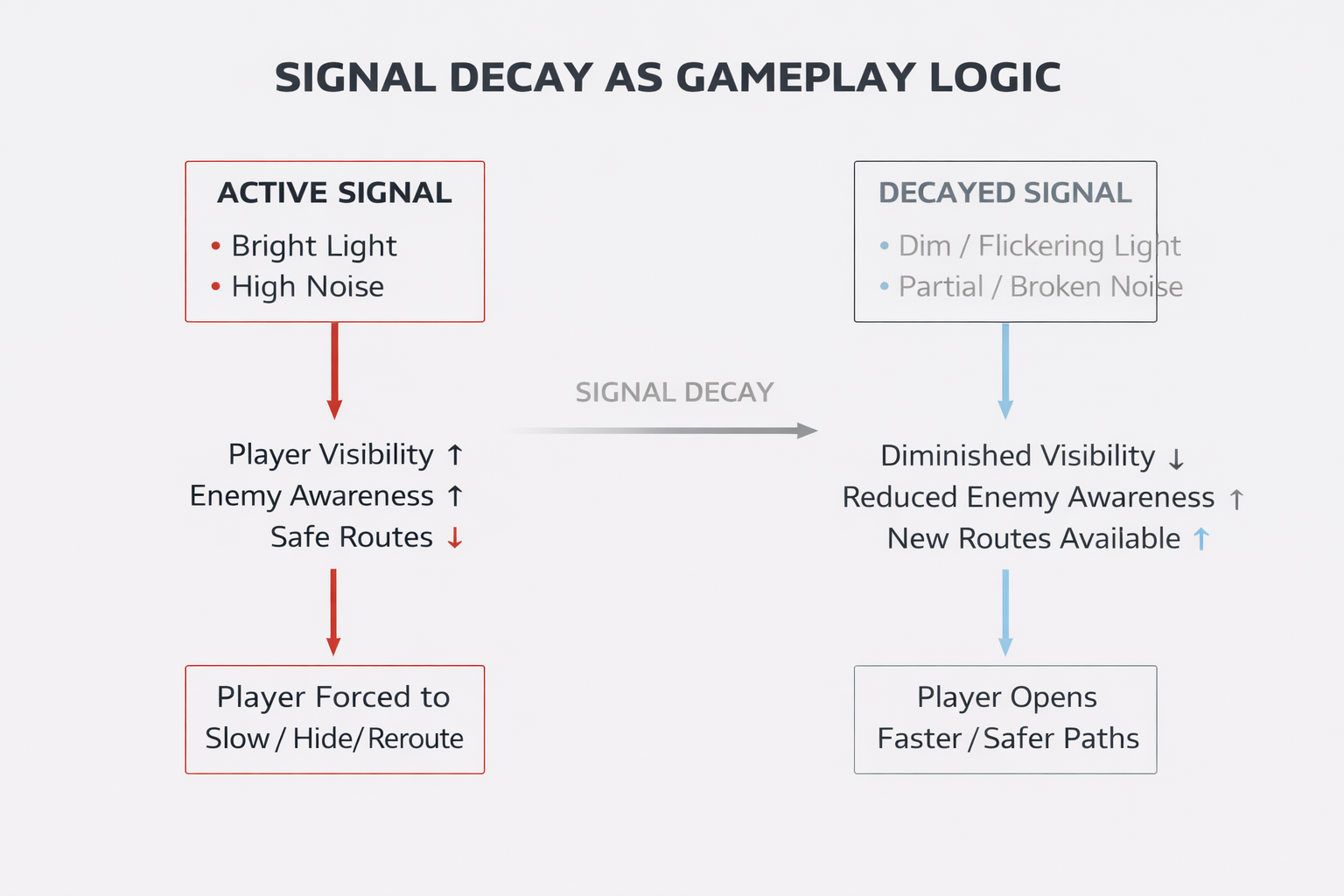
In THRESHOLD, the signalling system operates as both a narrative legacy and a mechanistic regulator.Light, sound, and residual signal activity directly affect player visibility, how enemies are perceived, and spatial legibility, creating a dynamic feedback loop between environmental states and play decisions.As the signalling infrastructure continues to decay, information becomes progressively fragmented, unreliable and ambiguous, transforming clarity itself into a constantly fluctuating resource.Signal decay is not merely aesthetic, but introduces systematic instability to every immediate level of play.Signal-active areas provide clearer navigational information but significantly increase exposure and enemy alertness, while signal-degraded environments reduce the risk of detection while increasing the likelihood of disorientation and miscalculation.Players must continually weigh the trade-offs between visibility and concealment, certainty and ambiguity.Through this mechanism, systemic collapse is no longer just “presented”, but experienced by the player as a dominant logic that directly shapes tension, rhythm and dynamism.In this system, player agency stems not from the reinforcement of power, but from the ability to navigate uncertainty – making judgements between when to take exposure risks for the sake of clarity, and when to turn ambiguity into a tactical advantage.Decisions are shaped by persistent fluctuations in the quality of information, making signal decay an active mechanism for regulating tension, tempo, and risk.Signal attenuation creates a continuous feedback loop between the state of the environment and player behavior.As clarity decreases, the player is forced to adjust the pace of action, the route of movement, and the risk tolerance threshold based on incomplete or unreliable information.The system does not provide a binary division between safety and danger, but rather ensures that decision-making is always contextual and fluid through graduated levels of exposure.As a result, signal decay transforms environmental degradation into a core gameplay moderator embedded directly in the player’s immediate experience, allowing for a tight integration of narrative-level collapse with operational-level experience.
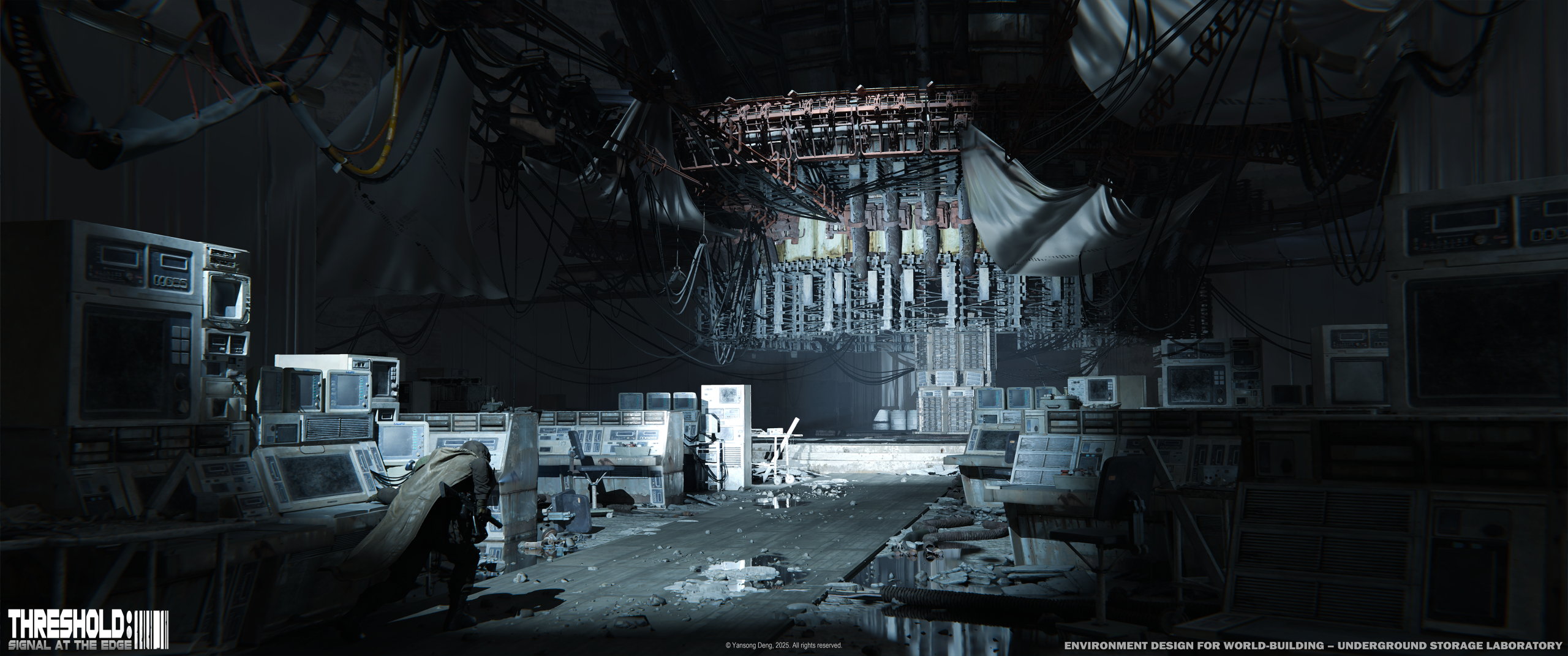
Stealth State — Low Signal Environment
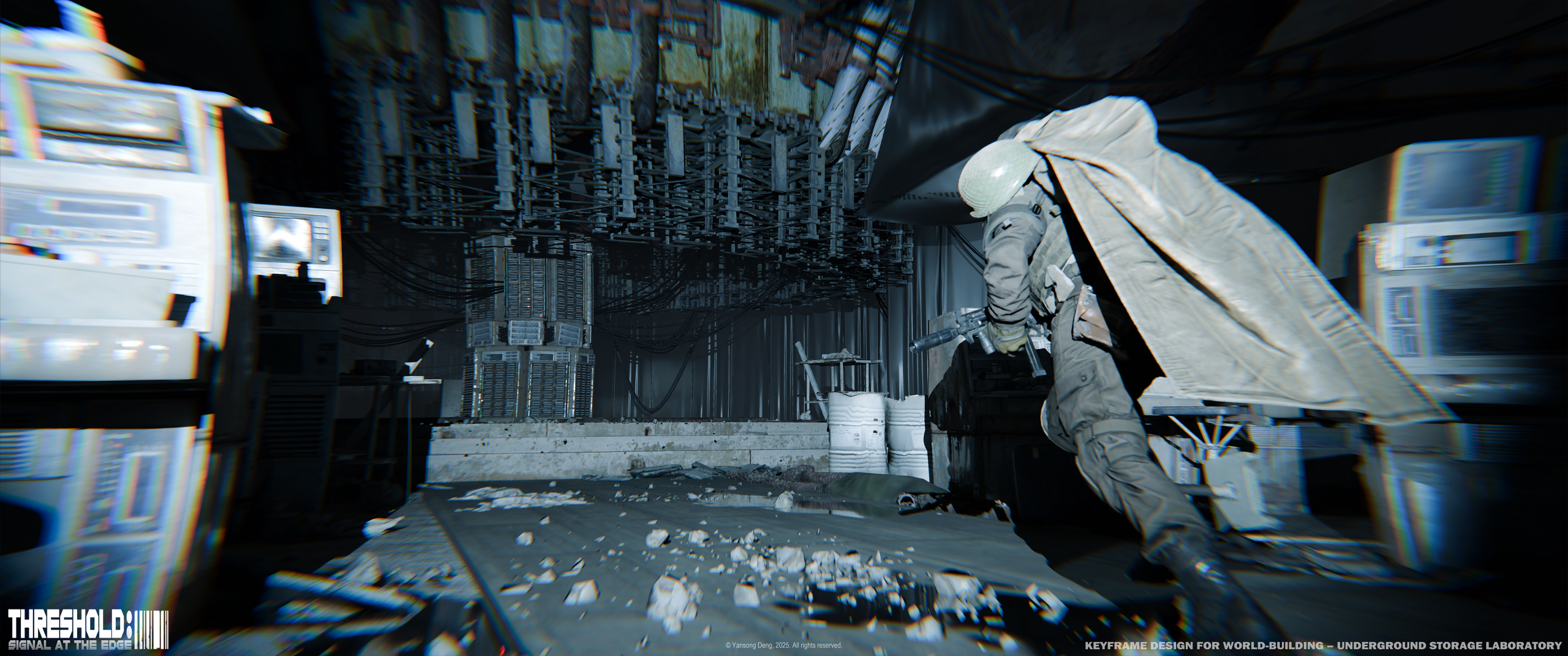
Exposed Movement — High Signal / High Risk
Pillar 04 — Verticality as Spatial Tension and Control
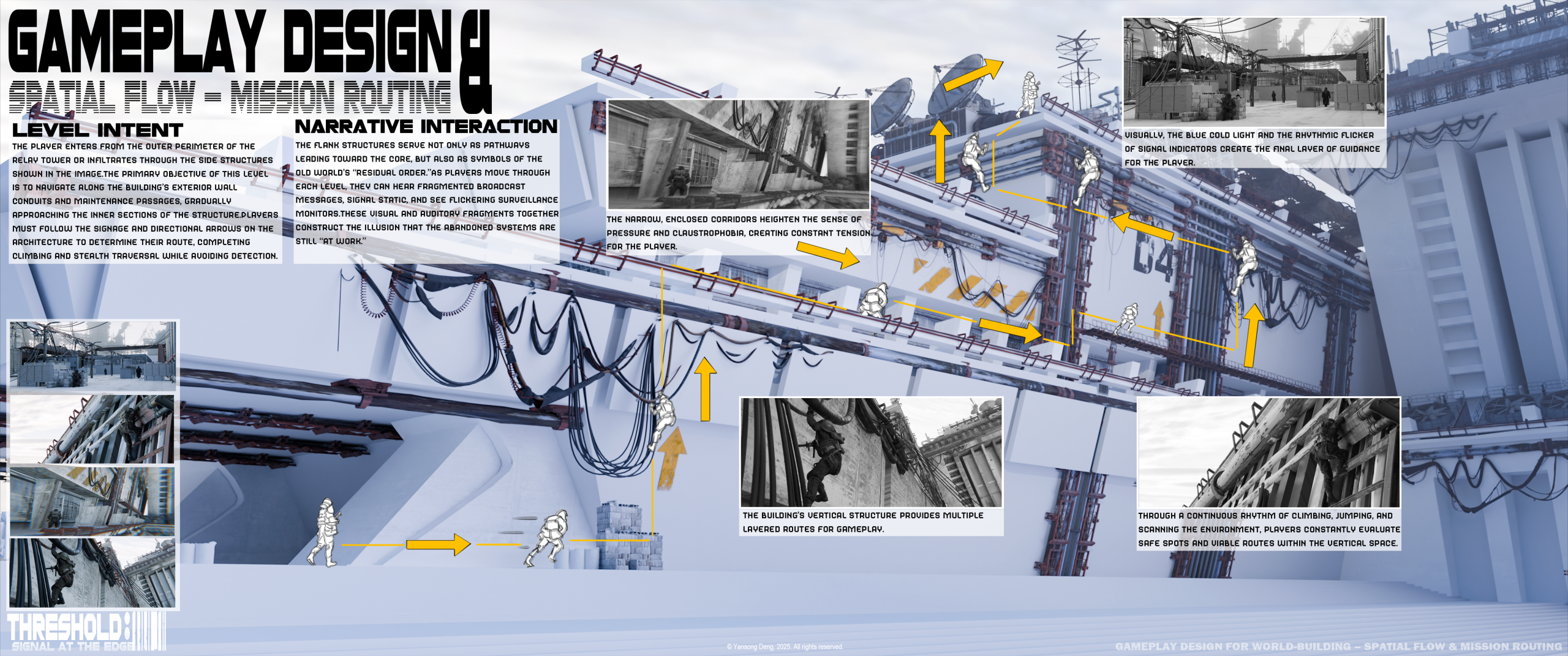
In THRESHOLD, verticality is not designed as an element of movement that gives the player a maneuvering advantage, but rather exists as a spatial system that revolves around tension, exposure, and control.Multi-level buildings, suspended walkways, overhead signaling infrastructure, and monumental relay structures combine to establish a persistent vertical hierarchical order that keeps the player in a state of heightened vulnerability.Height is not utilized to provide freedom of movement, but is used to regulate visibility, risk and decision-making pressure.Higher structures often assume the functions of surveillance and systematic authority, while lower spaces emphasize seclusion, a sense of ruin, and restricted navigational conditions.This asymmetrical relationship forces the player to constantly weigh exposure against safety, thus reinforcing a subterfuge-oriented approach to pacing and cautious advancement.By embedding vertical dominance in external landmarks and internal spaces, the environment transforms ‘height’ into a strategic and psychological stressor.Vertical space thus becomes a tool of control that shapes player behavior, both reinforcing the thematic expression of technical oppression and sustaining tension at the level of immediate play.
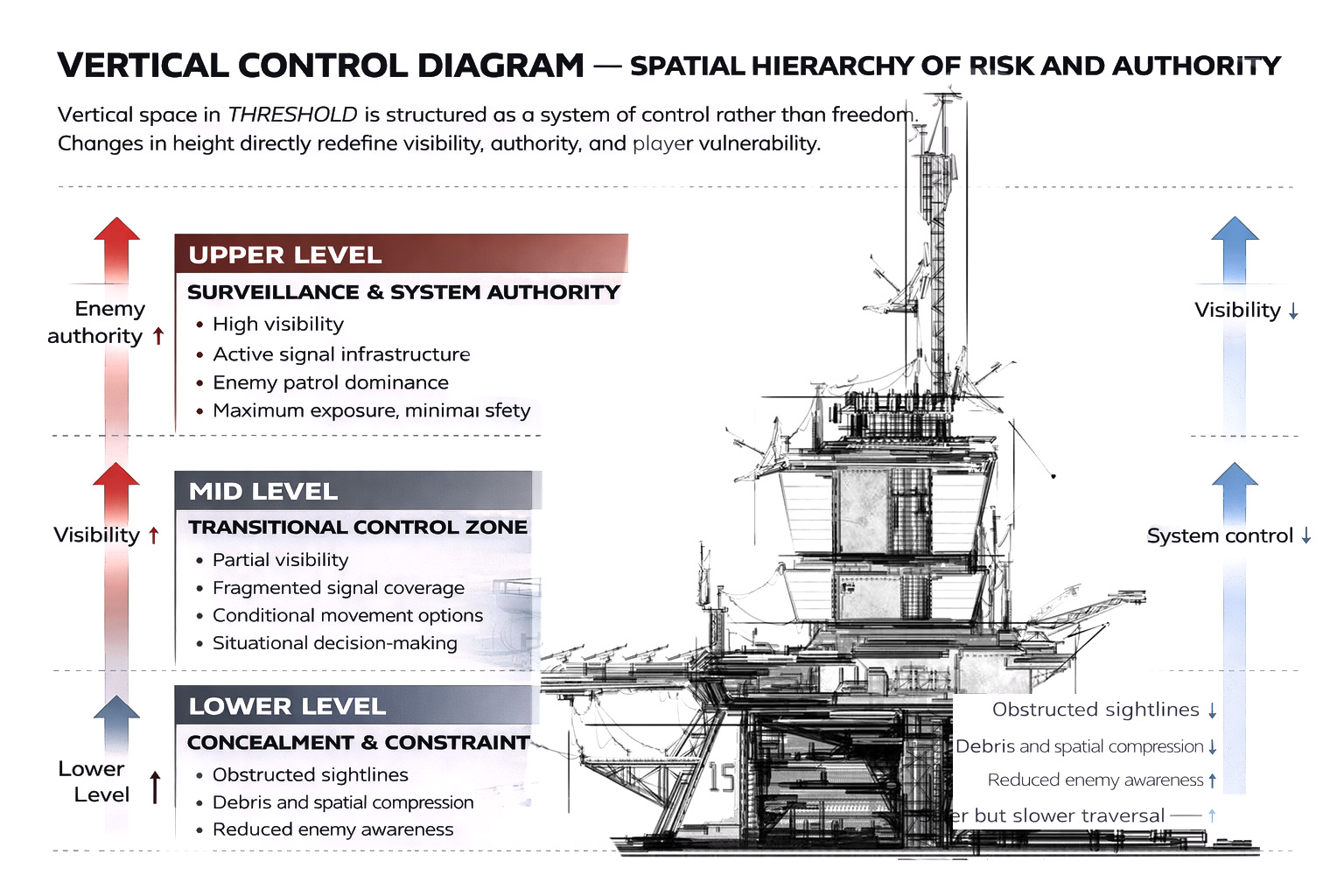
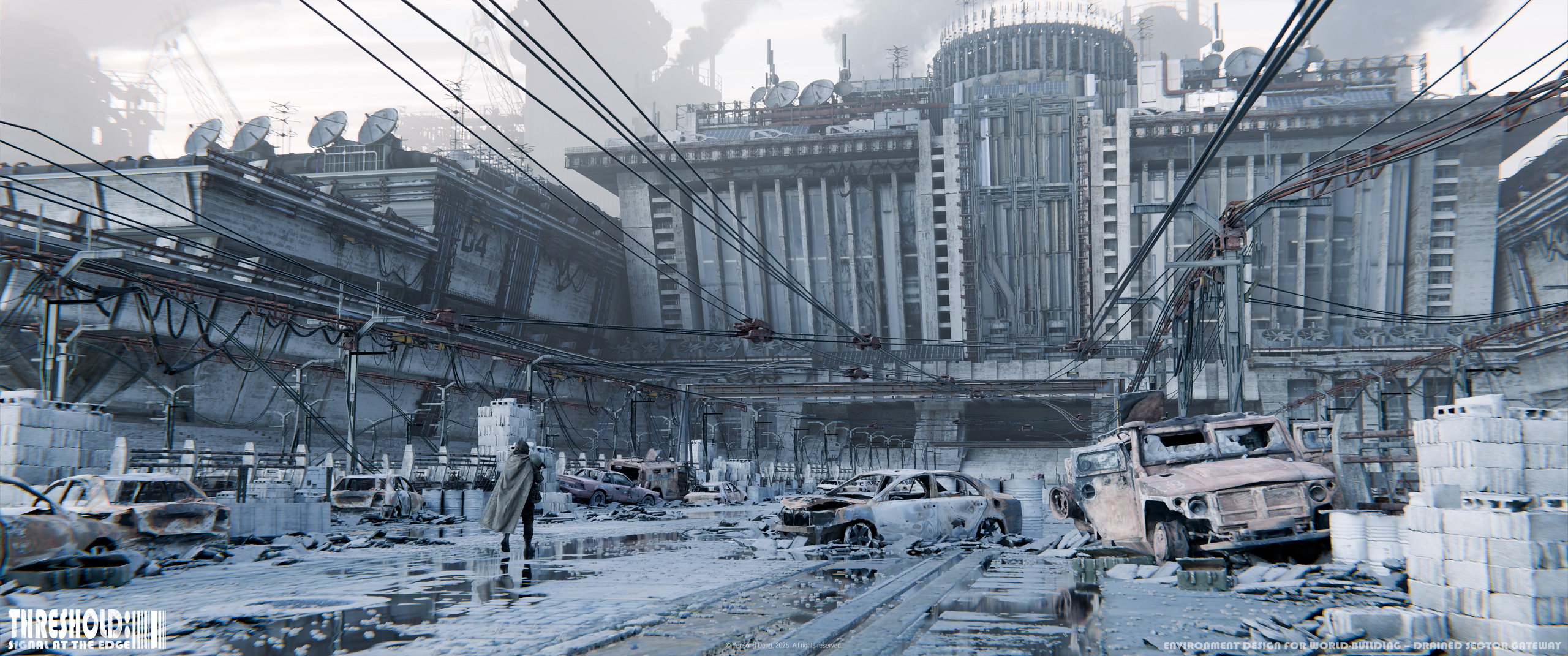
ertical space in THRESHOLD is not designed for empowerment, but for constant negotiation—
where height represents exposure, authority, and irreversible risk rather than freedom.