PLAYER EXPERIENCE
THRESHOLD: SIGNAL AT THE EDGE
PLAYER EXPERIENCE Overview
Player experience in THRESHOLD: SIGNAL AT THE EDGE is defined not by empowerment or mastery, but by sustained tension, uncertainty, and restraint. The game is designed to make players feel exposed, cautious, and constantly aware of their surroundings. Emotional engagement emerges not from dominance or spectacle, but from survival through observation, anticipation, and measured decision-making within hostile, decaying systems.
1.Psychological Pacing & Tension
1.1 Hesitation as the Core Rhythm
in threshold, the rhythm of the player’s experience is consciously shaped around “hesitation” rather than “motive momentus”. The game does not encourage continuous progress, but repeatedly prompts players to stop, observe and re-evaluate the current situation before taking action. Therefore, the measure of progress is not speed, but the player’s ability to withstand uncertainty and delay decision-making under pressure.
In terms of design, stillness and waiting are regarded as states of mechanical significance, not passive blank time. Waiting can not only help players collect information, but also introduce new risks – environmental conditions may deteriorate further, and the enemy’s patrol routes may change. As a result, the game establishes a rhythm defined by a sense of expectation and delay commitment, making restraint itself a positive and effective way of participation.
1.2 Decision-Making Under Sustained Pressure
In THRESHOLD, pacing and decision-making are inseparable. The player always has to choose between advancing, waiting, or retreating, and none of these options is absolutely safe.Moving may bring higher exposure risk, hesitation magnifies uncertainty, and stagnation may lead to the loss of viable pathways.By deliberately removing the ‘optimal solution’, the game transforms decision-making from a problem-solving process to a risk-management process.The ad hoc and context-dependent nature of each choice reinforces a kind of play cycle: instead of executing a pre-determined plan, the player continually re-evaluates the current conditions and adjusts the action strategy in response to changes in the environment.
1.3 Tension Through Consequence Awareness
The tension comes from the player’s continuous realisation that every action will have lasting consequences. Unlike systems that rely on sudden high-risk moments, THRESHOLD maintains pressure through gradual upgrading: slight judgement mistakes will accumulate over time, gradually increasing the enemy’s alertness, compressing the originally safe action path, or aggravating the instability of the overall system.
This structure ensures that the tension does not break out briefly, but persists. It is often difficult for players to determine whether the current state is improving or worsening, thus establishing vulnerability as a core experience condition, rather than just as a stage challenge.
1.4 Psychological Burden as Intended Experience
With the superposition of hesitation, uncertainty, and result perception, the rhythm of the game gradually turns into a psychological burden. Players must constantly weigh the cost of action and the risk of delay, so that time itself becomes a source of stress. Therefore, the advancement of the game depends not only on movement and path selection at the spatial level, but also on the player’s emotional endurance and psychological endurance.
Through this design, THRESHOLD redefines rhythm as an experiential system, not just a time control mechanism. Tension does not come from continuous action, but from players’ long-term exposure to risk, thus constantly strengthening the core themes of vulnerability, caution, and survival within hostile environments.
2.Perception, Uncertainty, and Cognitive Load
In THRESHOLD, the player experience is shaped by incomplete and unreliable information. Visibility, sound and signal clarity will continue to fluctuate, forcing players to act in a state of limited perception. The game does not provide clear and intuitive feedback, but deliberately emphasises ambiguity, requiring players to infer risks without certainty by interpreting environmental clues.
This design intentionally increases the cognitive load. Players need to track the enemy’s patrol rhythm, signal behaviour, vertical relationship of space and available environmental conditions at the same time. Therefore, psychological and thinking input itself has become the core component of the gameplay, which not only strengthens the overall tension, but also effectively suppresses impulsive action.
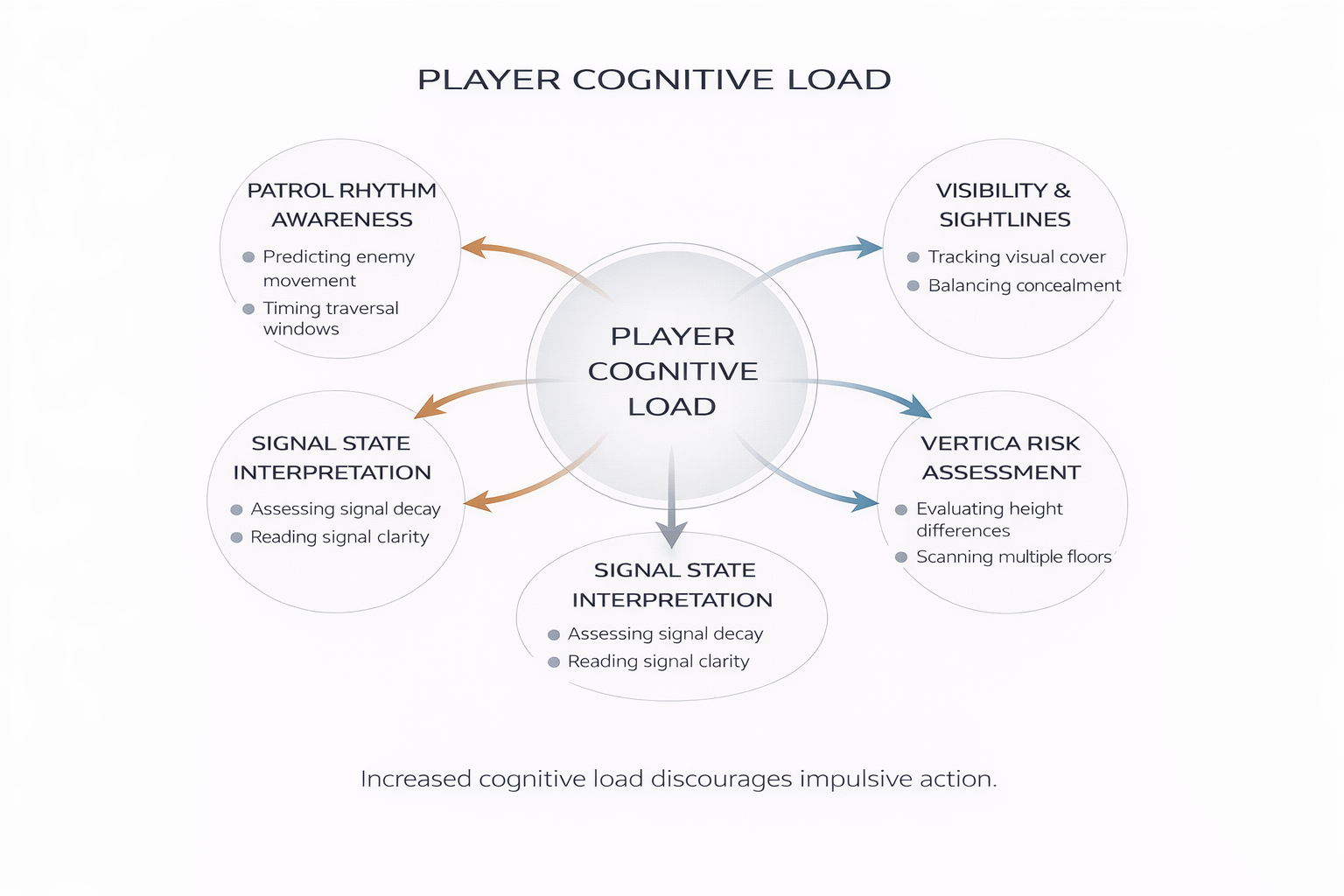
Cognitive Load as a Design Mechanism
In THRESHOLD, the game does not try to simplify the player’s decision-making process, but deliberately maintains high cognitive load as the core gameplay mechanism. The above systems do not operate sequentially, but in parallel at the same time, requiring players to process multi-level environmental information at the same time. The judgement of patrol rhythm, the interpretation of signal state, the management of visibility, and the risk assessment in vertical space continue to compete for players’ attention, making it almost impossible for players to completely eliminate uncertainty before taking action.
This cascading cognitive demand effectively suppresses impulsive behaviour and strengthens the cautious way of playing. Players can rarely achieve the optimal state in all dimensions at the same time; improving clarity in one aspect often increases the risk on the other hand. Therefore, psychological input and thinking burden are inseparable from survival itself, making perception and interpretation ability – rather than reflex speed or operation execution – the main source of challenges.
By embedding uncertainty directly into the information level, the game ensures that the cognitive load is not an obstacle that needs to be eliminated, but an experience state that needs to be continuously managed. The resulting tension does not come from the oppression of extreme difficulty, but from the continuous high-intensity psychological participation of players in an incomplete and unstable information environment.
3.Emotional Payoff and Player Agency
Agency Through Restraint
In THRESHOLD, the player’s dynamism does not come from the accumulation of power, but from information-based restraint. Choosing when not to act – avoiding exposure, delaying movement, and maintaining control under pressure – constitutes the main manifestation of dynagism. Survival itself is regarded as a meaningful form of success.
Emotional Payoff Under Pressure
The emotional reward does not come from a momentary victory, but from the cumulative experience brought by continuous tension. Only after players endure uncertainty and successfully overcome high-risk situations will a sense of relaxation and confidence truly appear. Therefore, dynamism is redefined as the ability to withstand pressure and constantly adapt in a hostile system, rather than relying on force to forcibly suppress or conquer the system.
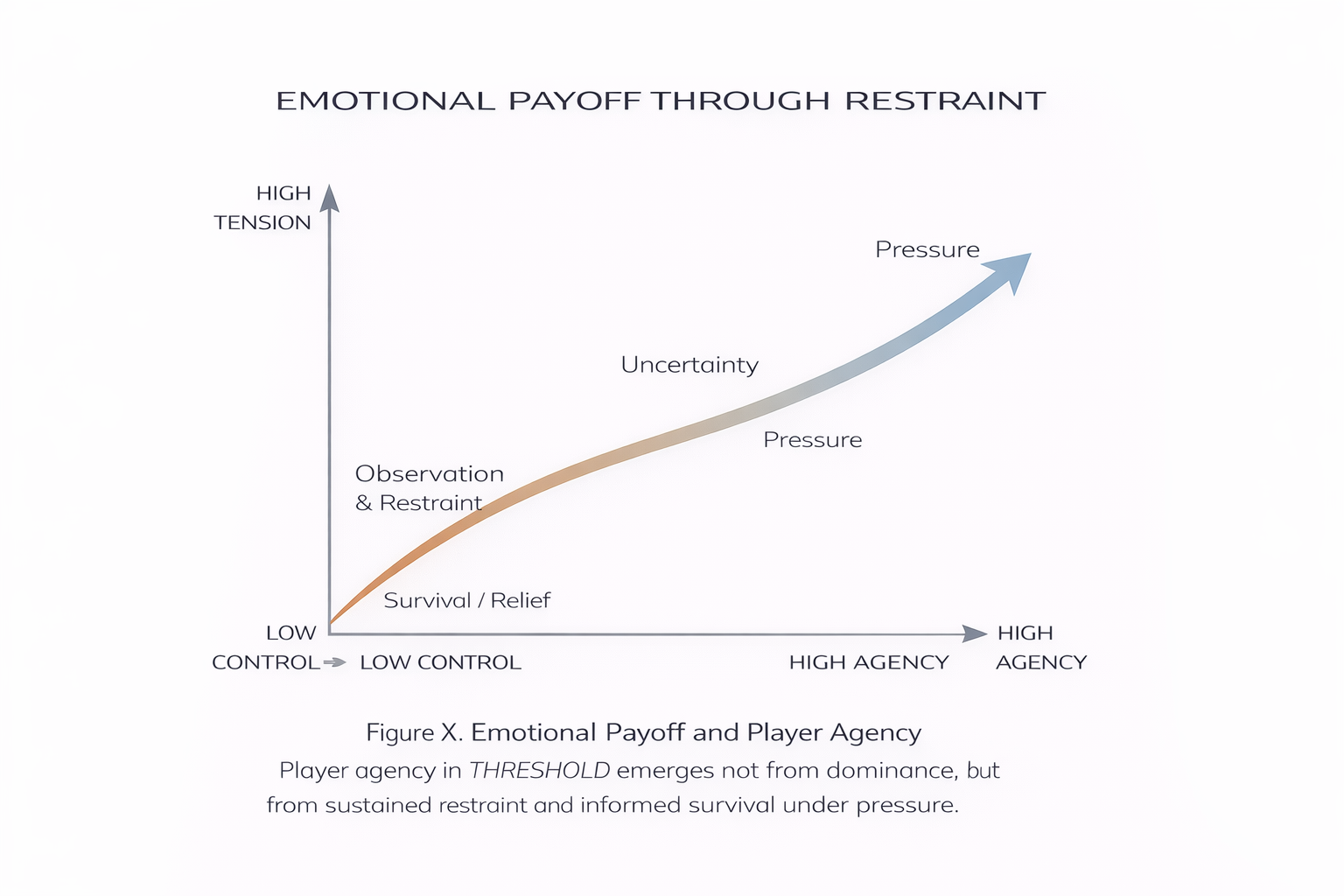
Player experience in THRESHOLD is designed to make restraint feel meaningful, uncertainty feel oppressive, and survival feel earned.