Structure & Progression
Systemic Narrative through Fragmented Operations
Overall Structure A Continuous Narrative System
THRESHOLD: SIGNAL AT THE EDGE is structured as a sequence of discrete missions, but conceptually functions as a single, continuous narrative system. Each mission represents a partial extraction of an ongoing world-scale event rather than a self-contained episode.
The game does not present a traditional chapter-based storyline. Instead, narrative meaning emerges through accumulation, where each operation contributes fragments of information, spatial context, and system behaviour to a larger, coherent whole.
Progression is therefore systemic rather than episodic, reinforcing the sense that the world exists independently of the player and continues to operate beyond individual missions.
1.Primary and Secondary Mission Logic
The main quests form the core skeleton of the advancement structure. They determine the player’s access to key locations, infrastructure layers, and signal states required to maintain narrative continuity.Side and optional missions are then unlocked by completing specific mainline actions. These missions are not filler content or fringe gameplay, but rather exist as contextual extensions to reveal aspects of the world that have been suppressed, marginalised, or buried deep in history.Together, the main and side quests form a unified narrative network, rather than a hierarchy based on importance.
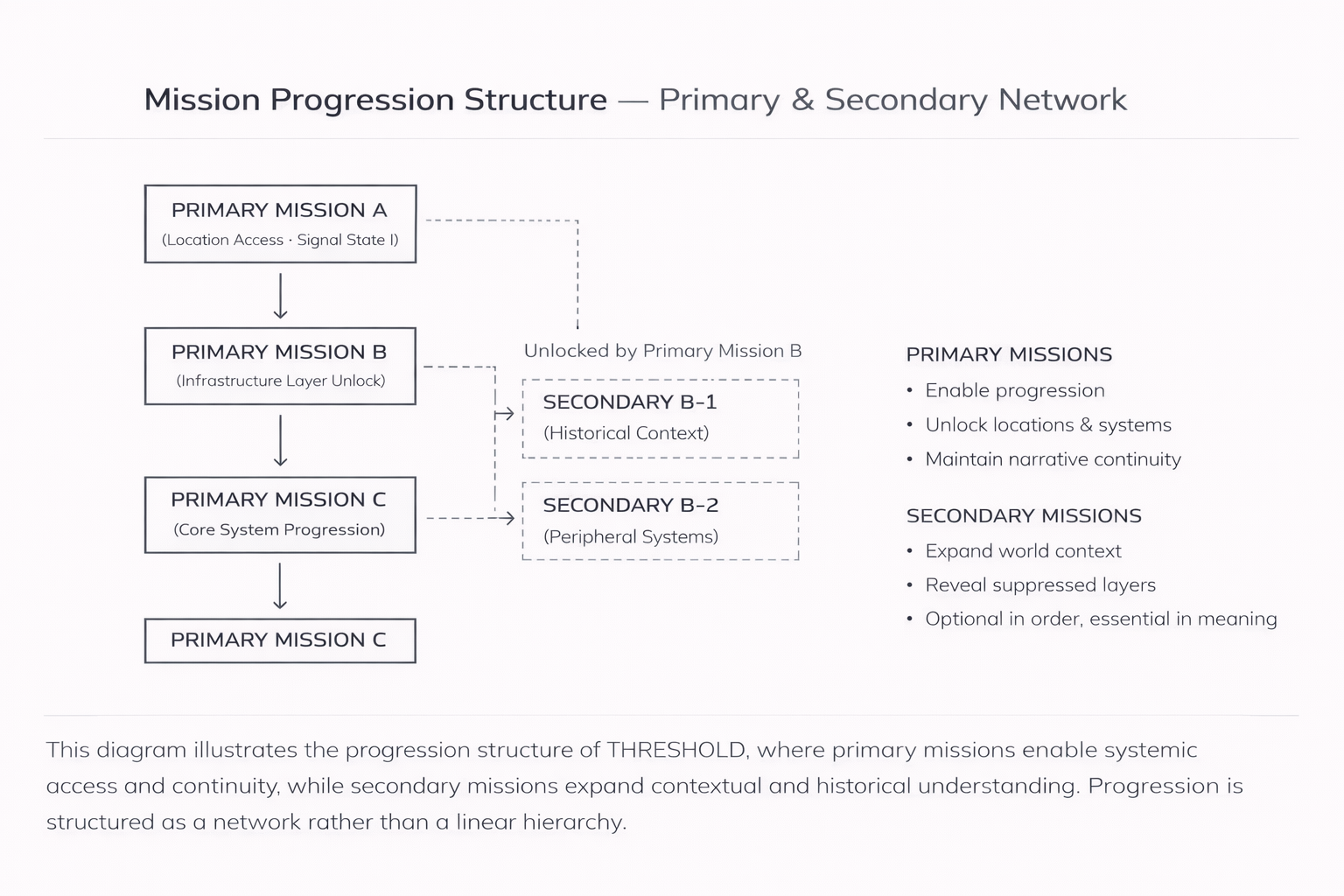
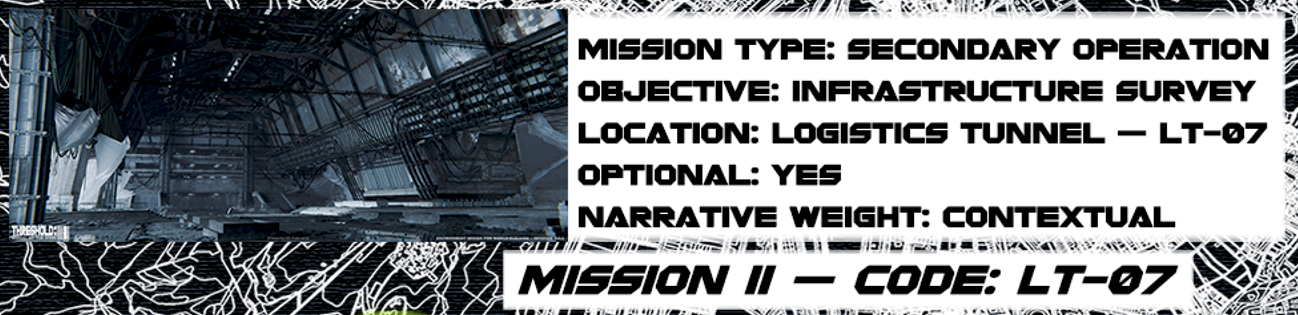
This diagram illustrates the progression structure of THRESHOLD, where primary missions enable systemic access and continuity, while secondary missions expand contextual and historical understanding. Progression is structured as a network rather than a linear hierarchy.
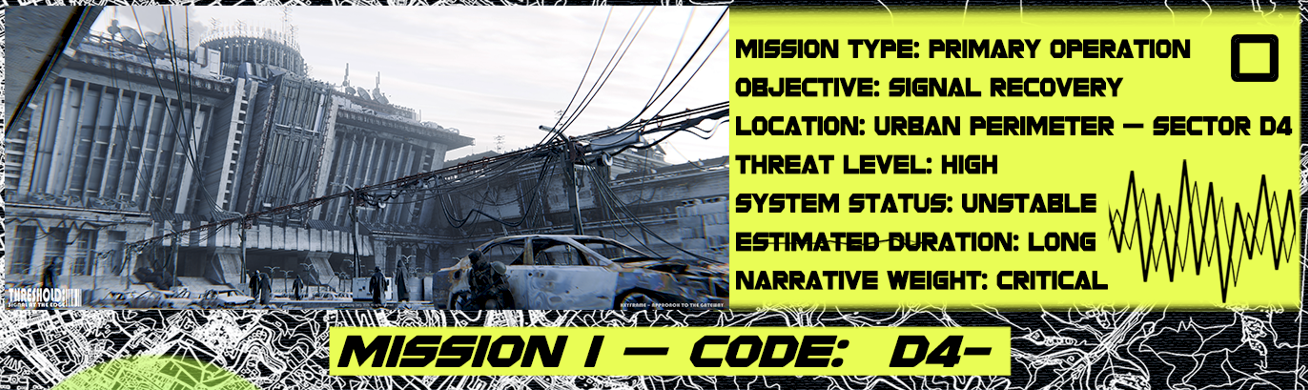
Primary Missions — Structural Progression
Unlock key locations and infrastructure layers
Define signal states and world accessibility
Maintain narrative continuity
Required for systemic progression
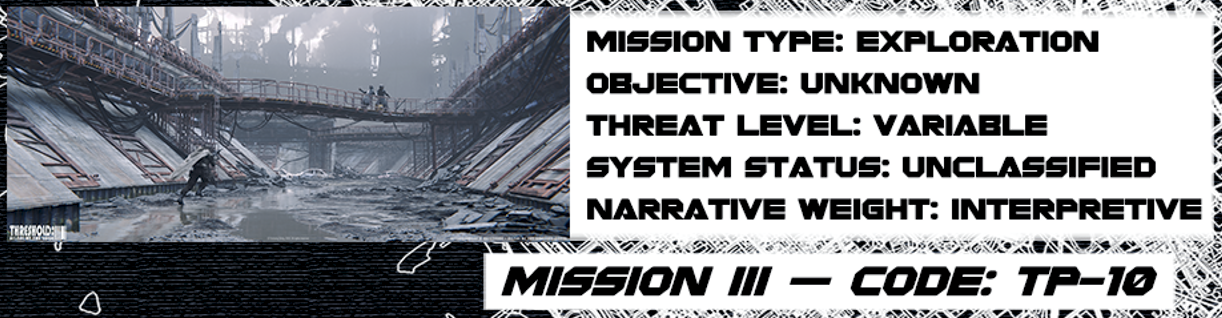
Secondary Missions — Contextual Expansion
Reveal peripheral or suppressed systems
Expose historical and environmental context
Deepen understanding of world logic
Optional in order, essential in meaning
2.Narrative Continuity — One Story, Fragmented Operations
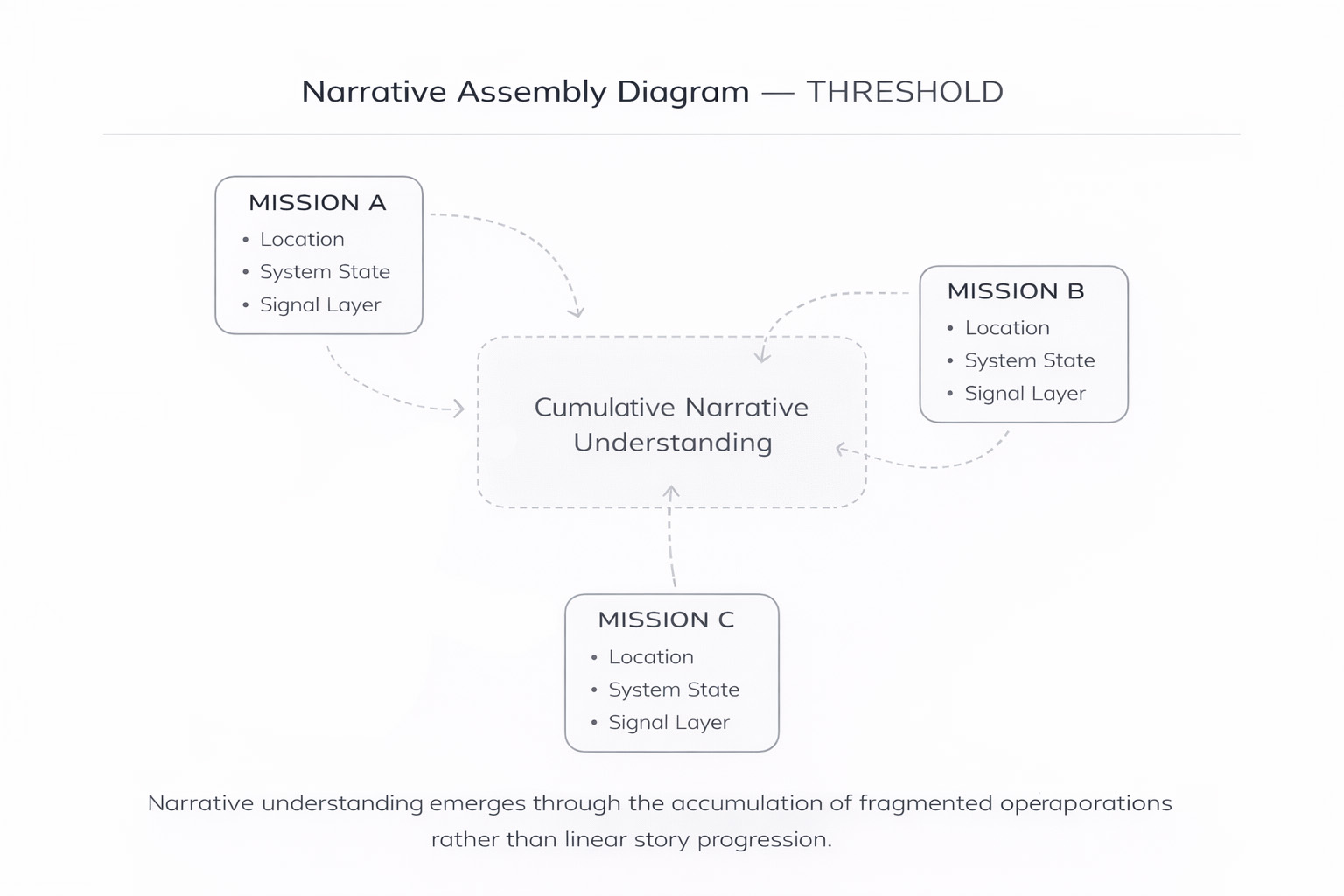
Although the missions are presented as mutually independent units of action, they are in fact all fragments of the same narrative trajectory. Rather than advancing their own isolated plot lines, each task reveals different aspects of the same world state.
Narrative understanding is formed in a cumulative manner. The player is not informed of the world’s history, power structures, or ideological tensions through explicit narrative telling, but rather gradually reconstructs them by piecing together the operational experience of one action at a time. This fragmented structure echoes the work’s thematic concerns with absence, signal decay and information incompleteness.THRESHOLD’s narrative continuity does not rely on character-driven plot advancement, but rather is sustained by recurring locations, systems and signal states.Environmental change, infrastructure destruction, and shifts in system stability persist across missions, allowing early actions to continually provide new contexts and interpretive perspectives for subsequent encounters.Meaning, therefore, does not come from a linear revelation, but is gradually generated through the accumulation, contrast and absence between fragmented actions.
3.Gameplay Focus — Stealth as Baseline, Not Limitation
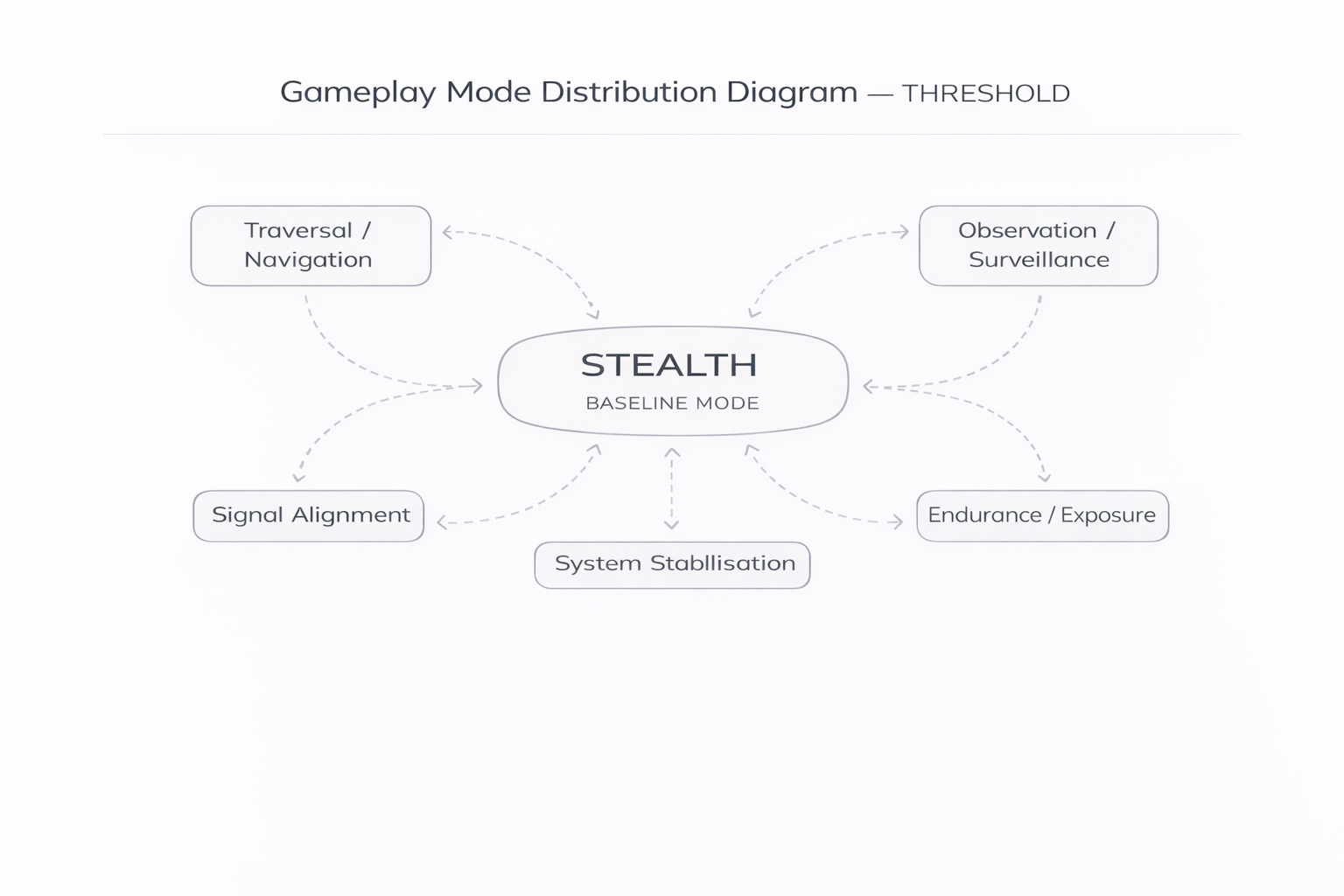
Sneaking constitutes the primary interaction in most missions, reflecting the player’s vulnerability within the larger system. However, gameplay does not remain singularly consistent at the mechanic level. Some missions shift their focus to movement and penetration, observation, signal alignment, endurance-focused navigation, or system-stabilising operations. These changes do not stem from incremental difficulty, but are naturally triggered by environmental conditions and infrastructure behaviours.
Sneaking is expected to exist as a base behaviour that can be temporarily disrupted or overridden, but not completely replaced, thus introducing variation while maintaining overall consistency. Gameplay differences are structured primarily at the mission and chapter level, rather than through mechanic upgrades or player specialisation.
Stages that deviate from sneaking do not imply upgrades or empowerment, but rather temporary reconfigurations driven by the state of the environment and system. These deviations act as structural perturbations in the overall progression and are used to recalibrate the player’s perception and pacing, after which sneaking once again returns as the default interaction state.
In this way, sneaking is no longer a limiting design choice, but rather a narrative and system-level benchmark that is constantly broken, reshaped and recontextualised as the game progresses.
4.Progression Philosophy — Understanding Over Mastery
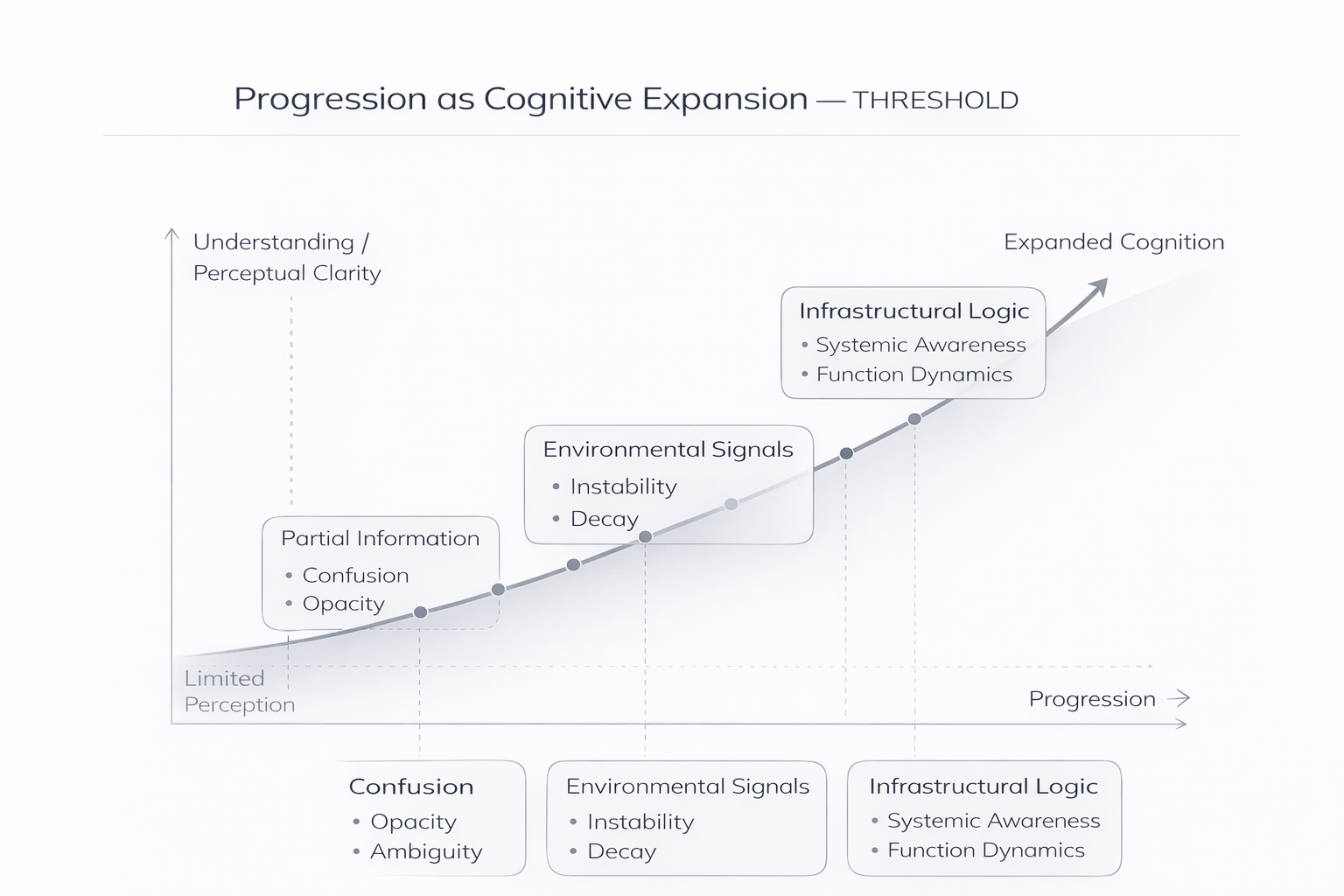
In THRESHOLD, advancing does not reward so-called ‘proficiency’ through the accumulation of power or the upgrading of mechanisms. Instead, advancement leads to the unlocking of deeper contexts, more complex spatial structures, and systematic understanding.The player advances not by becoming stronger, but by deepening the level of information – becoming more capable of interpreting signals, absent objects, and environmental patterns of behaviour. This mode of advancement further solidifies the player’s role as an observer navigating an autonomously functioning world, rather than a protagonist capable of reshaping the direction of the world.
Progression as Cognitive Expansion
In THRESHOLD, player growth is presented as an expansion of perceptual abilities and systematic understanding, rather than as numerical growth.Early in the game there is a deliberate emphasis on chaos, opacity and incomplete information. As the player progresses, he or she gradually gains a greater ability to interpret environmental signals, systemic instabilities, and the logic of the infrastructure’s operation – but this is not accompanied by any direct increase in combat power or survivability.