This won’t be long, as I don’t want to go into too much detail about the sketch I abandoned, but I will explain the relevant content in its entirety, even though the draft itself wasn’t adopted by me, it did inspire my final idea. Therefore, I added this part to refine my entire development process.
Inspiration
Initially, I wanted to create a game whose content would make people proud of themselves. The inspiration came from the Week 3 task where players wrote “I would like players to (Experiential verb) (something)”. The word “pride” suddenly popped into my head, so I wrote “I would like players to be proud for achieving what they already have”.
Research
When I think of games that boost player confidence or improve player morale through emotional guidance, the first one that comes to mind is Journey.
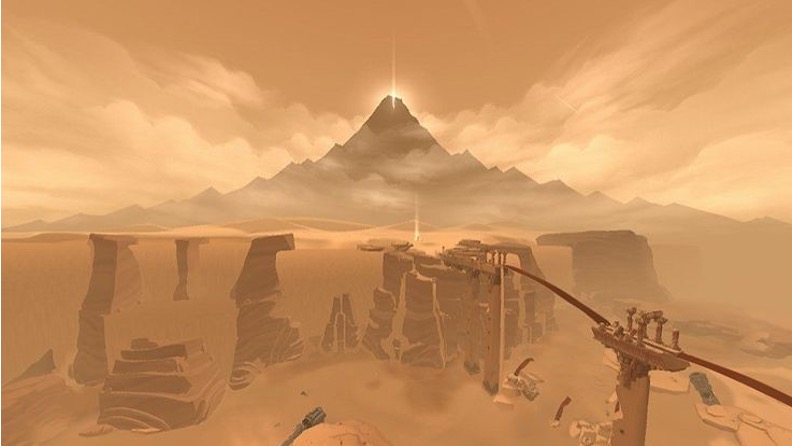
That game compony (2012) Journey [Video Game]. Sony Computer Entertainment.
However, I found that the emotional guidance method used in this game was not what I expected. It relied more on the environment, with various environmental details and changes, as well as warm colors, to gradually make players feel relaxed.
But that’s not what I want. What I want is for players to feel proud of what they’ve done, whether they’ve done it well or not.
I actually have two approaches in mind. One is to encourage players through external feedback, whether they complete the challenge or not. The other is to give players ample rewards upon completion, and guide them to reflect on their achievements and accomplishments when they fail, before providing appropriate rewards.
When I looked back at my first thought, I suddenly remembered a game I played a long time ago called ICEY.
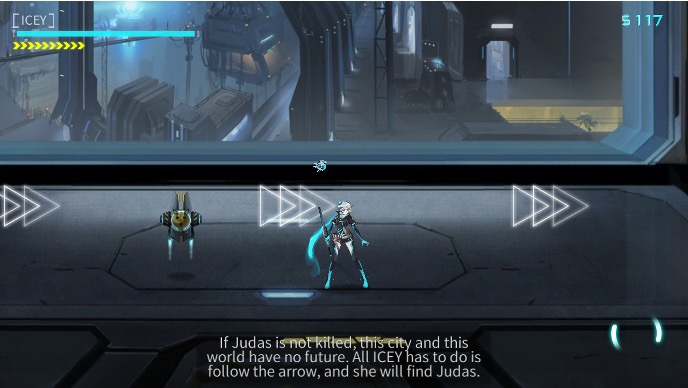
FantaBlade Network (2016) ICEY [Video Game]. X. D. Network Inc.
It guides players through voice-over instructions, and I suddenly realized I could use a similar method to encourage players when they haven’t completed a task.
I’ve decided to change the voice-over to an AI assistant. It will guide players in accepting challenges and report on the leaderboard for those challenges. During the challenge, it will also use live chat to update players on their current ranking and reduce pressure. However, even if a player doesn’t achieve a ranking or complete the challenge, it will still praise them after seeing their efforts, making them feel proud.
Initial idea
At this point, the basic outline of my idea had emerged: players would complete different challenge tasks, possibly succeeding or failing, and the AI assistant would encourage the player after completing the task, making the player feel proud of themselves.
Problem
I didn’t realize I had a huge problem until week 7, when Dr. Vanessa asked me a question during feedback, “What is this challenge?” My mind suddenly went blank. At that moment, I realized a very important problem, which is also reflected in the thought process above: I had been researching how to evoke these emotions in players, but I hadn’t considered at all what type of game this was, or how the game, as a medium, should convey what I wanted to achieve.
Reflecting on myself
Looking back at my idea, I still feel that the idea of making players feel proud is not inherently wrong; the problem lies in my approach. Therefore, I think it’s best to keep this idea as a blueprint and start again from the first week’s lesson.