This week, I learned more about how to describe my own game. It’s not just about having an idea, but about systematically describing my game through game positioning, system loops, and so on. It’s also about connecting narrative and gameplay, using narrative to explain gameplay. This allows me to explain what gameplay exists within the game world and how players can enjoy the game.
At the same time, another very important point is to control the scope. When designing, you need to consider whether the game can be made, and based on this, you need to impose limitations on the game.
On Thursday, due to the disappearance of a member of our group, we temporarily confirmed and modified the final version of our game. We removed the final short story and changed it so that the game would end after the player synthesizes the camera.
After confirming that we still needed to change the purchasing system and the background, I started working on it immediately. I knew time was running out because we might need to update the art assets later, so I decided to start now.
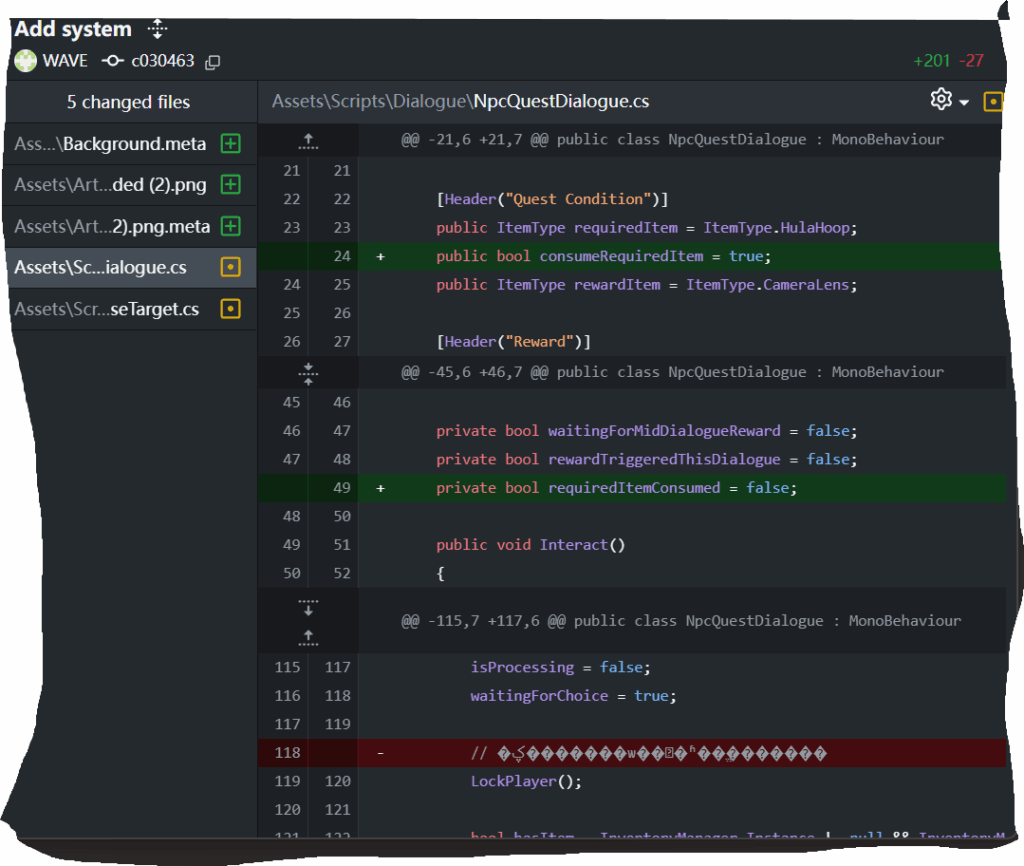
I modified the NPC dialogue system from playing dialogue sequentially to displaying dialogue options based on conditions. The system first checks if the player has the required items; if so, the dialogue will continue. If not, the player can only choose to leave and cannot continue the dialogue. Simultaneously, the NPC will remind the player what items are needed, thus ensuring a better gaming experience.