
This lecture commences a 12-week long project, focusing on research techniques and ideation rather than game-making. This project produces the supplementary outcomes used in semester two’s project, where we will produce a full game for our end of year showcase.
Alumni will come to our showcase as we are the 10th graduating year in this course, making it a milestone for this university. There will also be an opportunity to collaborate with music students.
We have two major showcases this year, one being in London during June/July in Shoreditch and one in Winchester. During these showcases, many people from the industry will be present, therefore these showcases are super important and vital to our employability opportunities after graduating.
Use this year to think about not what specialisation you want to be invested in, but rather YOU as a gamemaker in addition to something your interested in. Such as Gamemaker + problem-solver.
What makes a good classroom environment work?
- No crunch culture
- supportative + productive people
- Mutual interests
- Good equipment
- sunlight
The layout for this project is a little bit different to previous years. This project has two different phases; Research & Create. These two phases will be split up into four different sections based on presentations and major discussions.
RESEARCH PHASE
Research + Ideation start here
CREATE PHASE
Collaborations + realisations start here
| Phase One | Phase Two | Phase Three | Phase Four |
| Week 1 – 2 | Week 3 – 4 | Week 5 – 8 | Week 9 – 12 |
| Utilise this week to focus on research and getting into the groove of just researching with no game-like purposes! > Establish research focuses. > Create a research & action plan > Brainstorm, sketches, case studies, visual research, visits/field trips | After recieving feedback from week 3’s presentation, focus on the most interestingly recieved points and explode! > Alot of research themed workshops > Deep dive or New dive into that one focus > research within an inch of your life | After our expanded research presentation in Week 5, we can join with other interested in the same subject and become a team. > themed workshops > playtesting prototypes > testing/making ideas for games | After the presentation in Week 9, choose one idea after taking into account everyones recieval to the three. Expand this idea into a full ‘GPP’ > Playtest + prototype > translate the idea into a ‘GPP’ |
| Conclusion ->> Identify 100’s of possible research points to help prepare for Week 3, where you will need to present 4 focused research starting points. | Conclusion ->> Focus on the most interesting point and research it as deeply as you can. This expanded research will be presented in Week 5. | Conclusion ->> Present 3 game ideas in Week 9 with your team. | Conclusions ->> Display our GPP in the John Hansard Gallery Our hand-in is in Week 12 (12th Jan 4PM) , where we will package up and collate all learning |
Semester Two is when we will make the game we proposed in Semester One. This game should be a full game on a smaller scope and should be made in optimal groups of 2-3 people.
Workshop Activity
Working in pairs, write down…
- What makes you cry
- Makes you laugh
- Gets you excited
- Gets you angry
- Stimulates you intellectually
- Interests you
For this workshop activity, I paired up with Camilla and we filled out six A3 pages with a mindmap to answer each of these thinking points.
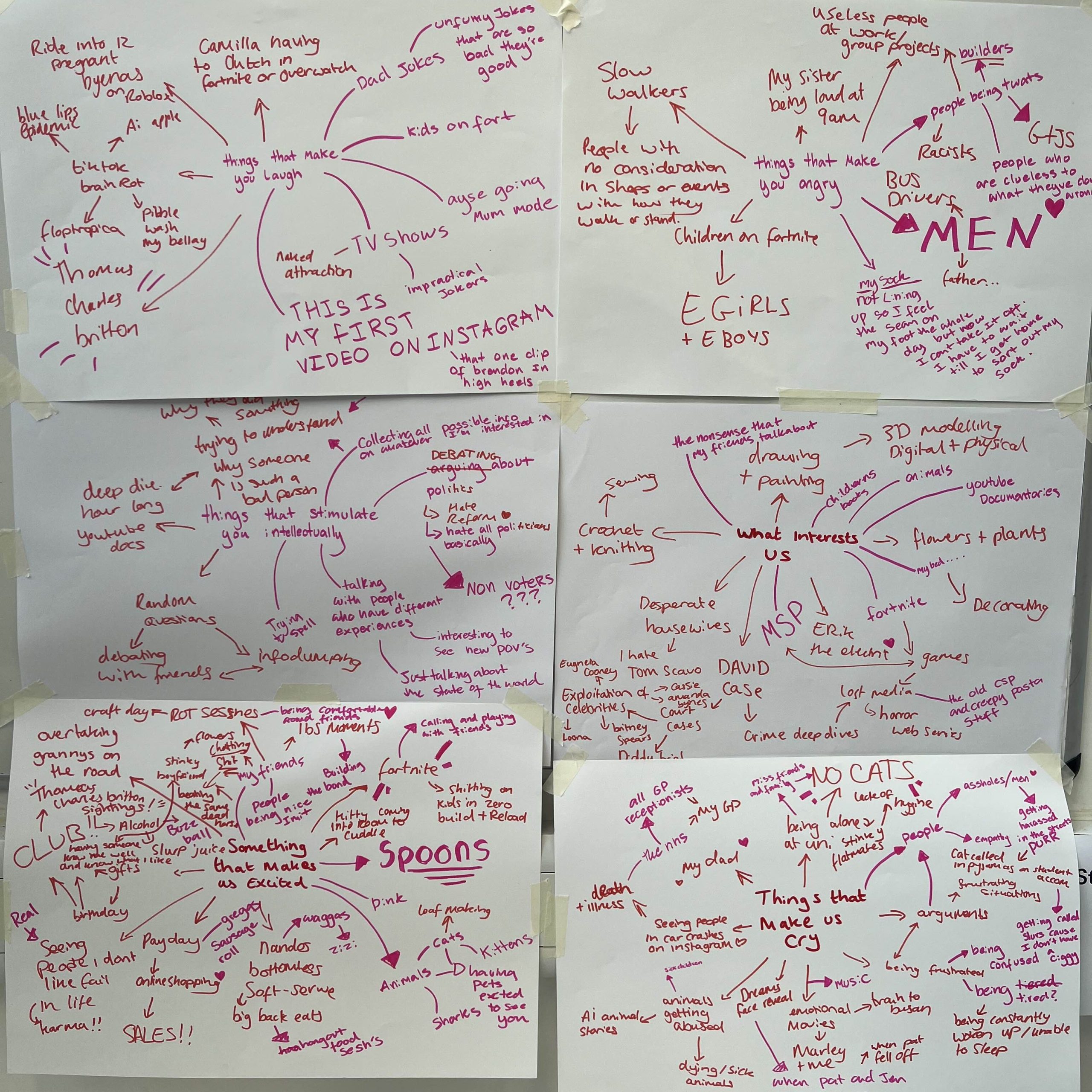
We found that answering the intellectually and interests prompts to be very hard. The other prompts we found easier to answer as it’s something we thing about often compared to the latter.
From this exercise, we were prompted further to take a point which interests us from one of the mindmaps and make a new mindmap with the lotus technique to expand on these thoughts.
What is a Lotus Mindmap?
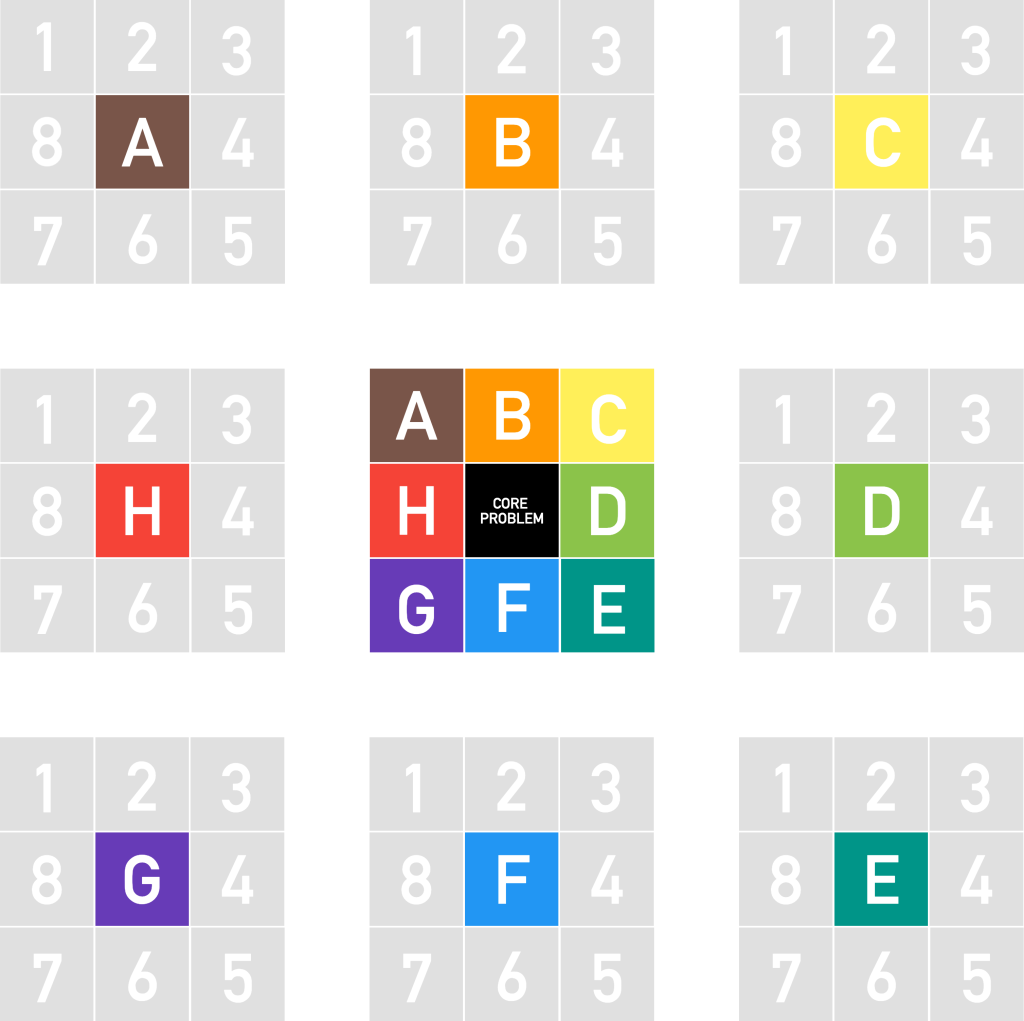
A lotus mindmap, is a 3×3 grid structured brainstorming technique that aids in generating ideas based on a central topic. This allows the person to expand easier on sub-topics to progress an idea creatively but thoroughly. It was developed by Yasuo Matsumura, director of Clover Management Research, to aid in his daily work.1
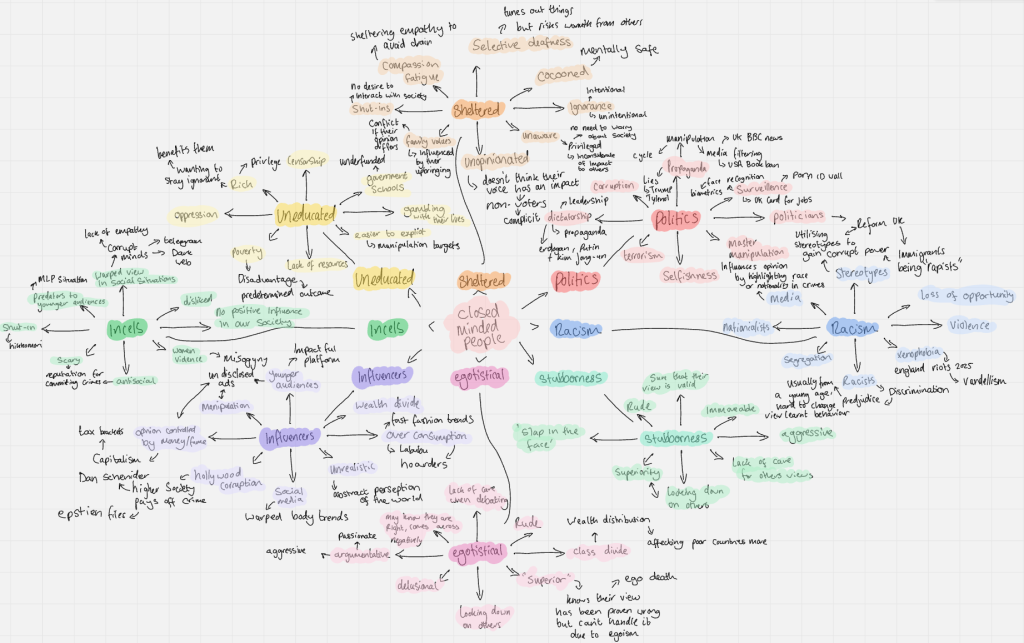
We chose to stem off the topic ‘closed-minded people’ as we found that a rather interesting topic. From this central topic, we stemmed off into uneducated, sheltered, politics, racism, stubbornness, egotistical, influencers and ‘incels’. We found that these 9 words represented who makes up closed-minded people and what could cause that feeling in the masses.
Personally, I wasn’t very interested in much of this mindmap as a concept to research other than particular social groups like influencers and incels and would be interested into looking into the history and how they come to be in my presentation. Because I wasn’t invested in many of the generated topics, I decided to carry this on into studio time and produce a lotus mindmap of my own, making the topic be about my interests.
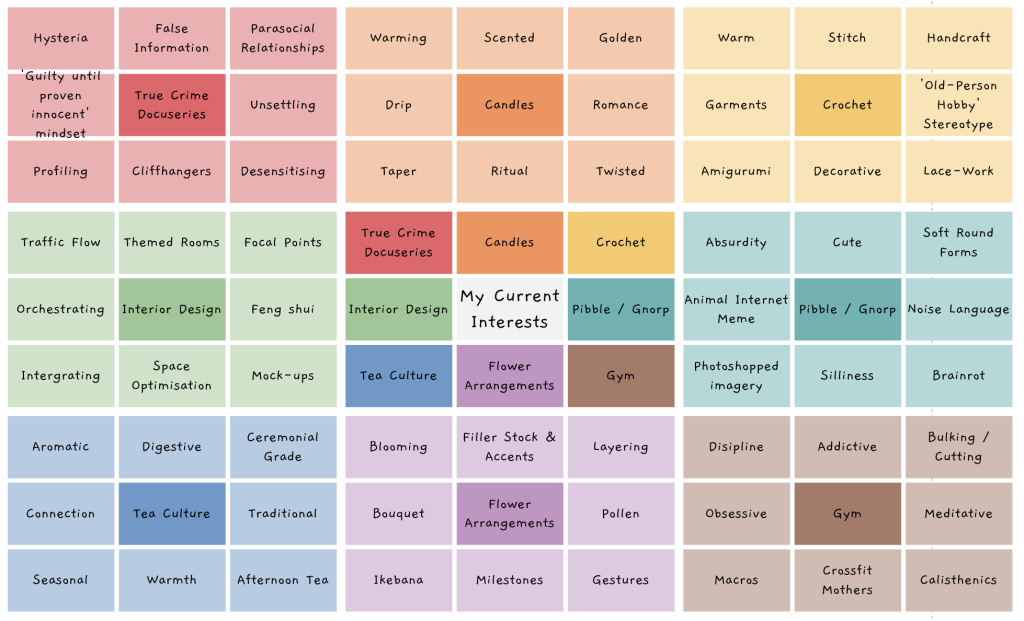
I used a digital template of the lotus technique to make my mindmap less visually messy and concise. I knew I would have a tough time settling on my four research ideas later, and wanted to make that experience in the future easier to do by increasing the readability. It definitely helped me with keeping each response to a few words only as well.
By making my core topic based upon ‘My Current Interests’, I allow myself to involve and become fully engrossed in my research. These subtopics are things I am already looking to adapt into my lifestyle or are things I already practice as a hobby or cultural things. I think it would also motivate me to stretch this research into a information filled experience as I would be invested in it, unlike more academic/political based topics which I find stressful and boring to research nowadays.
I found a few topics from this new mindmap to be quite intriguing, such as…
- Flower Arangements ->> there is so much to talk about on this as it is something invested in our culture, solidfying relationships and it is also something I like to do for others as well so it interests me as I practice it as a hobby.
- True Crime Docuseries ->> I find it quite intruging with people being able to talk about and digest such horrific things whilst someone is nonchalantly doing their makeup whilst discussing it, how people become parasocial with these felons and defending them, and also just what makes people do these things in the first place, morbid curiosity.
- Candles ->> I like candles and I find it a staple in my daily routine to light one. I would find it interesting to look into the psycological reason why I like this and how they achieve the look of them as it is such a small but impactful thing in my routine and I find them quite heartwarming as well.
- Gym Culture ->> This topic interests me as it is something I have been trying to involve myself in my freetime. There is a multitude of things to talk about but most importantly, for me to learn by delving into researching it. I also find it quite interesting how in recent years, some gym practices have been turned into online memes as well, which is another sector I could invest into my research.
Reflection
I found this workshop to be very useful and could see myself utilising lotus mindmaps to aid in idea generation to guide my research topic ideation.
I find the layout of this year to be well structured compared to previous years and will try my best to attend all lectures as I have found it difficult to previously.
I can also look at winchester.games to see what alumni produced in their final year to see what is expected of me within the timeframe.
Overall, I will use the lotus technique in my upcoming research generation and will try and keep my ideas based on anything but games design, this will keep it unique and less constrained.
I will continue these topics (Flower Arrangements, Gym Culture, Candles, True Crime Docuseries) from the lotus mindmap into further research, ultimately making up my presentation information for week 3.
- Guthrie, G. (2022). The lotus blossom technique: a creativity hack you need to know. [online] Nulab. Available at: https://nulab.com/learn/design-and-ux/the-lotus-blossom-technique-creativity-hack-you-need-to-know/. ↩︎