-
If you get a certain score or rating in a level you get a glass fragment and if you collect enough fragments, it forms into a picture frame, showing a memory and progressing to the next act

-
-
I want to change the plot of your death from being a suicide from attempting suicide, fail/reconsider and then a student you were “mean” to ends your life
Dad didn’t sacrifice himself via jumping on a grenade
Dad bought time for comrades to escape but gets shot in eye (explains monoeye design) -
- Sensitive Themes: Handle suicide, depression with care. Consider content warnings and resources in credits.
- Pacing: Balance rhythm challenge with narrative absorption—allow breathing room.
- Cultural Authenticity: Consult Korean 1970s historical/emotional context. (I can ask my grandmother and other relatives[a cousin of mine works in a memorial museum])
-
- Games
- Deemo, Osu, Cytus, Arcaea, Lanota
- Music
- MisomyL, Hiroshi Yoshimura, Laur, *wakadori, nulut, Xi, Yo Kaze, AO – infinity (by: 青龍)
- Others:
- OMORI, Your lie in April, Violet Evergarden
- Games
-
Target Platforms
- PC and mobile
Controls
- PC: Keyboard/Controller: D/F/J/K for lanes
- Mobile: Touch-screen taps, holds
Accessibility Features
- Adjustable note speed, calibration.
- “Story Mode” option: No-fail, focus on narrative.
- Optional mods: Double time, Hidden, Flash light
- Subtitles, colorblind modes for note types.
Save System
- Auto-save after each song.
- Chapter select after completion for memory review.
-
Chapter How many levels Memory unlocked Difficulty Prologue x montage of decline x Tutorial 1 childhood piano lesson – Act 1 1-5 none (just getting used to being in limbo) – Act 2 1-5 dad’s last day at home, mom learning the news of dad dying, after funeral, mom losing it medium Act 3 5 – hard Act 4 10 – expert Act 5 5 learning how dad dies – Finale 1 (dad will play with you duet style) struggle for life master Epilogue 0 waking up in the hospital easy (impossible to fail) Optional levels (tbd) x easy – master -
Music Philosophy
- Genre: Classical piano-driven, ambient, post-rock, occasional traditional Korean motifs.
- Track Progression:
- Early game: Solo piano, sparse.
- Mid game: Duet interplay (protagonist’s part represented in synth/string accents).
- Late game: Full orchestral swells during climactic memories.
- Composer Goal: Each track must feel like a conversation.
Visual Language
- Limbo: Dark blues, blacks, grays. Piano is the only light source.
- Memory Sequences: Warm sepia/overexposed film for happy memories; cold, fragmented, high-contrast for trauma.
- UI: Minimalist. Judgment text is subtle; note highway is transparent, almost like sheet music lines.
Pianist Entity Transformation
- Stage 1: Monstrous, distorted.
- Stage 3: More humanoid, details of father’s uniform appear.
- Final Stage: Clearly her father, translucent but recognizable.
-
Core Rhythm Gameplay (Memory Resonance System)
- Note Types:
- Tap: Standard note.
- Hold: Sustained emotional connection.
- Swipe: Memory transition/acceptance.
- Double/Triple: Complex emotional spikes.
- Visual Design: Notes are not abstract—they appear as memory fragments (fading photos, leaves, raindrops, light particles).
- Judgment: PERFECT, GOOD, MISS. Affects Dissonance Meter.
Example below

Source: Osu (from my laptop)
Dissonance Meter
- Function: Fills on misses/GOODs. At full, memory shatters, Pianist reverts slightly, player retries.
- Narrative Tie: Represents depressive thoughts overwhelming clarity.
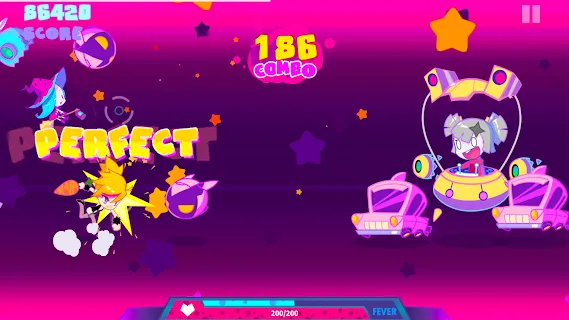
- Similar to a “Fever” stage
Example below
Source: Muse Dash (from my steam library)
Narrative-Driven Difficulty
- Easy: Simple patterns for calm, reflective memories.
- Hard: Complex, dissonant, rapid-fire for traumatic revelations.
- Unlock System: Beat a song to see its memory cutscene; higher scores unlock deeper “memory layers” (hidden story notes) similar to Append levels from Project Sekai.
Integrated Tutorial: “First Lesson”
- Context: Childhood memory. Father teaches Eun-bi basic piano.
- Mechanics Introduction:
- Tap notes = pressing individual keys.
- Hold notes = sustaining a chord while father harmonizes.
- Dissonance concept = “If you lose the rhythm, the feeling falls apart. Let’s try again.”
- Emotional Payoff: The lesson ends with father’s leitmotif—now a nostalgic anchor.
- Note Types: