Key Learning
Throughout this week’s course, we systematically explored how to structure an effective GDD and its genuine role within the game development pipeline. This has enabled me to clearly distinguish, for the first time, the differing roles of the Pitch Deck and the Game Design Document within the development process.
Design Thinking Shift
From Abstract Experience → Concrete Systems
This week’s most impactful shift for me has been in my approach to thinking:
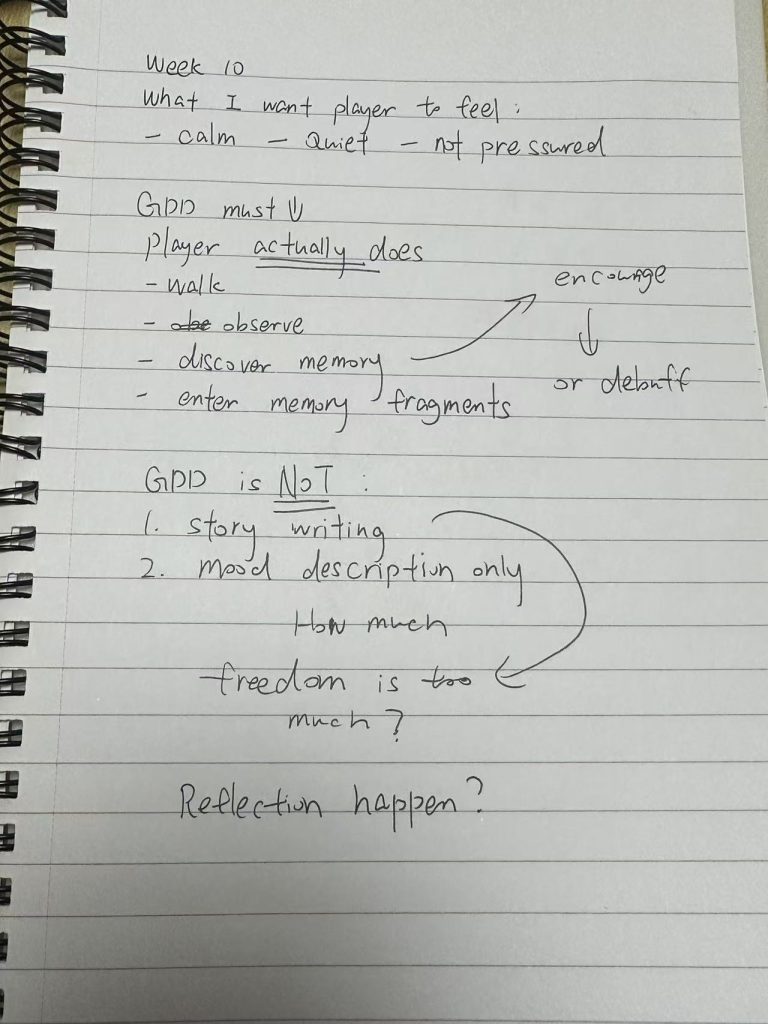
Previously, I primarily considered games through the lens of emotional experience:
• What do I want players to feel?
• Is the atmosphere sufficiently tranquil and gentle?
Within the GDD context, I began questioning myself:
• What exactly is the player doing? (What does the player do?)
• How does the system respond to this action? (System Response)
• How is the experience repeated and deepened within the loop?
This prompted me to deconstruct the emotional experience within the project into:
Gameplay Loop / Player Actions / System Feedback.
Applying GDD Structure to My Game
On a practical level, this week I began directly applying the GDD methodology learned in class to my own project:
• Defining the Core Gameplay Loop
• Distinguishing between Game Mechanics / Gameplay Systems / Player Flow
• Reflecting on what constitutes the Essential Experience versus elements that can be deferred or reduced (MVP thinking)
I’ve also come to realise that my project is no longer merely a ‘concept still finding its direction’, but has entered a phase requiring systematisation and structuring.
Reflection
This week’s most profound insight for me has been:
Clarity itself constitutes a design capability.
A good design is not complex; rather, it can be accurately described, understood by others, and ultimately realised.
This has also given me clearer direction and confidence to continue refining the Gameplay Systems & Player Flow page.