Introduction
In our current group project, there are five members in total, and we have provisionally divided our roles into two areas: art and programming. In contrast, my specific role is not yet clearly defined.
I therefore hope that by conducting role research on the position of World Designer, I can gain a clearer understanding of the responsibilities involved and explore the specific tasks I could undertake within the project (my potential contribution).
Case Study – Environmental Guidance
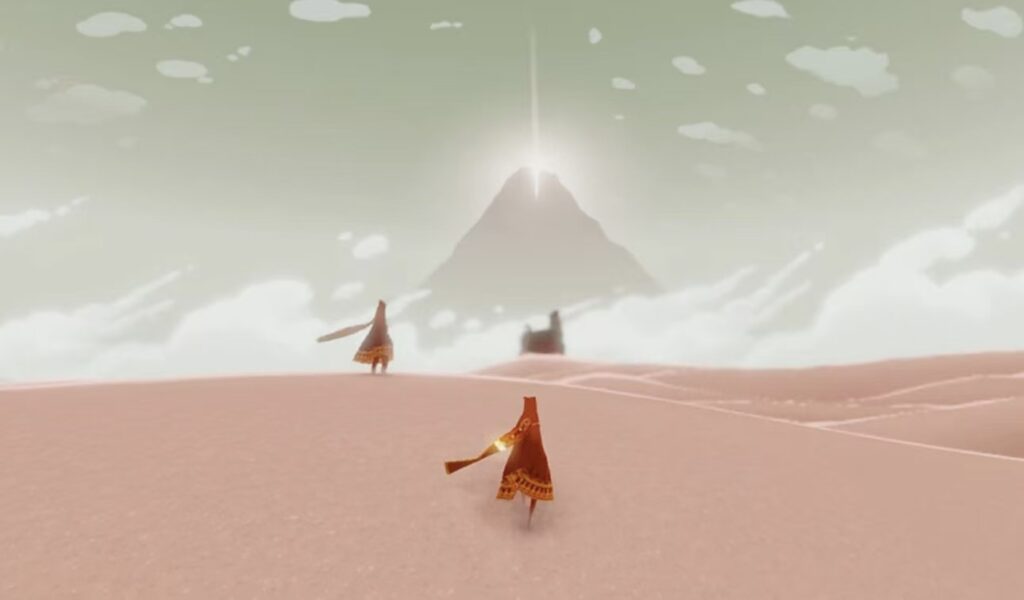
During my design research, I drew inspiration from the world design of Journey.
The world design in Journey made me realise that the environment itself can serve as a form of ‘guidance’. Players are naturally drawn to distant lights, changes in terrain or spatial orientation, rather than relying on obvious UI cues. This approach to driving exploration through the environment has also influenced my thinking regarding the world structure of *Soul Keeper*.
The game guides players forward through environmental transitions rather than relying on explicit UI guidance. For example, players are naturally drawn to distant light sources or changes in terrain, thereby creating a path of exploration that is ‘environmental storytelling’.
This design made me realise that world design is not merely about visual presentation, but rather a form of implicit guidance. In my own project, I also aim to influence players’ movement paths through the direction of water flow, vegetation density and changes in elevation, thereby reducing reliance on explicit guidance and enhancing immersion.
Theoretical Insight – Player Experience
Regarding theoretical references, I read The Art of Game Design: A Book of Lenses. This source mentions that design is about the player experience and not about the systems of the game.
This book made me realise that game design is not merely about establishing rules or mechanics; what matters more are the emotions, pacing and atmosphere that players actually experience whilst playing. Sometimes, it is not the specific systems themselves that players remember, but rather how they felt and what they experienced within the environment.
This book has made me rethink the importance of ‘player experience’ in design. Rather than simply establishing systems and rules, I have begun to focus more on how the environment itself influences players’ emotions, sense of rhythm and immersion, and how these elements interconnect within world design.
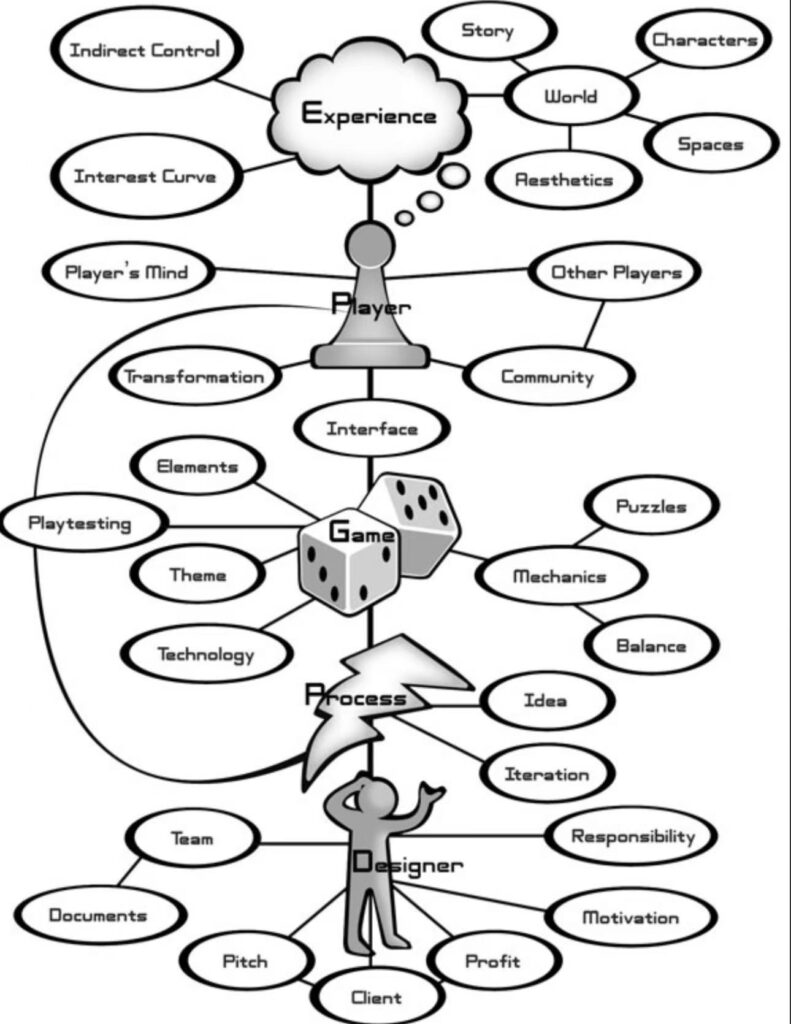
In light of this view, I have started to think about the role of world design as not only making a ‘space’, but also influencing how players see the world. As an example, the colour palette, lighting, and spaces of an environment influence players’ emotions and behaviour subtly. My focus within my project has shifted towards the emotional tone of environments.Rather than emphasising challenge or conflict, I aim to foster a sense of safety and connection through a soft visual tone, a tranquil atmosphere, and the presence of creatures.
Consequently, in my future world design work, I will not only consider structure and function, but also reflect on ‘what the player will feel’ within that environment, thereby ensuring the design is more emotionally complete.
This framework has helped me understand more intuitively that player experience, world structure, mechanics and narrative are in fact interdependent, rather than existing in isolation from one another. It has also made me realise that World Design is not merely about creating settings, but directly influences how players perceive the entire game world.
References
Leave a Reply