What I Did This Week
The main focus of this week has been preparing for Thursday’s presentation. I have completed my slides, which mainly summarise and document the research I have carried out over the past two weeks on animals and their habitats, including the classification of different regions and the corresponding basic information. The purpose of this presentation is not only to summarise the World Design research conducted over the past two weeks, but also to provide the team with a clearer understanding of the relationships between the current environmental structure, resource distribution and habitat classification.
Rather than simply presenting data on the animals, I hope to use this presentation to illustrate how different ecological zones support the gameplay atmosphere, environmental storytelling and player exploration.
Process & Collaboration
On Tuesday, we held a group meeting to finalize the essential format of the presentation. In the end, it was decided that each member would make a single individual slide that summarised when and what they did in the past 2 weeks. Furthermore, we were all going to use a 9:16 aspect ratio.
During the discussion, team members felt that organising habitat information by environmental regions would provide a clearer picture than categorising animals individually, and would also make it easier to understand the relationships between different ecosystems.
This approach has also helped ensure that my World Design research aligns more effectively with the art direction and gameplay structure.
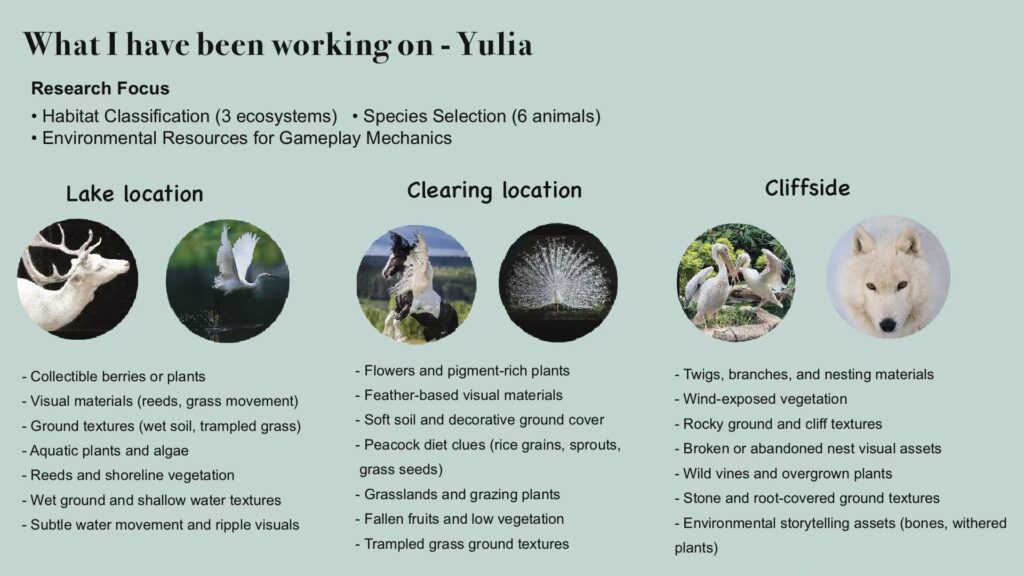
In this presentation, I have reorganised the habitat and animal research completed over the past two weeks and attempted to present the ecological relationships between different areas in a more visualised manner.
I have divided the entire game world into:
- Lake
- Clearing
- Cliffside
These three environmental regions, with the aim of more clearly demonstrating the differences in resource structures, animal distribution and environmental atmosphere across the various habitats.
Rather than simply presenting the research content, I have begun to focus more on how information hierarchy and visual communication can help the team quickly grasp the structure of the world design.
Reflection & Learning
Whilst creating this week’s PowerPoint presentation, I gained some new insights into visual organisation.
When laying out the design, I experimented with using circular masks to arrange the animal images, creating a greater sense of visual unity from what were originally rather scattered images. This approach gave the overall composition a softer visual tone, which also better suited the atmosphere of the game itself.
Through this presentation, I began to realise that visual communication is itself an integral part of the World Design process.
Even details such as image hierarchy, layout spacing or image grouping can influence the audience’s understanding of the relationship between the environment’s structure and gameplay.
Whereas previously I focused solely on the research content itself, I have now started to pay greater attention to how visual organisation can enhance the readability of information and the clarity of the environment.
Leave a Reply