For me, “imagining myself with sound” has always been more natural than “imagining myself with images”. It’s hard for me to describe “who I am” in a sentence, a photo, a fixed image, but if I use sound, I can capture that feeling faster.
Finkelstein (2007) argues that the self is not a stable entity, but is formed in the process of continuous reconstruction and performance. For me, this “non-fixed self” is most evident in the sound: I am composed of multiple frequencies, not determined by a single image. When I try to describe myself in terms of sound, what I hear is never a note, but the kind of hum that comes when the five strings of the bass BEADG are plucked at the same time. The five low frequencies interfere with each other and fight each other, forming a chaotic, heavy, but inseparable sound layer.
However, there is just a regular fourth degree between these five strings, so there is a certain order under the chaos. Outsiders may only hear the “final note” after mixing, just like in a powerful chord, everyone is more accustomed to hearing the clearer high note. For me, what really makes up “me” are the parts that hit each other: the frequency of fighting, the frequency of clarity, the frequency of humming, and even the frequency of harshness.
I am used to hearing myself in a polyphonic way. My sound is not a single note, but a multi-layered structure, some frequencies cooperate, some collide, but together they form the timbre I present to the outside world.
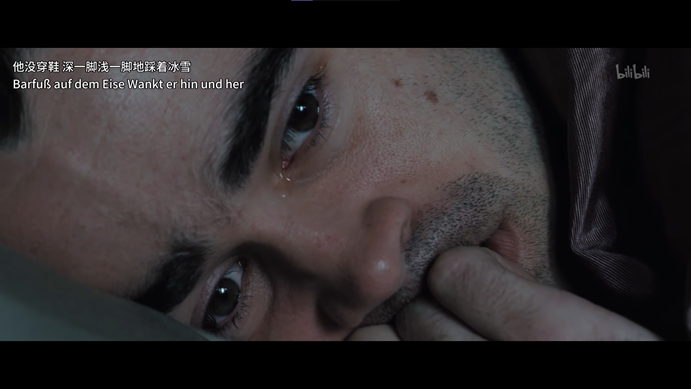
It was precisely because of this auditory experience that I was drawn to Ray in In Bruges (2008). Ray’s expression is always like an unstable low frequency: emotions are written on the surface, he chats “without scruples”, he does not understand architectural art, movie topics, likes lively and crowded places (big cities, bars), thinks about gifts under the Christmas tree before getting into the ambulance, etc. He was noisy on the outside, but his inner sound was extremely light and crowded deep in his chest, as if he was pressed down and did not dare to make a sound. He actually doesn’t know what kind of adult he should become, he has no control over his identity, and his self-awareness is also intermittent. Ray’s irritability, sudden bursts, sudden silences, and even his almost childish honesty all seem to be grainy from being over compressed.
Ray’s “sound” gives me the feeling of “I understand”. The Sound of Claudia Schiffer (2000) made me understand that sound can construct mental terrain, and Ray’s sound is a structure that constantly vibrates, shifts, and has unprocessed reverberation. It’s not familiarity, it’s an understanding of “I can hear how this frequency is suppressed.” That “sound” is recognizable to me, so I can understand his emotional rhythm more quickly. If someone were to make a movie about my life, I would probably choose Colin Farrell as well. He starred in another Martin McDonagh film, Seven Psychopaths (2012), in which the main character Marty gave me a similar feeling. He always performs a feeling of “unstable but real”.
Word count: 523
References:
Finkelstein, J. (2007) The art of self invention. book. I.B.Tauris & Co Ltd. https://api.pageplace.de/preview/DT0400.9780857710604_A23732105/preview-9780857710604_A23732105.pdf.
Image taken from In Bruges (2008)by Martin McDonagh, at 00:55:23, This image shows Ray in a close-up on a hotel bed. The camera focuses on the details of his eyes and face, and the tears show that he is under high stress and emotional load. Although his body is still, his gaze is out of focus, suggesting that his attention is occupied by internal mental activity.
Leave a Reply