As a student who is used to thinking about creation through the rhythm of the picture and sound design, when I watched Man with a Movie Camera (1929) and A Bite of China (2012), I felt not a simple “content difference”, but two completely different narrative mother tongues. The former is like a machine talking, it forms grammar with editing and speed; The latter is like a person telling his life, and emotions and details become sentences. For me, these two documentaries are not showing reality itself, but explaining in their own ways what is worth seeing and remembering.
While watching A Bite of China, my breathing slows down and my eyes stop at those hand movements and steamy details that are magnified by the camera, a physical reaction that is never seen in Man with a Movie Camera. Those shots about seasons, climate, and food are no longer just “cultural information” in documentaries, but memories that I used to take for granted but now need to be touched by images. The rhythm of the latter would push me into a “modern speed” that would make it almost impossible for me to stop and observe any emotion.
In contrast, Man with a Movie Camera‘s fast editing and urban structure seem to show another completely unfamiliar rhythm of life. So I began to realize that although the themes of the two films are different, they both express a “meaning of lifestyle” in the language of cinema. It is in these two completely different viewing experiences that I realize that the language of the film not only expresses the theme, but also hints at “who” is speaking, the city or the human being.
As Manovich makes at the core: Vertov is not just recording reality, but stitching together new visual grammar with fragmented images, as if inventing the “language of cinema” from scratch. In Man with a Movie Camera, this collage-like language is most evident. The labor, transportation, mechanical movement, and daily movements of the city are broken down into countless small segments and reassembled into a kind of “machine narrative” at a very fast pace. For me, this language brings not a story, but a physical experience of being engulfed in the speed of the city: I can’t even find time to stay on one detail and be pushed away by the next picture.
In contrast, the sound language of A Bite of China comes almost entirely from life itself. The sound of chopping vegetables, the crackling of flames, the agitation of steam together with the ambient sounds form a slow and full rhythm, allowing the movements of food and hands to become narrative units. The picture is not in a hurry to advance the story but allows culture and memory to be seen naturally at the pause of time. For me, this presentation of “slow time” is at the heart of its language: it allows people to understand life with their senses rather than speed.
The language of cinema is not uniform, it changes depending on the subject: the city has its mother tongue, and human beings have their own rhythm.
Word count: 521
References:
Manovich, L. (2002) The Language of New Media. 1st MIT Press paperback edition. Cambridge, Mass.: MIT Press.
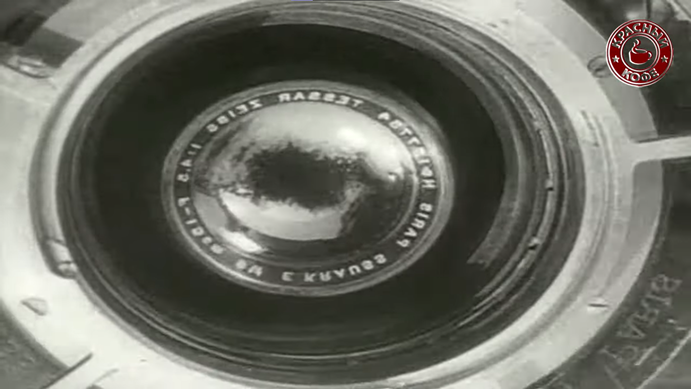
Image taken from the Man with a Movie Camera (1929)by Dziga Vertov, at 11’32” demonstrating Vertov’s understanding of the language of cinema is presented: language is made up of the camera itself. This image reminds the viewer that the film’s “narrator” is a machine that reorganizes reality through montages, angles, and technical visions
Leave a Reply