A Technical Audio Designer focuses on how sound functions within a game. This role is not only about creating sound effects or music assets, but also about connecting sound with player behaviour, game states, and spatial environments. In other words, a Technical Audio Designer designs audio behaviour: when sounds play, when they stop, where they come from, how they change according to game states, and how these audio responses affect the player experience.
In the Audio department listed by ScreenSkills, roles such as Audio Programmer, Music Composer, and Sound Designer (Games) are included, but Technical Audio Designer is not listed as a separate basic job category. Therefore, I understand Technical Audio Design as a cross-functional area between Sound Designer and Audio Programmer.
A Sound Designer focuses more on the sound content itself, such as sound effects, ambience, foley, music, and the overall sonic atmosphere. ScreenSkills describes a Sound Designer (Games) as being responsible for creating the game’s soundscape, including music and foley, and using sound to strengthen mood, tempo, and emotional depth. By contrast, an Audio Programmer focuses more on technical implementation. ScreenSkills explains that an Audio Programmer writes the code that makes sound work in the game, such as controlling volume, or making sound effects like gunshots and footsteps triggered by player actions (ScreenSkills, no date b).
The focus of a Technical Audio Designer is therefore how sound operates inside the game. This role does not only create sound assets, and it may not necessarily be responsible for low-level audio code. Instead, it focuses on implementing sound assets through tools such as Wwise, Unity, or Unreal, turning them into interactive, responsive, and maintainable game audio systems. Stevens and Raybould (2011) emphasise that game audio is not only about creating audio elements, but also about implementing interactive sound that supports gameplay. This supports my understanding of Technical Audio Design as a role focused on how sound behaves inside the game system.
Game sound is usually not played in a linear way. Instead, it is determined by player behaviour and game states. For example, footsteps need to be triggered when the player is moving, different ground materials may require different sound switches, UI sounds need to play when buttons are clicked, and ambience may change according to the player’s location or distance. In other words, sound in games needs to be controlled by rules, rather than fixed to a timeline like sound in film.
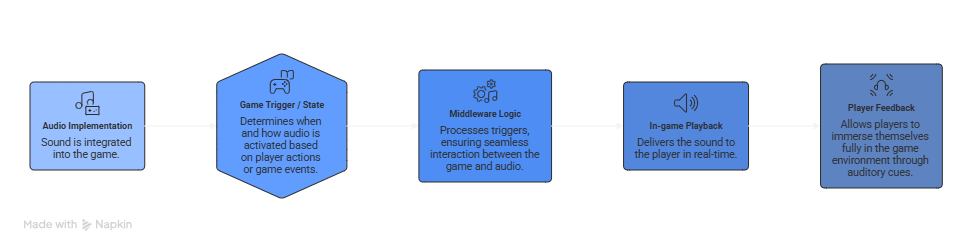
Therefore, I prefer to use the term Technical Audio Design rather than simply Sound Design. This is because my research focus is not only whether the sound is aesthetically effective, but also when the sound plays, where it plays from, how it changes according to player behaviour and game states, how it is managed through middleware, and how it can remain stable and debuggable within the project.
Resources
ScreenSkills (no date b) Audio programmer in the games industry. Available at: https://www.screenskills.com/job-profiles/browse/games/audio/audio-programmer/.
ScreenSkills (no date c) Sound designer in the games industry. Available at: https://www.screenskills.com/job-profiles/browse/games/audio/sound-designer-games/.
Stevens, R. and Raybould, D. (2011) The Game Audio Tutorial: A Practical Guide to Sound and Music for Interactive Games. Oxford: Focal Press.
Leave a Reply