When I was adding more research related to sound design, I read a piece of material from a related communication community about the basics of synthesis. Since the material is not convenient to share externally, I will only explain my personal understanding here. Although this part is not directly linked to my role as a Mechanics Designer, it is related to my later shift towards Wwise, interactive audio, and sound feedback. If I want to design UI sounds, ambience, or interaction feedback in a game, I cannot only rely on existing sound assets. I also need to understand how sound itself can be synthesised and shaped.
The material first emphasised that synthesisers are not simply tools for imitating real instruments. They are also sound design tools that can create entirely new sounds. Through different waveforms, filters, envelopes, and modulation methods, synthesisers can produce sound textures beyond real-world instruments. The material also mentioned several common synthesis methods, including subtractive synthesis, additive synthesis, wavetable synthesis, granular synthesis, FM synthesis, and physical modelling. Among them, subtractive synthesis is one of the more basic and easier-to-understand methods.
The basic logic of subtractive synthesis can be understood in three steps. First, an Oscillator / OSC generates a basic waveform. Then, a Filter removes the unwanted frequency content. Finally, an Amplifier / Envelope controls how the volume changes over time. In other words, subtractive synthesis does not build a complex sound from nothing by “adding” parts together. Instead, it starts with a sound that already contains a lot of frequency information, then shapes it by cutting and filtering. The first page of the material also summarised this process as: generating a basic waveform, removing the unwanted parts of the sound, and adjusting the volume change.
In the Oscillator section, the material introduced several basic waveforms, such as sine, triangle, square, and sawtooth. Different waveforms have different harmonic structures, so they also sound different. For example, a sine wave is closer to a single frequency and sounds purer. A sawtooth wave usually contains more harmonics, so it sounds brighter and rougher, and it is also more suitable as raw material for later filtering. This part made me realise that the first step of sound design is not immediately adding effects, but choosing the right sound source.
Filter is one of the most important parts of subtractive synthesis. The material mentioned concepts such as low pass filter, high pass filter, and band pass filter, as well as cutoff, resonance, and drive. Cutoff decides where the frequency filtering starts. Resonance emphasises the frequencies around the cutoff point, while drive can make the sound thicker and more aggressive. These parameters are very useful for game sound effects. For example, a soft UI feedback sound can reduce high frequencies and impact, while a warning sound or danger cue can use brighter and sharper frequencies to quickly catch the player’s attention.
Envelope, especially ADSR, is also very important. Attack decides how long it takes for the sound to fully appear after being triggered. Decay and Sustain decide how the sound drops and holds after reaching its maximum level. Release decides how long the sound takes to disappear after it ends. For game audio, ADSR directly affects the feel of feedback. If the attack of a UI click sound is too slow, the player may feel that the feedback is delayed. If the release is too long, the sound may feel muddy and reduce the clarity of UI interaction. Because of this, the envelope is not just about volume change. It is a key part of how a sound creates a sense of action.
The material also mentioned Modulation, such as LFO and Sequencer. An LFO does not produce the main sound itself. Instead, it uses low-frequency movement to control other parameters, such as pitch, filter cutoff, or volume. This can create periodic changes in the sound and stop it from feeling completely static. For ambience or certain electronic-style sound effects, modulation can make the sound feel more alive, such as through subtle filter movement, pitch drift, or rhythmic variation.
This research gave me two useful ideas for the project. First, sound feedback is not only about finding a suitable sound asset. In many cases, it also needs synthesis and parameter adjustment to shape its functional feeling. Second, sound in games needs to serve interaction. UI sounds should be short, clear, and responsive. Ambience can be slower and more continuous. Danger cues or objective prompts need stronger recognisability. Subtractive synthesis gave me a way to understand the structure of sound, so I could think more consciously about how a sound’s waveform, frequency range, dynamic envelope, and modulation affect the player’s perception of actions and environments.
Although this research is not directly linked to the core mechanics of The Verdant Trail, it supported the basic knowledge I needed for my later Wwise / sound design work. Especially after I shifted my focus towards player-facing feedback, understanding how synthesisers shape sound helped me judge what kinds of sounds would be suitable for UI, environmental atmosphere, or interaction feedback.
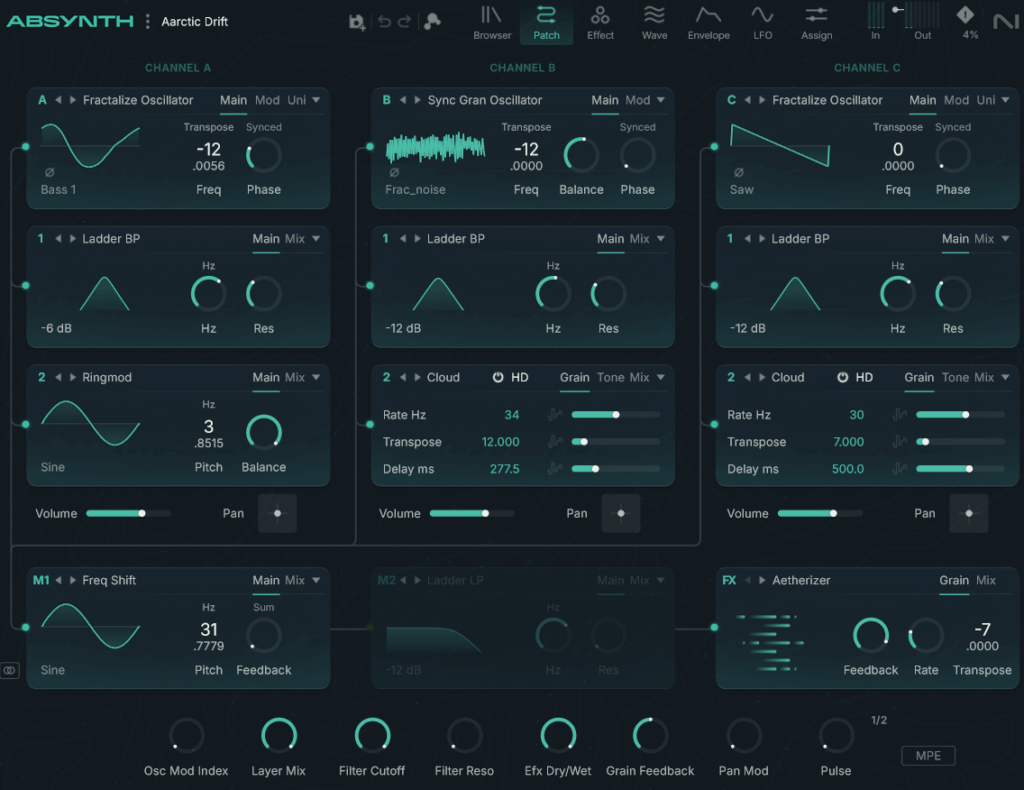
Resource:
Chenghui Hu (n.d.) 合成器基础. Unpublished course material.
Leave a Reply