Based on my own playthrough, I think the section in Resident Evil Requiem where the player collects three Joint Plugs in the basement is very interesting to study. This is because it is not simply a “find a key and open a door” puzzle, but a level design case that combines map backtracking, temporary routes, resource management, and pressure from threats. The player’s goal is clear: find three Joint Plugs, restore the power, and rescue Emily. However, the actual process requires the player to move between different rooms in the basement, insert and retrieve plugs, and change which routes are accessible. Walkthrough materials also mention that although this process is generally linear, it creates strong spatial memory pressure because the player needs to repeatedly move plugs, open different areas, and may easily get lost or leave a plug somewhere.
One important design point of this level is that it gives the player a clear main objective, but makes the route to complete that objective relatively complex. The player is not asked to wander around without knowing what to do. Instead, they always know that they need to collect three Joint Plugs. However, each plug is connected to the power state, locked doors, tools, and routes within the map. As a result, the pressure does not come from “I do not know what the objective is”, but from “I know the objective, but I need to understand the map structure in order to complete it”.
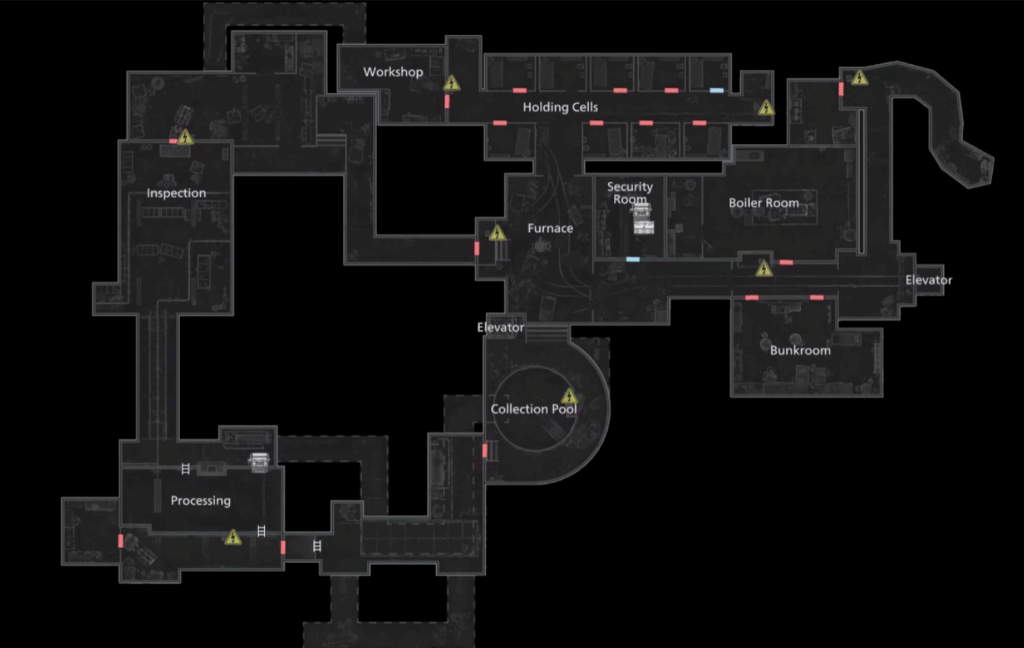
For example, in the first half of the basement route, the player first finds the first Joint Plug on the main device near Emily. When the player removes it, the area loses power, the lights go out, and enemies are triggered.
After that, the player needs to take this plug to the device near the Boiler Room and use it to open a new route. Once inside, the player can explore the Bunkroom and the area around the Boiler Room to obtain new information and items. However, this plug cannot be left there, because it needs to be taken back later to open other doors. Therefore, the player has to remember that this route is temporarily maintained by the plug, and that the plug needs to be retrieved before leaving. Walkthroughs also mention that although this section is generally linear, the repeated process of inserting, retrieving, and moving plugs can easily cause the player to get lost or leave a plug somewhere.
From a mechanics design perspective, the function of the Joint Plug is not only to open doors, but also to allow the player’s action to change the state of the map. Salen and Zimmerman (2004) argue that the meaning of actions in games comes from the relationship between player actions and system outcomes. In this level, inserting or removing a plug changes the power state, accessible routes, and level of danger, so this item interaction becomes part of the level’s mechanics. The action itself establishes an important rule: the Joint Plug is not just a key; it also changes the state of the space. The player is not simply “obtaining an item”, but is also making an originally relatively safe area become dangerous.
This route also demonstrates an important level design idea: a map does not become complex only through its size, but through changes in state. The same basement space changes its accessible routes depending on whether a plug has been inserted or removed. Each time the player passes through the same area, the conditions are different: sometimes they are trying to open a door, sometimes they are retrieving a plug, and sometimes they are looking for the next route under enemy pressure. Therefore, the route is not only a path of movement, but also a process in which the player understands rules, remembers space, and manages risk.
The biggest inspiration this design gives me is that good backtracking in level design is not simply making the player “walk back the way they came”. Instead, it allows the player to reinterpret the same space with new rules, new resources, or new risks.
Resources:
Capcom (2026) Resident Evil Requiem. [Video game]. Osaka: Capcom.
Salen, K. and Zimmerman, E. (2004) Rules of Play: Game Design Fundamentals. Cambridge, MA: MIT Press.
Leave a Reply