WEEKLY JOURNAL
WEEK 3 · CANVAS OF THE PAST · CONCEPT, PILLARS & LOOPS
This week I worked on the Canvas of the Past idea from Week 2. I wanted to explain more clearly what the player does inside the painting. I used the lecture on overviews, pillars and loops alongside the feedback on my concept.
ON THIS PAGE
Later development: These notes show the idea at this stage. I later developed the bird’s role in the story research and Before We Say Good bye.
1. Design intention and essential experience
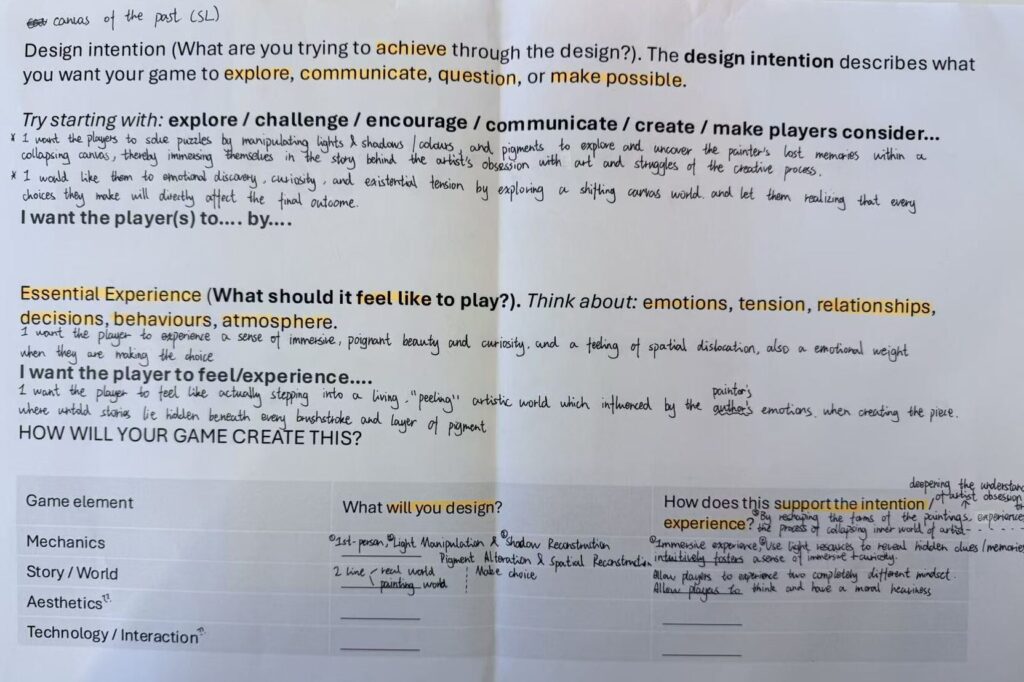
Design intention:
I want players to discover how the artist’s work preserves memories and hides things they find painful. Solving a puzzle with light, shadow or pigment should also help the player understand the story behind the image they are repairing.
Essential experience:
At first, I want the player to be curious about being inside a painting. As they find more memories, the space should become unsettling and the story sadder. By the end, I want them to care about the artist and feel some responsibility for what happens to the painting.
2. Developing the world and ending
The player starts as an ordinary visitor in a contemporary gallery. They notice a painting and are pulled inside it. From there, they explore in first person, solve puzzles and find clues about a tragedy in the artist’s past. Their discoveries lead to a choice at the end.
Canvas of the Past concept mind-map (PDF)
This is an early working map, with alternative story branches and some unused template notes. At this stage, I imagined the rooms reflecting the artist’s memories and obsession, so they did not have to follow normal architecture. The paragraphs below explain the version I wanted to build.
For a small version, I am planning a gallery and the world inside the painting. The painted world would have two main puzzle rooms, with a memory after each one. The final choice would come after the player has found both memories. This is the structure I want to build towards.
The threat and the ending
I considered two versions of the threat.
In the first, the painting would keep peeling and falling apart. The player would have to escape before the world collapsed.
In the second, the player would enter a world that was already damaged and repair it through puzzles.
I chose the second version. Giving the player time to look around and repair the painting felt closer to the recovery I wanted the story to explore.
That decision also changed the ending. The visitor now returns to reality in either outcome. Their choice affects the artist inside the painting.
I am still considering the choice between revealing a painful truth and keeping a comforting lie. I need to work out what each option would mean for the artist.
I do not want one emotional response to count as a failed escape. Both choices need a reason behind them. The memories will have to give players enough information to understand why this decision is difficult.
3. Peer feedback and my response
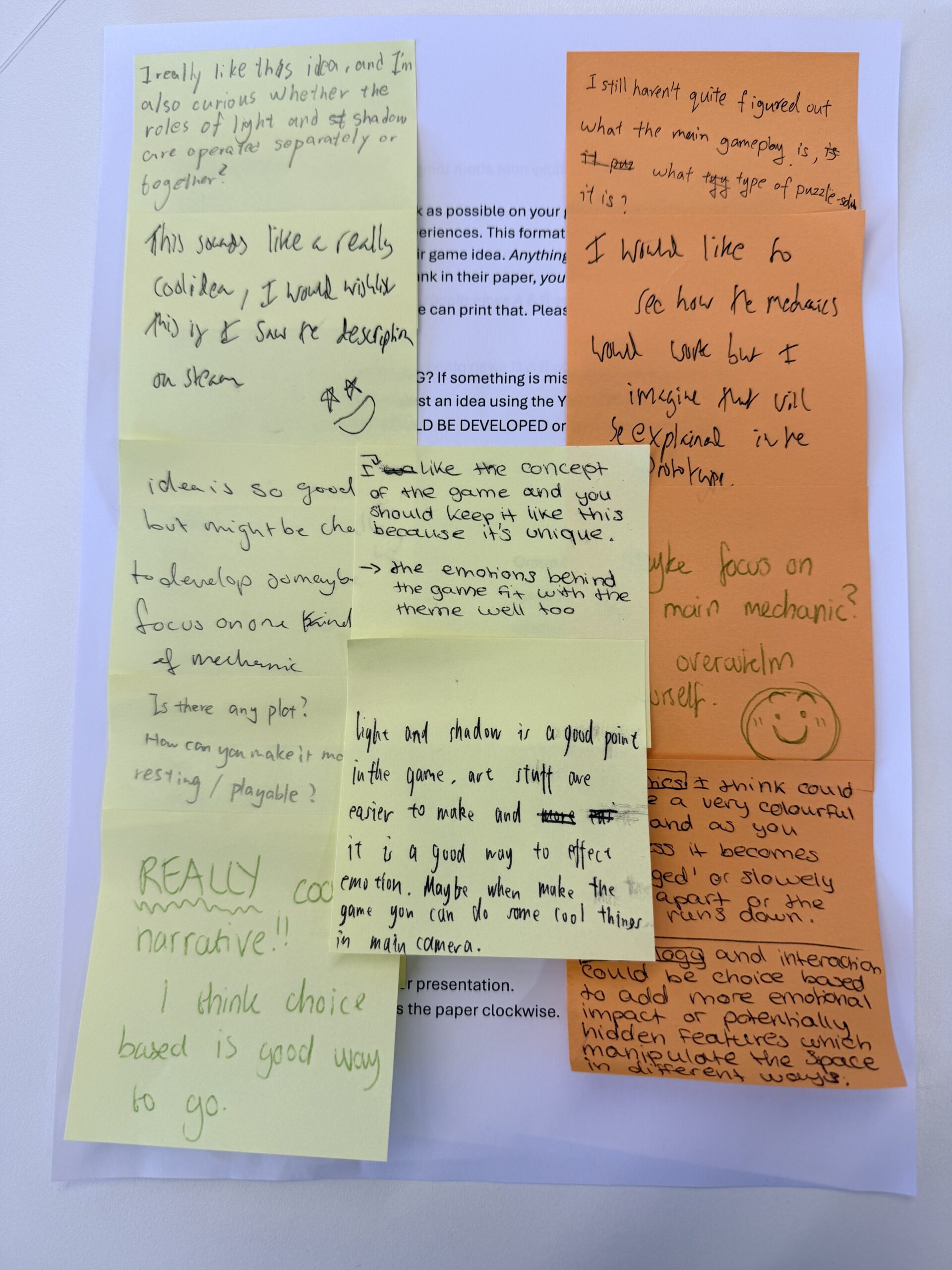
The positive comments made me more confident about the concept. The questions were just as useful, especially the ones about how the light and shadow puzzles work. I have put my responses beside the feedback below.
| Feedback | What needs clarification | Thoughts and ideas |
|---|---|---|
| Light and shadow | Do they work separately or together? What type of puzzle does the player solve? | Start with objects casting separate shadows. The player changes viewpoint to bring the shadows together into a target image. |
| Scope | Can the idea focus on one main mechanic? | I worried that repeating one mechanic might become tiring, so I considered adding colour as another puzzle element. |
| Narrative and choices | How does the story make play and decisions meaningful? | A solved puzzle reveals a memory that helps the player make the final choice. |
This also connects with the earlier feedback on the diver idea. In both concepts, I wanted repairing something to reveal part of the past. For Canvas of the Past, I need the image being repaired to have a clear connection to the memory.
4. Game overview and design pillars
What I learned from the lecture
The lecture asked us to explain a game in about 30 seconds, using two to four sentences. I found this useful because I could describe the painting world at length without saying much about the player’s actions. A short overview forces me to decide what someone needs to know first.
We also discussed using around three to six design pillars, each with a short explanation. I understand these as a way to check decisions while making the game. A label such as ‘good gameplay’ is too broad to help me choose a feature. I need pillars that relate to this particular idea, so I can check whether a new feature supports them or works against them.
The core loop describes what the player keeps doing from moment to moment. The longer-term loop explains how those actions lead to progress. For this game, progress includes learning about the artist and reaching another room, as well as collecting or using puzzle materials.
My overview of Canvas of the Past
An ordinary museum visitor enters an unfinished painting shaped by the artist’s obsession. The player explores in first person, changes their viewpoint and the light to align shadows, and may use pigment to restore missing details. Repairing an image reveals a memory and opens the next area. Those memories help the player choose between revealing a painful truth and preserving a comforting lie before returning to reality.
Defining my three game pillars
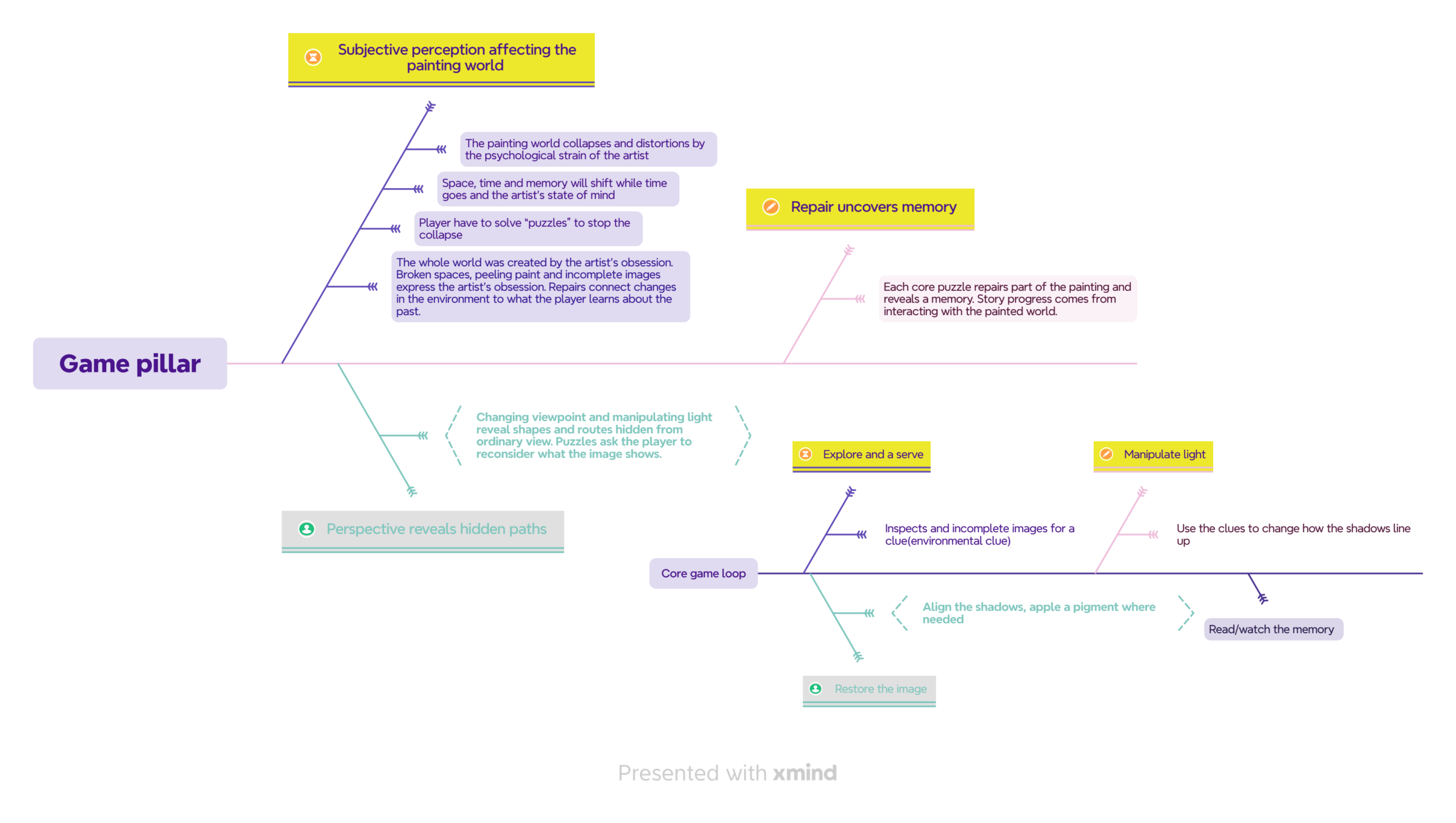
Subjective perception shapes the painting world
The broken rooms, peeling paint and missing details come from the artist’s memories and obsession. When a space changes, I want the player to learn something about why it was damaged.
Perspective reveals hidden paths
Changing position or moving a light can reveal an image or route that was difficult to see before. I want the puzzles to make players stop and look again at a space they thought they understood.
Repair uncovers memory
Solving a main puzzle repairs part of the painting and reveals a memory. The player should find the story by interacting with the room, so the repair gives them more than access to another door.
These pillars give me a way to question new ideas. Aligning a shadow fits the perspective pillar. Repairing part of a portrait could reveal a memory. If a feature only makes the game more complicated, I need to ask what it contributes to the painting or the story.
5. Core loop and longer-term progress
My mind map includes exploration, changing the light, repairing images and finding memories. I arranged them into this repeated sequence:
Explore and observe → adjust the viewpoint and light → repair the image and find a memory → enter the next damaged area.
| Player action | What happens | Progress or resource flow |
|---|---|---|
| Explore and observe | Look at objects, brush marks and incomplete images to work out what is missing. | Find clues and, where needed, a pigment for the image. |
| Adjust viewpoint and light | Use the clues to line up the shadows or separate parts of an image. | Try a solution and receive visual feedback. |
| Uncover the memory | Read or watch the memory revealed by the repaired image. | Learn more of the story, open the next area and start exploring again. |
I have not settled the rules for pigment yet. It might be used once, reused or belong to a particular image. I also want players to be able to adjust an incorrect shadow and try again without losing anything. That would give them room to experiment while learning the controls.
Connecting the core loop to longer-term progress
Across the two planned rooms, each repair would reveal another memory and add to the player’s understanding of the artist. They would then use that understanding when making the final choice. The choice comes at the end, rather than after every puzzle.
6. Developing the setting and a puzzle example
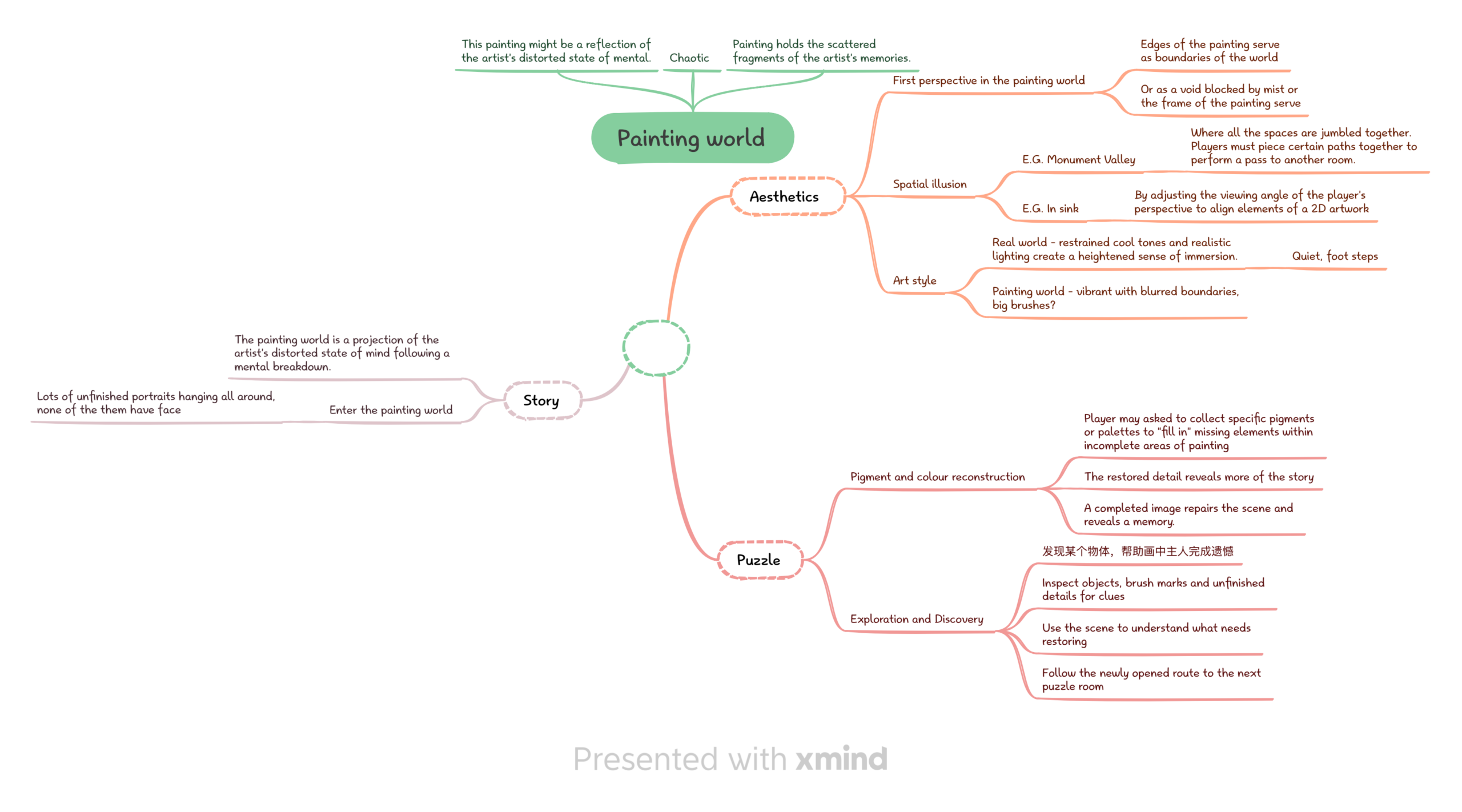
In the settings map, the real gallery is quiet, with cool colours and realistic light. Inside the painting, I want visible brushstrokes, stronger colours and less definite edges. A frame or mist could mark the boundary. Unfinished parts of the image could suggest that something is missing from its history.
A possible first-room puzzle
One puzzle idea uses an unfinished image beside a closed doorway. Objects cast separate shadows across it. Brush marks suggest the missing shape, and the player changes position and adjusts the light until the shadows line up. A pigment found in the room could fill the remaining gap.
Completing the image would repair part of the room, reveal its memory and open the next area. I still need to write that memory and find out whether adding pigment makes the shadow puzzle more interesting, or simply adds another step.
7. What I still need to work out
The biggest decision this week was to focus on repairing an already damaged painting. Looking back at our GRIS analysis, I think the player needs time to notice the changes and understand what they mean. A constant threat of collapse might pull attention away from that.
I am still worried that repeating the shadow interaction could become tiring. That is why I have considered colour as well. I need to try variations of the puzzle before deciding whether a second system is needed.
There is also a difference between finding a memory as a reward and finding a memory that matters. I want the repaired image to help explain what the player discovers. Otherwise, the story could feel separate from the puzzle.
Next, I want to sketch and prototype one small shadow-puzzle room. It needs a recognisable target, an adjustable light and clear feedback when the pieces line up. I would check whether someone can work out what to restore and what their adjustments change. After that, I can try a colour variation across the two rooms.
The ending also needs more work. The visitor escapes in both versions, so the real consequence is what happens to the artist. I need to decide what truth is being hidden, why the artist might want to keep it hidden and what the player has learned before choosing.
Leave a Reply