WEEKLY JOURNAL
WEEK 1 · RESEARCH & IDEATION
Working from emotions
What is a pitch deck?
- A short presentation that answers the main questions about a game.
- It can help find collaborators or explain an idea to publishers, investors and studio directors.
- It gives an impression of the game and what would be needed to make it.
- The aim is to get people interested and explain why the idea is worth developing.
- It is different from a detailed development document. It does not need to list every task or estimate how long each one will take.
1. Starting with joy
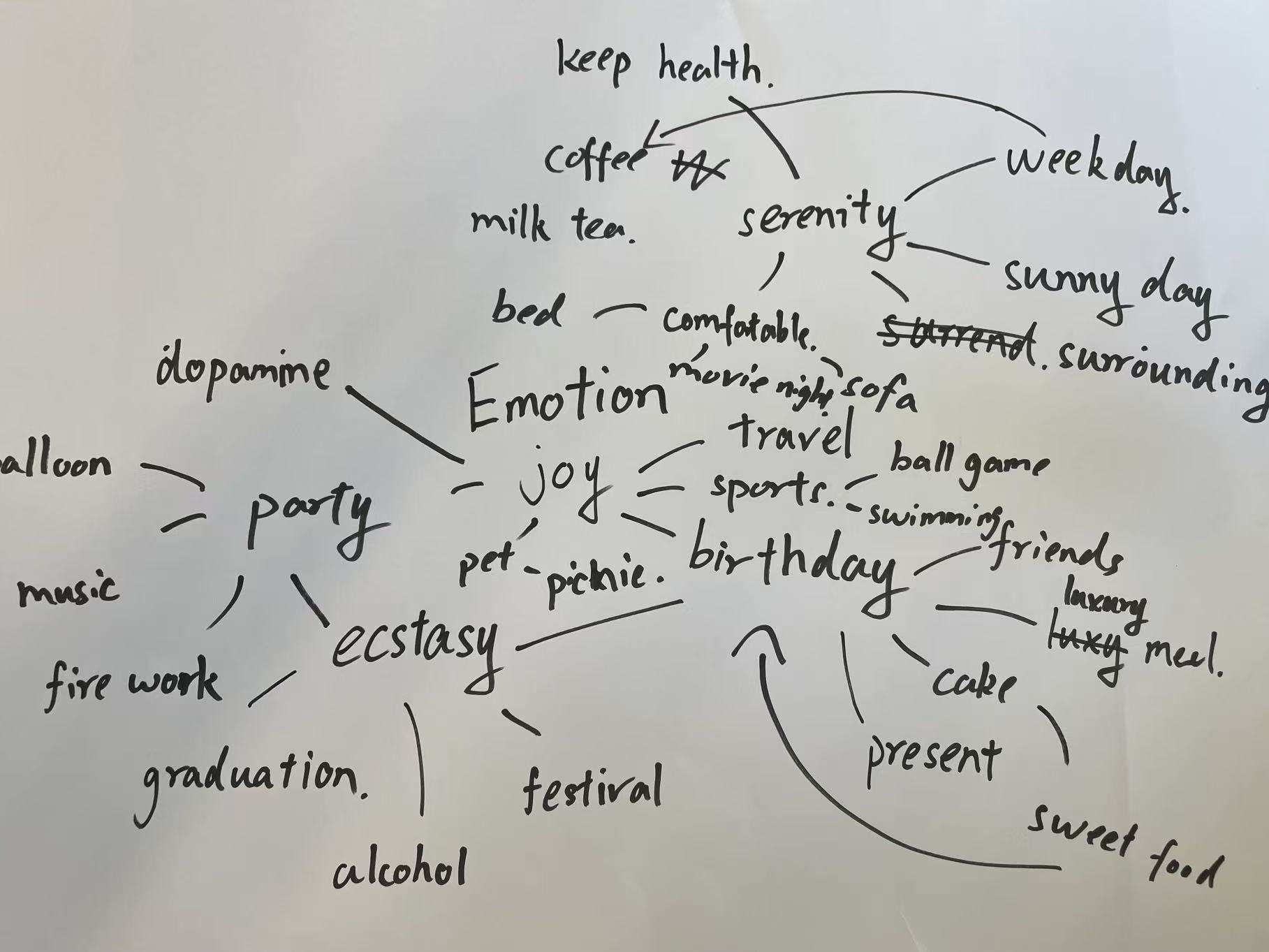
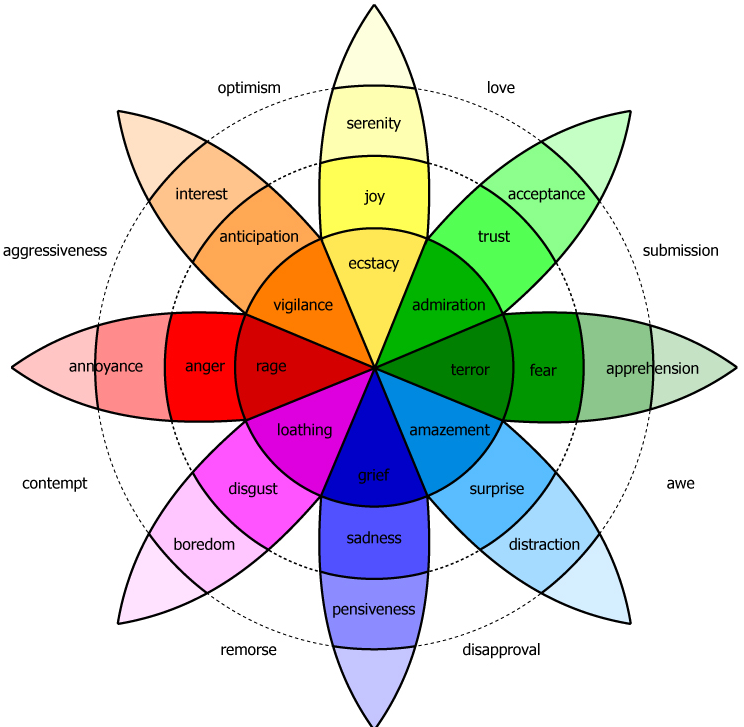
We chose joy as our starting point. Serenity and ecstasy were on the same ‘petal’ of the emotion wheel, so we included them in the map as well.
I was interested in the difference between these feelings. Serenity suggested a slower pace and familiar surroundings. The more energetic associations suggested movement, colour and being around other people. They all came from joy, but could lead to quite different games.
2. Finding ideas in the maps
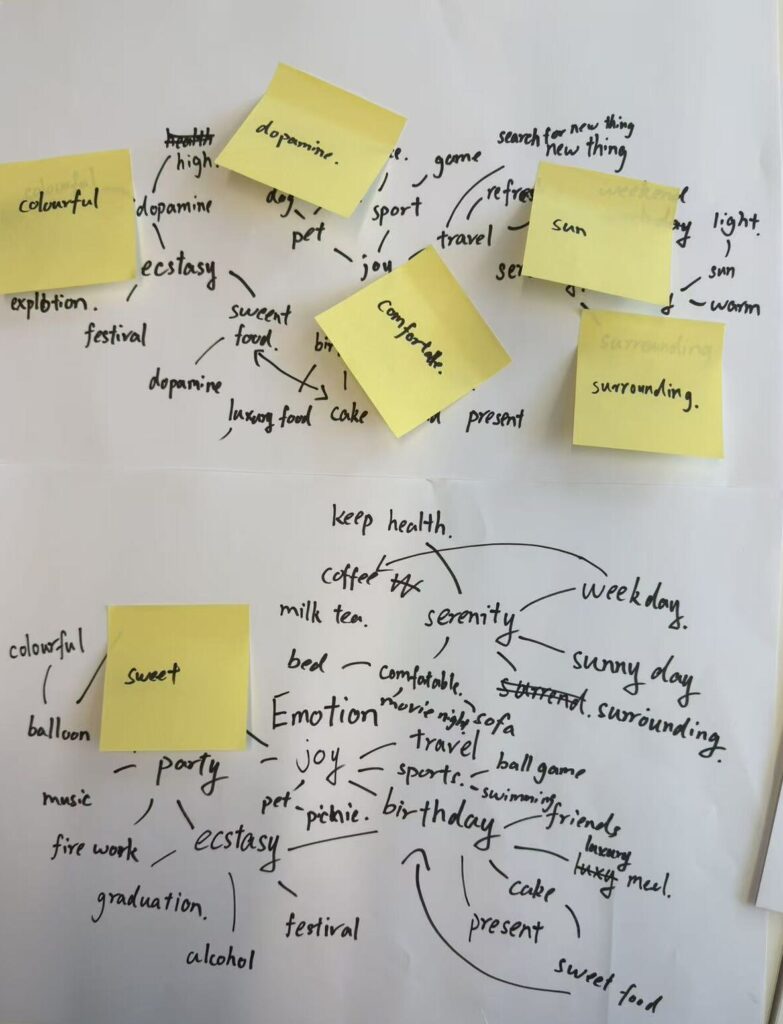
I tried to turn some of the words into things a player could actually see or do. For example, comfort might suggest a sheltered place, while celebration could involve colour and sound. Some notes described a mood and others suggested objects or sensations. ‘Dopamine’ also appeared on the map as an association with excitement and reward.
3. VNA ideation
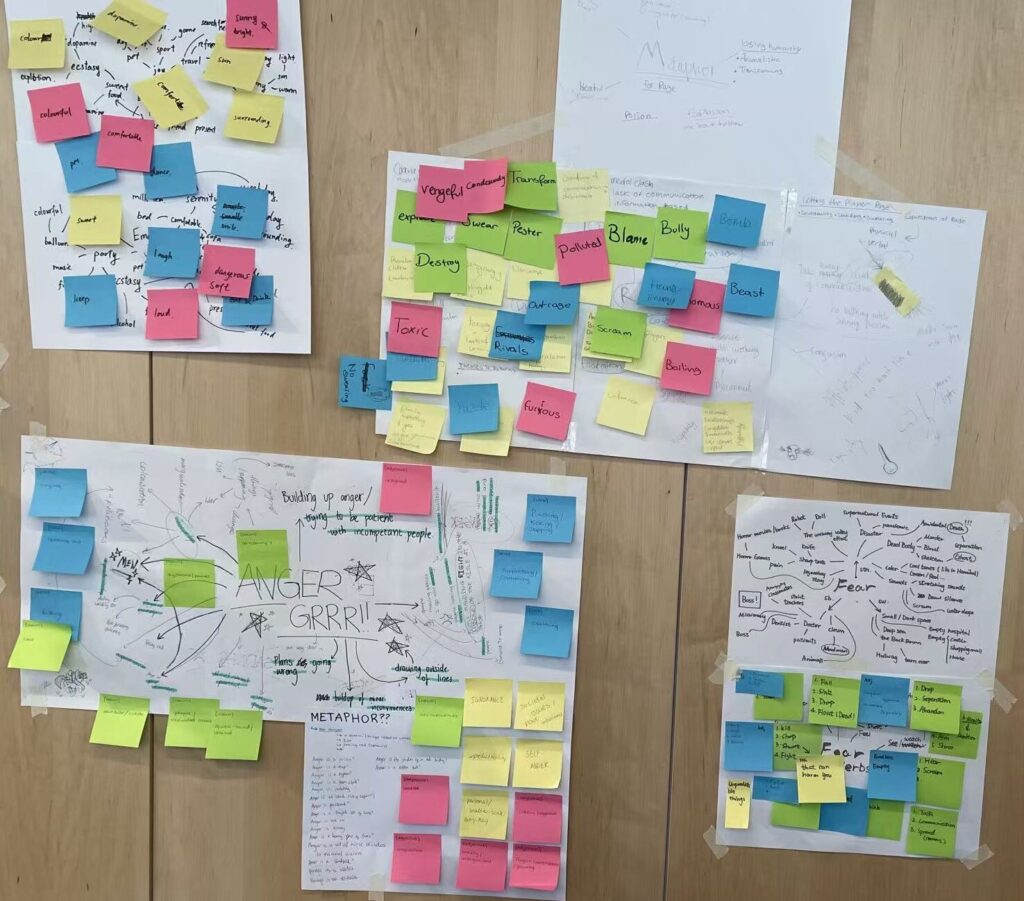
VNA stands for:
V – Verb
N – Noun
A – Adjective
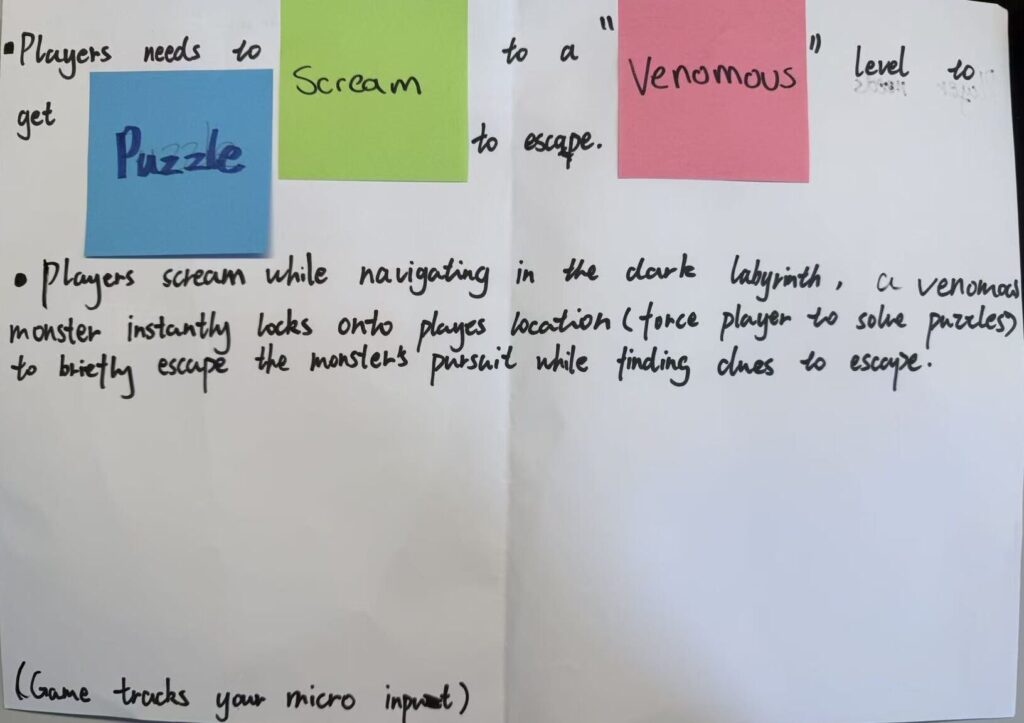
The words I chose were Scream, Puzzle and Venomous.
First idea:
The player is in an escape room. They have to scream at a certain volume to activate or solve puzzles and find a way out.
I struggled to connect the three words at first, so I started by putting them into one simple sentence. The first idea was quite basic, but it gave me something to change instead of staring at the words without a direction.
Second idea:
The player explores a dark labyrinth with their microphone switched on. A venomous monster can hear their screams. Solving puzzles gives the player chances to escape it and find more clues. I also considered jump scares, or puzzles that require the player to leave a safe area to search for something. Either could make them risk running into the monster.
Third idea, developed after the notes in the image:
The player is a combat medic exploring dungeons with a portable alchemy kit. They have to brew antidotes quickly enough to save wounded soldiers. The soldiers’ screams could disrupt the interface and attract monsters, making the treatment harder to complete.
Fourth idea, also not shown in the image:
The player is a warrior trying to win their freedom by defeating an arena champion. They enter commands in time with the music to perform attacks and parries. The boss uses venom, which damages the player over time and changes the rhythm patterns. Missing a beat causes damage and a scream sound effect. The player dies if their health reaches zero.
FOLLOW-UP IDEAS · DEVELOPED DURING AND AFTER JORDAN’S WEEK 2 CLASS

Ideas I wanted to take further
01 — Typing × Beat ’em Up
Player: An unarmed secret service agent escorting the President through a corporate skyscraper during a military coup. The agent starts without equipment.
Goal: Type commands for melee attacks, disarming enemies and hacking doors before the mercenaries reach the President.
Aim: Get the President safely to a helicopter on the roof.
Location: A high-tech corporate skyscraper under lockdown.
How it works: Action words appear above approaching enemies. Typing them makes the agent attack, throw nearby objects or hack a door to protect the President.
Obstacle: Shielded enemies require combinations of words. Taking damage raises the President’s stress level, which adds static to the typing interface.
Possible outcome: Accurate typing keeps the route clear and the President safe. If the enemies get through, they can capture or kill the President and end the run.
Design pillars
Under pressure: The player has to protect someone else as well as survive. Mistakes raise the President’s stress and make the interface harder to read.
Thinking: The player has limited time to decide which enemy is the biggest threat.
Typing: Word length, accuracy and punctuation would affect the strength and range of an attack, including whether it can hit several enemies.
Typing attacks and word rules
Basic Typing Attacks
Light strikes, 1–4 letters: Short commands such as JAB and KICK quickly interrupt one enemy.
Heavy combos, 5–8 letters: Words such as DISARM, TAKEDOWN and SUPPRESS can break a guard, stun an enemy or deal more damage.
Crowd control: Phrases such as SWEEP THE LEGS and THROW OVERBOARD affect several enemies and push them away from the President.
The panic meter
I also considered a Panic Meter for the President. It rises when enemies get too close or shots are fired nearby.
Low panic, 0–30%: Words appear clearly above enemies.
Medium panic, 31–70%: The screen shakes and colour distortion appears. Some letters become numbers or symbols, as in D1S4RM or L0CKD0WN.
High panic, 71–100%: Static makes the screen difficult to read. Commands could become hexadecimal strings, such as 0x4F8A, or reversed words. This would put more pressure on the player’s accuracy.
Possible commands:
Punch, kick…
I had wanted to continue with this idea, but this was where I ran out of things to add. I liked the typing mechanic, although I did not yet know how to develop the rest of the game.
02 — Depths of Remorse
Player: A deep-sea diver who lost their memory after a disaster and now lives in isolation.
Goal: Draw paths between adjacent grid tiles to purify toxic waste and connect matching memory fragments.
Aim: Clean the damaged ocean environment and discover why the research ship sank.
Where and when: A flooded research vessel at the bottom of an ocean trench, in the present day.
How it works: Drag through matching tiles to connect them. Linking waste nodes triggers a purification spell. Linking memory fragments reveals parts of the story through log entries.
Obstacle: Toxic sludge spreads into nearby grid spaces each turn. Increasing pressure gradually blocks the lower rows of the grid, changing the available routes.
Possible outcome: Clearing a chamber removes the waste, reveals more of the story and opens the next area. If the player loses control of the pollution, their diving suit can fail and end the run.
03 — Shush!
This idea came from the shared emotion board.
Player: A travelling physician accompanying a group exploring a dungeon.
Goal: Mix the right ingredients on a grid to make an antidote before a venomous bite becomes fatal.
Aim: Save the injured members of the group.
Where and when: A ruined expedition site with very little light.
How it works: Rotate and combine ingredient tiles on a 4×4 brewing grid to match an antidote formula before time runs out.
Obstacle: The injured character’s screams distort the screen, scramble the alchemy interface and attract patrolling monsters.
Possible outcome: A successful antidote saves the character and gives them a temporary rage buff. If treatment fails, the poison takes over and the quest fails.
Leave a Reply