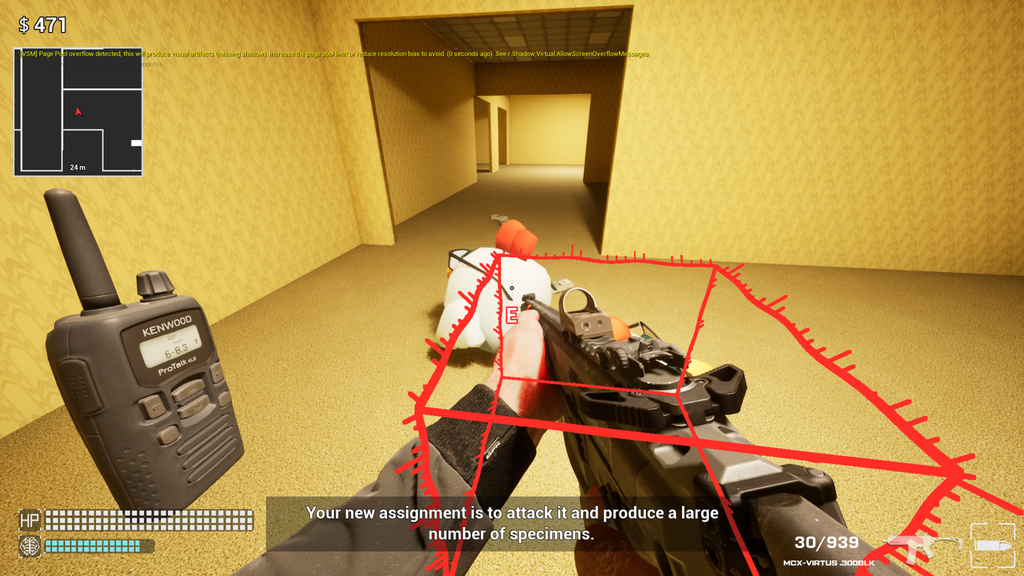
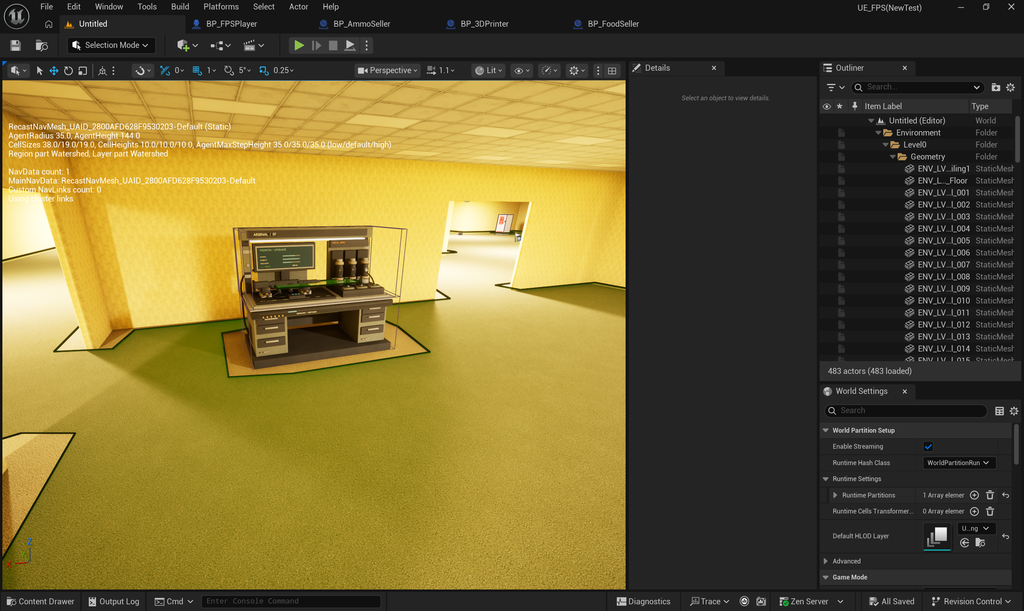
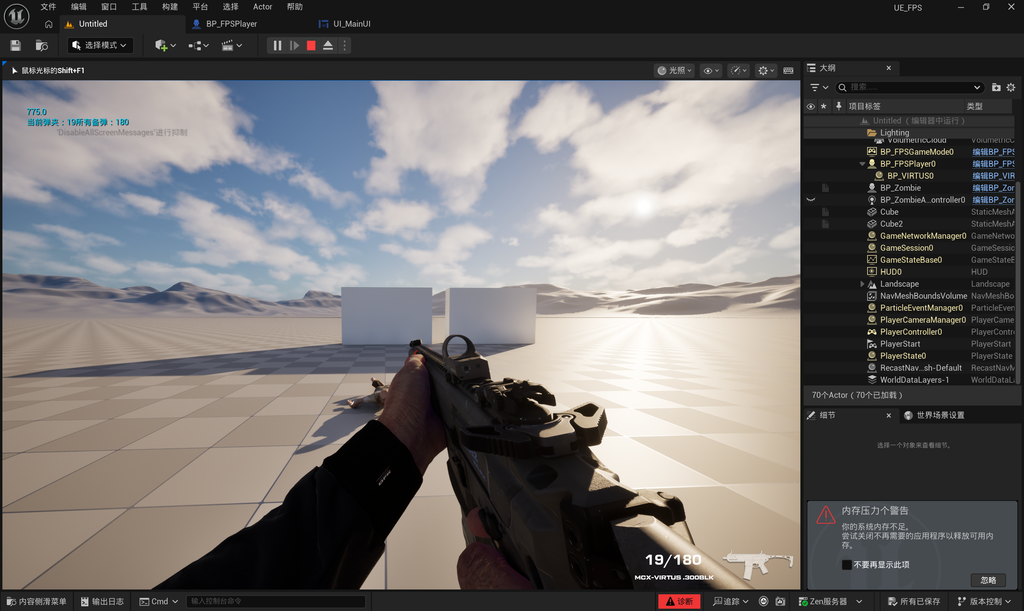
Over the past six weeks, I have used Unreal Engine 5 to develop Backroom DoGoJo from an initial concept into a functional, playable game prototype.
The current prototype features an expansive “Level 0” environment, creature replication and synthesis, a currency collection system, equipment upgrades, experimental data gathering, an in-game shop, a quest system, radio-based guidance, monsters, and a furniture-crafting mechanic via 3D printers. The furniture serves practical purposes, such as restoring Sanity, replenishing armor, and repelling nearby monsters.
While the prototype incorporates most of the core gameplay systems I originally envisioned, it remains an early-stage build with significant room for improvement.
Reflection
Looking back at the development process, one of the project’s primary shortcomings is its lack of accessibility for players with limited or no prior gaming experience. Although I have implemented quests, radio guidance, subtitles, and interactive prompts, certain mechanics may still prove confusing for newcomers. I believe the game requires further refinement—specifically regarding the tutorial, user interface, and the nuances of player interaction—to ensure a clearer and more comfortable gameplay experience.
Additionally, the current scope of the project is somewhat excessive; it encompasses a vast array of content modules. Moving forward, it would be beneficial to curate and streamline these elements to optimize the production workflow—a step that would be especially critical if this were to evolve into a team-based project.
Future Development
Should Backroom DoGoJo be selected as a group project for the upcoming semester, there are numerous avenues for further improvement and expansion.
Art and Asset Development
I believe this area offers the greatest potential for enhancement. Currently, several key assets—including firearms and creature models—are free, third-party resources used solely for prototyping. In future development, I intend to replace these with original models of my own design. This would not only provide an opportunity to further develop my skills in 3D modeling (including hard-surface modeling) but also help establish a more cohesive visual style throughout the game. Level Design and Exploration
The current “Level 0” environment remains relatively sparse, and I believe there is significant room to enhance the exploration experience. I plan to incorporate more interactive elements—such as puzzles, hidden areas, and a system where players must locate ID cards to unlock new locations. Looking ahead, I also intend to create gateways to other “Backrooms” levels, allowing players to discover further layers and unlock additional engaging content.
Gameplay and Player Experience
I aim to further refine the game’s guidance and progression systems, ensuring that even players unfamiliar with the mechanics can easily grasp how the game works.
Overall, I view the current prototype as a foundation for future development rather than a finished product.
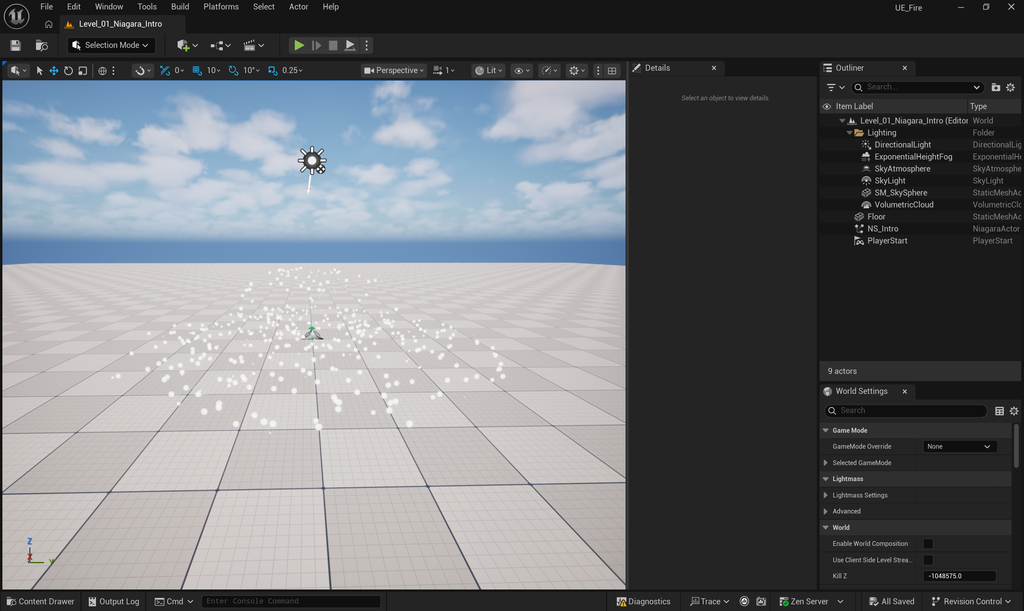
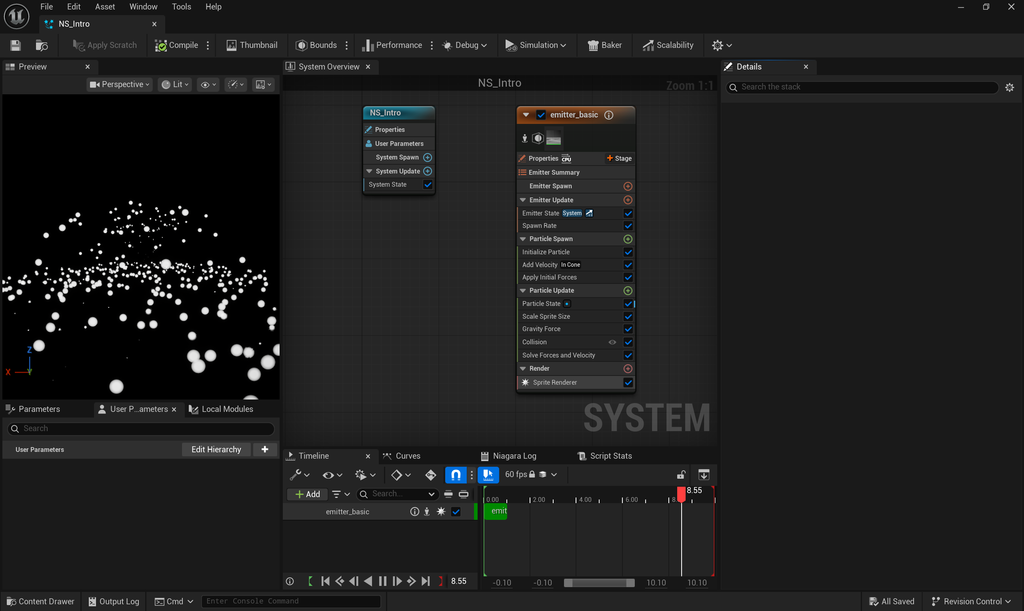
This week I didn’t spend a lot of time working on my personal project. I mainly spent my spare time learning how to create Niagara VFX in UE. This is the tutorial I referred to, and I completed 13 out of 20 parts of the tutorial this week. Here’s my work and notes.
This is the scene at the beginning of this lesson, briefly explaining how to use the Niagara system and particle emitters, including how to add turbulence effects to particles and the effect of upward force.
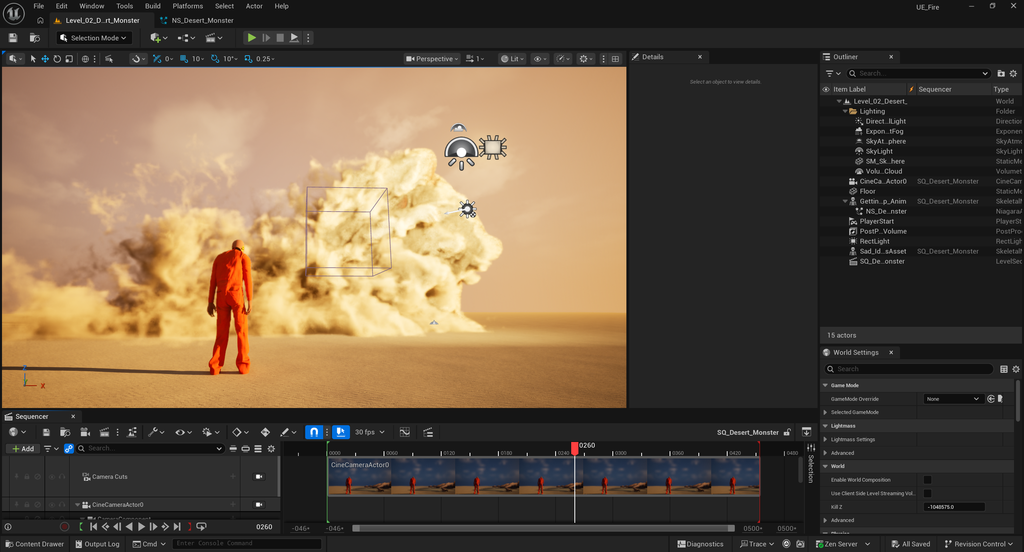
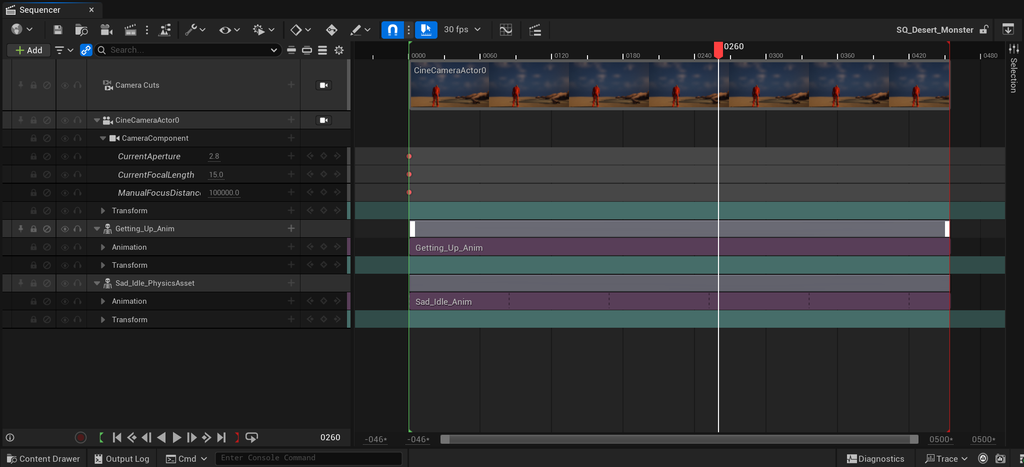
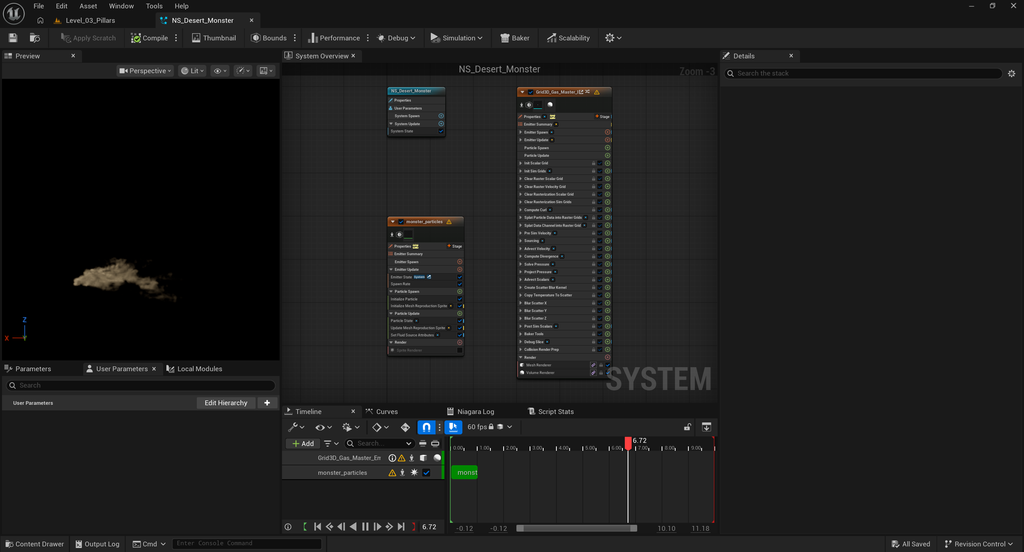
The second tutorial covers the creation of a “desert monster” scene, incorporating a timeline with special effects. The core technique involves generating a large number of emission points across an object’s surface and rendering them. From these points, sand is emitted—achieved, in this case, by tinting a smoke effect to resemble sand. Once the basic sand-emission effect is established, global turbulence and wind forces are applied, allowing the sand to be blown in the desired direction. Overall, the resulting effect is quite impressive.
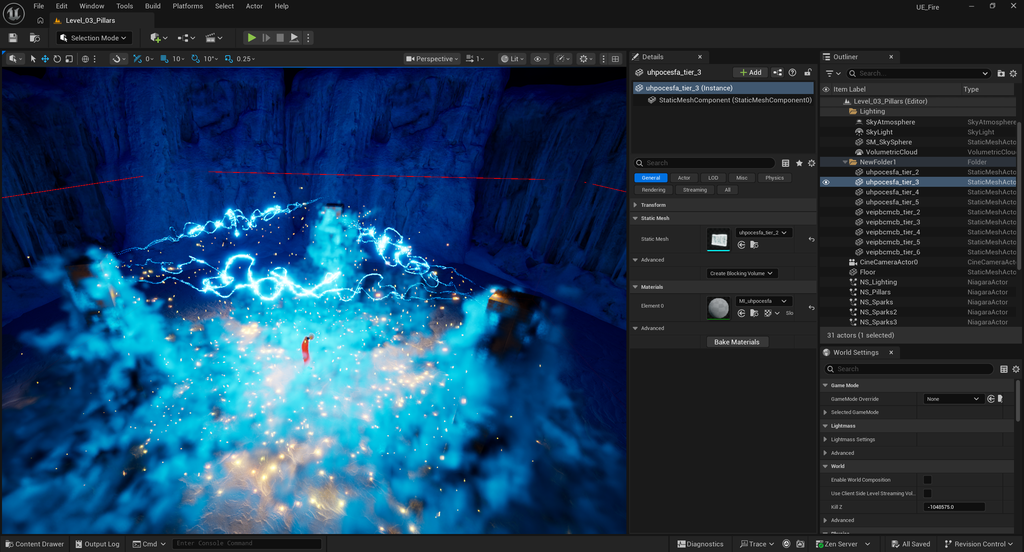
The third scene involves the creation of a magic circle, which is formed by three pillars; it’s a sequence that combines various different visual effects, and I think the result turned out quite well.
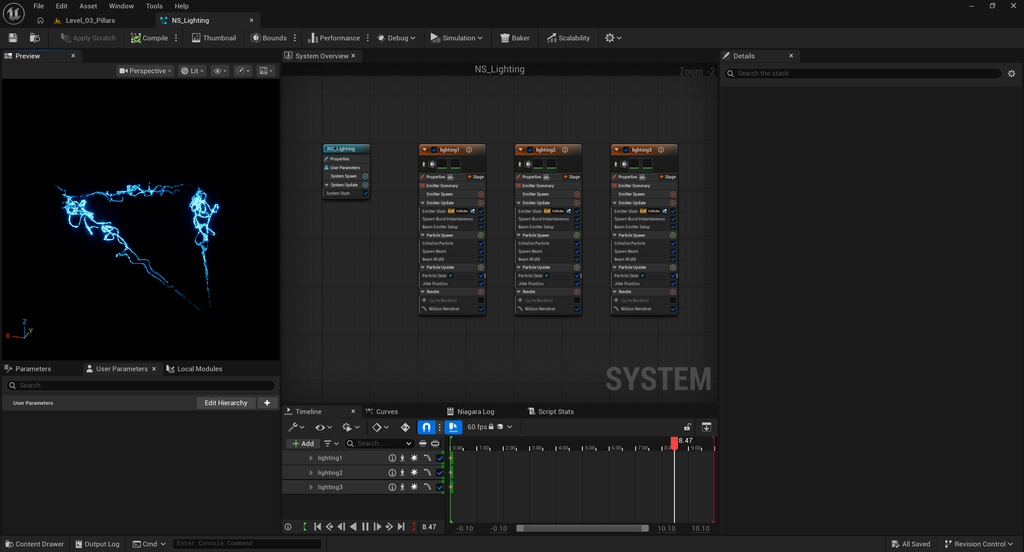
First, let’s look at the creation of the three lightning effects. Essentially, each lightning bolt is a beam formed by a series of small, consecutive light orbs generated along a straight line. To achieve the glowing effect, the color intensity (or percentage) is set to around 30%. Noise-based displacement is then applied to the beam, creating a constant, vibrating motion—most intense in the middle section, with a slightly lower amplitude of vibration toward the ends. Finally, duplicate the lightning effect twice, then adjust the start and end points for each instance so that they align with the tops of the respective pillars.
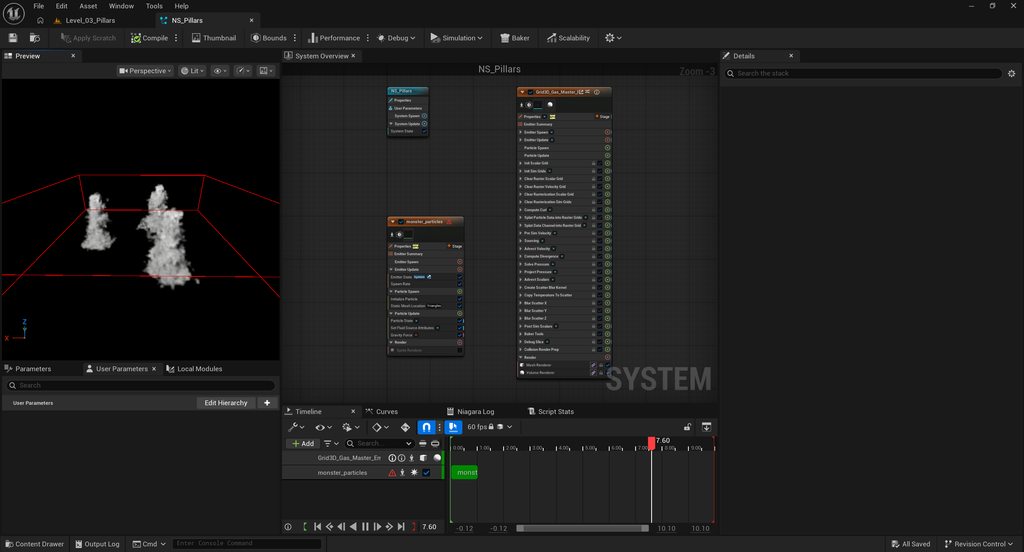
The special effect for the icy mist on this pillar is essentially the same as the one used for the desert monsters. You just need to change the object the effect is applied to, remove the wind influence, and set the mist to sink downward. Additionally, you’ll need to add collision and a gravity system to the mist; as for the color, adjusting it to blue will give it that icy, frozen feel.
Finally, there are the yellow sparks alongside the lightning. Essentially, these consist of glowing particles being continuously emitted from a line into the surrounding space—a relatively simple effect to create. Honestly, though, combining various distinct visual effects into a single scene is quite fun, and the resulting visual impact is really impressive.
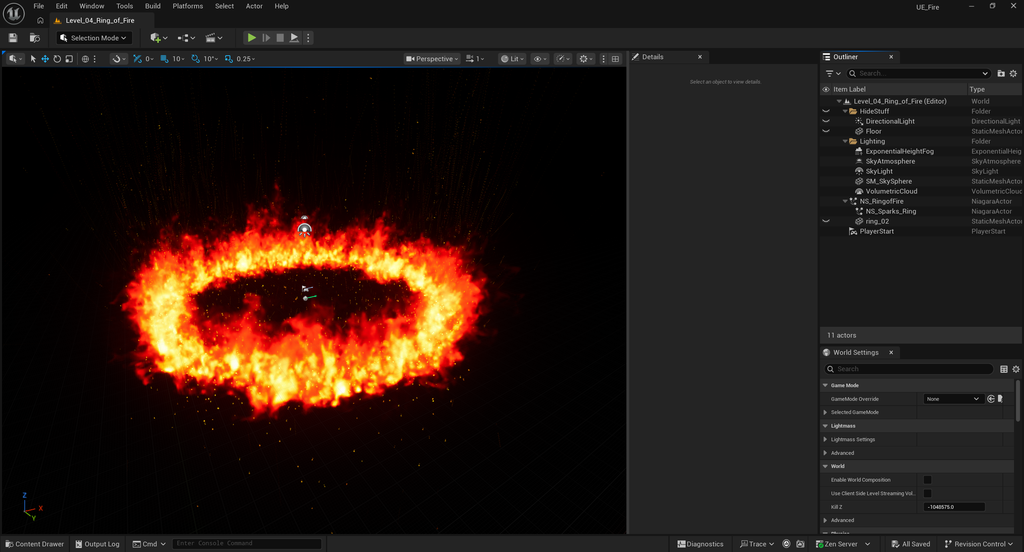
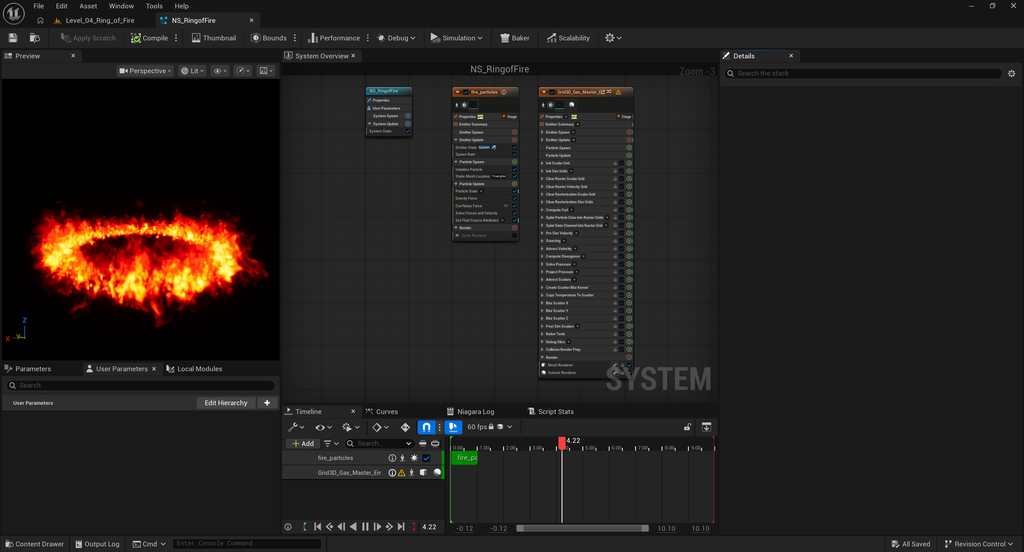
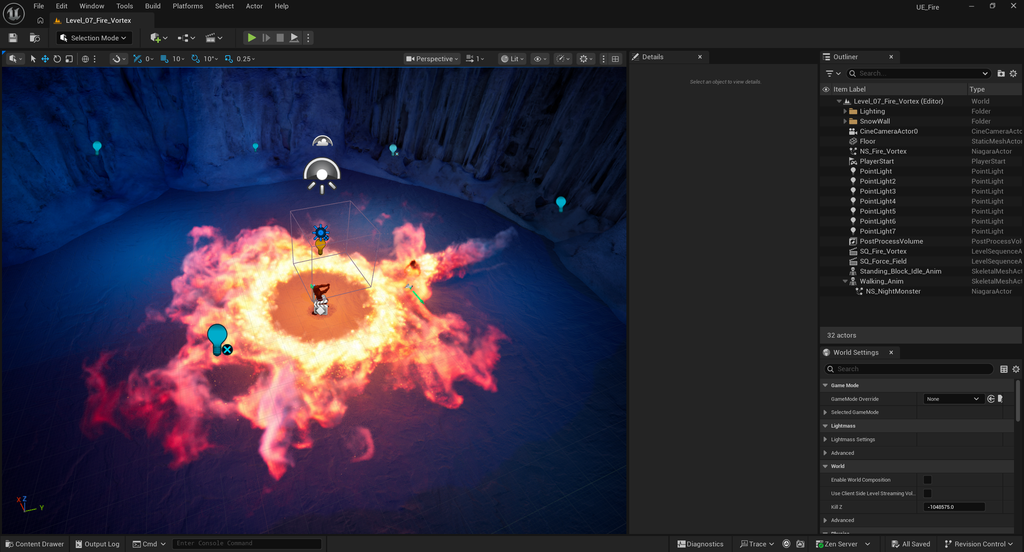
This scene focuses on the creation of a “fire ring.” The core task involves configuring the temperature system within the emitter—specifically, raising the temperature to trigger the generation of flames. The underlying logic remains largely the same: there is a physical ring-shaped model, upon which numerous small points are distributed to serve as emission sources. These points then act as the foundation for generating the flame effects. In this particular setup, I opted not to include any smoke, resulting in a “cleaner,” more focused appearance for the flames. By incorporating the spark effects from the previous scene, the final effect for this sequence was achieved.
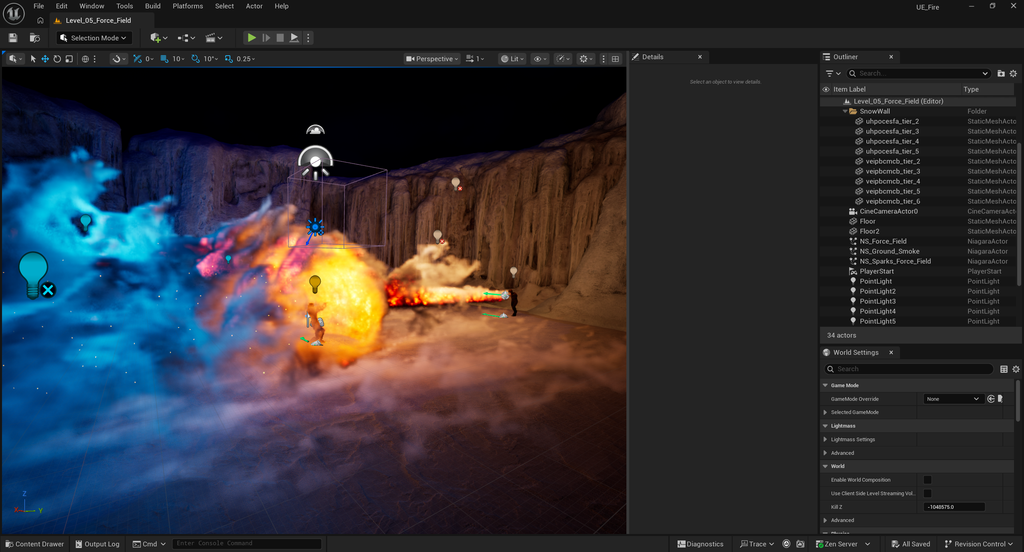
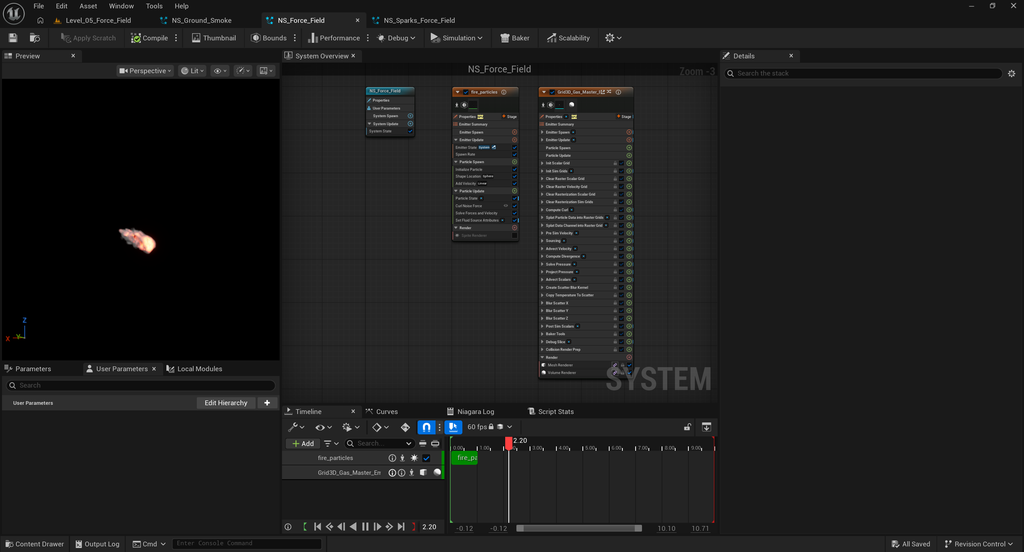
The special effect for this scene involves creating a defensive force field; I will briefly explain the basic logic behind its creation. In reality, this spherical force field—which is struck by incoming fire—is actually a transparent sphere.
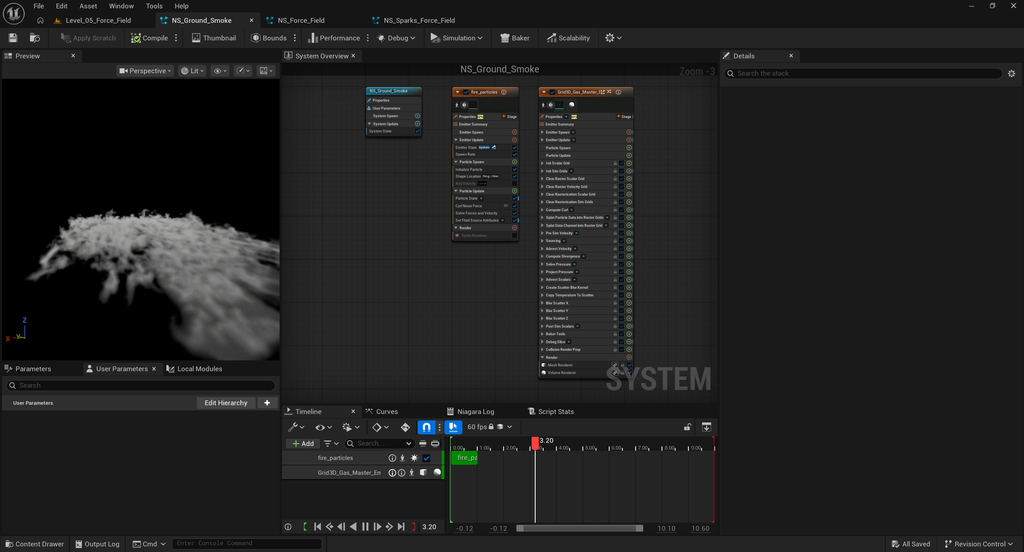
First, there is the ground-level smoke effect, which is generated by feeding data from a large, disc-shaped area into a separate fluid grid. The temperature channel is disabled, leaving primarily the density component to form the smoke. Wind and turbulence cause it to spread and roll across the ground, enhancing the atmospheric quality of the environment.
Fire-spewing visual effects: First, “source particles” are generated and propelled forward, continuously injecting density, temperature, and velocity into a 3D grid (Grid3D). The grid then calculates the flow, buoyancy, and turbulence, which are ultimately rendered as volumetric fire and smoke. In short: the particles provide the raw input, while the Grid3D transforms that input into flowing fire.
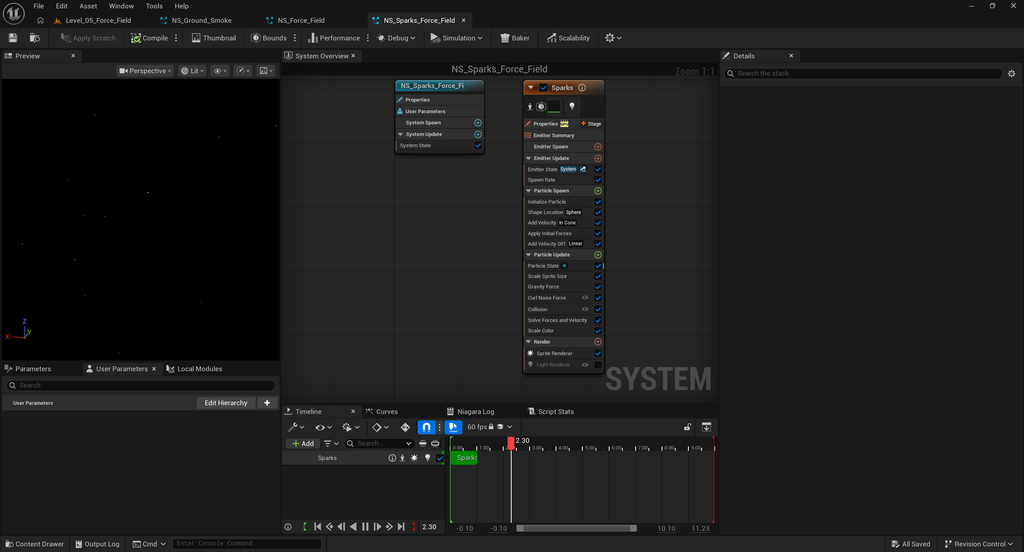
Finally, there is the creation of sparks on the spherical shell. Essentially, this involves generating a large number of small particles on the shell’s surface, setting them in motion, and then altering their trajectories using gravity, noise, and collisions. This effect is designed to convey the scattering and energy released upon impact—a standard particle effect.
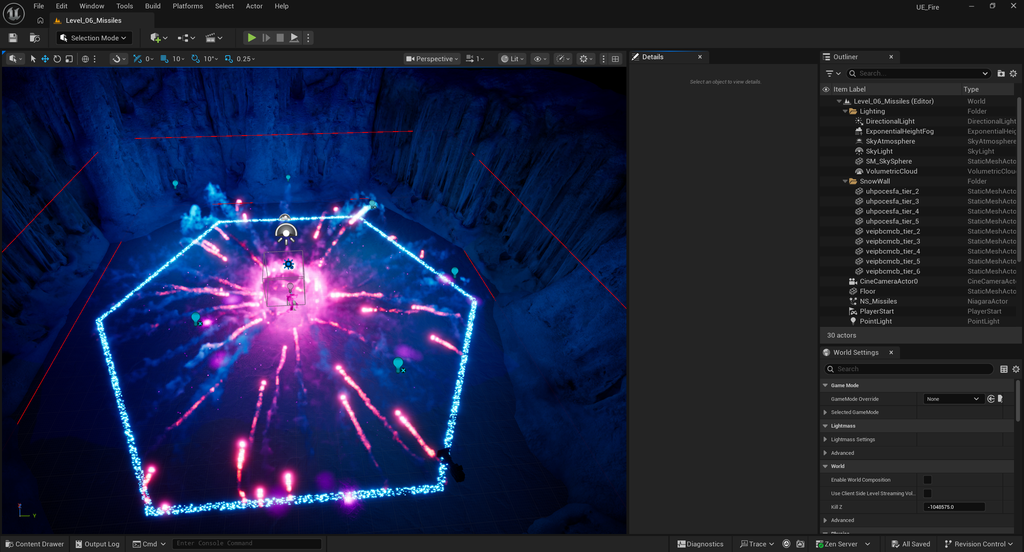
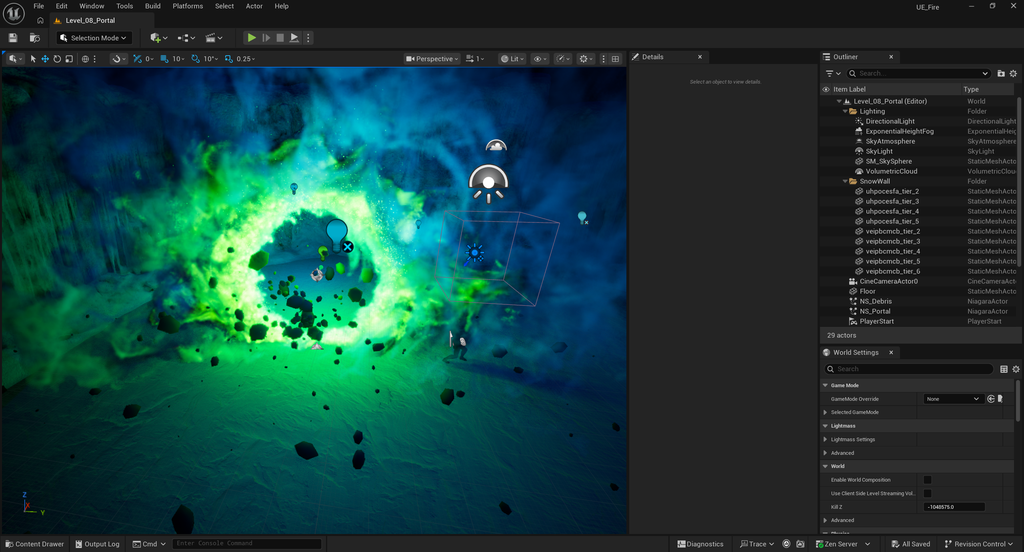
The final special effect created this week is relatively large and complex. It begins with a hexagonal magical field: a large number of glowing blue particles are generated along the edges of the hexagon to form a magic circle on the ground, indicating the area of effect for an attack.
Next are the sparks that scatter toward the center. The underlying principle is that the generated particles are first assigned a random upward velocity, and are then pulled toward a central target via a “spring force.” The initial velocity propels them outward and upward, while the attractive force curves their trajectories back, creating the impression of particles converging from all sides toward the center; meanwhile, drag governs the pace of their movement.
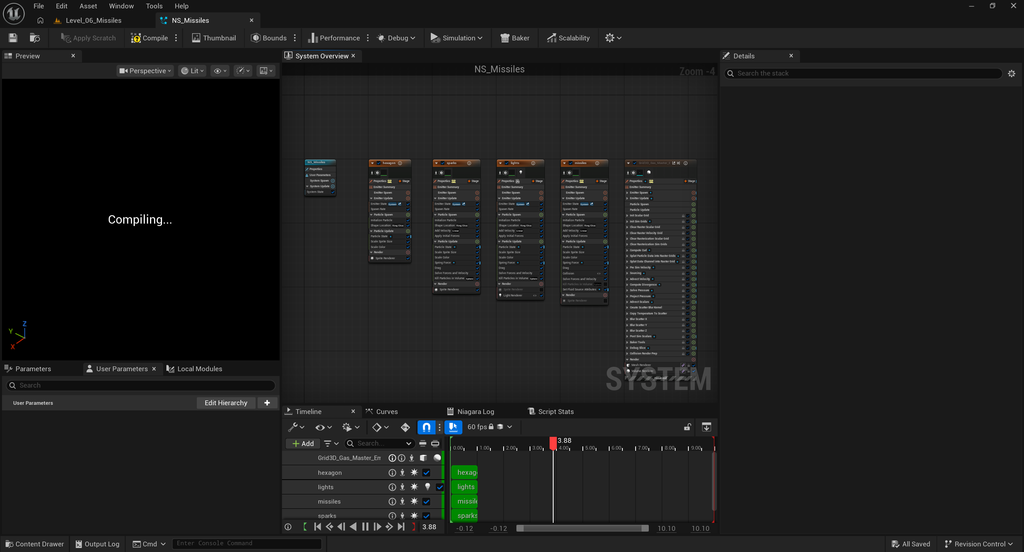
After replicating the Mars-themed visual effects, you can create effects for “magic missiles”—though some adjustments will be required. The flight trajectory is determined by initial velocity, spring forces, and drag. Furthermore, these projectiles feed their position, velocity, density, and temperature data into the fluid grid, effectively acting as “moving emitters” that leave a trail of smoke and fire in their wake.
Missile trails: By drawing from the missile’s emission source, the flow, the rolling motion, and the dissipation of smoke and fire are calculated within a 3D grid. As the missile moves forward, the smoke released previously remains behind, creating a trailing effect. Temperature primarily influences the luminosity and upward buoyancy of the flames, while density is the main factor in the formation of the smoke.
Finally, there is dynamic lighting: particles equipped with light renderers illuminate the ground and the surrounding environment, creating lighting shifts during an attack. This system handles the actual illumination of the scene, while the intrinsic emissive color of the particles themselves ensures they appear to glow.
This Friday, I presented the latest progress on my game prototype and explained its core concepts. However, because I spent too much time this week learning about special effects, I didn’t make much headway on the actual gameplay. As a result, the prototype’s playability isn’t quite where it should be, and there are several issues that will need to be addressed later. I plan to spend the weekend refining the existing content and adding new elements to the game.
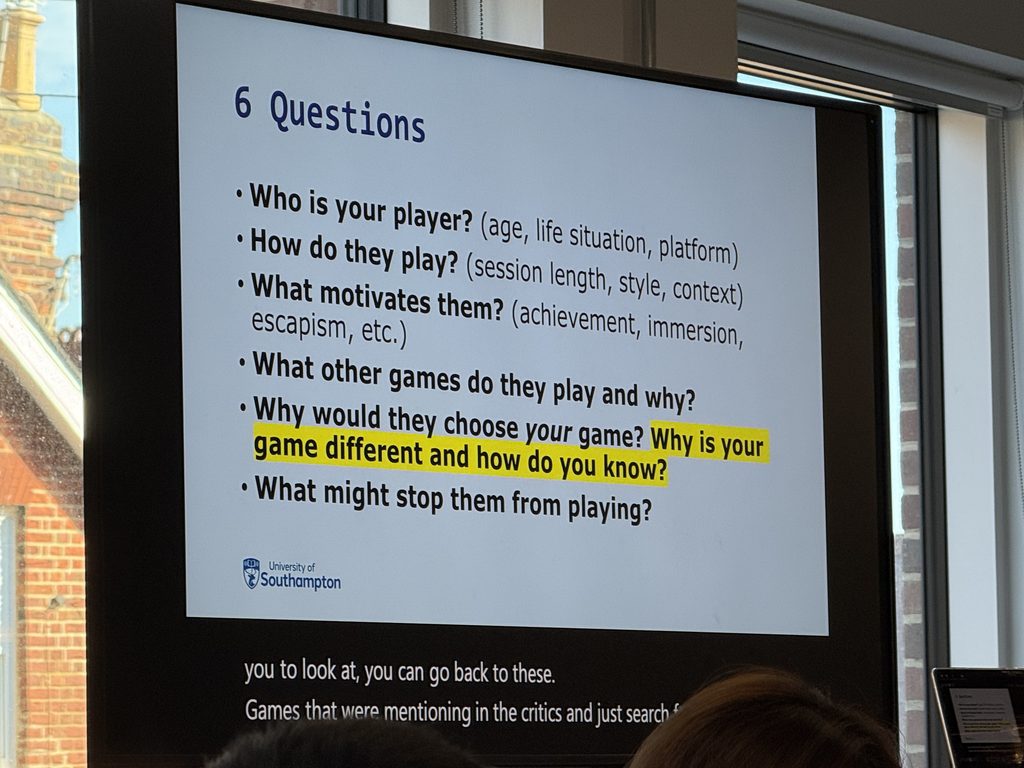
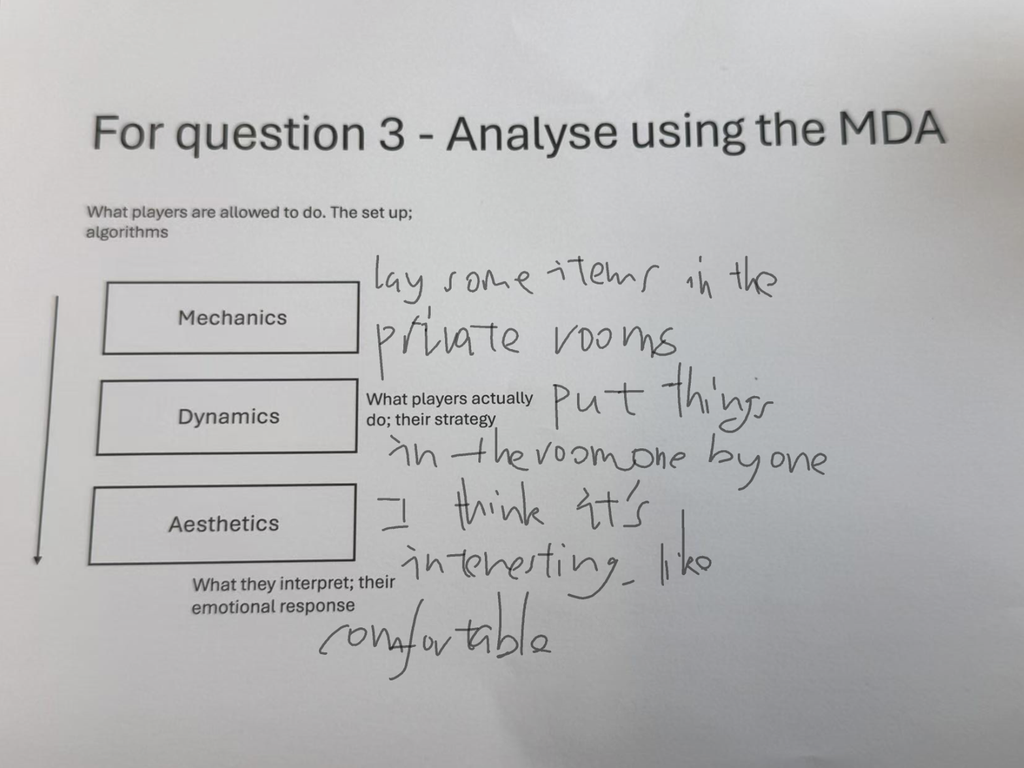
This photo was taken during class this past Monday. To be honest, I only really considered this question as I was developing the game—or perhaps it’s more accurate to say I had the answer in mind from the very beginning. I envision this game for players who aren’t particularly interested in combat or killing, and who might find typical horror games distressing—people looking for a sense of comfort within a horror-themed setting. Naturally, the primary audience would likely be fans of farming simulators and management or raising-simulation games.
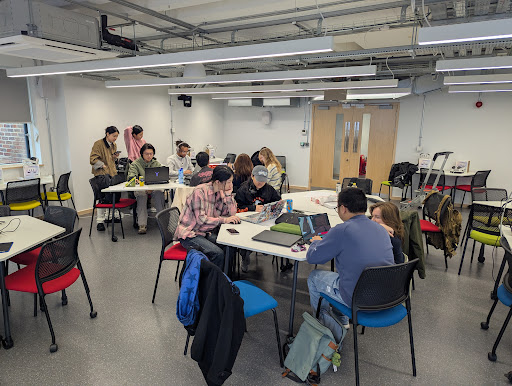
On Monday afternoon, we conducted a fairly professional playtest. An expert instructor evaluated the game and provided a great deal of feedback. To be honest, the optimizations I made over the weekend didn’t turn out well; the playtest revealed many shortcomings—to the point where, in my view, the game is currently barely playable. There are still significant issues with the core game loop, map exploration, and the utilization of map space.
Next, I will demonstrate the specific improvements I made to my project this week, along with the problems these changes addressed. I have used red and black text to present these points in a side-by-side comparison.
Feedback “Sound of money” effect ⭕️ Incorporate audio cues when collecting money to enhance the player’s sense of financial gain ⭕️
These two changes are primarily intended to enhance the feedback players receive when collecting money. In the initial version, there was no feedback whatsoever when a player picked up money from the ground—no sound effects and no “vacuum” or “suction” visual effect. During testing, my instructor suggested adding these elements to encourage players to collect money.
Add visual or sound feedback when items are ready to be combined ⭕️
In the initial version, when a player picked up a chick by pressing ‘E’, a green border would appear around it; however, this border remained unchanged during the crafting process. Through testing, I discovered that the presence of this static green border didn’t necessarily help players understand how the game’s crafting system actually works. Players need the border to change during the crafting process to determine whether a specific crafting action can be performed—which is why I implemented this change.
Enable a gameplay loop where players can scavenge for items in open areas ⭕️
Introduce blueprints for creating new types of chickens to prevent players from getting stuck or aimlessly running back and forth ⭕️
In the original version, the map was extremely sparse, offering little incentive for exploration. By introducing “ground data” required to unlock higher tiers of chicken synthesis, players are now compelled to venture out, explore more of the map, and then return to their original location. This is a pivotal change—one that fundamentally shapes the game’s core loop and determines its overall viability.
Implement a radiation mechanic and a weapon upgrade system 🚫
This change was ultimately not implemented. The primary objective was to ensure that as players ventured further from safe zones, they would face increasingly greater threats. In the current version of the game, I’ve adapted this by having monsters possess higher health the further they are located from safe areas; I will consider incorporating this mechanic more fully in future game development.
Core gameplay loop: players earn money, explore the map for resources, combine chickens to generate more wealth, and upgrade equipment (e.g., radiation resistance, increased damage, and unlocking new ammo types) ⭕️
This content serves as an annotation for the overall revisions, outlining the player loop experience that we aim to achieve within the game.
Guide players through a few essential introductory points before letting them loose in the larger open world, rather than dropping them into an empty space with no direction ⭕️
During playtesting, it was observed that players would initially wander the map somewhat randomly, failing to engage with the game’s core objectives and often becoming disoriented. This suggested a need to teach players the basics before letting them loose in the game world—a crucial insight. However, my actual implementation takes a slightly different approach: I keep the “chick” unit hidden at the start, allowing players to explore freely. If they haven’t found the chick after a certain amount of time, the game automatically teleports them to its location. In practice, this method has proven to be just as effective—if not better.
Monster spawning and character models ⭕️
In the test build that launched at the beginning of this week, there are no monster spawns, which means the game completely lacks a terrifying, exploratory atmosphere—not what I’m aiming for. Furthermore, the placeholder monster model is currently just a zombie; I need to create custom “Backrooms” monster models and implement a spawning mechanic to flesh out the experience.
“Angry Birds”-style mechanic 🚫
This system was originally designed to encourage players to return to their original location after exploring the map. I haven’t implemented it yet, but I plan to in the future. The system is quite complex to implement, requiring consideration of both ensuring the chickens can kill each other to reduce their numbers and the speed at which this cannibalization occurs.
Alerts for declining SAN (sanity) levels ⭕️
In the game, players will die if their Sanity (San value) drops too low; however, since the game content doesn’t explicitly highlight this, I need to add appropriate prompts or indicators.
Structures that restore SAN, repel enemies, and provide bonus armor ⭕️
The purpose of this content is to enhance the role of furniture in the game. In the original game, furniture items are merely decorative models that can be placed around; they do not contribute to a player’s sense of security. I feel this falls short of my intended vision for this system, so I need to add features that allow players to perceive their collection of furniture as a true sanctuary.
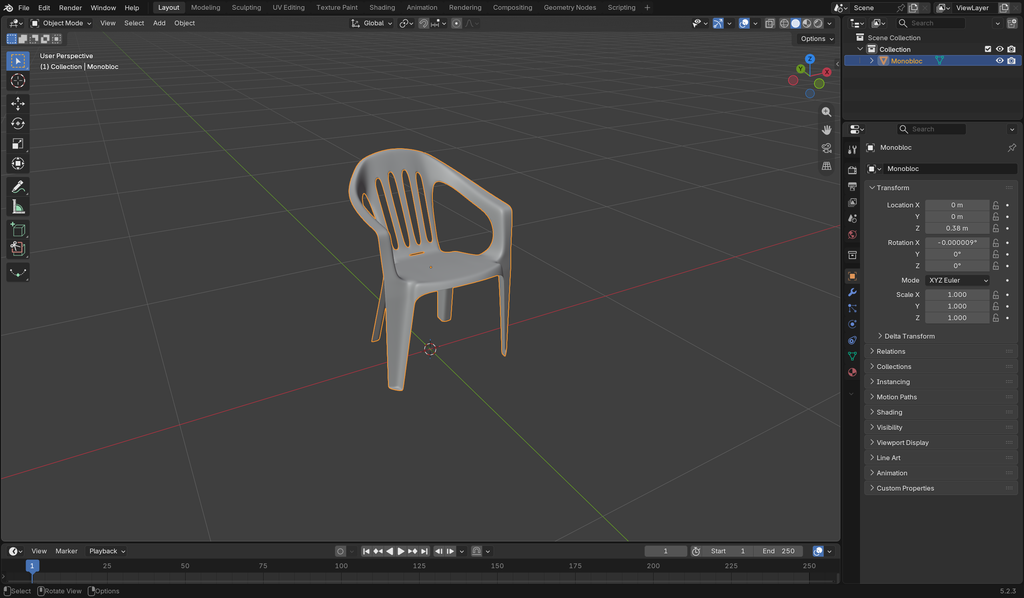
A special “Vergil” chair ⭕️
This content enhances the playability of the furniture system.
On-screen prompt for switching ammo types (using the ‘Q’ key) ⭕️
The initial version lacked a prompt indicating that players could press ‘Q’ to switch ammunition—a feature that had essentially been overlooked—so we have added this functionality during this week’s development.
Encourage players to shoot chickens to create multiple copies before combining them (currently, some players pick up the chickens immediately upon seeing a prompt, bypassing the intended combination mechanic) ⭕️
In the early stages of the game, the prompt instructing players to press ‘E’ to study a chick—which appears before the chick has a chance to replicate—ends up being more misleading than helpful. This needs to be adjusted to better guide players in learning the chick-crafting/synthesis system.
A quest system that directs players toward combining chickens (highlighting this as a core gameplay loop) ⭕️
Initially, the game lacks any defined tasks or objectives; players might simply leave after testing the chicks a bit. I would like to see players engage in a gameplay loop that centers more around the chicks.
Subtitles and a dedicated button to review past radio transmissions (allowing players to focus on gameplay without needing to constantly listen, and providing a way to catch up on missed dialogue) ⭕️
This content serves to improve the instructional system.
Monster health increases as they get closer to the edge of the map, scaling up to a maximum of 300% ⭕️
This addition enhances the sense of depth in the map; players face a greater threat from monsters the further they venture toward the outer areas. In practice, however, I’ve found that the level of threat posed by these monsters remains somewhat insufficient—it will need to be increased further down the line.
A progress bar for “paper” (resources) to show how much is needed for the next level 🚫
After careful consideration, I have decided not to change this aspect. I want players to remain uncertain about exactly how much content they have collected; this adds a layer of ambiguity to the collection process, encouraging players to spend more time exploring and to undertake more exploration runs.
Introduce more distinct variations for chickens at different levels to make leveling up feel more rewarding and surprising (crucial—simple changes in size alone aren’t enough to make a level-up feel significant) up)⭕️
This comparison touches upon the game’s core loop. From the very beginning of the design process, the upgrade system for the chick was intended to be the primary gameplay loop and the main source of surprise for the player. Initially, these upgrades simply increased the chick’s size—an approach that was undeniably dull and made it difficult to gauge the chick’s actual level. Consequently, this change represents a crucial adjustment.
Eating food no longer requires pressing ‘E’ or ‘F’; it now depends on where your crosshair is aimed. 🚫
This is essentially a bug; I discovered during testing that pressing ‘E’ in certain locations could trigger things you didn’t intend to activate. I felt that distinguishing between ‘E’ and ‘F’ was a good idea, so I decided to keep it.
Added a crosshair. ⭕️
little change.
Included a settings menu (sensitivity, music volume, and toggle for ‘E’ key interaction—tap vs. hold). ⭕️
Enhance the completeness of the game
Upgrading a chick causes it to “spit out” money. ⭕️
This addition primarily enhances the positive feedback players receive when merging chicks, encouraging them to engage in the merging process more willingly.
Added prompts to inform the player about the two designated weapon-upgrade zones. ⭕️
The feedback regarding the game’s content emerged following a playtest this past Friday; no changes have been implemented yet. Overall, the playtest went quite smoothly. Players with prior gaming experience will likely find the game accessible and easy to pick up. For those with less gaming experience, the experience might be a bit more challenging, though still within an acceptable range. Moving forward, my optimization efforts will focus on refining details and lowering the entry barrier—specifically by improving the tutorial system—to ensure that even less experienced players can quickly grasp how to play the game.
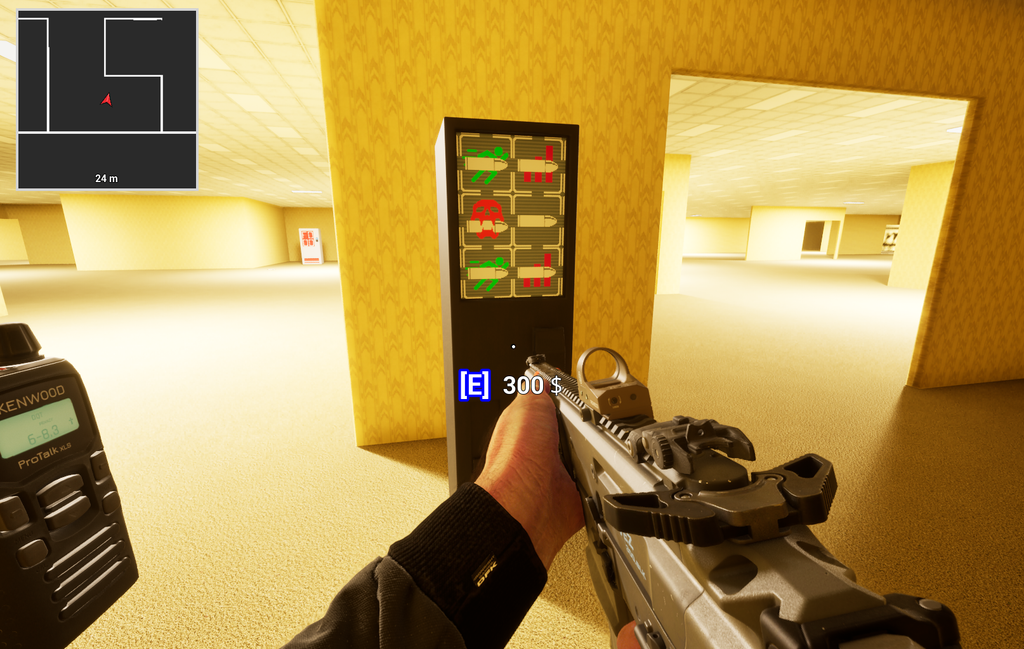
Refined the map. Added cues indicating that players can fight enemies. Prevented switching to locked ammo types via the ‘Q’ key. Added on-screen prompts for all basic controls. Changed chair interaction to “tap to grab.” Implemented a tutorial-based progression to unlock features gradually. Reduced player mobility while on the phone. Added a “Recall” (log) UI accessible via the ‘Tab’ key. (Ensuring consistent game pacing is crucial.) Added a prompt regarding the “10 o’clock” position. Added a UI for the ammo vending machine. Calls are answered automatically after three seconds. Added the option to decline calls; call content is logged directly to the ‘Tab’ menu. Added a UI prompt (for the first five instances) explaining that aiming at another chick of the same level allows for merging.
This week, I continued working on the Niagara tutorials and completed the entire set of instructional content.
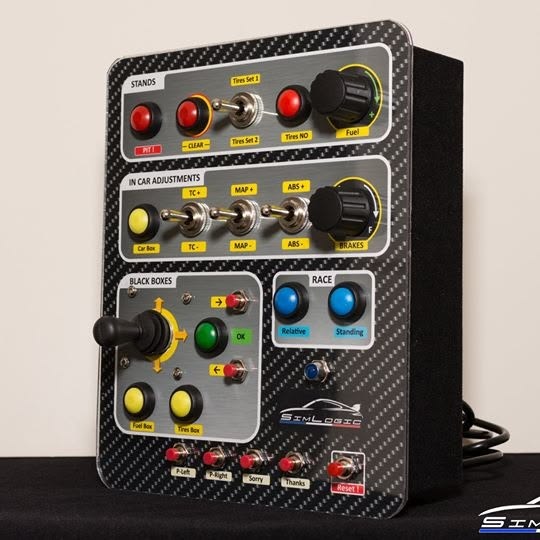
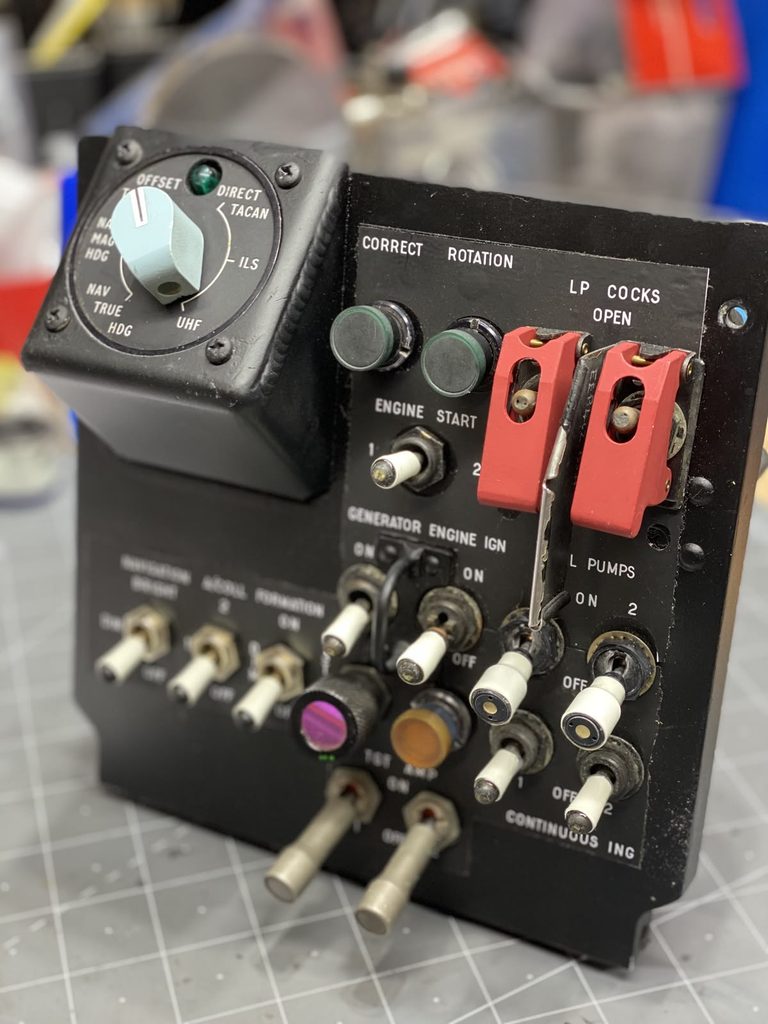
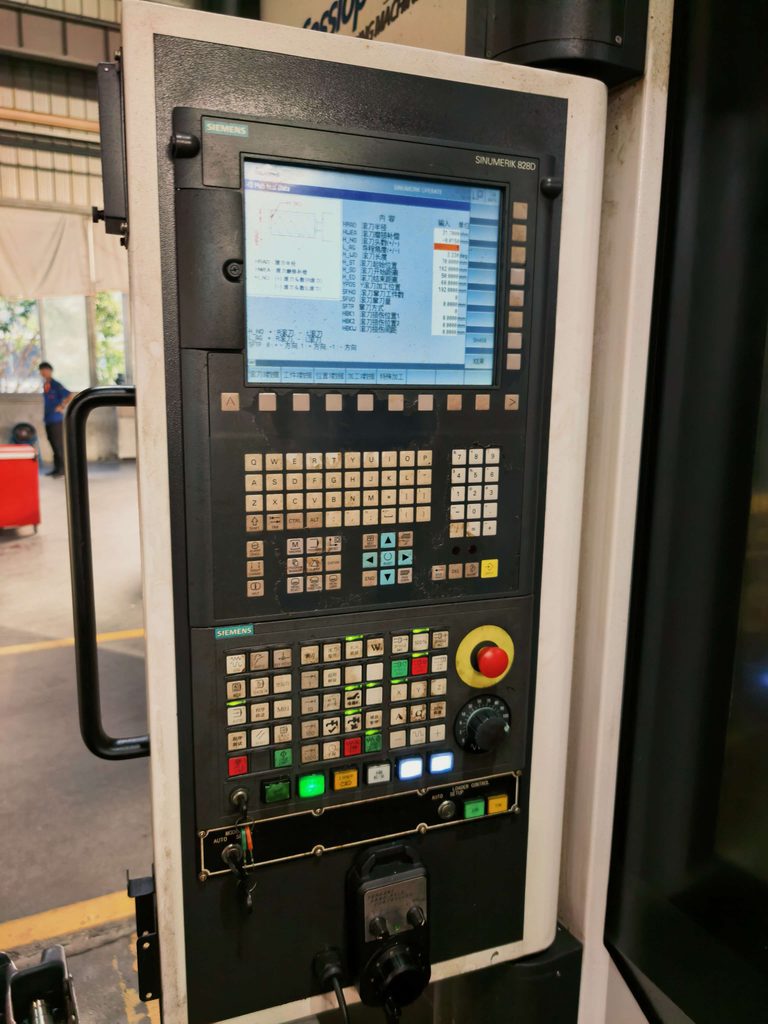
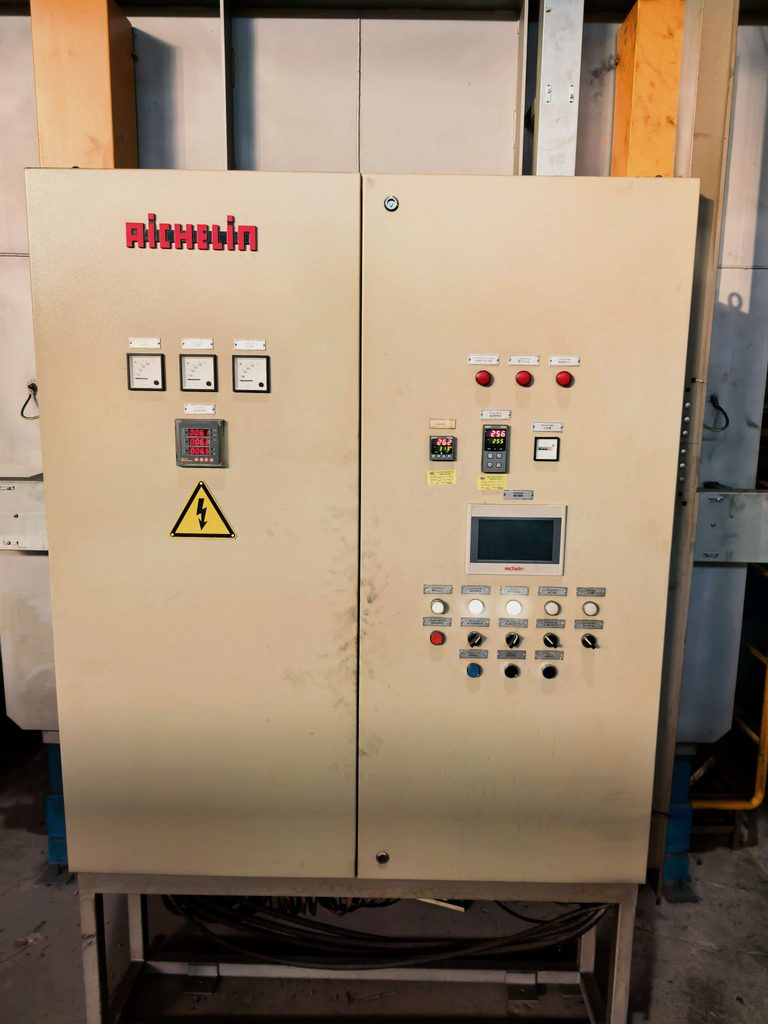
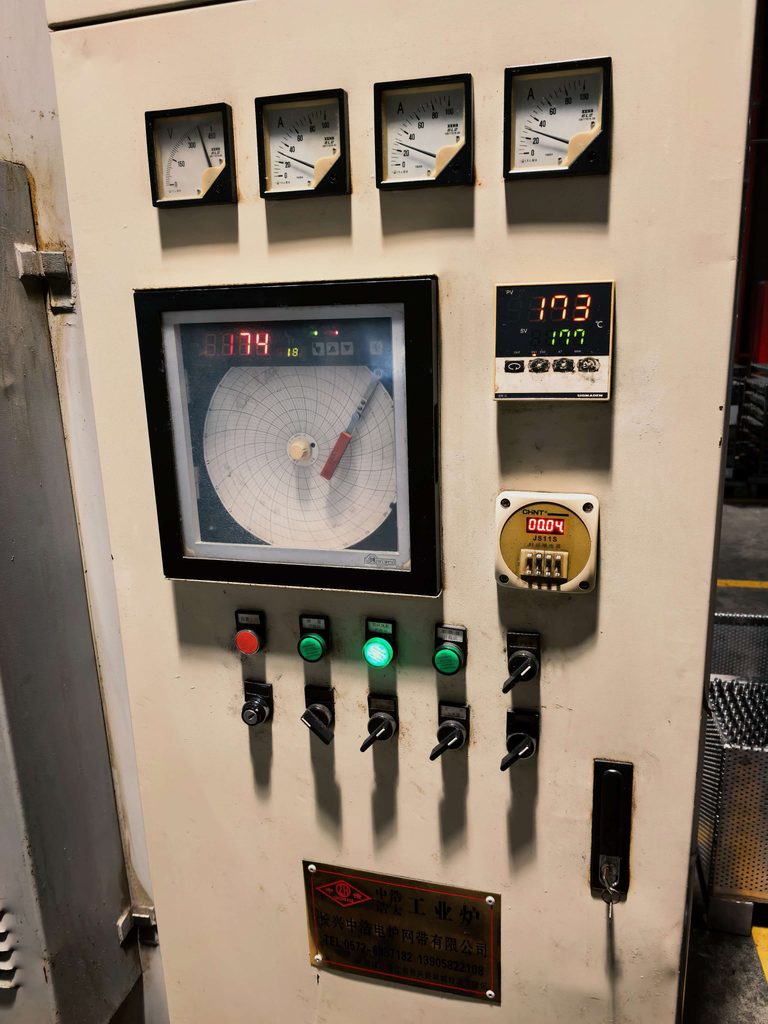
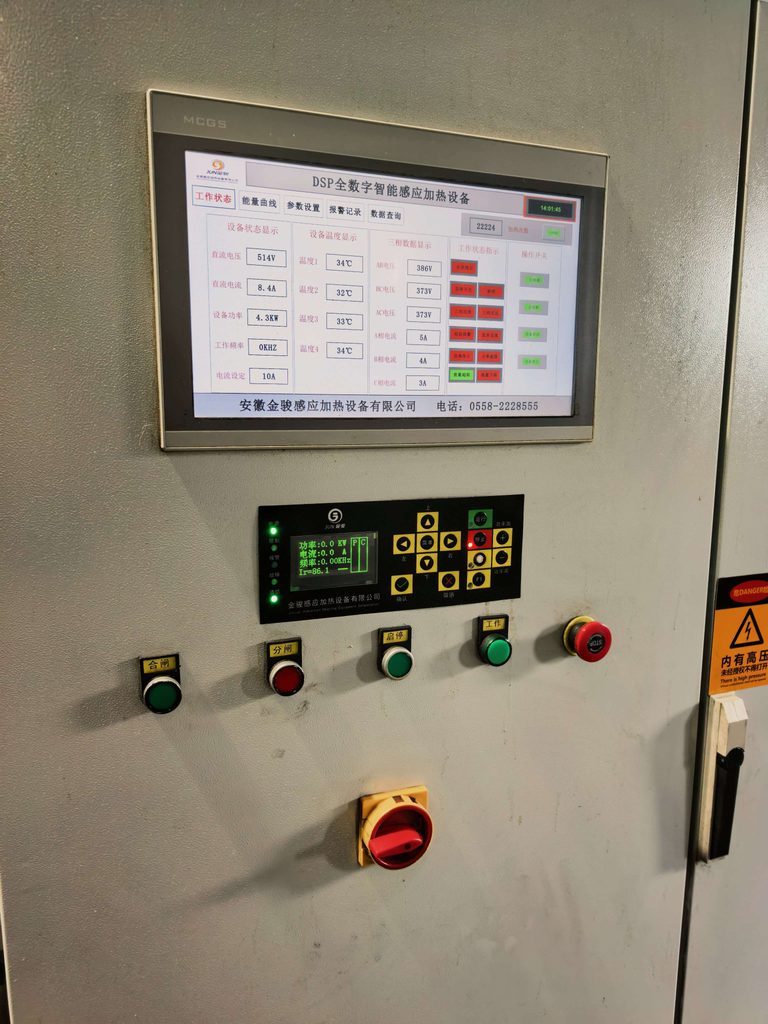
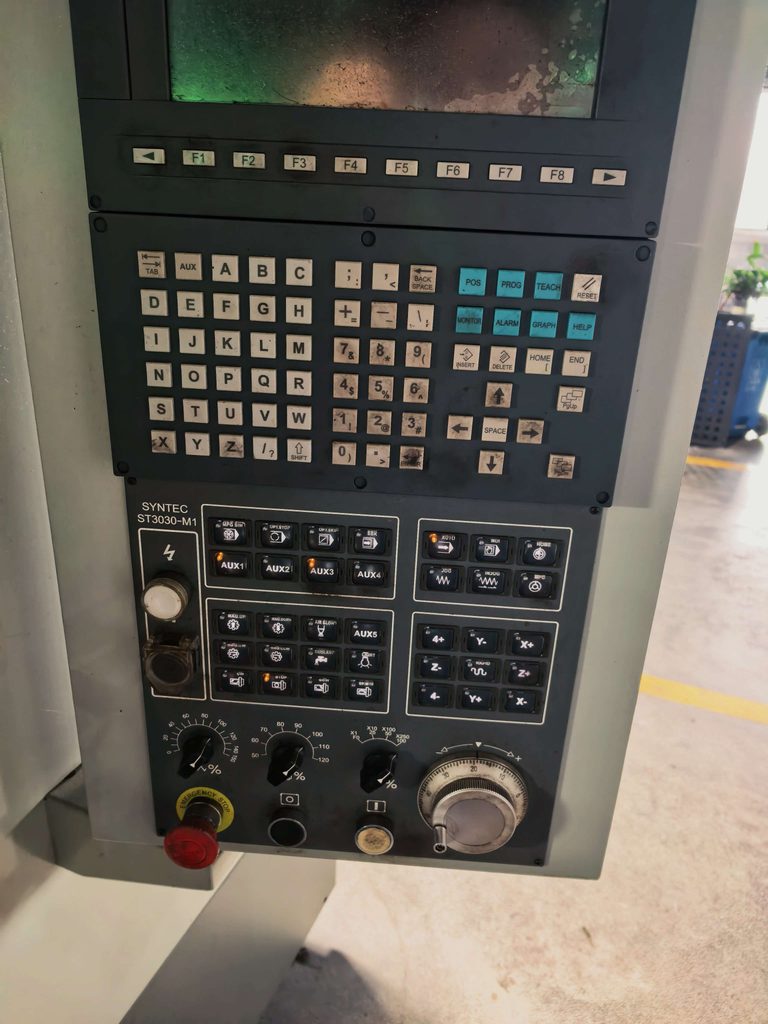
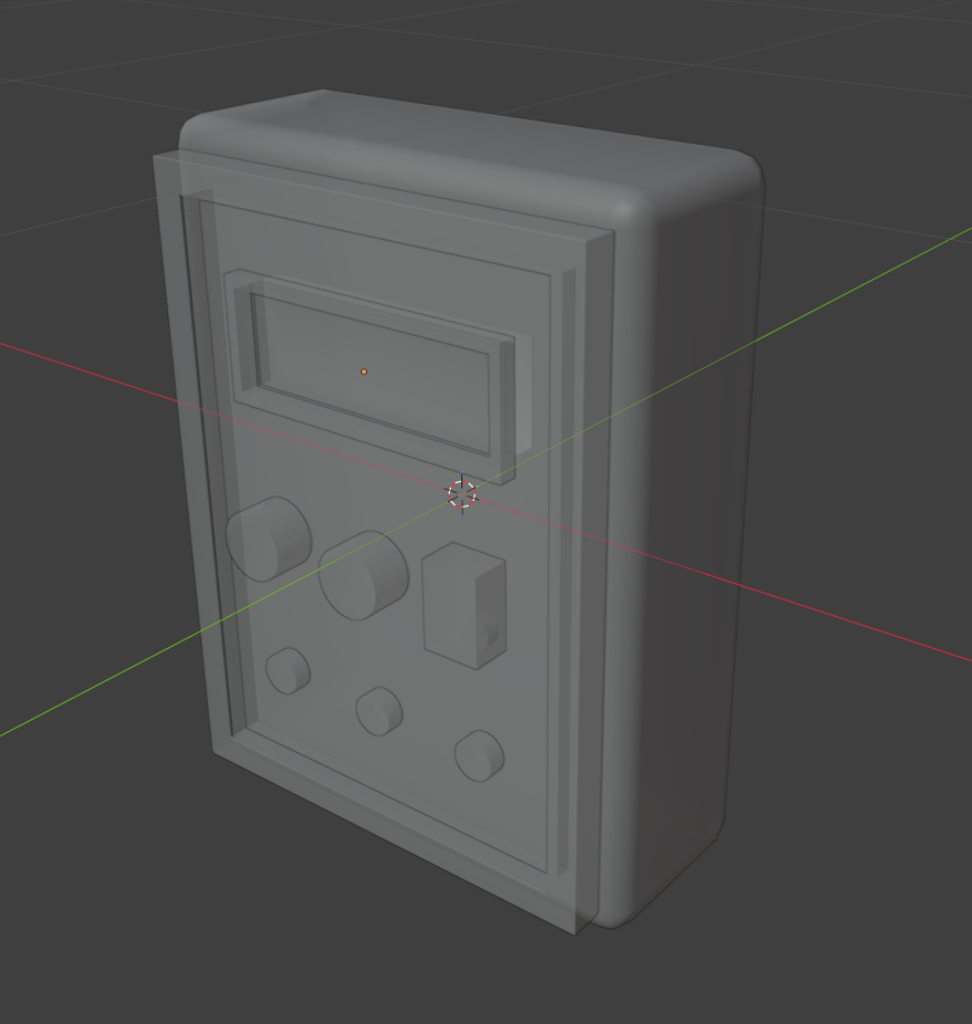
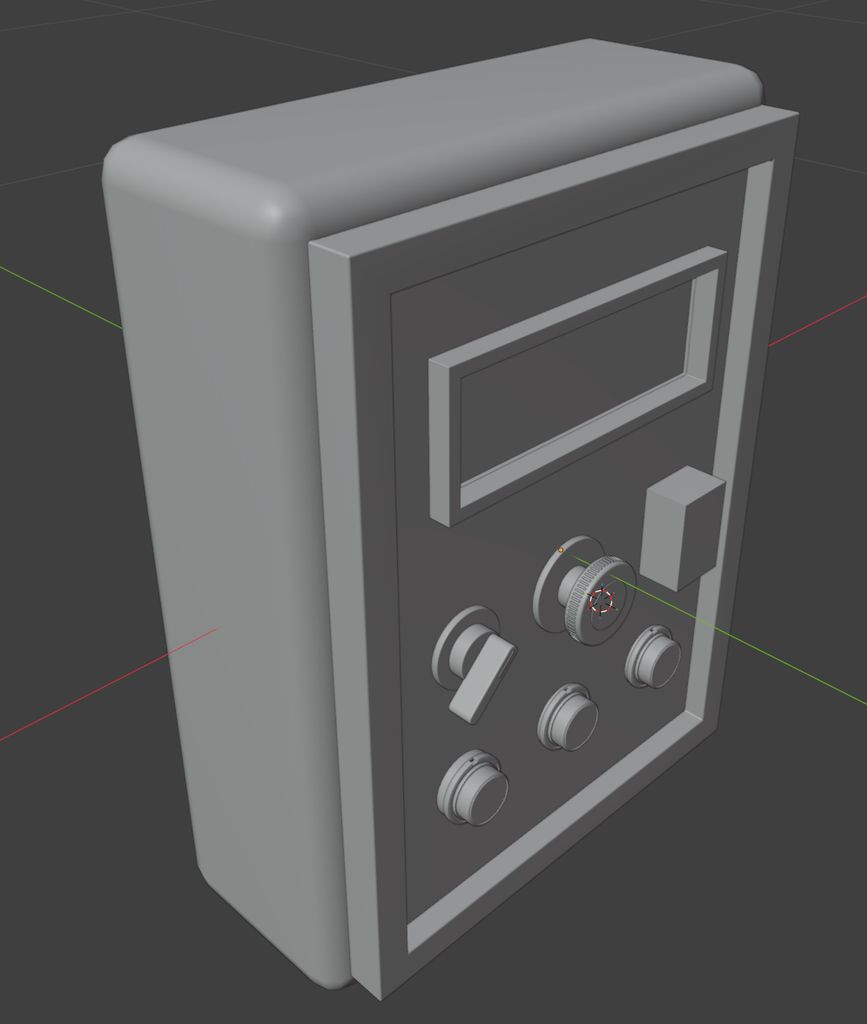
This week, I began a personal study plan focused on high-precision modeling and the production pipeline for AAA-quality game assets. I anticipate needing to create various in-game interactive props—such as ID card slots, control panels, and buttons—during the mid-to-late stages of this project. Consequently, I’ve decided to start by modeling a control panel, dedicating some time to it each day.
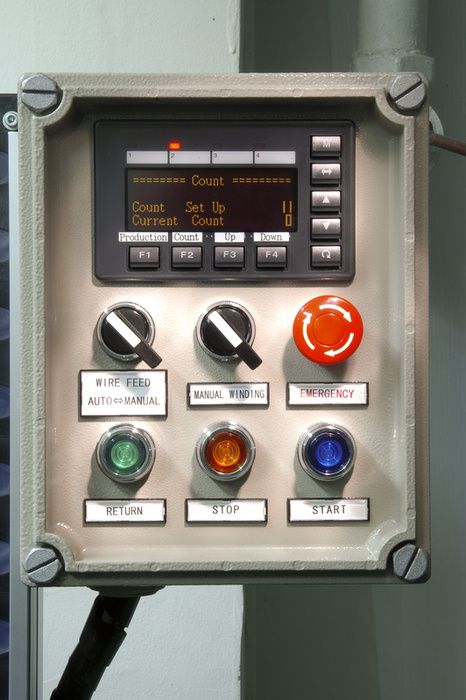
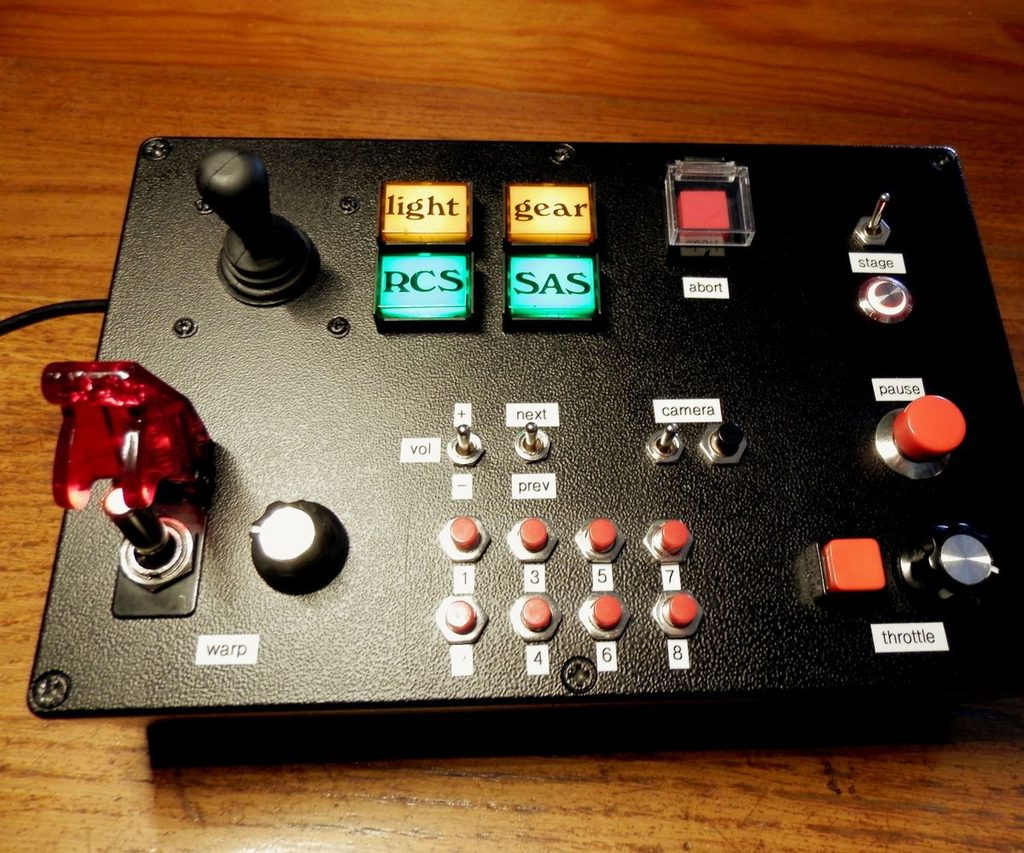
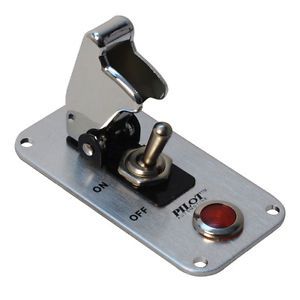
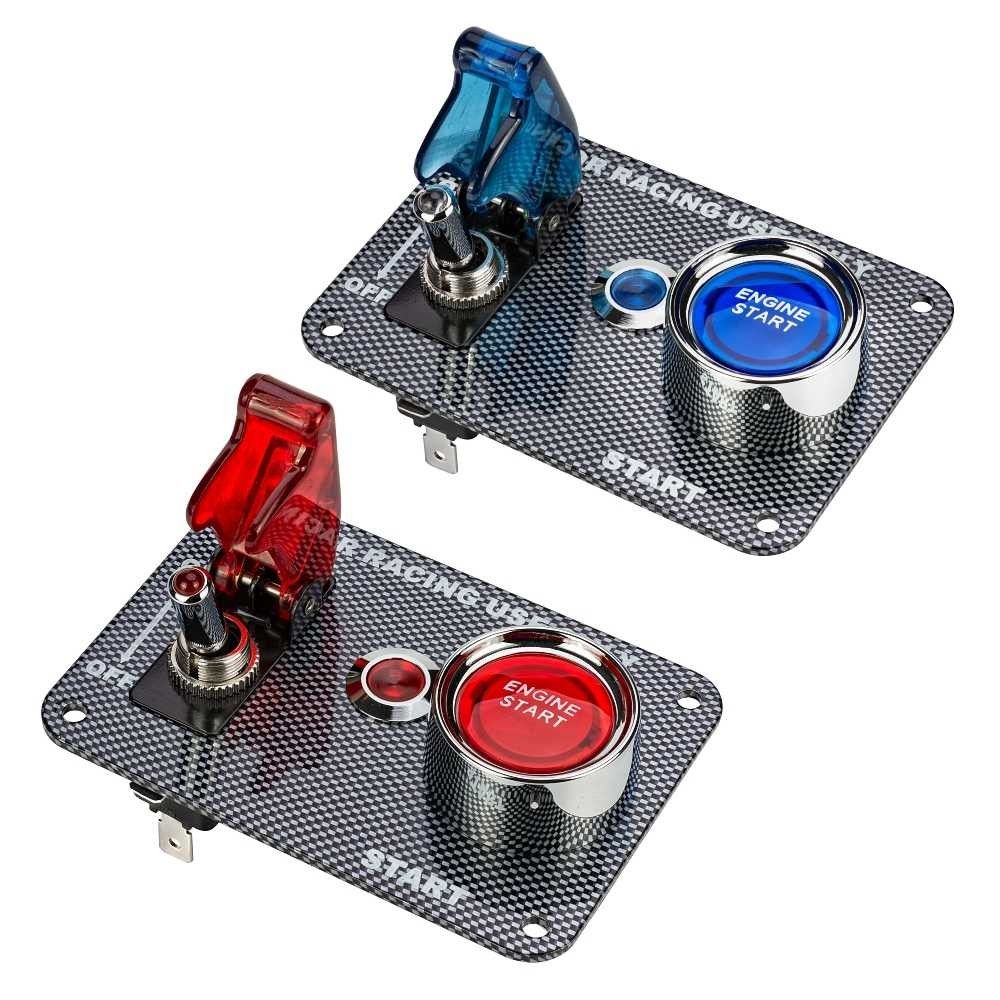
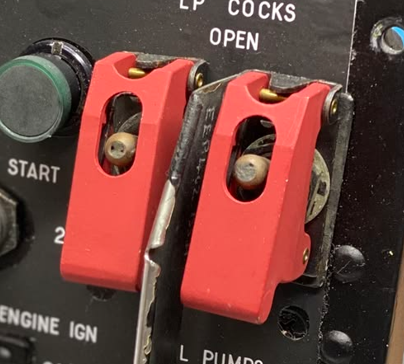
The content above is primarily sourced from the internet and served as a reference for me while creating the control panel. Additionally, I reached out to my family, who took some photos of actual control panels in a factory for me.
I think the research behind this content is excellent; it’s very helpful for my workflow.
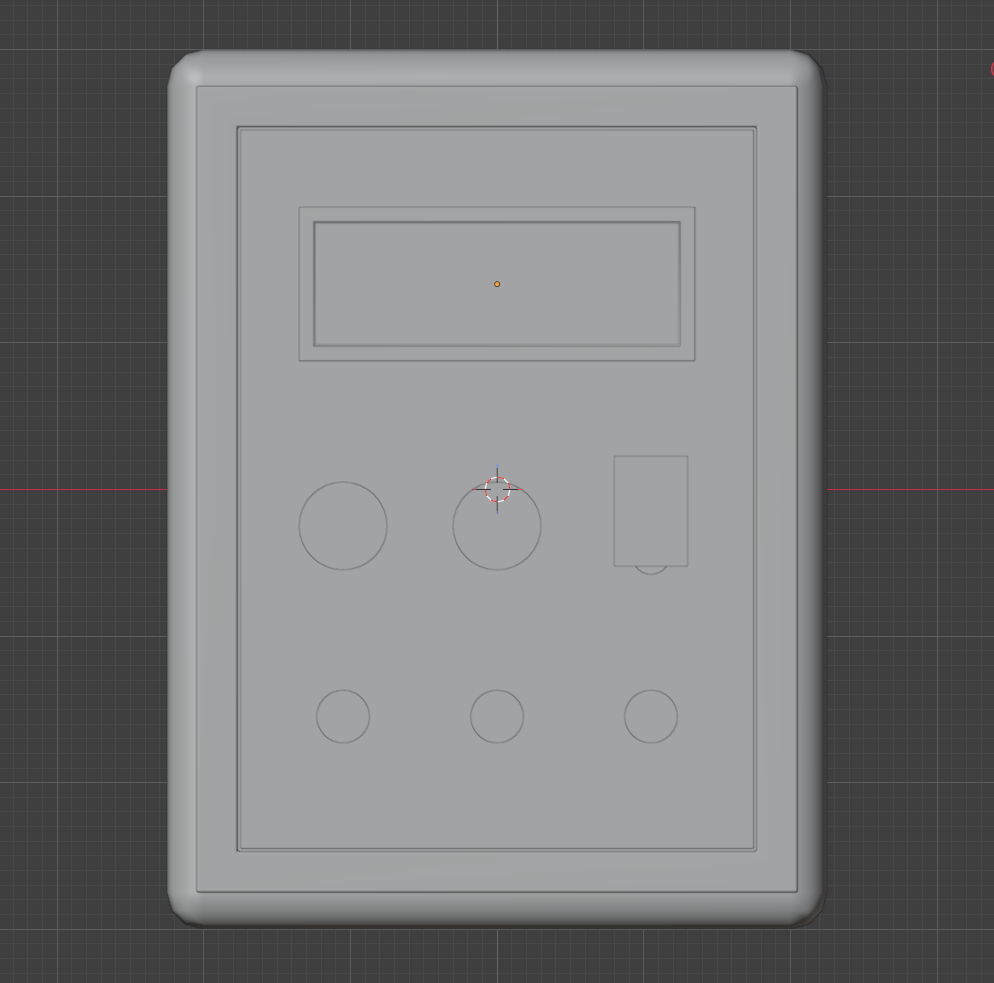
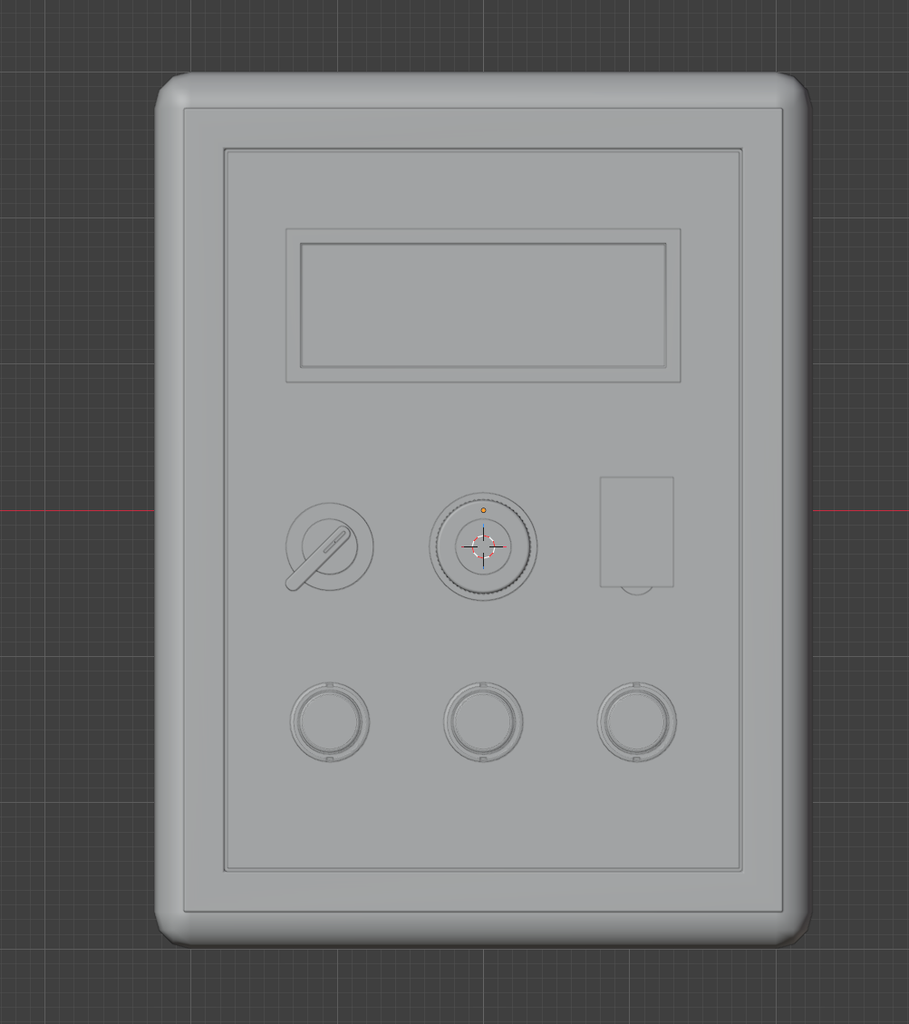
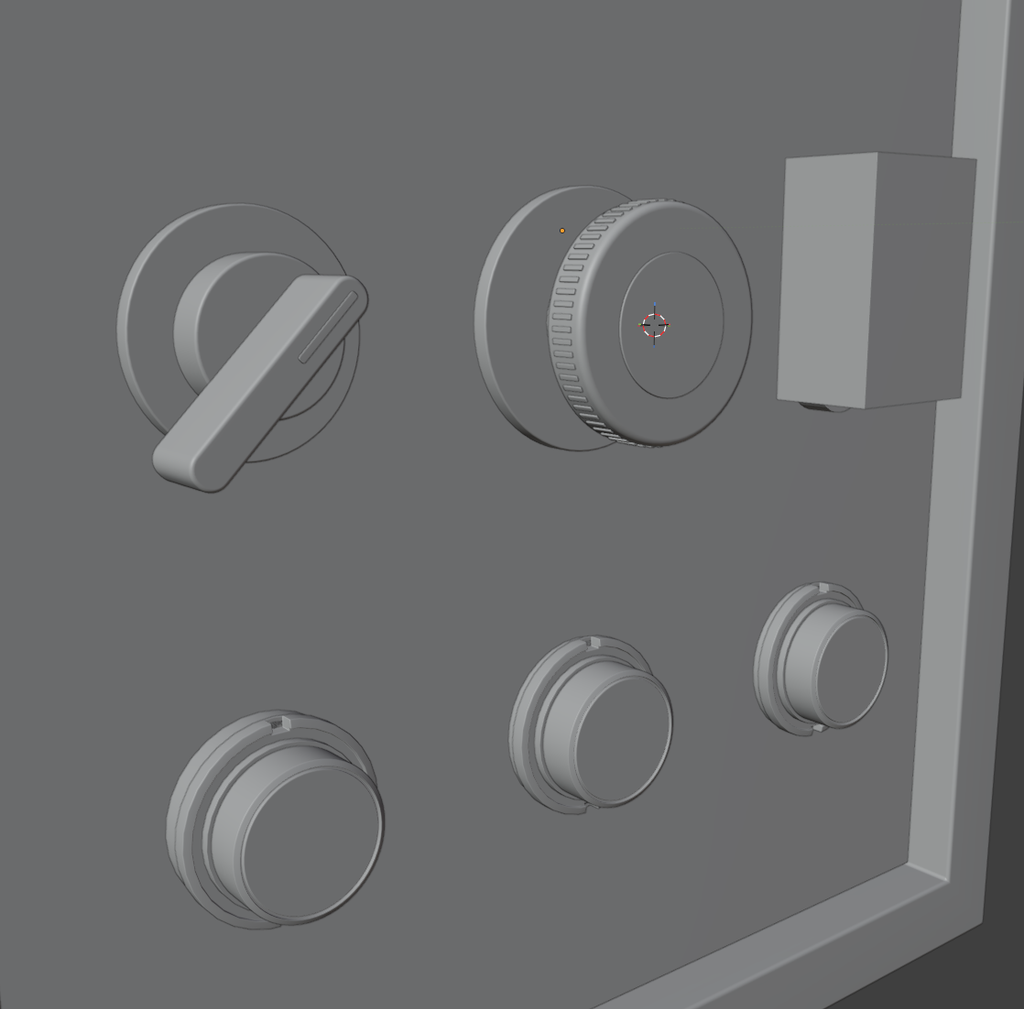
To begin, I drafted an initial concept for a control panel. While I incorporated some assets found online, I customized and redesigned the buttons themselves. My goal was to treat this project as an exercise—specifically to practice creating a wide variety of buttons—in order to sharpen my proficiency in hard-surface modeling, rather than simply repeating the same two or three button designs across the panel.
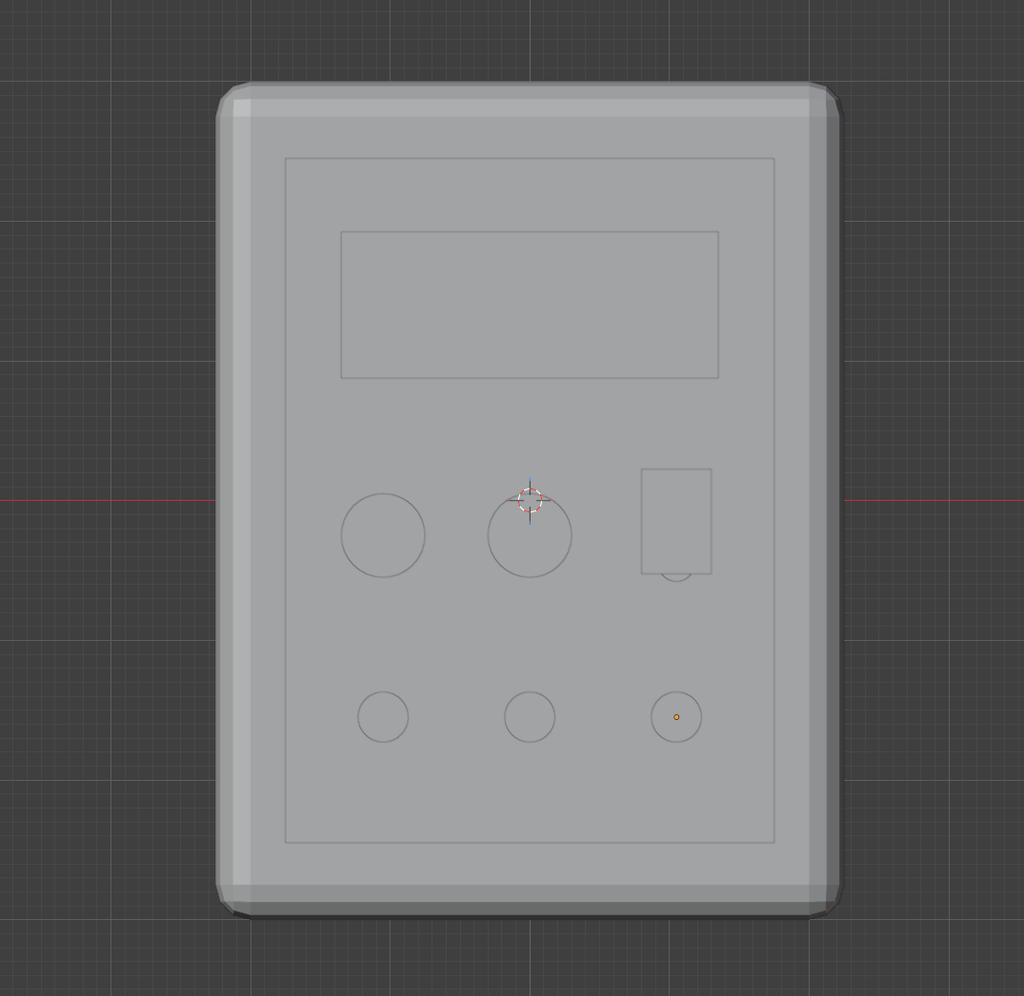
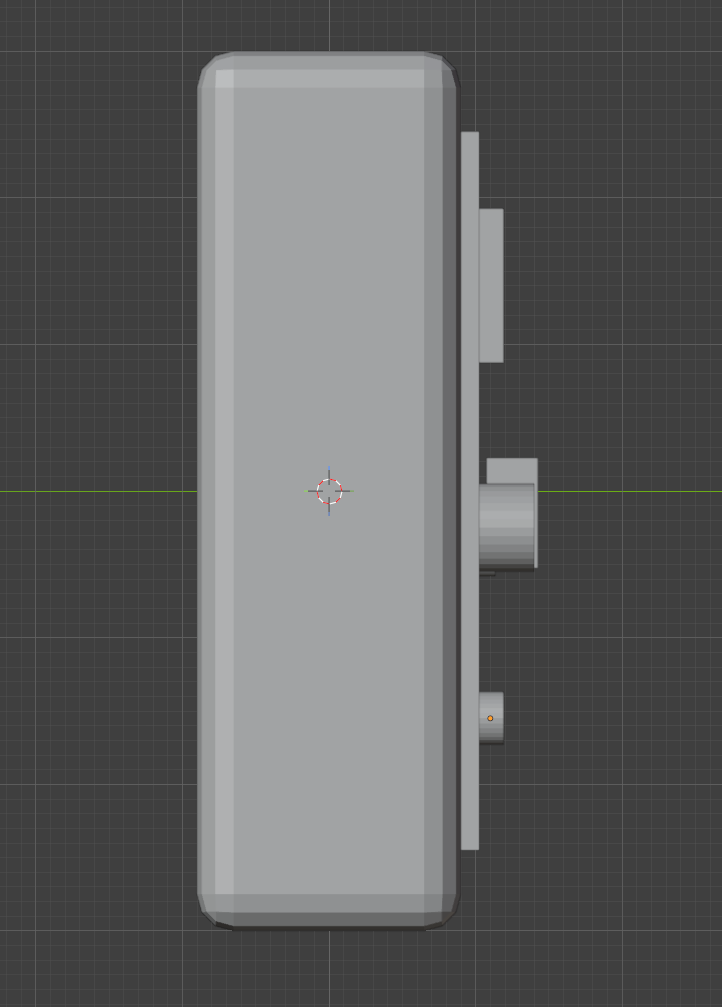
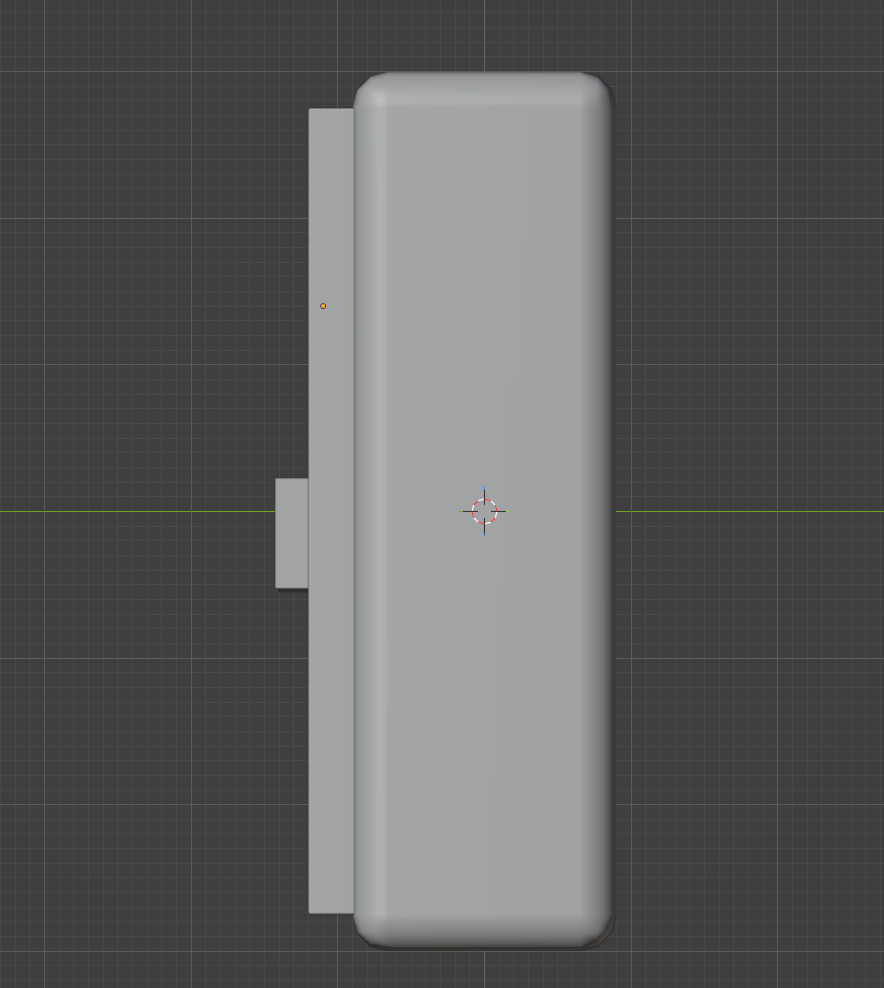
The second step involves further refining the content based on the first step, but at this stage, the focus is mainly on the proportions of the model, without much attention to detail.
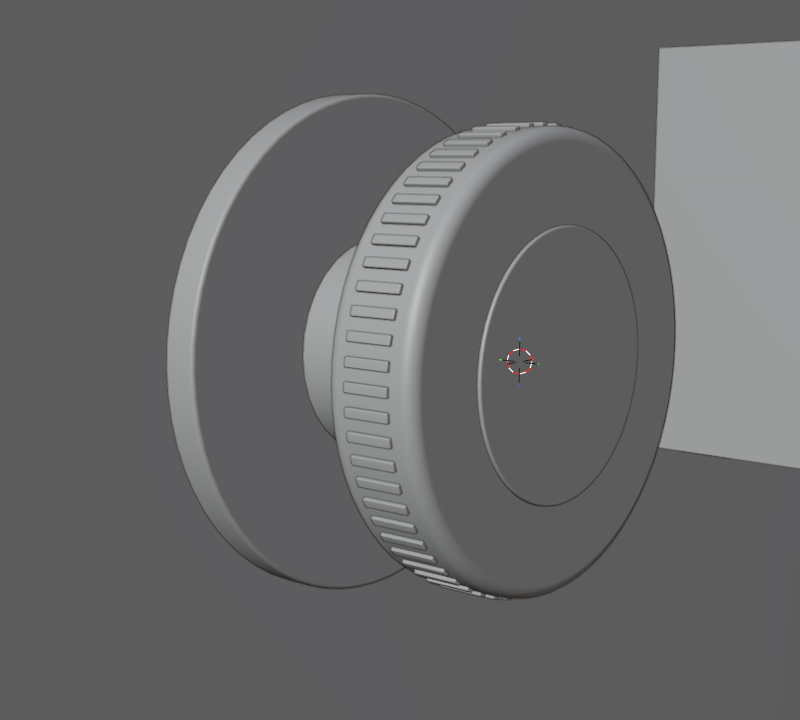
In the third step, I added details to most of the buttons. This served as a great refresher for various Blender features and components—such as the Array modifier, as well as face extrusion and complex modeling operations. The process didn’t take too much time—perhaps around 5 hours—largely because I made a conscious effort to ensure that the dimensions of each model were logical and that the fine details held up well when viewed up close.
However, the next step took up a significant amount of my time, as it involved a relatively complex topology—specifically, this button with a cover.
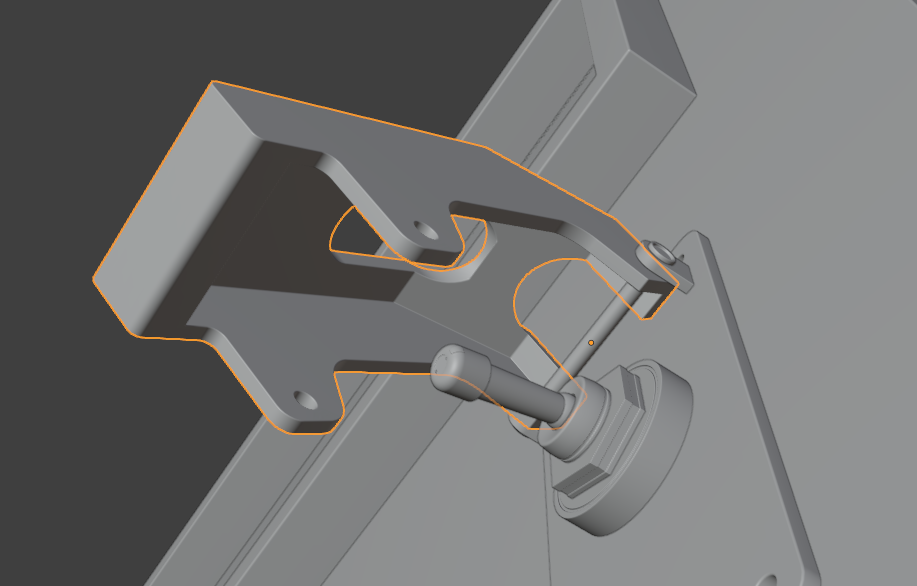
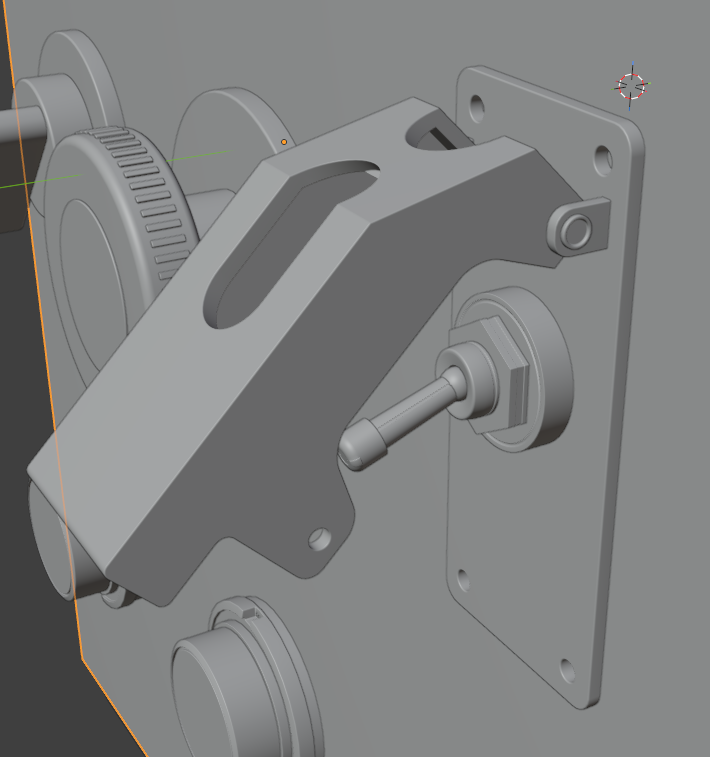
This covered button consists of two parts: a lower rocker arm button and an upper cover.
I think the toggle switch at the bottom is relatively straightforward to create; essentially, it involves the back-and-forth topological transformation and stretching of several circular rings, followed by adjusting the angle of the control lever.
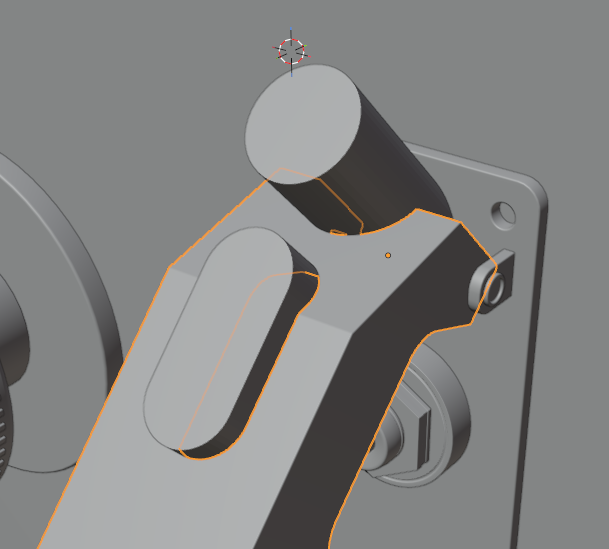
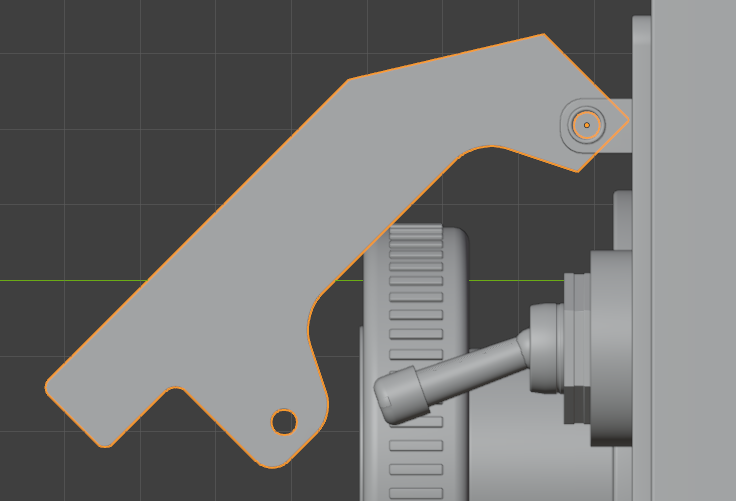
However, creating the top cover is a bit too challenging for me at this stage. To begin with, the cover starts as a rectangular shape. Furthermore, I need to incorporate cutouts—specifically, the opening for the joystick and the cutout on the upper section—both of which can be achieved by using cylinders for Boolean operations.
However, the openwork design on the sides of the cap is quite challenging to execute. Based on my reference images, this structure is divided into three or four distinct sections. It includes a toggle-like cover—shaped to fit a human finger—as well as a load-bearing component that supports the entire assembly. Since both of these parts are circular in form, they cannot be created using simple chamfering techniques.
I ended up dividing this block into two trapezoidal sections and then applying chamfers to achieve the desired curvature. Throughout this process, I also had to ensure that the thickness of the lid remained perfectly uniform—it turned out to be significantly more difficult than I had initially imagined.
However, after a long period of effort, I feel I’ve gained a lot. I’m particularly pleased with the final version of the joystick button with its cover—it turned out very well and was well worth the time I invested. At the same time, this project has clearly exposed the shortcomings in my hard-surface modeling skills. I need to take some professional-level courses to address these gaps, especially since my career goals and future plans are focused specifically on this field.
This week I mainly worked on creating the prototype of the game, the basic code, and basic models to implement the game features. The game isn’t actually playable yet, but it can be used to show some of my ideas.
First is the creation of the game’s UI, and then adding different types of bullets in the FPS CODE. I completed this module in Aseprite, which was relatively simple. In the game, you can press Q to switch bullet types, which is like an extra little feature in the game.
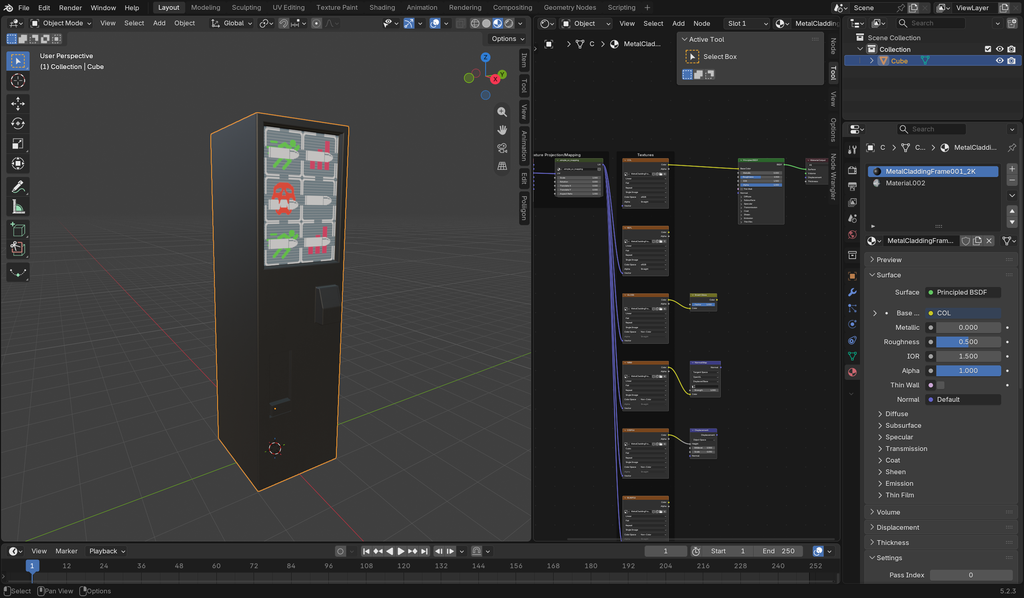
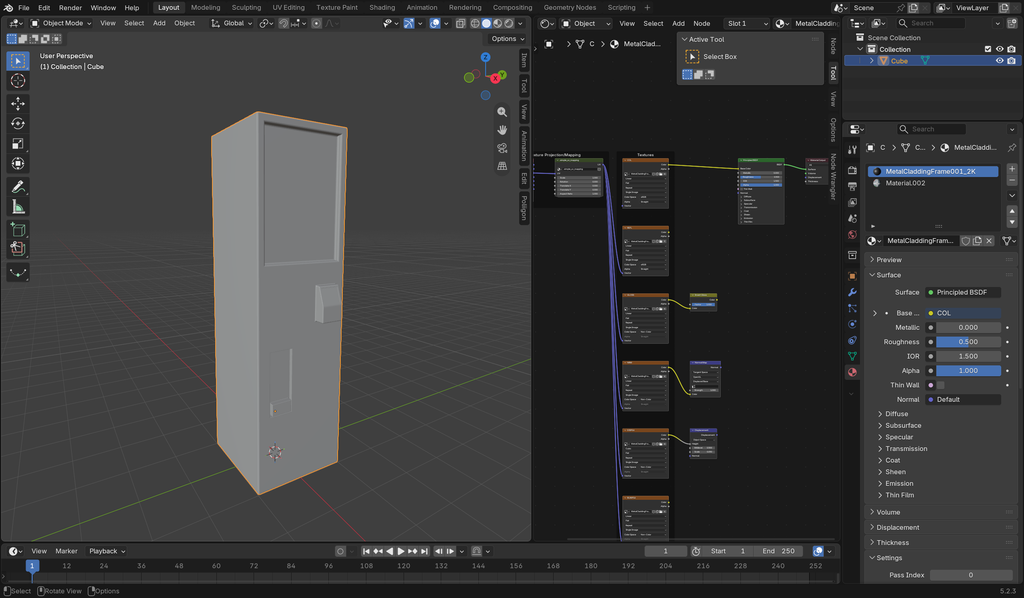
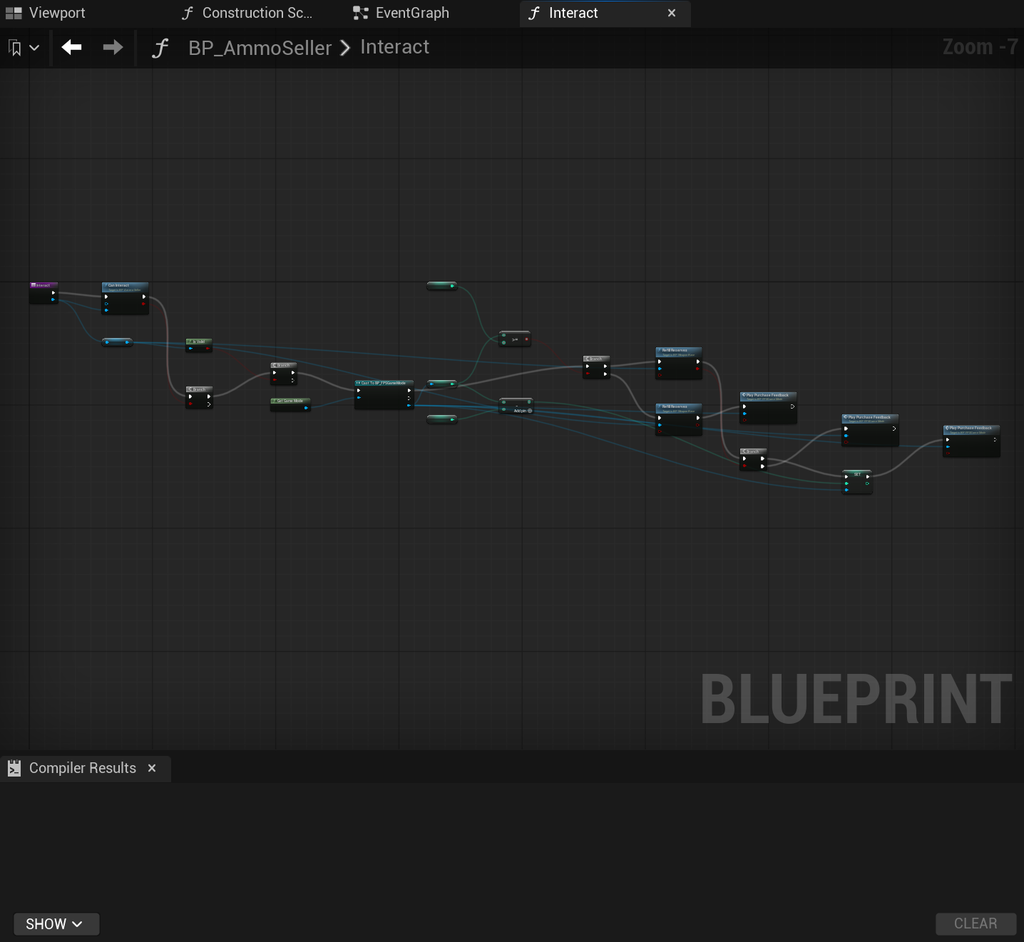
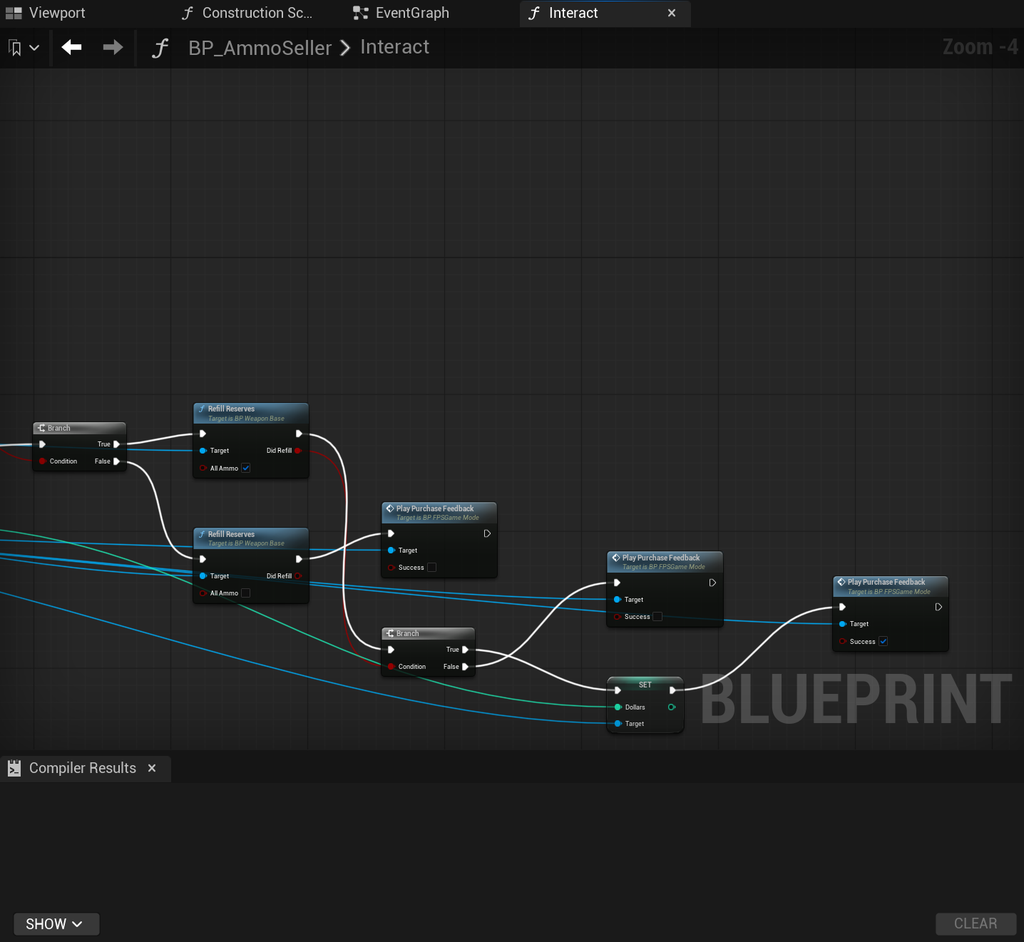
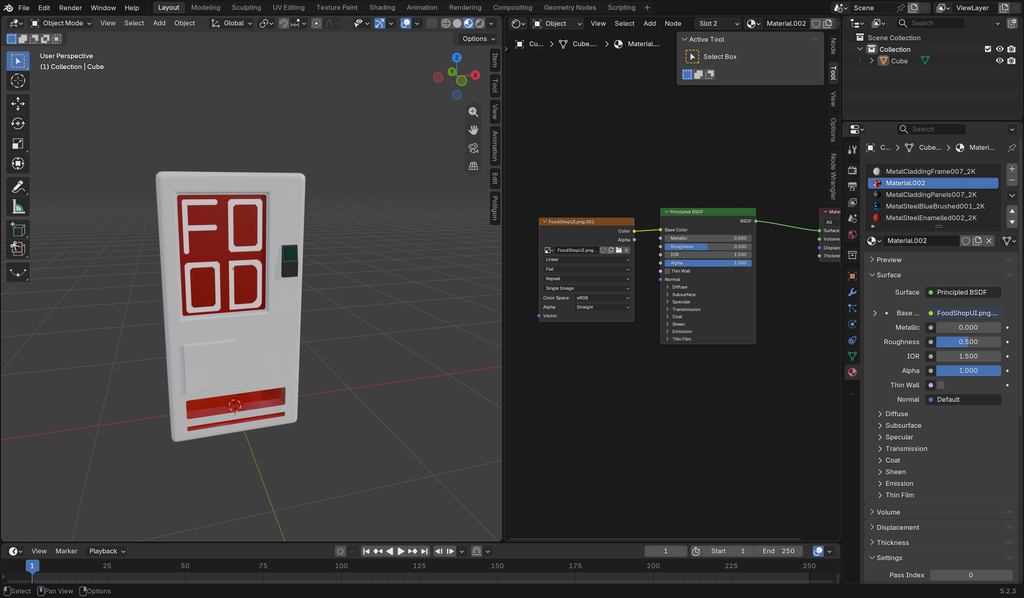
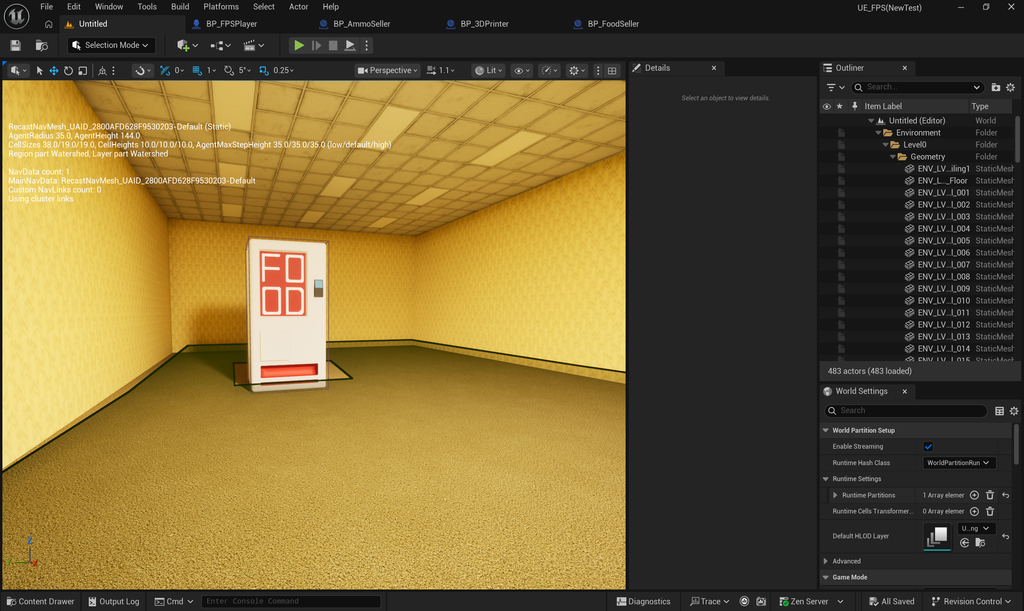
The second item is an ammo vending machine in the game. The model is pretty simple, but I think I did a good job with the textures. You can clearly tell it’s an ammo vending machine, and the model has a nice metallic shine and looks good in the scene. Players can press E to pay 300 bucks to refill all their ammo.
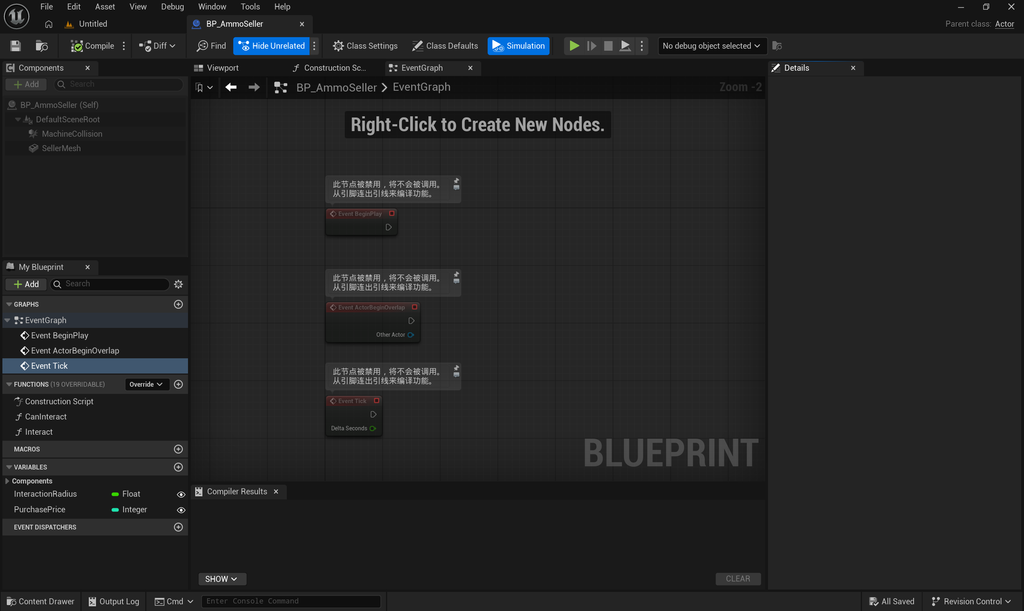
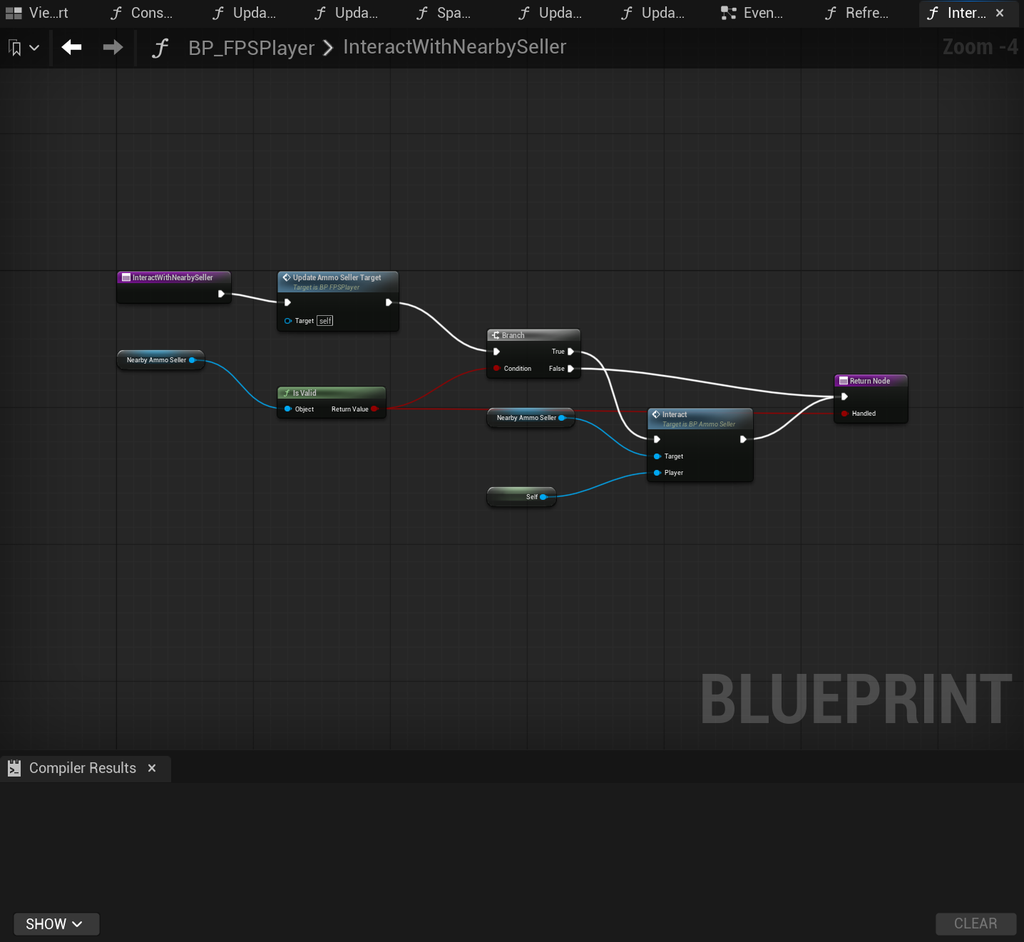
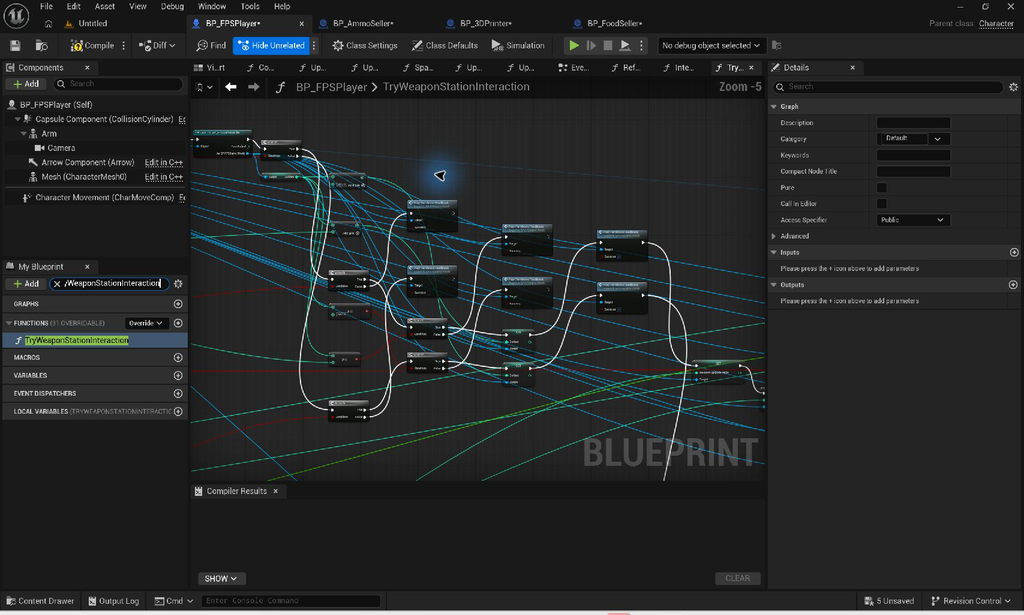
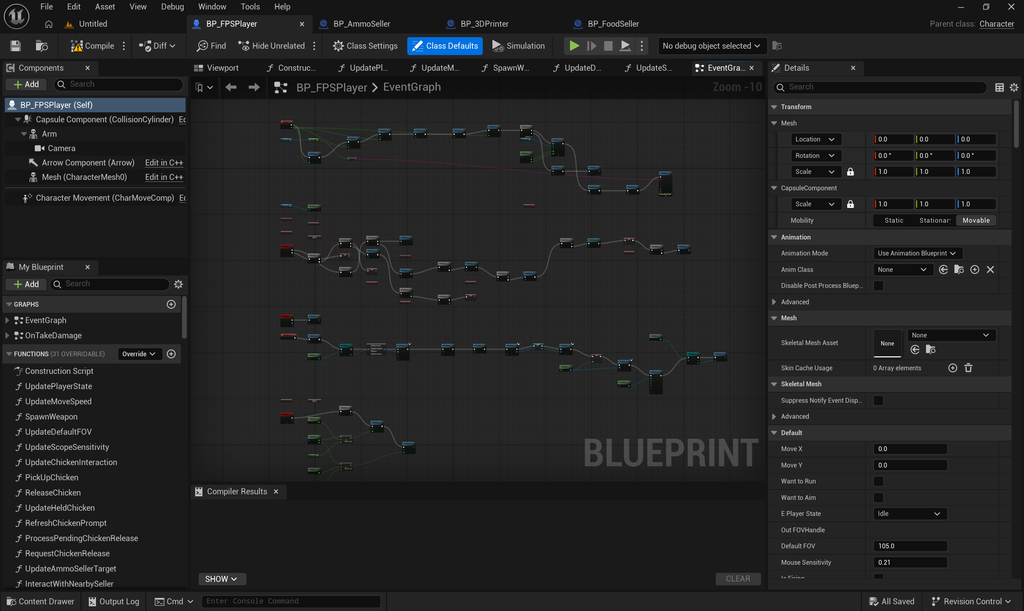
The player Blueprint identifies the nearest valid seller within interaction range and passes the player reference to its Interact function. The ammo seller checks the current weapon and money balance, then calls RefillReserves. A successful $300 purchase replenishes normal and unlocked special ammunition. Money is deducted only when a refill is needed, and the ammunition HUD and purchase feedback are updated.
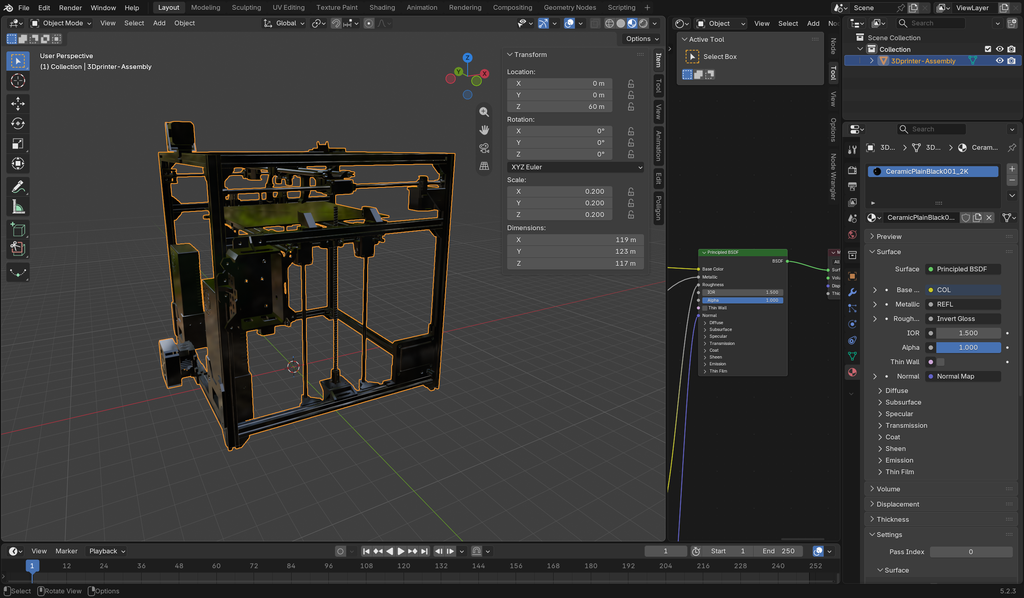
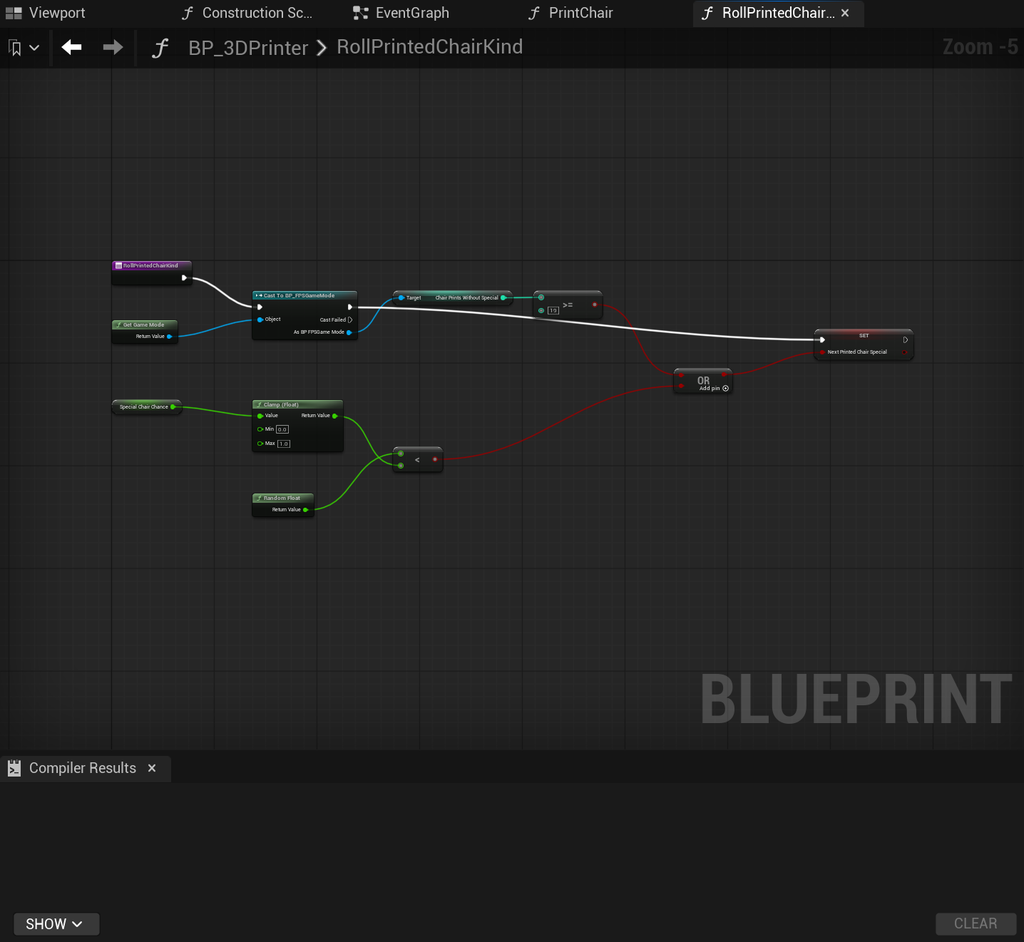
The printer validates the player, interaction distance and available output space before creating a chair at its PrintPoint. Deferred spawning allows the chair type to be initialized before spawning finishes. A random test gives each chair a 10% special-chair chance. An additional counter guarantees a special chair after 19 consecutive normal results, and resets when a special chair is produced.
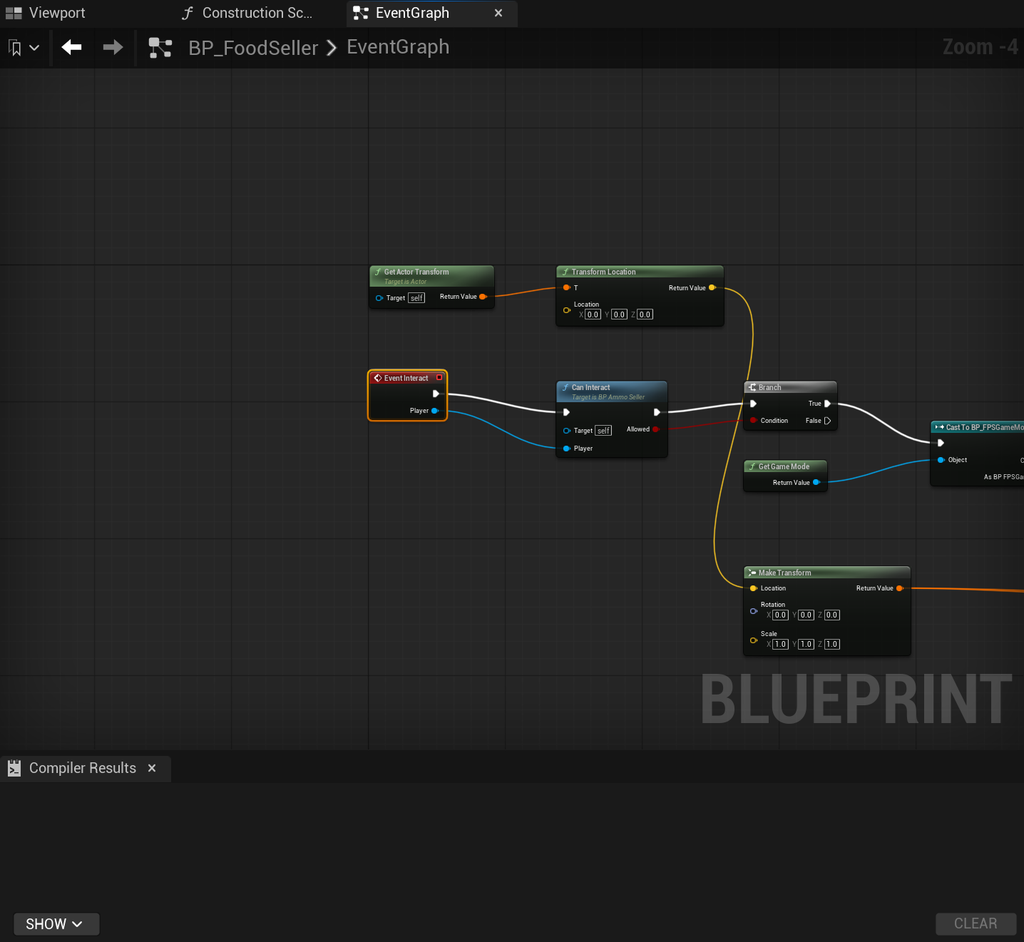
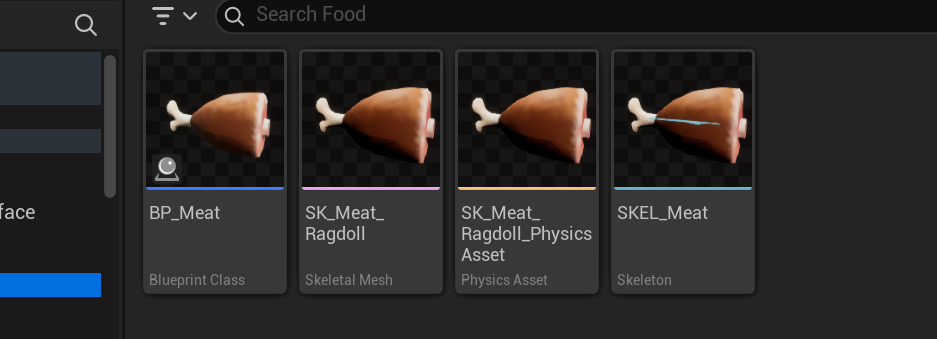
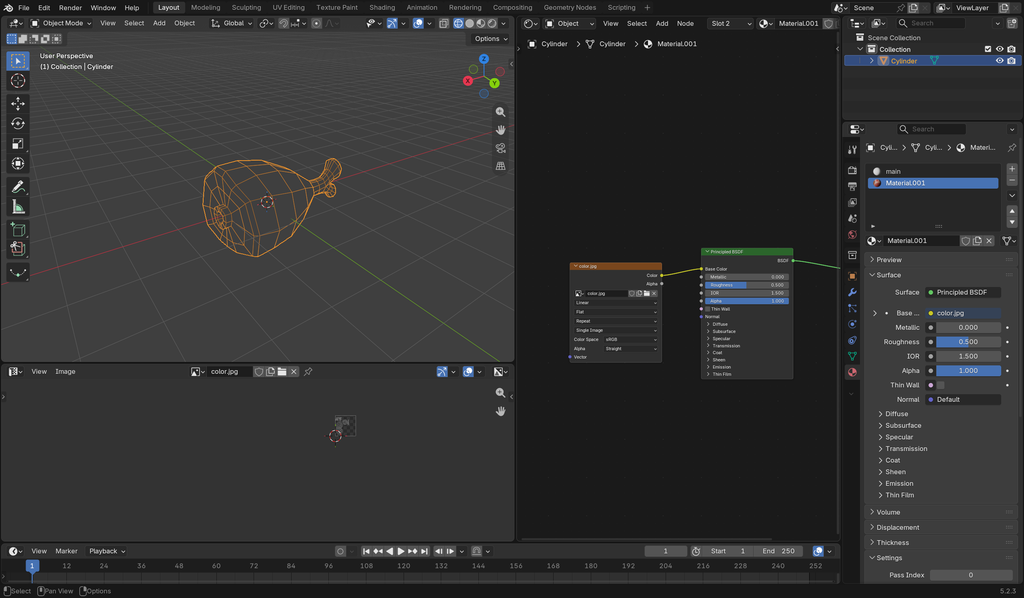
BP_FoodSeller inherits from BP_AmmoSeller, reusing its interaction checks while overriding the purchase behaviour. Its interaction event checks whether the player has $150, calculates a spawn transform relative to the machine and attempts to spawn BP_Meat. Payment and successful feedback occur only after a valid spawn; insufficient funds or a failed spawn produces failure feedback.
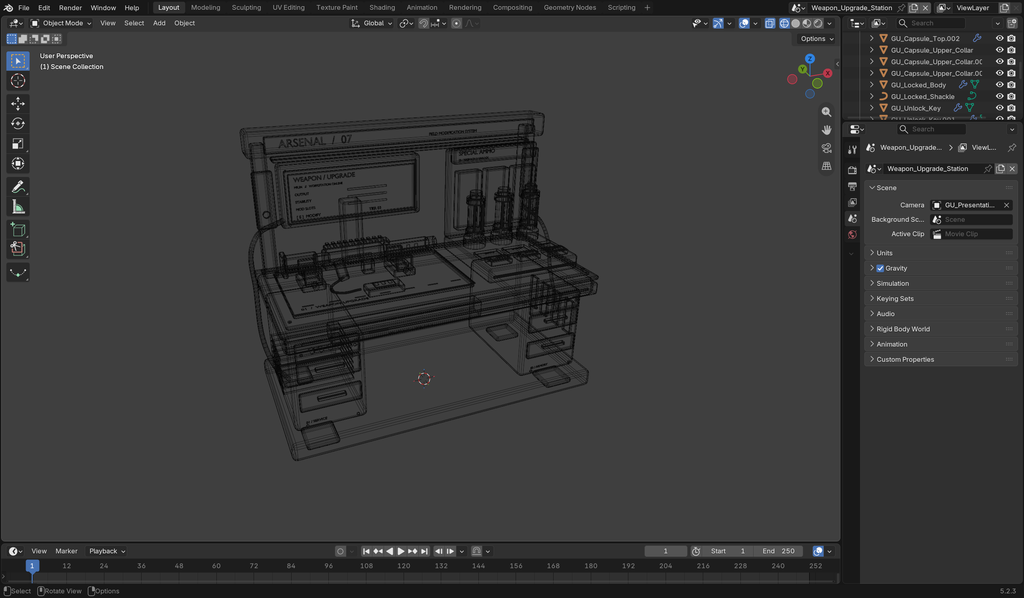
A camera line trace identifies the targeted station component. Component tags select either weapon upgrades or ammunition research. Successful upgrades increase the weapon level, add a fixed damage increment and double the next upgrade cost, with a maximum of five upgrades. Ammunition research costs $3,000 per type and sequentially unlocks Big, Kill and Speed ammunition, granting 150 rounds and refreshing the HUD.
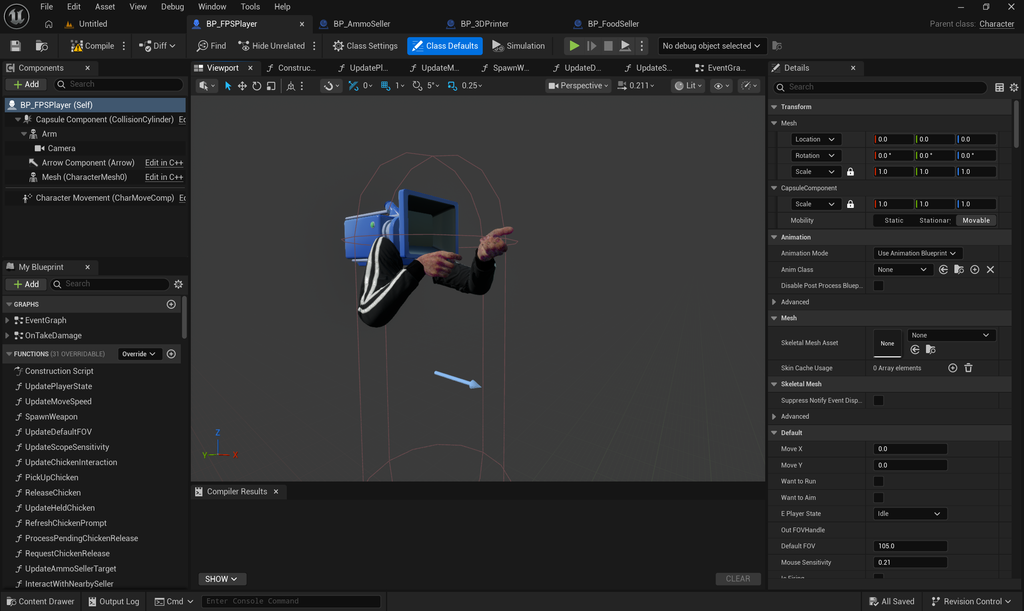
This is for the main player’s overview of abilities and blueprint editing
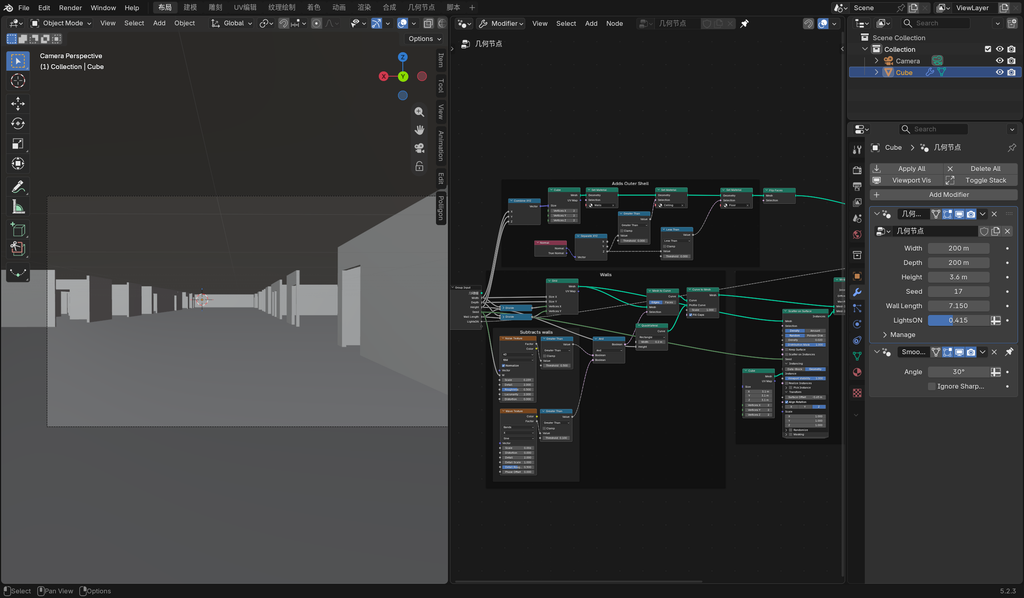
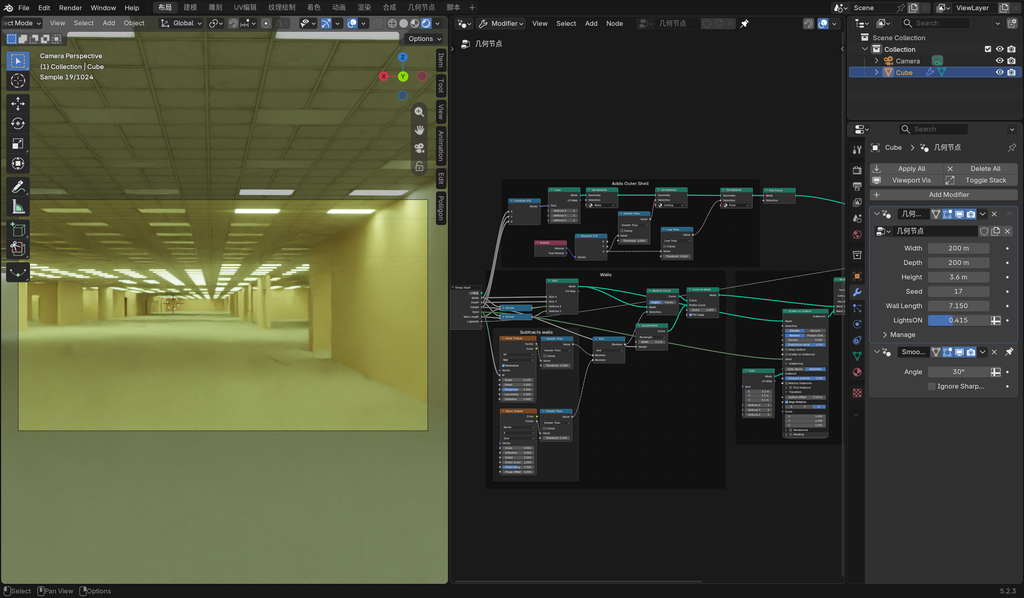
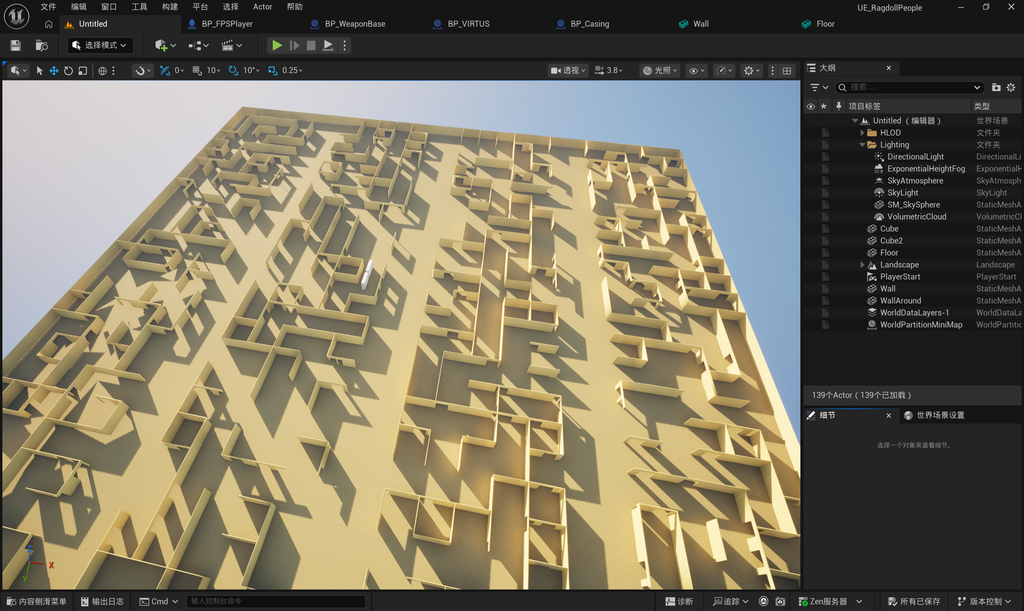
The Backrooms scene was made by following this tutorial. On this basis, I applied Blender’s geometry nodes and exported the scene as an FBX file to present it in the UE engine.
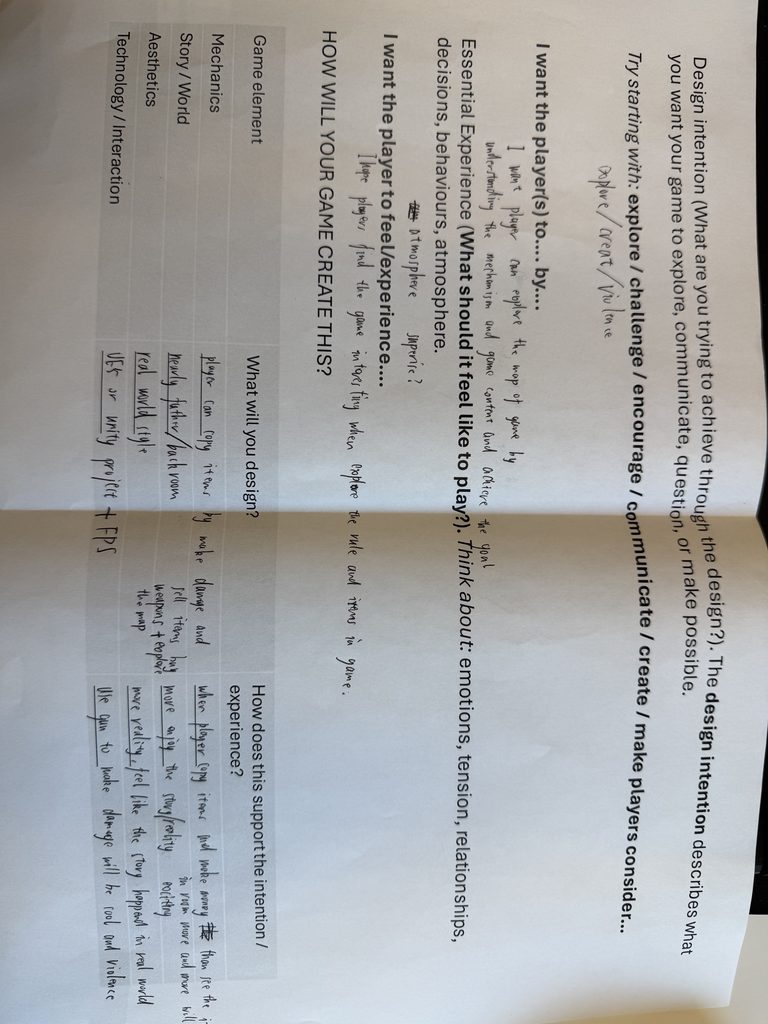
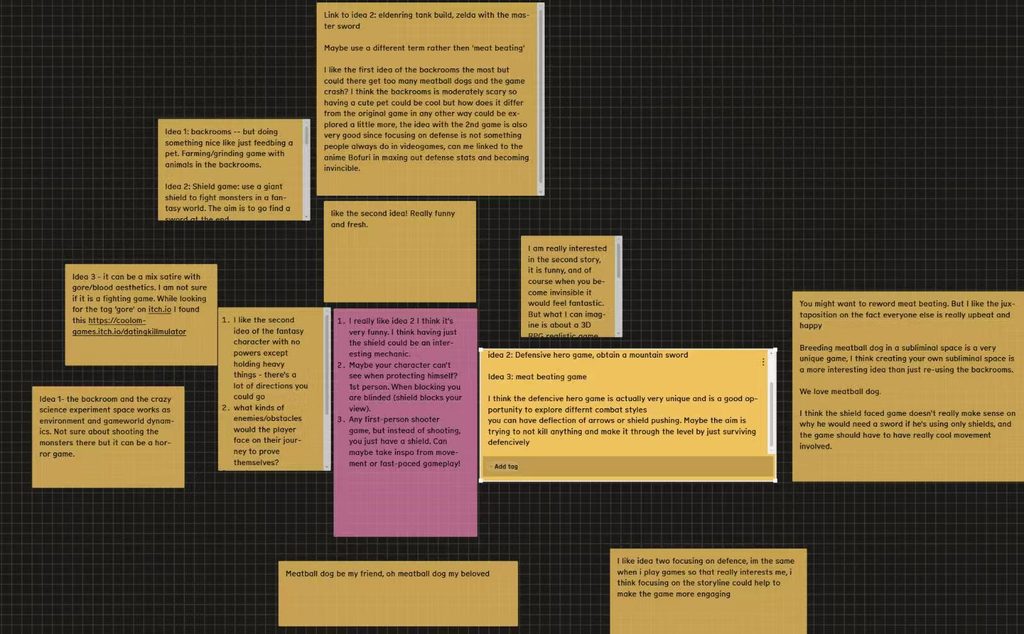
The main content of this week’s class was to help us establish our own play styles and think about what kind of feedback and feelings players should experience during gameplay. I had actually been focusing on this aspect last week, and it didn’t seem too difficult for me. But during Tuesday’s personal project discussion, I ran into a pretty big problem. I wanted to create a game where you frantically duplicate objects in the backrooms to make money, but since the protagonist is in the backrooms, they wouldn’t actually need money, so the game’s logic doesn’t really hold up.
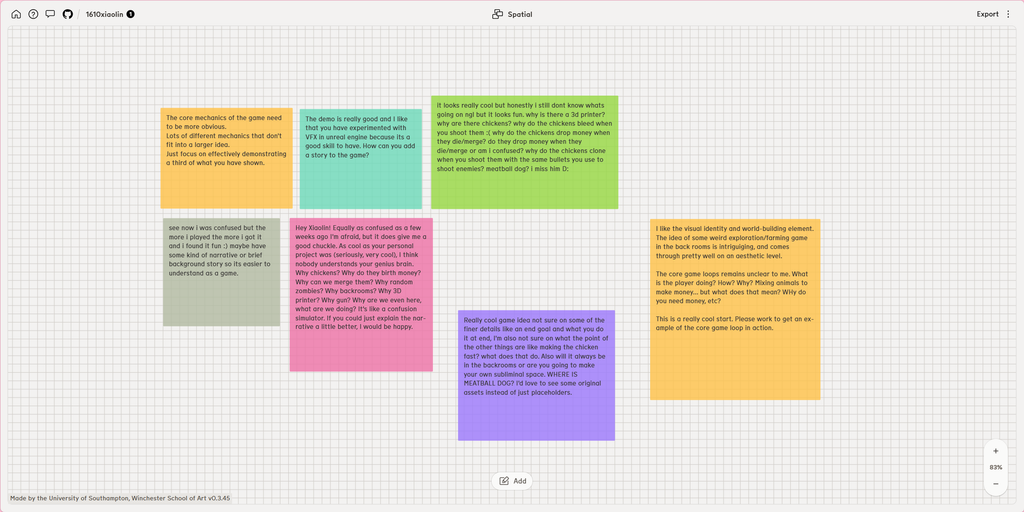
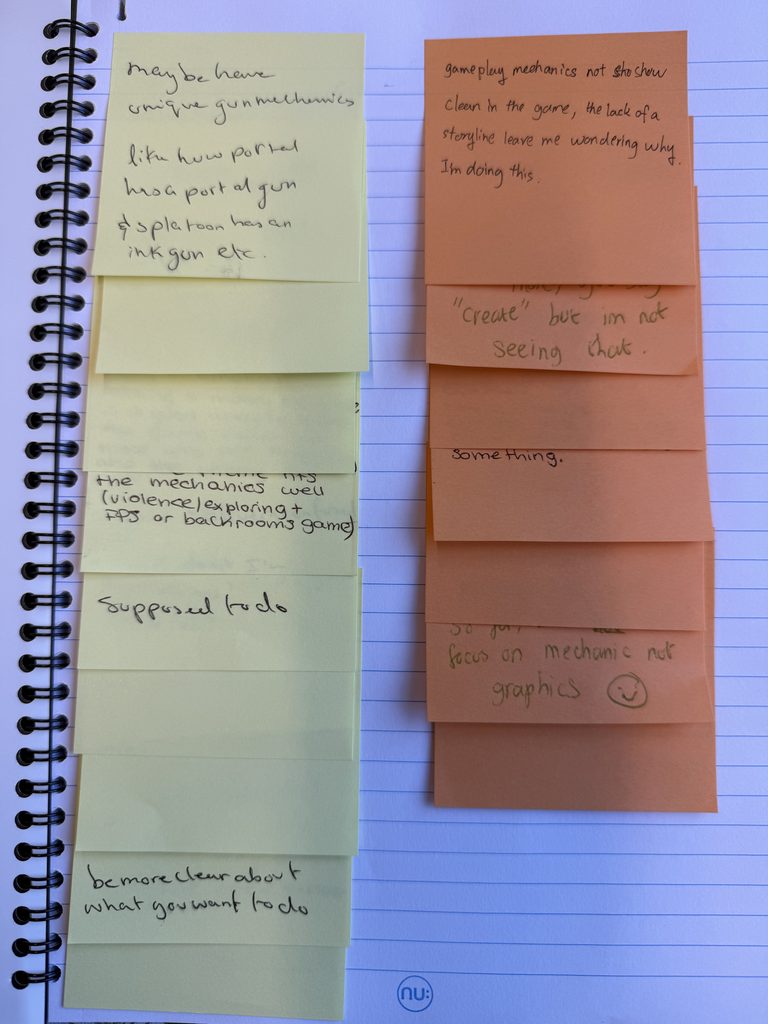
On Thursday, we wrote down our own ideas, and on Friday’s class, we did peer evaluations. I feel like my project presentation wasn’t very clear, which led to a lot of negative feedback, like not being able to understand why I would make players feel more curious to explore and so on. But I think these are all problems that can be solved.
This week, I completed my basic FPS content based on tutorials on the Bilibili website. My character can move freely in the environment, shoot, and the visual effects are pretty good. I think this will be a solid foundation for my game.
On Thursday, I discussed some issues in the UE engine with Teacher Rose. My scene models have serious problems with collision import in the game. Specifically, if the player spawns inside the scene, they can’t move, and if they spawn above the scene, they can’t enter it and end up floating.
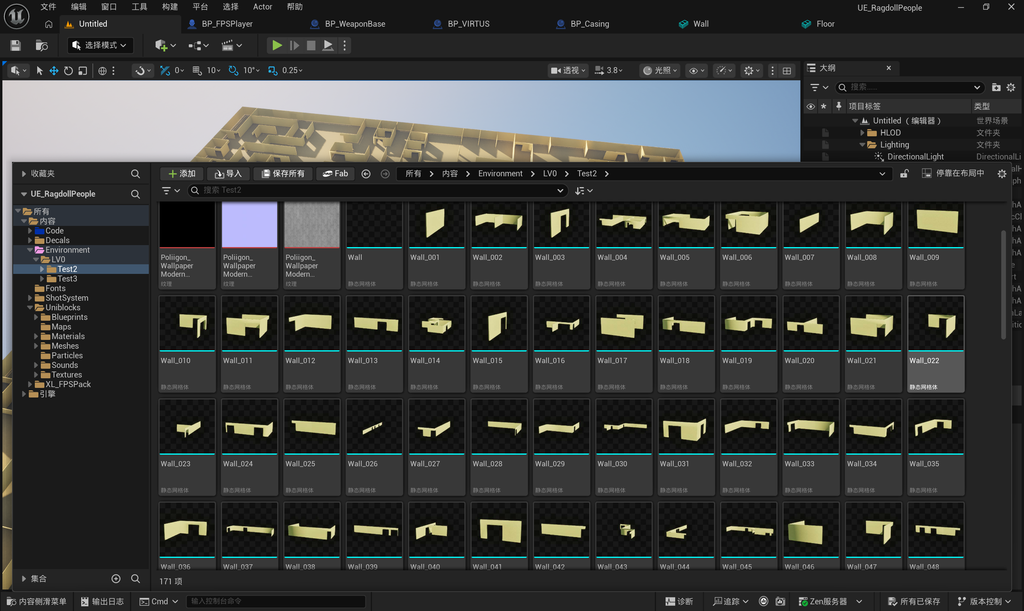
In the end, I went through each little section of walls in the scene, broke them down, and assigned the corresponding volume to each one, which solved the problem, including the ceiling and floor. The biggest issue was that the original scene was imported as one huge object, and UE couldn’t handle such detailed subdivision of the mesh volume automatically, which caused errors.
Who is the player / who are they in this situation
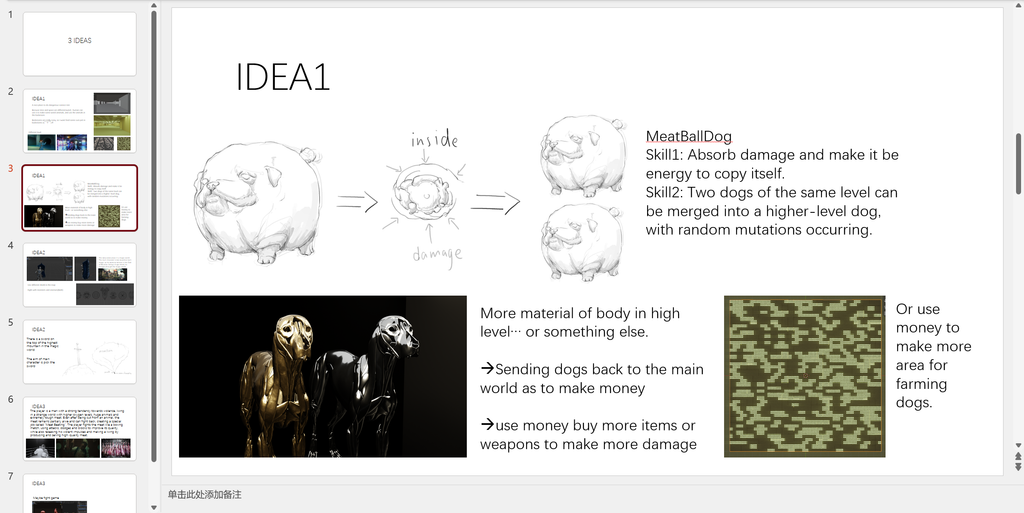
The player is a criminal who is thrown into the backrooms and participates in the “Meat Dog” breeding experiment as a test subject.
The player is not an ordinary breeder but someone forced to take part in the experiment. They need to be responsible for raising and managing “Meat Dogs” in the backrooms and, by continuously increasing the number and level of the Meat Dogs, provide resources for the real world, thereby earning rewards.
What are they trying to do
The player’s main goal is to efficiently produce lots of Meatball Dogs in the Backrooms and transport them back to the real world for rewards.
Why are they doing it
Players do this mainly because it’s the task given to them by the experiment, and they need to complete the experiment to get rewards.
From the perspective of the whole worldview, humans are looking for more space and resources they can use. Since the Backrooms have extraordinarily large spaces, scientists put the meatball dogs, which are hard to control in the real world, into the Backrooms for large-scale breeding.
Where / when is this happening
The story takes place in the near-future Backrooms.
How might they do it
Players mainly go through four steps: damage, breeding, synthesis, and transport:
Players use various items in the game to attack Poke-balls Dogs.
When a Poke-balls Dog takes enough damage, it consumes all its energy to summon a completely identical new Poke-balls Dog from a parallel universe.
After obtaining two Poke-balls Dogs of the same level, players can merge them into a higher-level Poke-balls Dog.
As the level increases, Poke-balls Dogs may gain new appearances and materials, like metal, gems, etc.
Players transport the Poke-balls Dog to the real world.
Players earn money or other rewards.
They use the rewards to buy new tools and equipment to improve future production efficiency.
Repeat this process to continuously expand your Poke-balls Dog production scale.
What get in the way
Space of backroom, player need spend money on some area of back room, and go different level of the back room to feed different meatball dogs.
What might happen because of their action
Will have a huge backroom filled with all kinds of cute meatball dogs
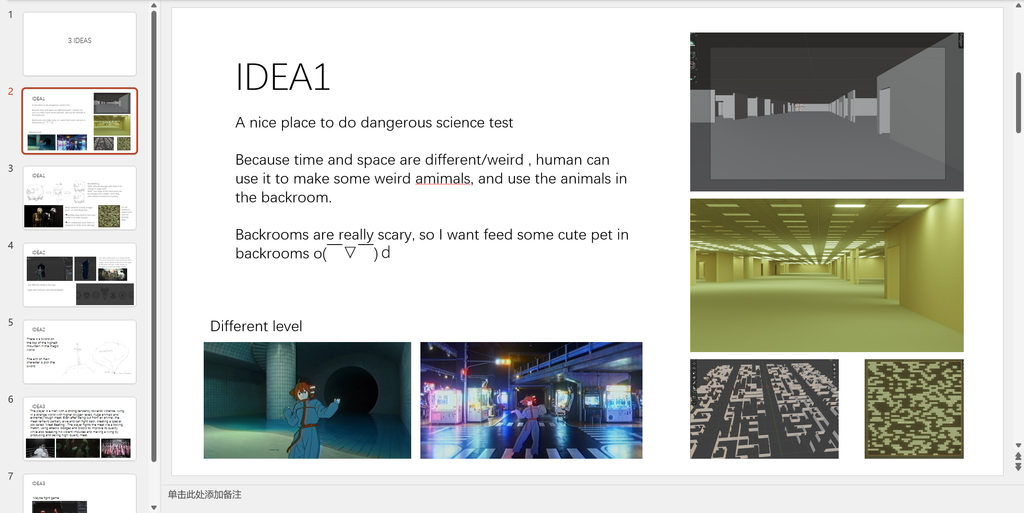
In the near future, humans try to create artificial spaces to obtain more space and resources. However, the experiment fails and creates the Backrooms. Scientists later discover a strange creature called the “Meat Dog”. When it takes enough damage, it can summon an identical copy of itself from a parallel universe. Two Meat Dogs of the same level can also be combined into a higher-level Meat Dog. Since these creatures would be difficult to control in the real world, humans decide to breed them inside the huge space of the Backrooms.
The player is a criminal who is sent into the Backrooms to take part in this experiment. The player damages the Meat Dogs to make them multiply, combines them into higher-level creatures, and sends them back to the real world to receive rewards. These rewards can be used to buy new tools and equipment to increase production efficiency. As the Meat Dogs become stronger, they can even change into valuable materials such as metal and gemstones.
The player takes on the role of a criminal placed inside the “Backrooms” to participate in an experiment involving the breeding of “Meat Dogs.” The backstory goes like this: in the near future, humanity sought to create new artificial spaces using technology to secure more resources and living area. However, a glitch in the experiment resulted in the creation of the Backrooms—a realm where space-time relationships are chaotic, yet the defining characteristic of vastness remains. Through their efforts, Earth’s biologists created a new lifeform known as the “Meat Dog.” These strange creatures possess two unique abilities: first, when sustaining sufficient damage, they channel their total energy to summon an identical copy of themselves from a parallel universe; second, two Meat Dogs can merge to form a higher-level, more specialized variant. While such creatures—capable of infinite division—would be a nightmare to manage on Earth, their explosive population growth within the Backrooms allows them to serve as a massive resource pool for humanity. High-level Meat Dogs can even alter their physical composition, transforming into materials like metal or gemstones. The player’s mission is to breed these creatures in the Backrooms; for instance, using in-game items to damage the Meat Dogs triggers their division, and transporting them to the real world earns the player rewards that can be used to purchase items to further boost production efficiency.
IDEA2
Who is the player / who are they in this situation
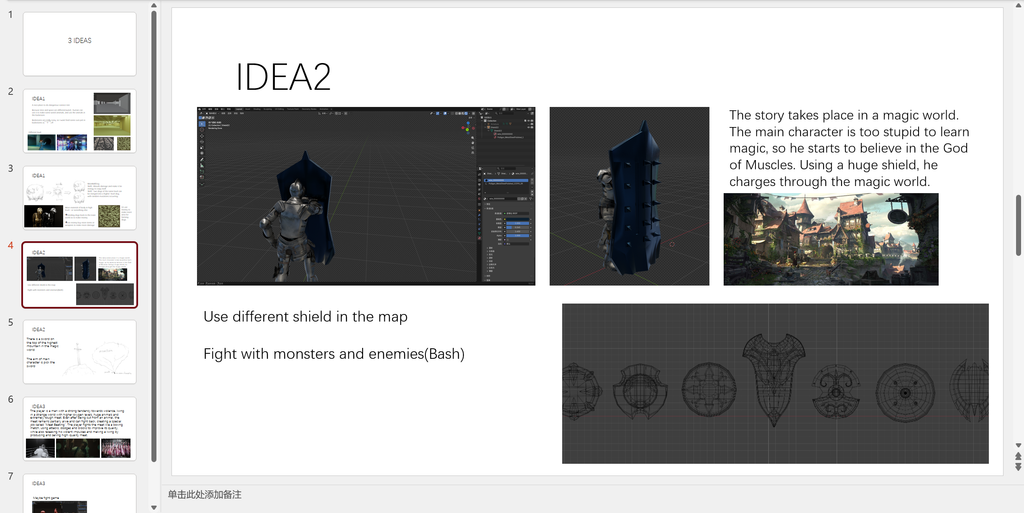
The player is a very strong but simple-minded soldier. He is not good at using weapons such as swords or spears because he is too strong and often hurts himself or his teammates by accident. Because of this, his main weapon is a huge and extremely heavy shield.
The player was originally part of a team that was hunting a dark mage, but the other members of the team were killed by the dark mage’s followers. He is now the only one left.
What are they trying to do
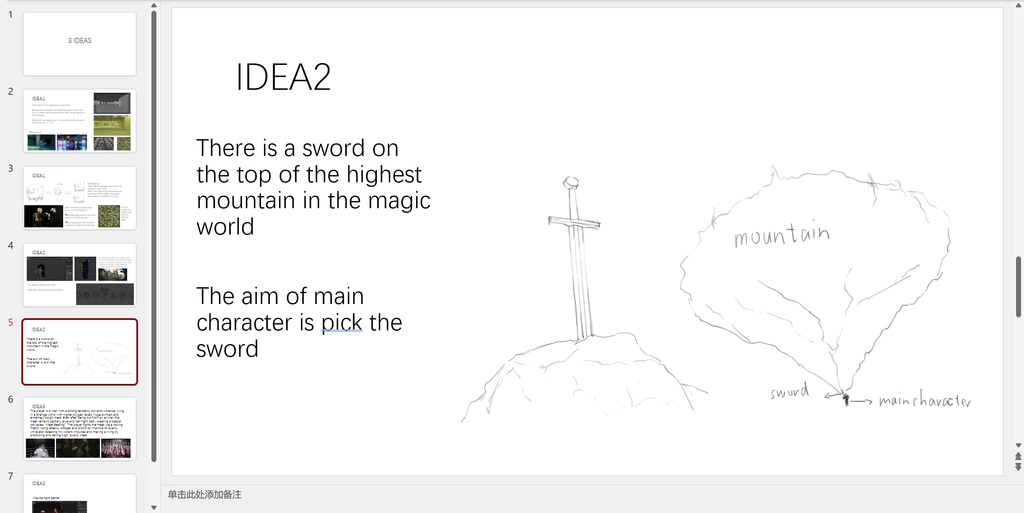
The player is trying to continue the journey alone and find and defeat the dark mage.
Why are they doing it
The player’s teammates have all been killed, so he decides to finish the mission for them.
However, he is very stupid and does not even understand what “retreat” means. He does not realise how dangerous it is to fight the dark mage alone.
For him, the mission is simple: keep moving forward and hit the dark mage until he wins.
Where / when is this happening
The story takes place in a fantasy world where magic exists.
The story takes place in a world where magic is an important part of life
How might they do it
The player mainly fights with his huge shield instead of using traditional weapons or magic.
His main attack is very simple: raise the shield, run towards the enemy and crush them with the shield.
Along the way, the player can collect different shields and items, such as:
Huge Shield: Provides very high defence and weight.
Mirror Shield: Can reflect light or enemy magic attacks.
Rocket Shield: Uses rockets to launch the player towards enemies and crush them.
Anti-Dark-Magic Potion: Helps the player resist dark magic.
Special Shields: Provide different offensive or defensive abilities.
The player becomes stronger by collecting these items and improving his strength, defence and impact power, eventually relying on raw physical power to defeat his enemies.
What get in the way
The main obstacles are the dark mage and his followers.
What might happen because of their action
As the player continues his journey, he becomes stronger and collects increasingly powerful and ridiculous shields.
Eventually, he may reach the dark mage’s castle and fight the dark mage in the final battle.
The game takes place in a fantasy world filled with magic. The player is a very muscular but simple-minded soldier. Because he is too strong and cannot use weapons properly, he often hurts himself or his teammates during combat. As a result, his main weapon is a huge and extremely heavy shield.
The player’s team was originally on a mission to defeat a dark mage, but all of his teammates were killed by the mage’s followers. The player does not realise that he should retreat, so he decides to continue the mission alone.
The player mainly fights using his huge shield, using blocking, charging and special shield abilities to defeat enemies. During the journey, he can collect different shields and items, such as a Mirror Shield that reflects magic, a Rocket Shield that launches him into enemies, and potions that protect him from dark magic. He becomes stronger by collecting better equipment and eventually reaches the dark mage’s castle to fight him alone.
The protagonist is a soldier with a massive, muscular build but very little brainpower; too dim-witted to handle sharp weapons effectively—and prone to accidentally injuring his own teammates—he relies solely on a colossal, incredibly heavy shield as his weapon. He lives in a magical world where his entire squad was wiped out by the minions of a dark wizard while on a quest to defeat him, leaving him as the sole survivor. Yet, he resolutely decides to press on and confront the dark wizard alone—simply because he is too stupid to understand the concept of retreat. Along the way, he collects various items, such as potions to counter dark magic and a range of shields—including a mirror shield that reflects light and a rocket-propelled greatshield that allows him to charge at enemies and smash them to pieces. His primary method of attack is to simply hold up his massive shield and ram his opponents to death; he is a straightforward, unadorned juggernaut of raw stats.
IDEA3
Who is the player / who are they in this situation
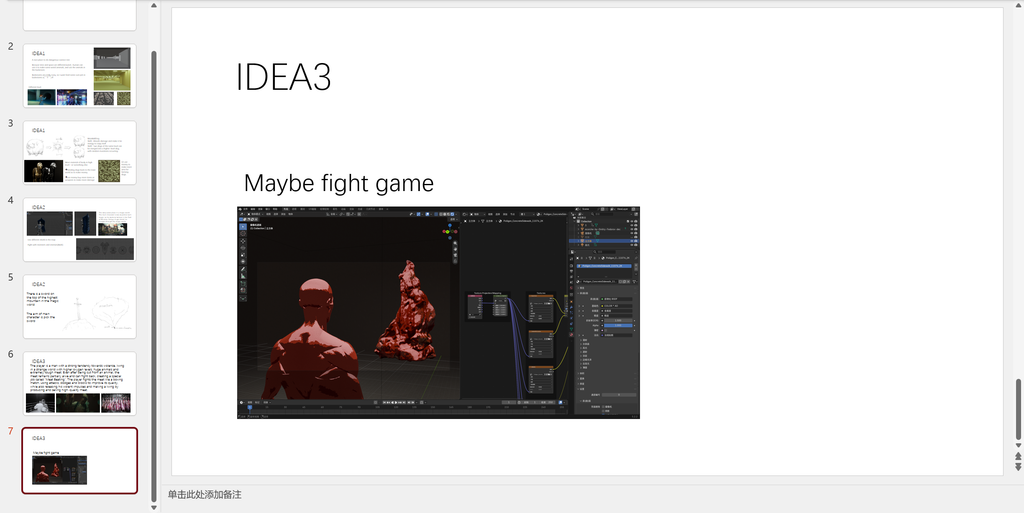
The player is a man with a strong tendency towards violence. He lives in a strange world with high oxygen levels, where animals are much larger and their meat is extremely tough. To control his violent behaviour, he works as a “Meat Beater”.
What are they trying to do
The player needs to repeatedly attack large pieces of meat to make them softer and more delicious. At the same time, they must dodge or block the meat’s attacks during the fight, eventually turning it into high-quality meat that can be cooked and sold.
Why are they doing it
The player uses Meat Beating to control his violent tendencies while making a living from preparing meat and cooking. For him, the job is both a way to release his violent impulses and a way to earn money.
Where / when is this happening
The story takes place in a strange world that is different from our own. It has higher oxygen levels, much larger animals, and extremely tough meat. Even after a piece of meat is cut from an animal, it remains partially alive and retains some ability to attack.
Because of this, people secure large pieces of meat in their workplaces and fight them to improve the quality of the meat.
How might they do it
The player hangs or secures a huge piece of meat from the ceiling and fights it like a boxing match.
The player can use punches, melee attacks and different movements to attack the meat while watching its movements and reacting with dodges, blocks and counterattacks. Although the meat cannot move freely, it can swing, hit the player and make small counterattacks.
As the player continues fighting, the condition of the meat gradually changes, eventually becoming softer, tastier and more valuable.
What get in the way
The main obstacle is the meat itself. Although the meat is fixed in place, it remains partially alive and can attack the player.
The player also needs to control the timing and strength of their attacks, because attacking too aggressively may damage the meat and reduce its final quality.
What might happen because of their action
By successfully beating the meat, the player improves its quality and can turn it into more delicious and expensive dishes, earning more money.
As the game progresses, the player may face larger and more dangerous pieces of meat with different attack patterns. The gameplay therefore becomes a combination of boxing, dodging, blocking and meat processing in a close-combat action game.
The player is a man with a strong tendency towards violence, living in a strange world with higher oxygen levels, huge animals and extremely tough meat. Even after being cut from an animal, the meat remains partially alive and can fight back, creating a special job called “Meat Beating”. The player fights the meat like a boxing match, using attacks, dodges and blocks to improve its quality, while also releasing his violent impulses and making a living by producing and selling high-quality meat.
The player takes on the role of a man with severe violent tendencies living in a world characterized by high oxygen levels and massive animals whose meat is incredibly tough. Strangely, severed chunks of meat retain their aggressive nature; consequently, a profession known as “meat-beating” exists, where massive cuts of meat are suspended from the ceiling and pummeled like punching bags to tenderize them and improve their flavor. The protagonist channels his violent urges into this activity, using the brutal act of striking the meat to manage his aggression while simultaneously producing delicious meat dishes to make a living.