In this section, I will be researching in depth the culture and geography surrounding our game. These are the things I’m primarily focused on as someone who is dictating the art direction:
- Natural environments (main focus)
- Flora and fauna
- Ocean
- Climate
- Navigation and canoes
- Star Navigation
- Architecture
Highlighted in blue are the critical analysis of my findings.
Polynesia is a group of islands in the Pacific, usually defined by the Polynesian Triangle: Hawaii, New Zealand, Easter island. Polynesian culture are heavily focused on oral story telling, exploration, and mythology. Today, Polynesians maintain their traditions through ceremonies, dance, and community practices.
Polynesians are culturally distinct due to their strong connection to the environment. (webmaster@youngpioneertours.com, 2024)

Natural environment
Flora and fauna
Some species of plants and animals have migrated from Southeast Asia to the Pacific either from natural distribution or by humans. The number of species decrease the more east you go, so French Polynesia has fewer species than Fiji in comparison to islands more West. (Frommers, 2026)
Plants
The flora in Polynesia changes according to the island’s topography. Mountainous islands that receive rain from trade winds have a greater variety of plants, interior highlands are covered in sprawling plants and ferns. On the other hand, atolls receive little to no rain and can only support a small scrub bush or coconut tree.
Ancient settlers brought plants such as coconut, breadfruit, taro, paper mulberry, pepper / kava, and bananas to the isolated pacific islands because of their usefulness in food or fibre. These plants are typically found in inhibited areas, not so much in the interior bush.
Tropical flowers also began to work their way into the Pacific with the company of humans. Flowers such as: bougainvillea, hibiscus, allamanda, poinsettia, croton. plumeria, and water lilies add to the islanders’ love for flowers. (Frommers, 2026)
Animal and birds
The fruit bat or known as the “flying fox” are the only mammals native to the islands. Early settlers introduced domesticated animals such as dogs, cattle, chickens, pigs, rats, and mice. There are very few land snakes or other reptiles in the islands. However, there are a few exceptions; geckos and skinks.
The number of birds also diminish the more you go East. Most birds live further away from settlements. For this reason, most birds that are likely to be seen are terns, herons, petrels and noddies. (Frommers, 2026)
Sea life
The Pacific Ocean is known to contain several hundreds of species of animals. More than 600 coral, roughly 10 times the amount found in the Caribbean. There are also a plethora of tropical fish that live in the lagoons. (Frommers, 2026)
In French Polynesia, you can expect to encounter several stunning creatures:
- Sharks
- Manta rays and sting rays
- Sea turtles
- Tropical fish
- Dolphins (Henderson, 2024)
The fauna and flora of Polynesia have been no mistakenly shaped by the intervention of man kind with biodiversity decreasing as it faces inwards. As a result of this occurring, areas such as French Polynesia have very sparse biodiversity and is more environmentally fragile due to the lack of flora and fauna. In comparison, islands such as Fiji have thriving greenery and animals as it’s more west than French Polynesia. Additionally, plant life is greatly supported by island topography as mountainous islands have greater vegetation where as atolls can only sustain a few species. Early settlers that have introduced plants such as coconuts, breadfruit, and taro altered eco systems, but they did it in order to survive, demonstrating adaption to the environment. Rich marine life with several species of coral and home to tropical fish form the ecological foundation of Polynesian life. However, this becomes increasingly weaker as the years go on as climate change affects the sea levels, demonstrating the balance between human life and ecological impact.
Primary Research
Although the Philippines isn’t in Polynesia, some of the plants it has were brought over by early settlers and the archipelago share similar climate and island topography. The following pictures have been taken by me when I had visited during August of last year.

This flower is called a plumeria or known as a frangipani. These flowers are fragrant and they are known for their vibrant colours and 5 petaled structure. Although they were native to the Americas, it was brought over to Hawaii, India, and the Philippines.
Cultural significance: Used for leis in Hawaii, and used as offerings in Bali. It is planted in Southeast Asia due to its relation to mourning or spirits. (KHON2 News, 2019)
This flower is called a hibiscus, it is a large, colourful and is recognisable by the long pistil in the middle. Most hibiscus flowers only bloom for a single day and wilt by afternoon.
Medicinal uses: Buds, leaves, and flowers offer a soothing and anti-oxidant for skin and internal inflammation. (Terry, 2023)
Symbolism: A symbol for welcome and island life. In Polynesia, the placement of the flower signifies relationship status. (Terry, 2023)


This flower is called a desert rose but is also referred to as the Dwarf Kalachuchi due to its resemblance to the native plumeria. It was originally introduced by Thailand and is easily grown in the Philippines due to the similar climate.
Symbolism: It symbolises resilience due to its ability to thrive in harsh conditions. It also symbolises prosperity and good fortune with the belief that it brings good luck to the owner and environment. (Flowers, 2024)
Below are images of the natural environment and topography of the island Panay. Across the Philippines, greenery is rich and flourishes due to the weather being constantly sunny and rainy, which supports the living conditions for a lot of these plants. The image at the bottom shows the Ocean from my Grandpa’s house, however, the structures by the coastline weren’t always there.
Due to climate change and rising sea levels, the government or council had to install jackstones to prevent the locals by the beach line getting hit by oncoming waves. When I saw these structures, it made me sad looking at the jackstones as the beach was one of the most memorable parts of coming back to the Philippines, but I’m glad that they were installed for the safety of the locals.
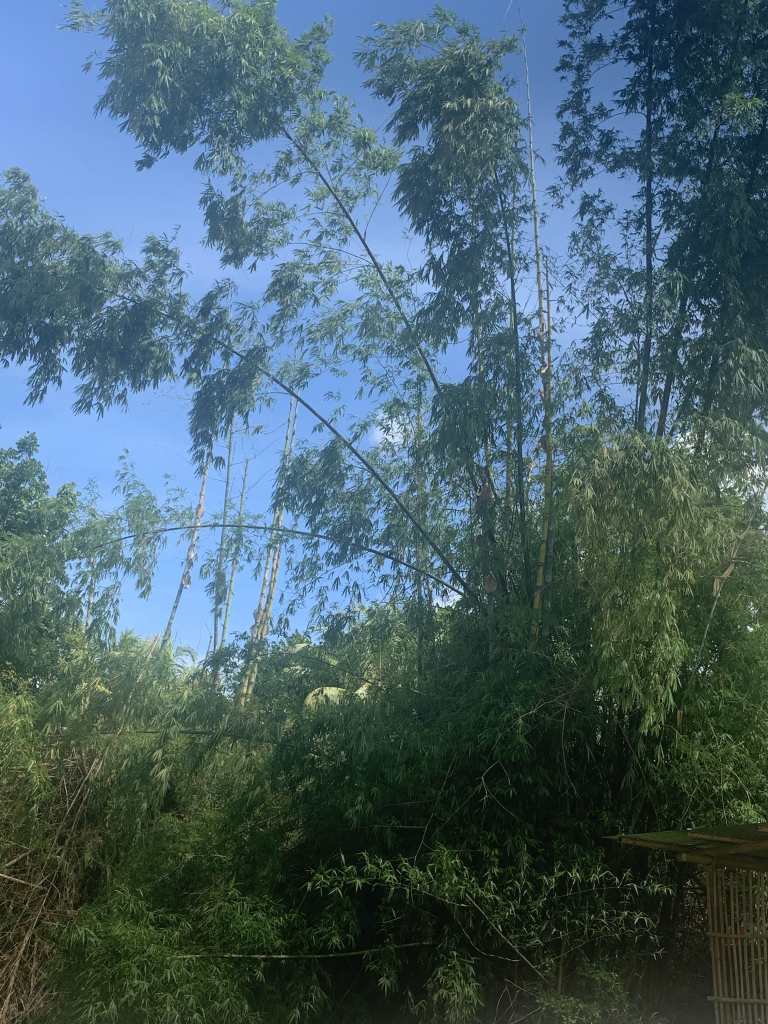

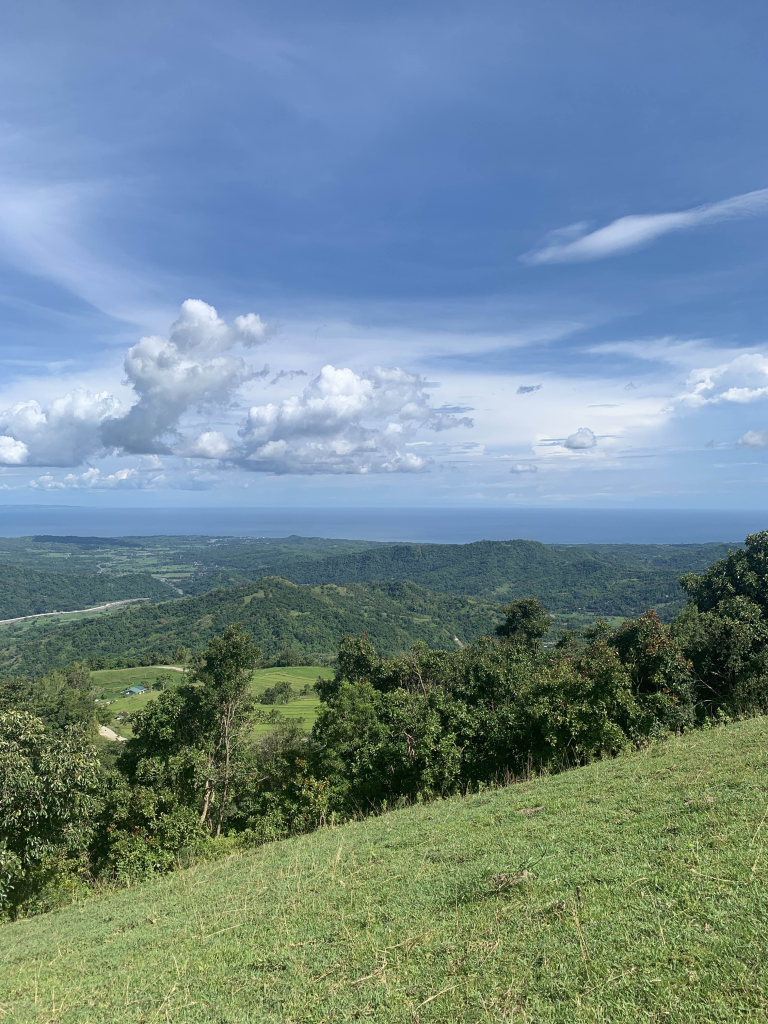

However, it’s not all bad! The jackstones also host the perfect environment for some marine life such as barnacles, sea snails, and several small crabs.
Wayfinding and star navigation
Before the invention of the compass or clocks, Pacific islanders have been using ocean voyages and their observation of the stars and sun without any instruments or tools. In the 20th century, this method was still practised in areas of Micronesia, however, traditional knowledge and techniques have been lost due to modernisation and colonisation of island cultures. (Polynesian Voyaging Society, 2023)
One of the natural cues that Polynesian voyagers used for navigation is the knowledge that islands block the waves and ocean swells. (Polynesian Voyaging Society, 2023)

Image above shows examples of how islands can (A) block, (B) refract, or (C) reflect waves .
Master Polynesian navigators memorised the rising and setting points of hundreds of stars. One of the ways they would do this is by utilising the Hawaiian star compass. This divides the sky into eight families of stars occupying thirty two houses. Having the knowledge of knowing where a star house rise and set mean you can chart a course from your starting point to any given destination. (Polynesian Voyaging Society, 2023)

How to navigate using stars
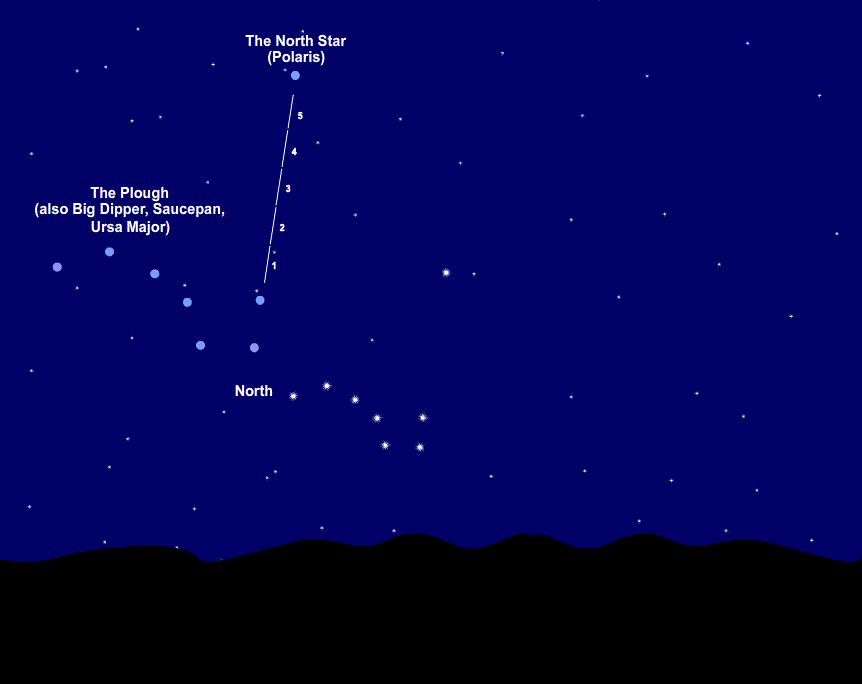
To navigate using stars, we need to find a star that is directly above the place we need to go and it will point exactly the right direction, from a quarter of the globe away.
Unfortunately, the star you have chosen to be an anchor point, would’ve moved a few minutes later. Fortunately, there seems to be one star in the night sky that doesn’t appear to move, and that star is called Polaris, or known as the North Star. If you were to follow this star, it would lead you to the North Pole. This means if we chose a star under the North Star, we would be heading North.
The easiest method for finding the North Star is finding the Big Dipper, which is part of the constellation Ursa Major. The Big Dipper rotates anti clockwise from the North Star, so it will sometimes appear on its side or even upside down. (Natural Navigator, 2019)
Early Polynesian navigation demonstrates a high level of sophisticated knowledge on natural systems by the use on observing the stars, ocean and sun rather than just using tools like clocks or compasses. With this knowledge it allowed Pacific Islanders to undertake long voyages with incredible accuracy and efficiency. Techniques such as reading wave patterns or memorising star patterns with the Hawaiian compass bring to light how navigation was deeply rooted in their culture and environmental awareness. Unfortunately due to modern interference such as colonisation, cultural heritage have almost been lost with most Pacific Islanders not needing to use this technique anymore. Although modern tools are much more convenient, they have severed a tie connecting Pacific Islanders to their ancestors, creating tension between cultural preservation and technological progression.
Architecture
Native Hawaiian house
A native Hawaiian house is called a hale and it is a traditional structure made from local materials such as pili grass, ‘ōhi‘a wood, and coconut fibre. These houses are built without nails and uses lashings and thatching. Hale is reflective of Hawaiian values of sustainability and connection to nature. (Coastal View Construction, 2025)
Types of Hale and purposes:
- Hale Noa – the main residential area where families lived and carried out daily life.
- Hale Halawai – used as the meeting house, a place for conversation, storytelling, and decision making within in the community.
- Hale Ku’ai – functioned as a small market place or trade shelter.
- Hale Wa’a – stored canoes and paddling gear.
- Hale Pe’a – was a small structure for women to stay in during menstruation. (Coastal View Construction, 2025)
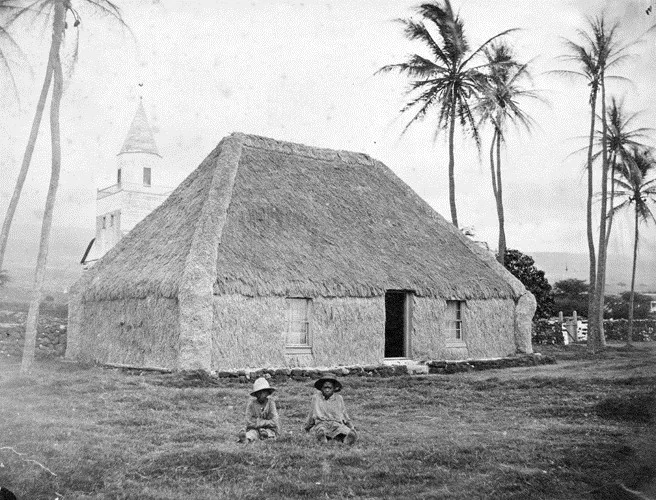
How they were built
Traditional hale were built on top of the ground or stone platforms.
Wood posts often formed the frame of the Hale. These were then lashed together using braided coconut husk rope which creates a flexible, yet strong structure that could move with the wind instead of resisting.
Everything from framing roof beams was tied with natural cordage. This method not only suited the environment, but it also carried significant cultural meaning, connecting the builder to the land.
Thatched roofs were made by layering bundles of pili grass or sugar cane in overlapping rows.
As a result of the roofs being thick, it shed rain water easily and helped regulate temperature by blocking the Sun, whilst also letting warm air escape.
It was also common for the community to regular upkeep the roofs and change them. It was a way to show respect for their housing over time. (Coastal View Construction, 2025)
Cultural and social meanings in Hale design
Chiefs typically lived under a larger Hale on raised stone platforms with multiple structures for sleeping, worship, and entertaining. These spaces were often marked with carvings with symbolism, staffs, and statues telling of their status.
The common family typically lived in smaller Hale’s to suit their daily needs.
Hale design followed Kapu, which is a set of spiritual laws and social laws that shaped their every day life.
Buildings that are held for religious ceremonies or gender specific roles, like menstruation or prayer, were reserved. The placement of the Hale was just as important as it held spiritual value; they didn’t want to offend ancestors and they wanted to avoid spiritual contact. (Coastal View Construction, 2025)
Traditional Hale architecture is reflective of the Early Pacific Islanders’ environmental adaptation and cultural values. As a result of the Hale’s materials, it is able to move alongside with the winds, rather than resist it which exhibits a great knowledge of the climate and need for flexibility. The use of pili grass and sugar cane provided not only insulation, but protected families from rain. However, these materials needed to be changed frequently showing the limitations of these structures as the durability relied on communities to help each other. Social hierarchy and spirituality were embedded with these buildings, this illustrated that these structures had cultural and physical expressions of belief systems. Unfortunately, due to modernisation, these buildings aren’t that common anymore.
References
Coastal View Construction (2025). Page Restricted. [online] Coastalviewconstructionllc.com. Available at: https://www.coastalviewconstructionllc.com/native-hawaiian-houses/.
Flowers, M.G. (2024). Philippines Flower Gift Traditions. [online] Myglobalflowers.com. Available at: https://myglobalflowers.com/blog/lifestyle/flower-gifts-in-the-philippines.
Frommers (2026). Environment in French Polynesia. [online] Frommers. Available at: https://www.frommers.com/destinations/french-polynesia/in-depth/environment/ [Accessed 8 Jan. 2026].
Henderson, C. (2024). Marine Life in French Polynesia: A Diver’s and Snorkeler’s Dream. [online] Tahiti By Carl. Available at: https://tahitibycarl.com/marine-life-french-polynesia/.
KHON2 News (2019). Fun facts about the beloved Plumeria flower. [online] YouTube. Available at: https://www.youtube.com/watch?v=cVyk1o-YScA [Accessed 8 Jan. 2026].
Natural Navigator (2019). Tristan Gooley. [online] The Natural Navigator. Available at: https://www.naturalnavigator.com/find-your-way-using/stars/ [Accessed 9 Jan. 2026].
Polynesian Voyaging Society (2023). Polynesian Wayfinding. [online] Hōkūleʻa. Available at: https://hokulea.com/polynesian-wayfinding/ [Accessed 8 Jan. 2026].
Terry, T. (2023). Hibiscus Flower: Everything You Need to Know! – Sakuraco. [online] Sakuraco | Japanese Snacks & Candy Subscription Box. Available at: https://sakura.co/blog/hibiscus-flower-everything-you-need-to-know.
webmaster@youngpioneertours.com (2024). Pacific Ethnicities: Exploring the Distinctions Between Polynesians, Micronesians, and Melanesians — Young Pioneer Tours. [online] Young Pioneer Tours. Available at: https://www.youngpioneertours.com/pacific-ethnicities/.
Leave a Reply