Before this project commences, I’m going to take the time to think about how I am going to go about this project. As the game’s main artist, I want to take the time to think about what I am going to produce and show what I am capable of within a short time frame of 4 months.
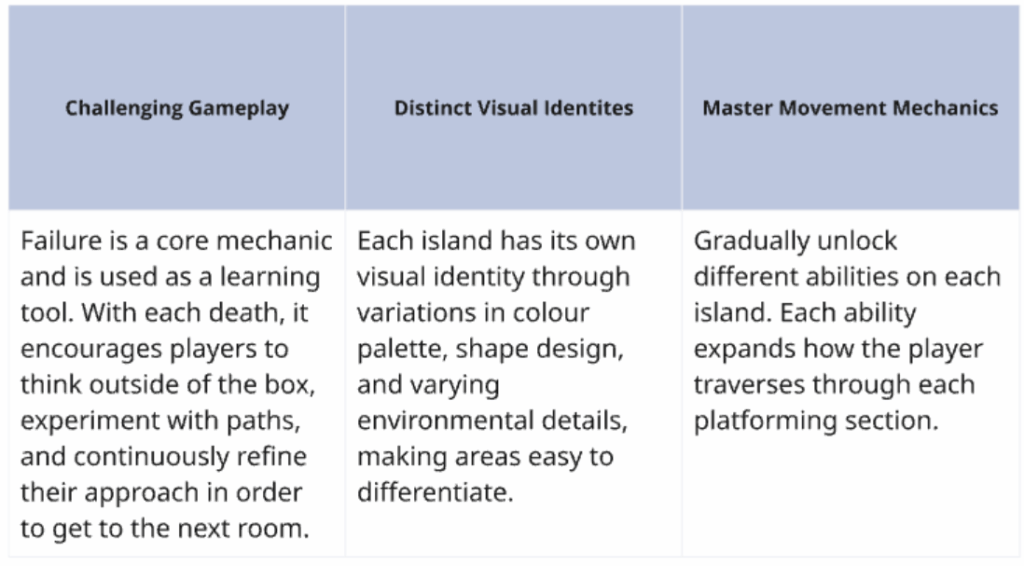
Game Pillars
These are the game pillars me and EJ both agreed on at the start of our game. These pillars would serve as the fundamental “rules” we would have when considering decisions and finalising ideas.
Initial concepts
Previously in last semester, I wanted to create a singular island aesthetic but incorporating varying landscapes whilst sharing the same style. The aim of this design was to create a picturesque island life that features blue skies, flourishing greenery and golden sand to create an immersive and visually appealing immersive environment.
However, this approach only prioritised visual cohesion and didn’t allow room for creativity, limiting potential for varied, distinct environments.
From last semester, I wanted the environment to look like this:
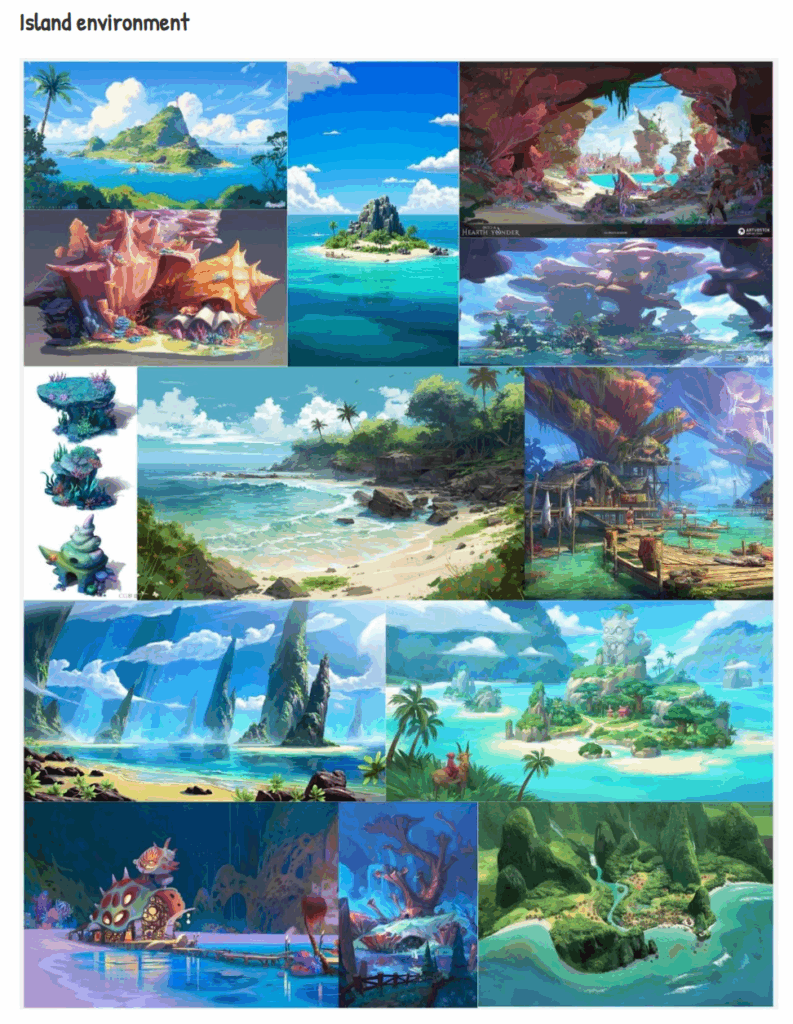
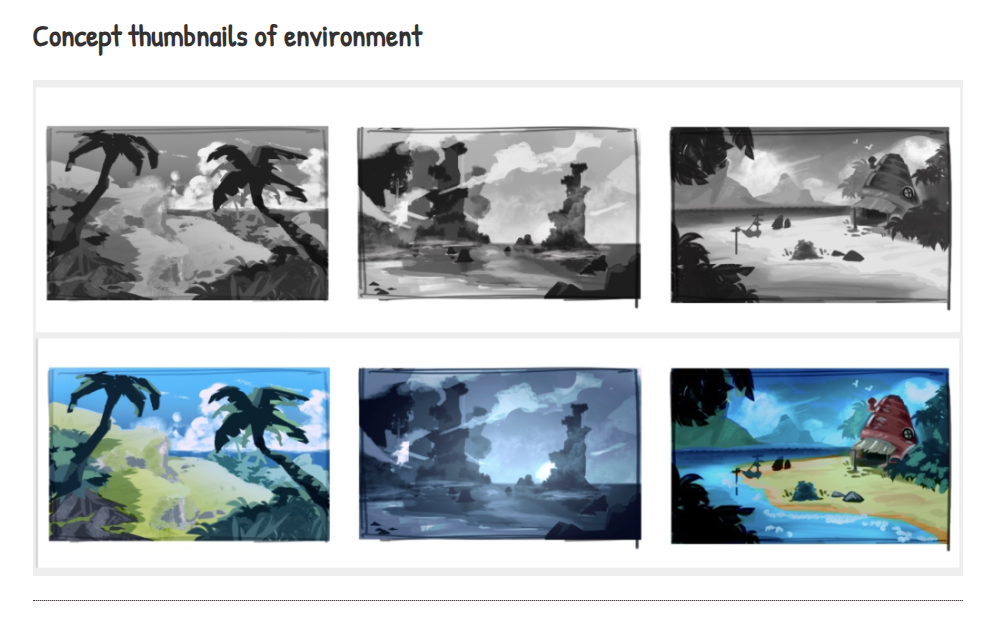
However, I am choosing to not move forward with this idea. Although I think it would be more simple to pursue this ideation, I feel like this wouldn’t push my capabilities. With this being said, I want to create a game where each island has its own distinct visual identity that makes the player feel like they’ve travelled far from where they were originally at. However, I don’t want it to feel too different to the point of absurdity, which is why I explored the idea of what each island could offer.
Style exploration
Before finding images of what I want to create, for me, a good concept comes up in a form of a brainstorm. This way, my ideas branch out into other ideas that are completely different from the original idea it stemmed from.
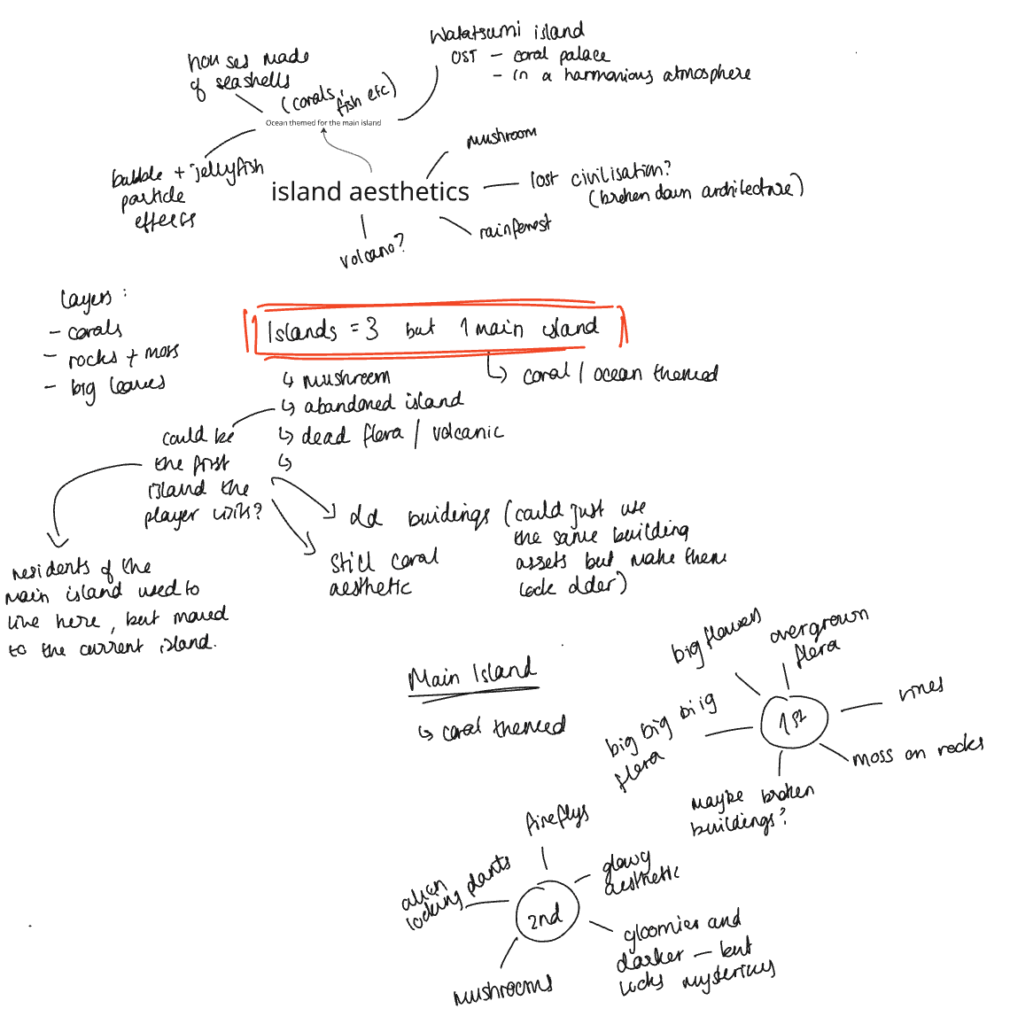
In the brainstorm above, I explored a range of ideas. One of the ideas that I wanted to pursue was a coral themed island due to the uniqueness in idea and potential for interesting asset design. I then started branching out into other ideas such an “overgrown” island identity. This island would be intended as the player’s first area they would play in, setting the narrative and tone for the game.
One of the ideas my team mate suggested was a volcanic island, however, this was then discarded considering the colour palette I wanted to move forward with—this island would disrupt the harmony of the style. While this concept would’ve offered an incredible high contrast environment, the scope of our project and maintaining a readable, consistent aesthetic will be prioritised.
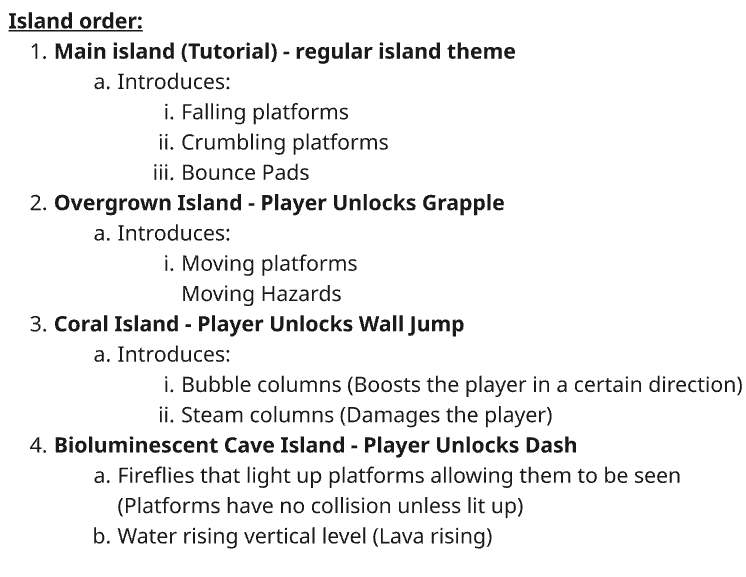
After the initial brainstorming, I collaborated with my team mate and evaluated the potential for each of these ideas. EJ wanted 3 playable islands and 1 main island completed. Each of these islands would offer the player a new mechanic, enabling them to apply these skills as they advance. Eventually, we both agreed that the layout below would serve as the overall structure of the game, providing new mechanics to be introduced in a structured way.
Asset planning
Island assets
| Asset name | Amount | Purpose | Notes |
| Background | 4 | Provides visual depth and establishes the island’s atmosphere | Unique in each island |
| Above ground asset | 12 | Adds to the environmental detailing | Used to create depth |
| Ground asset | 27 | Creates the terrain and adds environment detailing | Used to create depth and environmental storytelling |
| Tile set | 1 | Used to create the foundation platforming | Recoloured to fit each island’s aesthetic |
| Hazard tile set | 1 | Acts as an obstacle for the player | Supports our trial and error game pillar |
| Bouncing pad | 2 | Allows the player to interact and jump on it | Introduces one of our movement mechanics |
| VFX | 1-3 | Creates an immersive experience and depth | Low priority, most likely will do nearing the end of production |
Player character assets
| Asset name | Type | Purpose |
| Running animation | Animation | Movement feedback |
| Idle animation | Animation | Player’s resting state |
| Jump static | Static image | Air movement |
| Fall static | Static image | Falling movement |
| Wall cling static | Static image | Wall clinging movement |
Priorities from both tables:
| Asset name | Priority level | Reasoning |
| Tile set | Very high | I am not experienced making tile sets, it is also the foundation of the platforming for the player |
| Ground asset | Very high | Creates the fundamental environmental storytelling, there is a lot of assets to do in such a small amount of time |
| Background | High | Requires a lot of planning on perspective, angle, and environmental detailing to come out with the best result |
| Running animation | High | Little experience in animation, this animation will have a lot of movement, best to get it out of the way ready for playtests |
Asset pipeline
From the previous semester, I did some research on different artist pipeline and found that this one works the best for me:
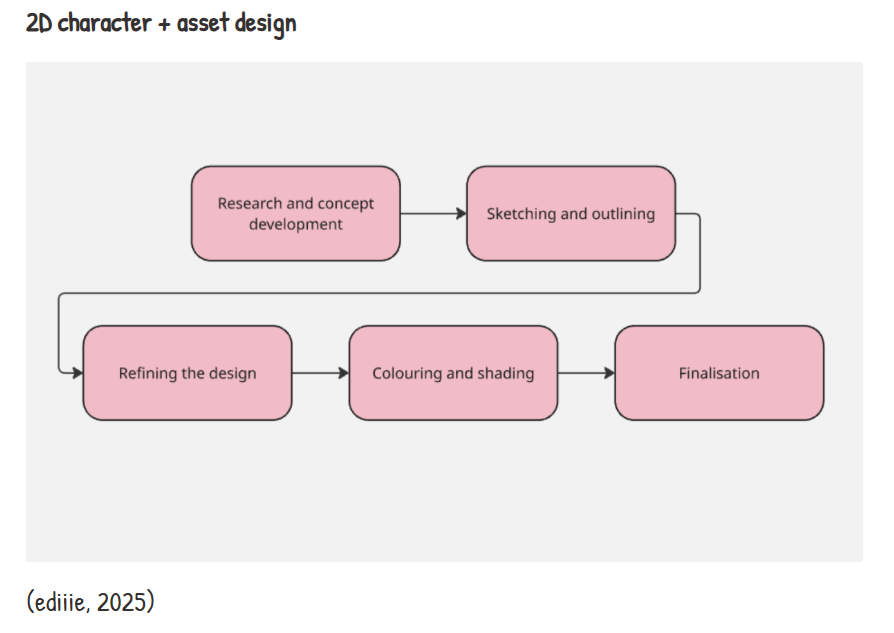
This structured workflow will support the production of the game and ensure visual quality across all the islands and character. Each stage requires constant feedback from either my team mate or a class mate, ensuring that the aesthetic meets clarity and feasibility.
This process starts off with basic research and concept development such as mood boards, it allows me to gather inspiration and potential images to create the necessary assets I will need. Then once I have obtained a sufficient amount of research and inspiration, I’ll move onto sketching and basic ideas. This stage shouldn’t take too long as I will just be experimenting with different shape languages and environmental details (flowers, leaves etc). It’s imperative during this stage that I nail shape language and sizing. The refining stage is quite simple, this is where I begin to actually lay down the ink for the assets; structures need to be clear and readable. I’ll then move onto colours and shading, this stage is imperative that I get fluent colour harmony across all pieces as the wrong hue can make or break a piece. Finally, once the piece is rendered, I’ll tweak the colours or shapes to make sure it fits with the background.
By following this iterative approach, its goal is to ensure that all assets align with the game’s visual direction.
Constraints and considerations
Time constraints: Due to the very limited time frame of this project, there are certain things I need to cut back on so that the idea of 4 islands is feasible. I need to prioritise key assets such as backgrounds and assets that make the islands feel more lively. This influenced my decision to simplify the rendering of certain environmental assets to maintain consistency.
Maintaining visual consistency: To maintain the same visual consistency across all islands, I have decided to limit the colour palette or at least stay in the same colour wheel. Additionally, to remain in a consistent rendering style, the same brushes will be used and the same techniques to unify the style.
Scope: Given the scope of the project, creating 4 detailed required planning and changes to make sure that we deliver on time. This creates a challenging timeframe landscape especially with a large amount of assets to create. To manage this, I will be making the assets that I am not very comfortable in such as animation and tile sets so I can nail them down early before it becomes a bigger problem down the line.
Roles
This section will outline the industry roles that both myself and my team mate will take on, highlighting our own individual responsibilities and how collaborative workflows overlap and support our development. Establishing clear roles allow for an efficient workflow, mirroring real industry practices where collaborations between specialisations is essential to make the final product.
Before the start of this project, me and EJ both agreed to strictly work on our own disciplines to allow room for growth and development. Below is a table showing our responsibilities and room for improvement.
| Name | Responsibility | Weaknesses |
| EJay | Programmer, game designer | Not familiar with workflows that import assets into the game engine – Unity Animator, Tilemaps etc. |
| Paula | Artist, Visual director | Not familiar making game specific art and the technical boundaries. |
Responsibilities of a programmer and game designer:
- Level building, constructing the environment and pacing the game’s difficulty curve
- Writing code to build the gameplay dynamics and physics engines
- Bug fixing and resolving errors during playtesting
- Inventing the storyline and game loops
Responsibilities of an artist and visual lead:
- Propose the core look of the game such as characters, environments, and overall themes
- Create the art assets for the game
- Work closely with the programmer to ensure that artistic creativity and technical functionality exist on the same plane
This project will be a collaborative one, with both me and my team mate contributing to different aspects of our game. While I am art orientated, my team mate is more focused on programming and level design, ensuring that the game feels good to play and systems function within the game.
Communication will be ESSENTIAL for this project, as a team of two, there really is no excuse to not be communicating. Which is why we will be communicating mostly on Discord and/or Slack. As an artist, communication will be an important skill to have as it’ll be how I get my feedback and it ensures that my work aligns with the game’s requirements. A collaborative workflow allows for continuous feedback after each iteration and idea, ensuring that all assets are visually effective and functional in the game.
This workflow closely imitates industry practices where artists and developers work closely with each other to ensure that the visual design is feasible and supports the game play. Stating each role clearly at the beginning of the semester is essential for maintaining consistency in the development pipeline.
This project will highlight my strengths in visual design but it also points out areas I’m weak in such as technical implementation as well as animation.
Production plan
In the previous semester, we made this GANTT chart to lay out what needs to be completed by what deadline:
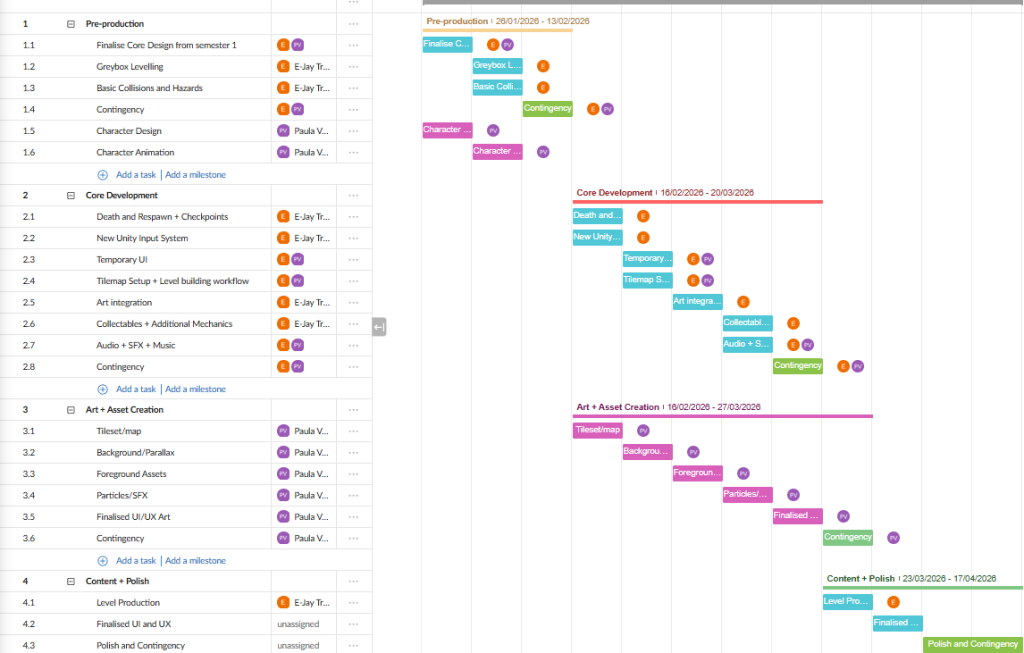
I realised that this Gantt chart underestimated our deadline so I made a new one that applies to me. These tasks cover the major ones I need to complete and not the unplanned assets.
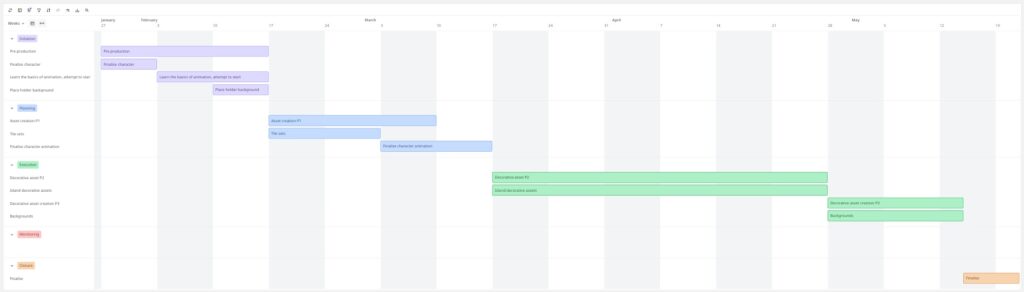
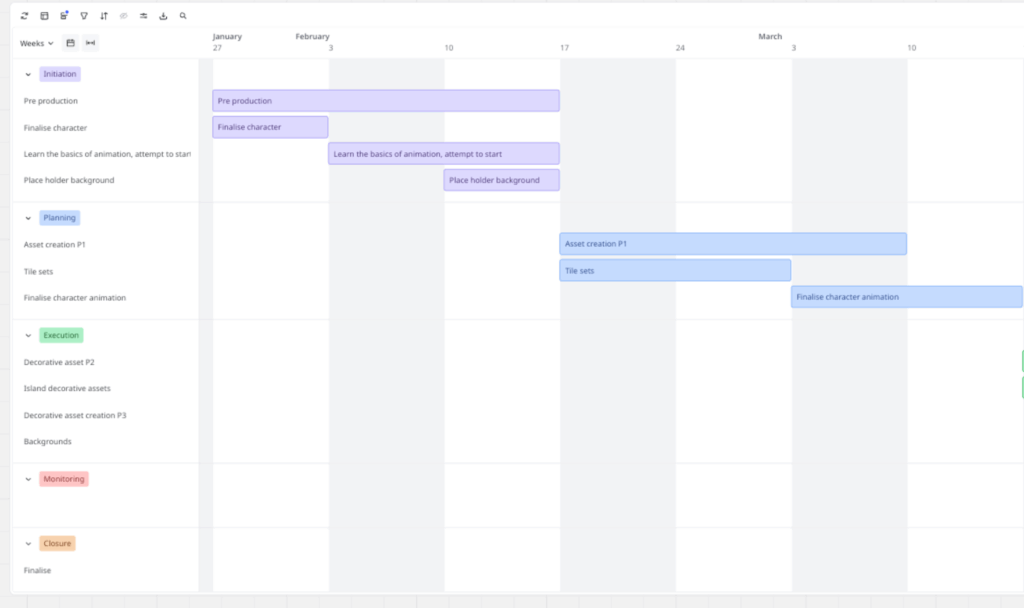
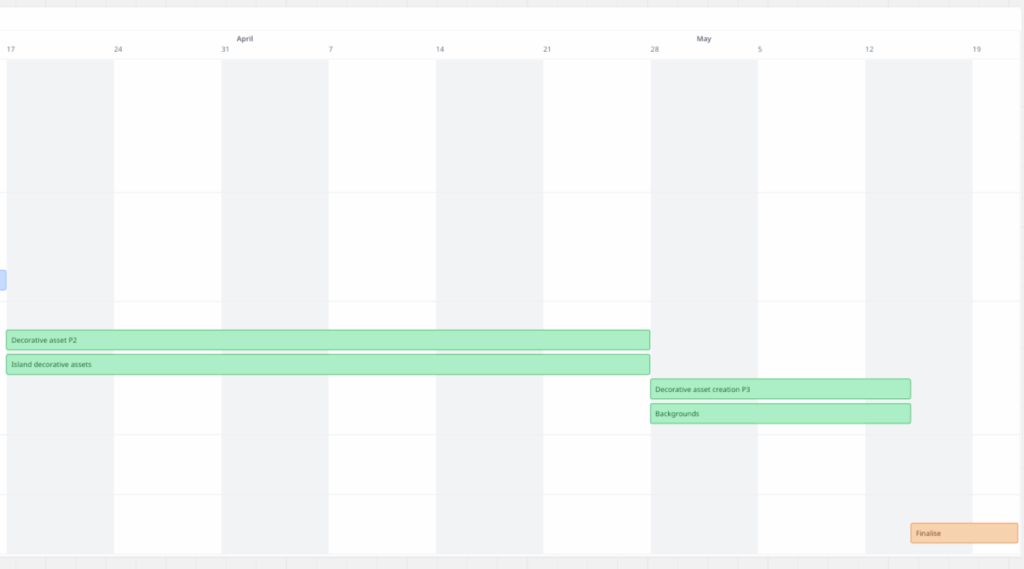
All together we will have 5 sprints, including the closure one where we make final polishes to our game before deadline.
I also want to clarify why I’m doing the tasks I am not confident in first. I believe my productivity will increase exponentially as the project goes on. By putting tasks I have no or little experience in first will allow me to allocate my time for departments I am confident in.
Leave a Reply