
Exploring the themes of children’s storybooks, unreliable narrators, decisions, and loops.
Click on the sentences below to find out more!
Main story I thought for the game :
- Wake up in the middle of the forest ( daytime )
- The unreliable narrator is distracted by something / a random noise
- Bump into sheep after exploring a bit, after the narrator disappears
- Sheep talk to the protagonist after trying to run away. Then the wolf appears, looking to chase the sheep: it asks you for directions
- Depending on what choice you make, the Wolf will either call you a liar or thank you for honesty
- The narrator comes back to narrate your story, and while you follow the instructions, he gets distracted again, but randomly mentions not to trust the ‘wicked wolf.’
- The wolf is stalking you now, but doesn’t confront you. So instinctively run away from the wolf.
- As you run away, you come across a white blank empty area detached from the forest area (this place is the ‘end’, the blank space is filled with unfilled pages/ empty pages with distorted images/ or story tales but now the narrator returns and is not happy.
- As you continue running from the wolf/narrator, you end up back in the place where you woke up, reseeing the wolf and the lamb before they encountered you.
- You get to see a bit of the conversation between the wolf and the lamb (before the lamb bumps into you)
- Then the narrator repeats the story with the same dialogue but with a different character; this time, you accidentally make a noise. So the narrator gets distracted as he did previously.
- You get two options now: 1. Follow the lamb,2. Follow the wolf
- 1. Following the innocent lamb will lead you to pa ack of sheep where the narrator appears, instructing them on the next story as he’s sort of like the shepherd.
- 2. Following the Wicked Wolf will lead you deeper into the forest, where he confronts you, asking how you haven’t disappeared. You mentioned you want to get home, and he laughs, explaining that you aren’t real, and when the narrator finds out, it really will be the ‘end’ for you. You refuse to believe him and ..
Multiple endings: not fully polished yet
- Bad ending: the player dies inevitably, but teaches a moral lesson to those who listen to the story.
- Good ending: the player lives.
- Another ending: the story is incomplete, no one knows what happened at the end, or is a warning being sent?
- Spiral ending: They realise they can’t make decisions for themselves and start spiralling.
Characters:
- The narrator
- Could have a plot twist where the narrator is the villain ( similar to Little Misfortune)
- The witch (player character)
- The wicked wolf
- The lamb
- The cat
Decisions:
- Why did I turn the main character into a magical witch?
- I personally wanted to give the player character a whimsical, magical person, and in folklore, there are often witches associated with that. So I decided to make it into a story about a witch trying to get back to her cat, Miss Mya
- Why a wolf and a lamb?
- I want the ‘wicked wolf’ and the ‘innocent lamb’ because I’m referring to the fable story ‘The Wolf & the Lamb,’ however, in this interpretation, the lamb flees the wolf, and the wolf declares the lamb to be evil.
- But I don’t want it to be perceived that way right away, giving the player the option of trusting the wolf or not, leaving ambiguity.
- Why a narrator?
- Well, I wanted to have a narrator, similar to how children’s fairytales are told by grown-ups.
- The narrator represents control; he’s like the puppet master to the reader. In the game, I wanted him to serve as a guide for the player and show that he’s in a position of power. However, later on, when the instructions become questionable. So this way, I can create tensions between the narrator and the player and make the player think more carefully when making a choice, rather than following the rules blindly.
Possibilities for narrators reveal :
- A witch that can control fate/past/present (reference In Norse mythology, the Norns, female beings who create and control fate.)
- A future person rereading a traditional story ( the game )
- An evil antagonist acting like the puppet master.
What tone do I want for the story/game:
⁃ Whimsical, but weirdly eerie.
What inspired this game idea:
The inspiration for the game came from children’s stories, fate, and previous research into existing 2D story-driven games such as Little Misfortune and Franbow. Personally, I’ve always been fascinated by story-driven games and how engaging they can become. I planned to make a game using pre-existing fairy tails meant for children; however, this may change as the idea grows.
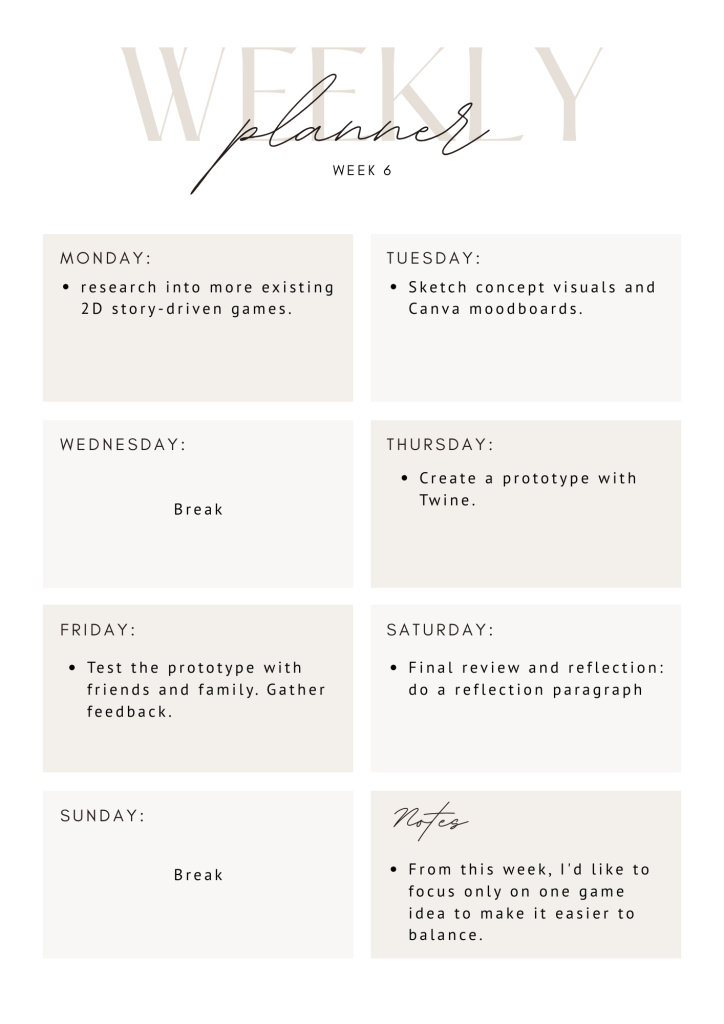
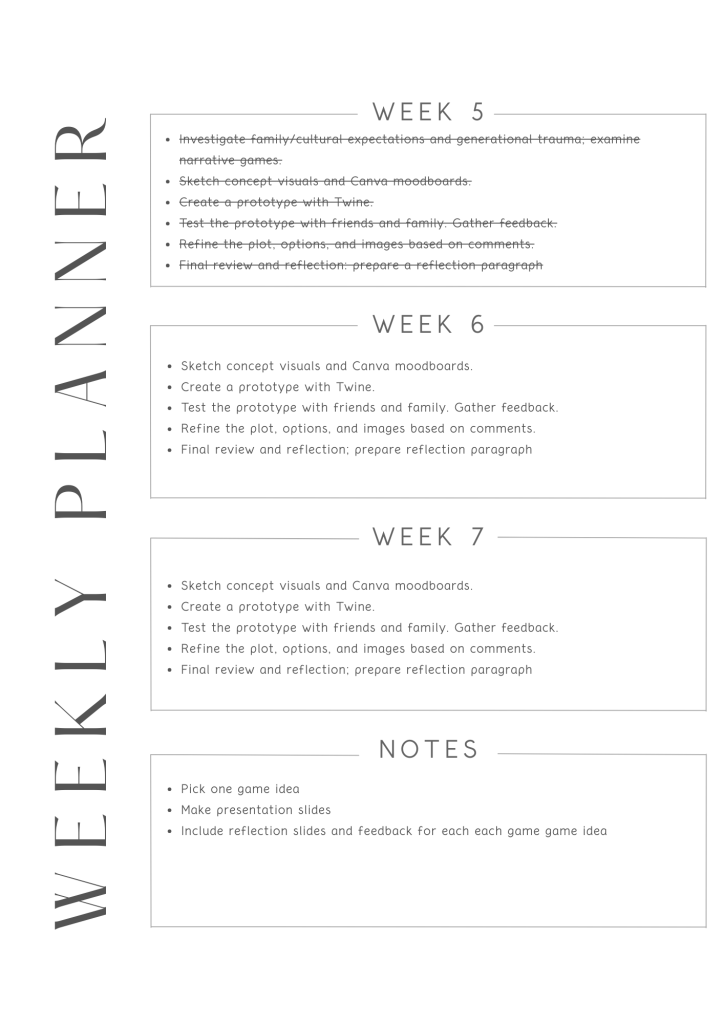
To manage my work, I created a simple schedule: One for the in-depth week tasks and one for the coming weeks.
Reflection:
My game is a 2D narrative-driven concept that centres on player choice and storytelling. At this point, the game idea exists as a concept supported by early planning and research, to further develop it through prototyping. The concept covers current trends in game design, specifically the rise of narrative games that prioritise player engagement. I was mainly inspired by prior research from existing 2D story-driven games like Little Misfortune and Franbow. The game research helped to make sure that future story idea decisions should have a meaningful link to the overall story so it will be more engaging for the players overall, and although the game is just a idea, I’ve tried to use industry-supported methods: such as sketching visuals, creating prototypes, brainstorming, S.C.A.M.P.E.R technique (substitute, combine, adapt, modify, put to another use, eliminate, reverse), inspiration from other mediums and real life. I did this because I wanted to try and engage with industry-supported methods for game ideas. I also wanted to explore the moral impacts of my game idea, specifically whether they would help another character in the story by appearance without judgment or consequences. Hence, I included characters like the sheep and the wicked wolf in the story.
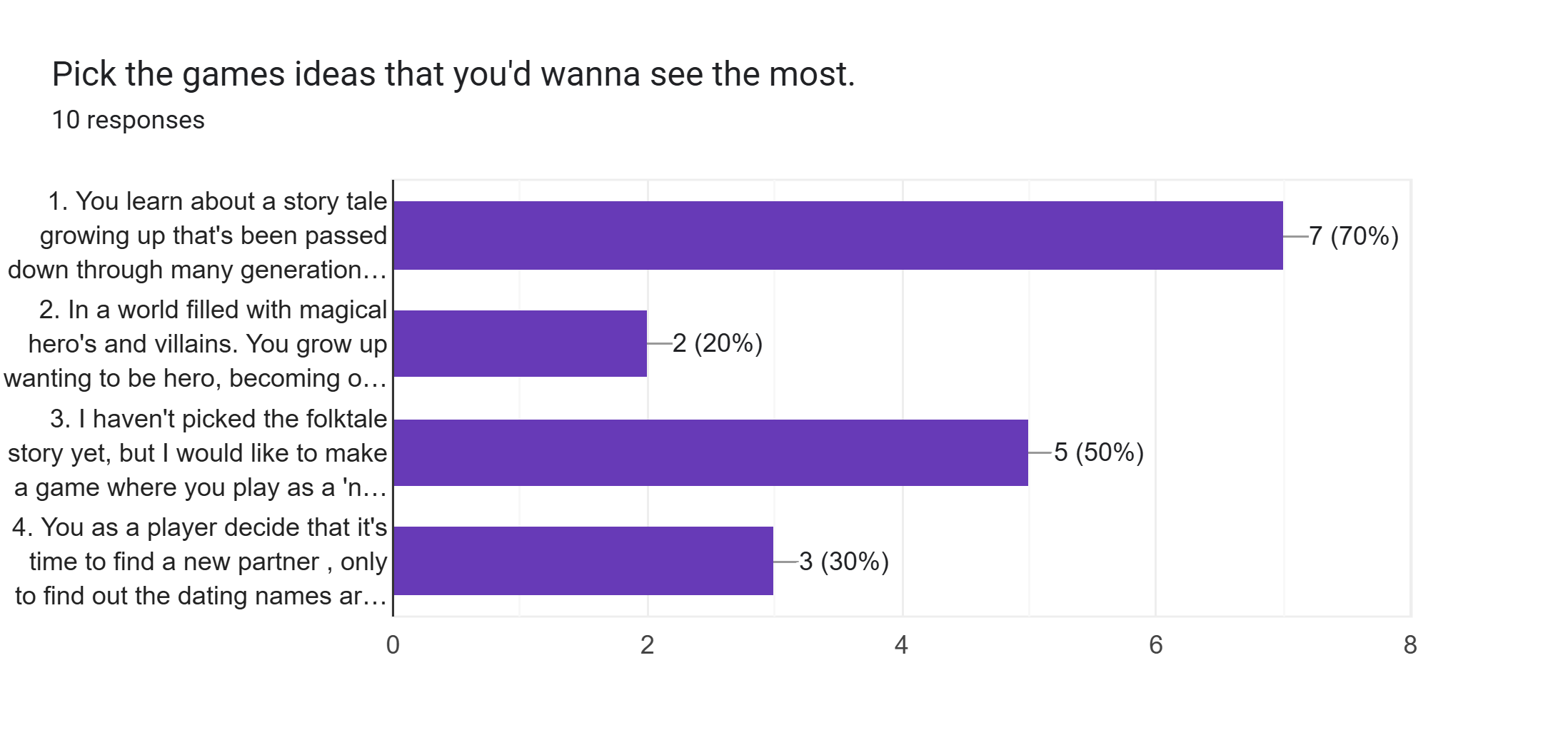
This was the second most popular game idea in the survey. Developing this concept needed considerable thought and reflection, and to be honest, while I did try to keep the scope realistic and appropriate for my current skills. It was difficult to actually fully refine the whole story, and since I’m also deciding to work alone, I’ve acknowledged that I may have to cut a few things from the game, so instead, I made a list of possibilities for future development of the game.
As the concept progresses, the next phases will be prototyping and visual iteration to further refine the idea.
Leave a Reply