Professional Contexts Reflection
The transition from university to getting into the games industry can sometimes be quite daunting. To help prepare ourselves, we were given the opportunity to hear from industry guest speakers, some alumni from the BA Games Design and Art course. Each speaker had a different role, from senior games designer to 2D concept artist. We were advised on what to include in our portfolios, how to effectively network, as well as what a path into the games industry may look like.
For my current career plan, I am on a path to becoming a 2D character concept artist or generalist. 2D art is one of my strengths, and a skill I have been honing since having an Instagram account in 2019 to showcase some of my digital art. Although I am open to working in the creative industry as a freelancer, I expect to be working in an indie studio as my first step into the games industry, as generalists or more versatile artists are more common in smaller studios or on smaller teams.
Jamie Blacknell
Like in any other industry, networking is essential as it opens doors for new opportunities, provides career advice, and creates mutually beneficial connections. Our first guest speaker, Unity developer Jamie Blacknell, gave sound advice on ways to network. With the increase of AI, speaking to real people in the industry, learning about the artists in media that you like, and being an active member of your community are a few examples, but have become even more important than ever. Ultimately, forming connections with seniors in the industry provides us with valuable knowledge and insights to further our professional development.
Not only seniors, but our peers are valuable connections too. One example in which we can form connections with our peers is by adding them on LinkedIn. I made an account in my second year of university and have been steadily growing my number of connections by adding staff, peers, graduates, and other creatives. After each guest speaker, I added them as a connection. During our first and second years of university, we worked in groups with our peers, which showcased that I was able to work in a team to achieve a shared goal. Although I have yet to post anything, I plan to make my first post, which will feature a collection of concept art for my Project Proposal module or showcase art from a previous, unfinished game. In a LinkedIn guide for game artists, they advise updating your LinkedIn profile at least every four to six months, or whenever you complete a major project, learn a new skill, or create a noteworthy piece of art. Content you can post is ‘high-quality images or videos of your art, animations, or level designs, and explain the creative process or techniques used. This not only displays your talent but also your ability to articulate your craft’ (Tealhq.com, 2025).
Jamie also recommended we join game jams and challenges, as this gives us the opportunity to work with others in the industry, as well as make a game separate from university work. Previously, taking the initiative for anything new and ‘optional’, with people I was not familiar with used to overwhelm me, but after these talks, I realise how beneficial it can be to put yourself out there. I plan to apply this advice to my professional development by participating in a game jam during the summer through studios like Snappy Gurus. They last hosted a game jam from August to September of 2025, with their summer game jams being an annual event.
Mentioned briefly, I created an Instagram account in 2019 for digital art in mobile interactive games, fandoms I was interested in, as well as for commissions. After a few months, I was able to gain over one hundred followers. Feeling inspired by some of the guest speakers’ talks about being present online and in person, I revived the account after a few years of inactivity by sharing some of my art in communities that I was part of. As a result, I was able to get more reach, create meaningful connections with other creatives, and found it was not bad to take up space. Jamie suggested that we make accounts on Artstation, Github, Instagram, or establish a blog/personal website to showcase our work. I have an account on all these platforms as well as itch.io, posting artwork I made in my first and second years of university. After his suggestion, I am considering posting more finished pieces/projects on my Artstation and itch.io as well as revamping my Instagram art account or creating a Twitter/X account and posting more frequently, as this also creates more exposure and reach, and therefore opportunities.
Although Jamie works mainly in 3D, his advice on displaying our artistic ability in our portfolios was still very relevant to me. Drawing at a competent level, following through with a concept, and showcasing experience with all (industry-standard) software make for a strong foundation in your portfolio. He also mentioned a few other important tips, such as researching to inform your artistic decisions and thinking about the details and context of what you are making. Doing these things in your process makes for much stronger work, as it shows an attention to detail, thoughtfulness, and passion for your art. Although my research is already quite strong, this serves as a reminder to document everything that goes into the design process, making sure that it is concise and contains sources.
One piece of advice that Jamie gave was to be a ‘jack of all trades, master of none,’ and university was the perfect opportunity to explore different skills. Being able to communicate with and understand the different disciplines of the people you are working with will prove to make teamwork much smoother. Originally, for my final year project, I favoured working in a team as it meant I could showcase effective teamwork skills and meant I could focus on what I knew my strengths were, which was 2D art. However, after some consideration, I was leaning more towards working solo on my project, as this would not only strengthen my technical and soft skills but also prove that I could handle a heavy workload with level-headedness to create a game that I was proud of, and that is meaningful to its audience. After acknowledging that I did not have much experience in coding and other areas in the pipeline to make a game, by taking the time to hone these skills and to familiarise myself with different software/engines in a solo project, I believe this choice will help me grow both professionally and personally.
Olivia Gregory
Our guest lecturer in week 4, 2D concept and visual development artist Olivia Gregory, had invaluable advice when it came to presenting our portfolios and what to include, as like me, she is a 2D artist who uses Procreate (I pivoted to this software in my second year of university). Olivia specialises in props, environment art, as well as disability representation and how to integrate it into creative media.
For what to include in a character portfolio, she recommended: anatomy, turnarounds, poses/expressions, texture callouts, rendered pieces, and colour variations. Moreover, she stated that we can feature fanart and inspired work in our portfolios, as this displays an ability to work from a concept. Linking back to my Instagram page that I mentioned previously, I recently made artwork inspired by a musician and shared this at an event in November, with my Instagram page linked, and was able to gain a few followers.

Listed above are the basics for what to include in a character portfolio, and although I had already included some of these in my own work, it made me realise that documentation is extremely important. For my Project Proposal module, as well as future projects, I will be thorough when documenting my process. I will do this through screenshots of first sketches and moodboards to finished pieces, time-lapses of making a digital art piece, as well as written documentation.
Furthermore, Olivia added that showing our process was an important step to demonstrate that you can work in a pipeline (e.g. rough sketches, concept art iterations, etc.). For my Project Proposal module, I drew a very rough sketch of a potential design for the protagonist in my game. I then used this as a reference when using the technique of photobashing to flesh out my design. I am starting to integrate their advice into my own practices, making sure I document each step of the pipeline and, most importantly, into my portfolio.

Since I also wanted my environment art to be strong, including different perspectives, the process/iterations, layouts (clean linework), different seasons/times, and scale were just a few essentials of what to include in your portfolio. Before, I used to want to avoid doing backgrounds as I felt as if this was not a strength of mine. However, as stated previously, being an all-rounder, especially in indie studios or smaller teams, can be quite helpful as it opens up many more opportunities.
Olivia also showed us the distinction between work/portfolios that are better suited to illustration (e.g. art books, exhibits, promotional material, etc.) versus concept art. This was important to note as curating your portfolio with work that shows your skill, but is also appropriate for a concept artist role, could be the difference between what gets you hired and what does not. Some tips she shared with us were: cut any work that is not adding to your technical or creative showcase; otherwise, it will dilute your work. Also, have a speciality, quality always over quantity, and, leading on from Jamie’s suggestion to join game jams, include these in your portfolio as well. This made me re-evaluate a lot of work I had in my portfolio, removing work that was not as strong and thinking about what types of work are worth showing.
Bea Grove
Many of the guest speakers had very similar points, but it really helped to drive home how important having a strong portfolio is, understanding the basics of what goes into making a game (e.g. understanding at least the basics of coding, learning industry-standard software, etc.), and not being afraid to put yourself out there. Bea Grove, a senior games designer, made points on the industry, portfolios, university, as well as interviews. A key reminder she gave was that AAA is not always the way, and with quite a few guest speakers discussing how their step into the games industry was not always immediate, it is important to know what options are out there. With so many people out there with a passion for games, indie studios will always be around. In addition, mobile, web, and board games exist as well, with the mobile games industry currently thriving.
One piece of advice that Bea gave was that transferable and cross-disciplinary skills are still, and always will be, beneficial. Many people start in QA and move across to other departments, and even non-game jobs can bring over skills. Although a career in the games industry is the likely end goal, I still see myself working in other areas within the creative industry or working on passion projects. Our guest speaker in week 4, Olivia, also mentioned that while working in the games industry, she is also a freelancer, which proves that this is a viable option. However, for this to be a viable option, a strong portfolio is essential. Bea suggested that we include projects from all three years of university and specify our roles, self-led projects, designs for unmade games, and, as mentioned, game jams. I already included some work from my first and second year projects on my Artstation, but I plan to post more on my other platforms, as well as some work from other projects outside of university work.
For Bea and many other guest speakers, university helped bridge a gap that they otherwise would not have as easily been able to access in preparation for getting into the games industry. For example, the opportunity to work in a team during the first and second years helped us to learn how each role worked in a game development team. It was also a space where we could learn code with the help of staff and peers, as programmers, designers, and artists all need to know the basics of code and engines. It also helped by kickstarting our portfolios as we could showcase projects we worked on over the three years of university and demonstrate our improvement.
During the application and interview process, it is important to research the company so that you are able to answer basic questions and be able to ask them questions – you are interviewing them, too. Also, showing a passion for games, even if you are not as skilled as another candidate or the role is not your dream job, can be what shows them that you are dedicated and willing to learn.
Meghan Matthews
Our guest speaker in week 8, game designer Meghan Matthews’s portfolio advice was also extremely helpful. She stated that having a portfolio of at least 4 – 6 projects that is clear and accessible and guides the viewer is the foundation of a good portfolio. According to Myhideout.xyz (2025), who suggested a similar amount of work to have in a portfolio, says to have at least 2 projects with 8-10 pages of work that revolve around a narrative. Additionally, ‘the most effective portfolios are often built around narratives rather than random, standalone art pieces… reflects critical thinking, and worldbuilding, and influences every decision made in the design.’ This links back to some advice that Jamie gave about presenting your work professionally and in the theme of your artwork.
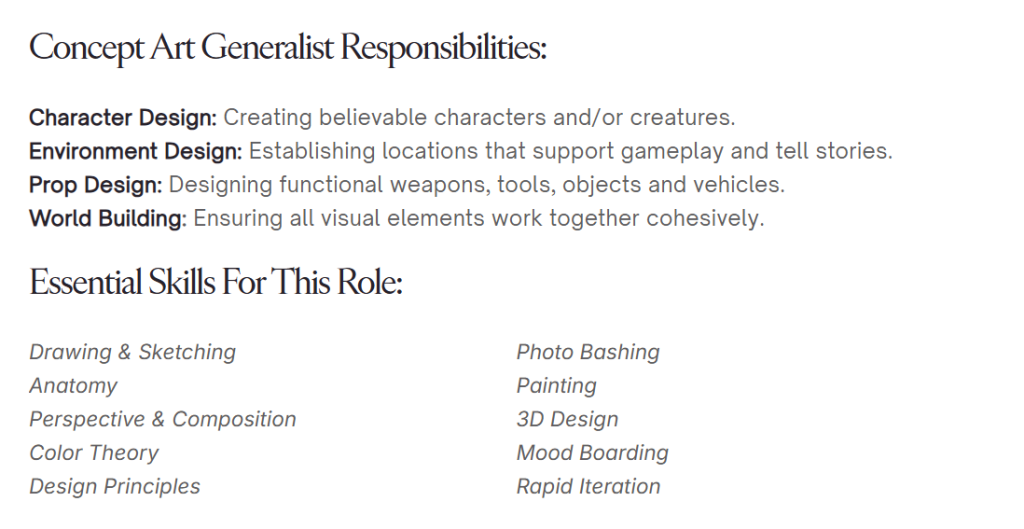
Much like Olivia’s portfolio advice, including a basic understanding of anatomy and perspective, with the addition of the use of different techniques and design principles, are essential skills for the role of a concept art generalist. To strengthen my skills in 2D art, I will practise improving my artistic skills more often, taking responsibility by giving myself set days or schedules to post art on social media, as well as follow tutorials on Udemy, Gumroad, Arstation, and YouTube.
Utilising my university portfolio by experimenting with different themes and layouts, I applied Meghan’s advice by making my game design blog sleek and easy to navigate with drop-downs and categories to organise my posts.
My Plan
Preparing for a career in the games industry requires a combination of artistic skill, targeted portfolio development, networking, and a strong understanding of pipelines in game production. These guest speakers proved to be extremely helpful by inspiring me to become more proactive with my professional and personal development. As well as by bridging a gap in my understanding of what makes an artist stand out in such a competitive industry. With the advice from guest speakers such as Jamie Blacknell, Olivia Gregory, Bea Grove, and Meghan Matthews, as well as my own reflections on my strengths and aspirations, I have created the following action plan to guide my development as I work toward becoming a 2D character concept artist or versatile 2D generalist.
My priority is to strengthen my portfolio, ensuring it demonstrates both technical competence and familiarity with the concept art pipeline. Following Olivia’s advice, I will produce character artwork that includes anatomy studies, turnarounds, dynamic poses and expressions, colour variations, and finished, rendered designs. I will also improve my environment art through perspective studies, lighting variations, and showcasing scale. Furthermore, I will document each stage of my process – from early sketches and moodboards to iterations and final renders – to show a clear, professional workflow. Regularly reviewing my portfolio will allow me to curate my most recent and strongest work.
Building a strong online presence is another key part of my plan to prepare myself for a future in the games and creative industry. I will continue growing my network on LinkedIn by adding peers, lecturers, guest speakers, and other creatives, as well as by posting updates when completing a project or sharing my art. To increase visibility and engagement, I intend to revive my Instagram art account or create a Twitter/X profile dedicated to showcasing my artwork. I will keep my Artstation and itch.io frequently updated. I also aim to join a game jam in the summer or work on a passion project to have more content in my portfolio.
To become a more competent and versatile artist and team member, I plan to expand my technical skills. This will include learning more coding fundamentals, familiarising myself with and becoming more confident in industry-standard software such as Photoshop, Blender, and Unity, and exploring 3D blockouts or other tools that can enhance my concept work. My decision to work solo on my final-year project aligns with this goal, providing the opportunity for me to develop stronger independence, problem-solving skills, and a deeper understanding of the different disciplines within game development. By documenting this project through written blog posts, screenshots, and videos, I intend to produce a substantial body of work that demonstrates my ability to manage a workload, navigate challenges, and develop a game concept from the initial idea through to a finished and functional game. Together, these actions form a comprehensive plan that will prepare me to enter the games industry with confidence, professionalism, and a strong creative identity.
References
Myhideout.xyz. (2025). Concept Art Portfolio Guide. [online] Available at: https://www.myhideout.xyz/artcareer/portfolio/concept-art
Tealhq.com. (2025). 2025 LinkedIn Guide for Game Artists – Headline & Summary Examples. [online] Available at: https://www.tealhq.com/linkedin-guides/game-artist
Reply