Concept
In the Sherlock Holmes series, it created a new world background and story type.The vast majority of DND-type games tend to focus more on combat.Create an innovative detective game set in the DND world, featuring a wider variety of crime types and methods. This will result in more interesting cases, allowing players to have more imaginative detective ideas.Using the detective approach to gradually complete the story supplementation enables players to experience the entire story and have a more immersive experience. Moreover, when players unlock the true ending and the complete story through their own thinking and efforts, it can also stimulate their sense of achievement and satisfaction.
The game is set within the DND universe. What kind of different cases and stories would occur if Watson and Holmes were present? Therefore, DND provides an important world view and story background, allowing me to use this background as a foundation to continue writing more fantasy stories. So, as I mentioned earlier, I have covered the basic world view and popular content of DND.
What are the commonalities between D&D and Sherlock Holmes?
On the surface:
- D&D = Fantasy, Adventure, Combat, Magic, Dice
- Sherlock Holmes = Reality, Crime, Deduction, Evidence, Logic
However, their core gaming experiences are actually very similar:
The player encounters an unknown situation → Collect information → Make a judgment → Take action → Continue to explore based on the results.
The Core That Is Most Suitable for Integration: “Skill Evaluation” in D&D + “Inference” in Sherlock Holmes
This is the mechanism I recommend most highly for your game.
In the 2024 edition of D&D, Study has been clearly linked to Intelligence-related skills, including Arcana, History, Investigation, Nature, and Religion; while Search corresponds to Perception, Insight, Medicine, and Survival.
Moreover, the definition of Investigation in the 2024 DMG is extremely suitable for your game:
Investigation is not simply “whether something was seen”, but rather using reasoning and deduction to figure out how something operates or reach a conclusion.
This is almost perfectly in line with Sherlock Holmes’ way of thinking.
The second point that is highly suitable for integration: Dice create “the uncertainty of the detective”
This is a very important aspect that D&D can bring to Sherlockian-style games.
There is a common problem in traditional detective games:
If players fail to find a certain key clue, they get stuck.
D&D can solve this problem with dice. For example:
The player examines the corpse.
Possible actions: Medicine Check
Assumptions:
- 1–5: Only surface wounds can be detected
- 6–10: The time of death can be determined
- 11–15: Traces of poison can be found
- 16–20: The true fatal injury can be identified
However, there is a crucial design principle here:
Don’t let failure = no clues at all.
Otherwise, players will get stuck immediately due to a single dice roll failure.
A better approach is:
Low dice: Obtain incomplete information
Medium dice: Obtain ordinary information
High dice: Obtain additional information For example:
“There was a red mark on the neck of the corpse.” ↓
Ordinary player:
“The wounds seem to be caused by some kind of rope.” ↓
High investigative ability:
“It wasn’t caused by a rope, but rather some thin rope with metal fasteners.” ↓
The player continued to reason:
“The weapon might belong to an NPC.”
This way, it can simultaneously maintain:
- The randomness of D&D
- The deductive reasoning of Sherlock Holmes
The third integration point: D&D classes = Different investigation methods
I think this is particularly suitable for being incorporated into your game system.
Don’t let all players have the same investigative ability.
It can be designed as:
Rogue / Thief
Abilities:
- Stealth
- Lock-picking
- Theft
- Investigating footprints
- Entering restricted areas
Corresponding to the characters in the Sherlock Holmes world:
Baker Street Irregulars / Intelligence Agents
⸻
Wizard / Sorcerer
Abilities: * Arcana
- Magic item identification
- Magic traces
- Ancient script
- Supernatural cases For example:
The body showed no external injuries.
Ordinary detective:
“It’s inexplicable.”
Mage:
“There is still Teleportation magic remaining here.”
And the case changed instantly.
⸻
Bard / Poet
Very suitable: * Persuasion
- Deception
- Intelligence Gathering
- Chatting with NPCs
- Inquiring information at the tavern
In fact, this is very similar to Holmes’:
Obtaining information through social networks.
⸻
Cleric / Priest
Can investigate:
- The deceased
- Diseases
- Poisons
- Souls
- Religious clues
——————————————————————————————————
“Combining the role-playing, skill determination, and open-ended exploration mechanisms of D&D with the observation, clue analysis, and logical reasoning of Sherlock Holmes, a narrative puzzle game centered around a fantasy crime investigation is constructed.”
Then my innovation points can be written as:
① The fusion of fantasy and detective genres
The traditional D&D emphasizes: Adventure / Combat / Fantasy
Traditional Sherlock emphasizes: Investigation / Deduction / Crime
My game: Fantasy Investigation
Game Introduction
This is a side-scrolling 2D narrative puzzle game with mouse-click interaction. Players take on the role of a protagonist, freely exploring a fairy-tale world and advancing the story by conversing with NPCs in a specific sequence.
Throughout this process, you’ll need to carefully observe clues in the scene and solve various puzzles—such as number riddles and coded messages. Only by cracking the correct answers can you unlock the sealed doors and proceed to new areas.
The entire game was developed using the Unity engine, primarily relying on the Fungus visual plugin to implement dialogue systems, quest logic, and scene transitions, with almost no custom code written. Featuring a cinematic widescreen aspect ratio, the game combines a detailed hand-drawn UI and animated cursor to create an immersive storytelling experience.
Game Name:
The Magic of Watson
Features and Specific Manifestations
Core Gameplay: Mouse-click exploration, NPC dialogue, clue collection, puzzle solving
Story-Driven: NPC conversations follow a strict sequence, progressing logically
Puzzle Types: Mathematical logic puzzles (e.g., number guessing), text fill-in-the-blank questions, item collection to unlock content
Visual Style: Side-scrolling 2D, hand-drawn UI borders, widescreen aspect ratio, character breathing animations
Interaction Feedback: Dynamic cursor highlights interactive objects on hover; information panel pops up upon click
Development Tools: Unity + Fungus plugin (visual scripting), minimal C# auxiliary scripts
Type: Narrative game
Using the detective approach to gradually complete the story supplementation enables players to experience the entire story and have a more immersive experience. Moreover, when players unlock the true ending and the complete story through their own thinking and efforts, it can also stimulate their sense of achievement and satisfaction.
Recommendation age:
16+ (Contains psychological horror and philosophical themes)
Game duration:
Main storyline 10-12 hours, all achievements 15-18 hours.
Target platform:
PC/console (core of puzzle game), simplified version compatible with touch screens can also be accessed on mobile devices.
Target players:
Fans of logical puzzle-solving in “The Return of Oberduran” and “The Holmes” series.
Core selling point:
“Stay alert in a crazy world, seek the only solution in a split truth”
Your name is John Watson. In this world, you are a Bard. You are the partner of the great detective Sherlock Holmes. Sherlock is always immersed in his experiments and reasoning, while you help him collect various case materials and evidence. One day, a man who looks very down and out finds you in a panic and tells you what happened to him. But as you gradually investigate, you find that this matter is not so simple…
At the end of this game, I created an open-ended conclusion and gave everyone a clue to guess. The mystery figure that appeared at the end was left for everyone to figure out – who exactly was this person? Some people might think it was Morialti, but in fact, his identity was a much bigger mystery that allowed players to freely imagine who it could be that made Watson show such an expression of shock and astonishment.
This way, players will be more interested in the subsequent plot and feel curious, which will make them want to continue playing. I hope that after this graduation project, I can further improve this game. In my eyes, every game I make is my most precious child. I don’t want any of my works to end in a hasty manner. Due to the grand world view and complex cases this time, I can only complete the first case. However, in the subsequent plot, there will be more cases and more twists. So my friend and I decided that after graduation, we will focus on further improving and correcting our game. This game can reach a publishable quality and then be released on Steam or various game platforms. I hope this is the beginning of something for us, and it is also a responsible act for our university years.
………………………………………………………………………………………………………………………………………………………
DLC
Expandable Content (DLC concept)
DLC1: “Personality Corridors: Infected Archives”
· Gameplay: Play as one of the other victims and experience the personality splits of different occupations
· New Mechanic: Each profession has its own unique personality type (such as the “Arcane Personality” of a mage, the “Shadow Personality” of a thief)
· Mainline Supplement: Uncover the full extent of Moriarty’s experiments
………………………………………………………………………………………………………………………………………………………
Game engine
In Unity game development, the dialogue system is a crucial part for realizing the plot and interaction between characters. However, traditional dialogue systems often require complex programming work, which poses a challenge for many game developers without a programming background. Fortunately, there is a plugin called Fungus in the Unity community, which has received widespread praise for its powerful functions and ease of use. This article will provide a detailed introduction to the usage methods and insights of the Fungus plugin, helping readers quickly build an efficient dialogue system.
Fungus Plugin Introduction
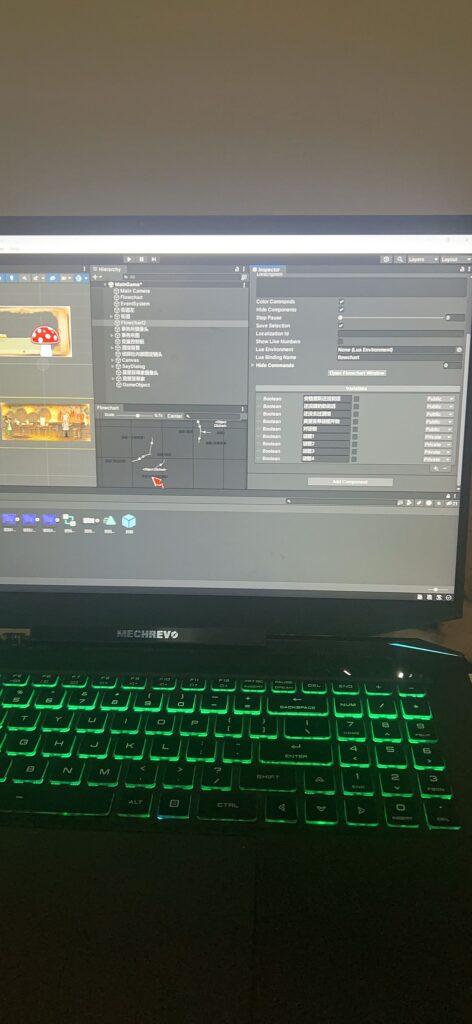
Fungus is an open-source Unity plugin designed to enable player-npc conversations without the need for coding. It offers an intuitive visual scripting system, allowing developers to easily build complex dialogue logic without writing any code. Additionally, Fungus supports localization, camera control, sound effect processing, and other features, making it ideal for creating visual novels, role-playing games, and other types of games.
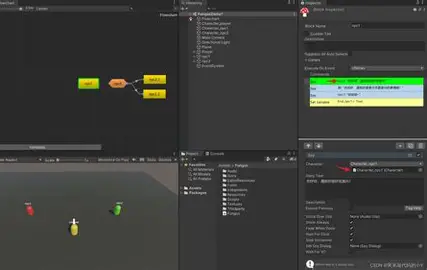
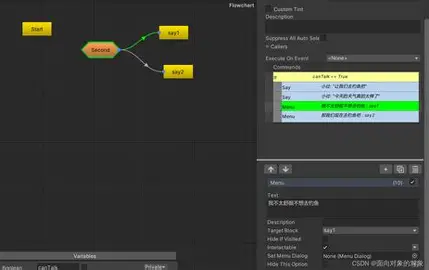
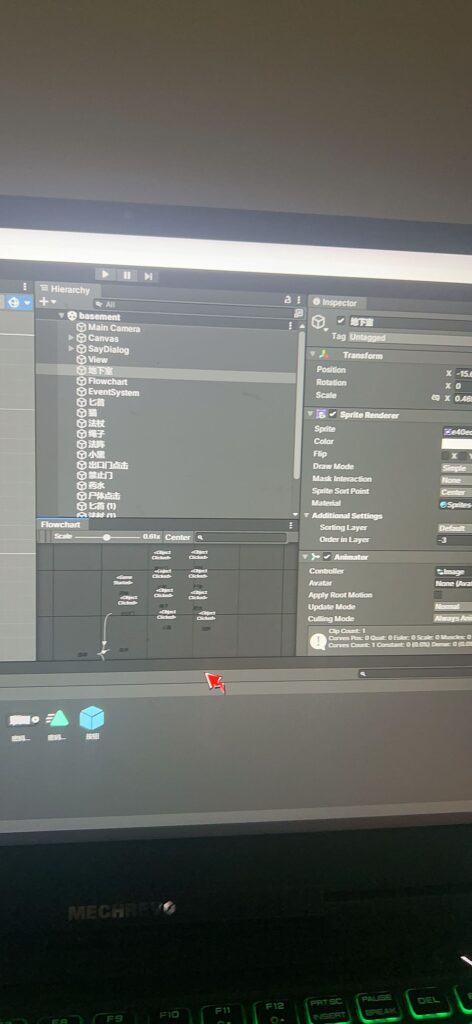
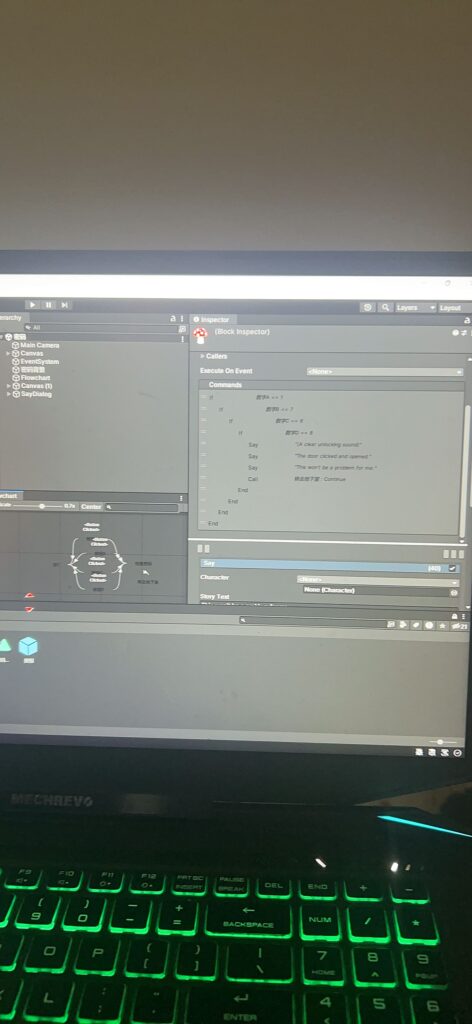
This is the program I wrote during the basic development using Unity and Fungus.
Spine
In 2D games, we often see various character animations. Animations can bring vitality and charm to the game. Creating a wonderful animation not only requires powerful software tools, but also a complete workflow.
Spine is a 2D skeletal animation editing tool specifically designed for game development. It offers a more efficient and streamlined workflow for creating the animations required for games.
Why choose skeletal animation?
In Spine, by binding images to the bones and then controlling the bones to achieve animations. 2D skeletal animation has the following advantages over traditional frame-by-frame animation:
Minimum volume: Traditional animation requires providing images for each frame. However, Spine animation only saves the animation data of the bones. It occupies very little space and can provide unique animations for my game.
Artistic requirements:
The Spine animation requires fewer artistic resources, which can help me save more manpower and material resources and enable me to better devote them to the game development.
Fluency:
The Spine animation uses the interpolation algorithm to calculate the intermediate frames, which ensures that my animations always maintain a smooth effect.
Mixing:
Animations can be mixed together. For example, a character can shoot a gun while also walking, running, jumping or swimming.
Program animation:
The bones can be controlled through code. For example, it can achieve effects such as aiming at the mouse for shooting, looking at the enemy, or leaning forward when climbing uphill.
In the subsequent thesis project development, I will pay closer attention to several aspects: first, standardizing the project structure, minimizing unnecessary plugins, and avoiding overly complex editor scripts and static initialization logic; second, developing good habits in version control and periodic backups, such as using Git and committing changes promptly once features are stable, to prevent data loss and ensure recovery if needed; additionally, I will focus more on understanding Unity’s compilation process and resource management mechanisms—such as asmdef, packages, and Library caching—rather than merely staying at the level of “knowing how to use Unity.”
Timetable
Game production schedule (February – May)
- Phase 1: Core framework establishment (February 15th – February 28th, approximately 2 weeks)
- Objective: Be able to walk, be able to point, and be able to have conversations.
Weeks and Tasks
Week 1 (Mid-February) – Determine the game name and story outline; Create a Unity project, import Fungus; Build the first scene, place the background and the main character; Implement the left and right movement of the character.
Week 2 (End of February) – Implement mouse-clicked NPC triggering dialogue; Create the main menu scene (start/exit buttons); Implement scene switching (main menu → game scene); Build a fixed UI Canvas
Phase 2: Plot and Dialogue System (March, approximately 4 weeks)
Objective: All NPCs should be able to have conversations in sequence, and the task logic should work properly.
Weeks and Tasks
Week 3: Complete the story script (who is where and what they say); create all NPC objects and configure Clickable2D / Event Trigger.
Week 4: Implement the sequence of dialogues using variables (must first visit the village chief); implement “display prompt when clicking on incorrect NPC”.
Week 5: Develop the task system (collecting fragments / solving puzzles to open doors); implement the pop-up information panel (display large image + text after clicking an item).
Week 6: Create NPC task animations (instantly move to the NPC’s position, appearance of the kitten after the conversation, etc.); adjust the dialogue rhythm (typewriter speed, breathing animation).
Stage 3: Puzzle and Level Design (April, approximately 4 weeks)
Objective: All puzzles can be solved, the door can be opened, and the scenes can be switched.
Weeks and Tasks
Week 7: Design and create the first puzzle (such as a number riddle lock); create the password input UI panel (Unity UI + script).
Week 8: Design and create the second puzzle (such as a word fill-in question); implement the logic of “the door opens after solving the puzzle”.
Week 9: Design the third puzzle (such as collecting fragments); implement the logic of switching between multiple scenes (trigger new scene animation after leaving the current scene).
Week 10: Connect all the level processes to ensure that the entire journey can be completed; fix obvious logical bugs.
Stage 4: Visual and Experience Refinement (May, approximately 3-4 weeks)
Objective: Attractive, excellent, smooth.
Weeks and Tasks
Week 11: Replace temporary materials with official art (background, characters, UI borders); adjust widescreen ratio and camera boundaries.
Week 12: Create dynamic cursor (changes when mouse hovers); add breathing/animation for characters; add background music and sound effects.
Week 13: Produce opening text performance (black screen + line-by-line text); optimize UI hierarchy and font size; test all resolution compatibility.
Week 14 (mid-May): Complete full test; fix all bugs; package and export executable file (PC version).
Leave a Reply