Art Bible & Visual Direction
Introduction
After validating the visual implementation pipeline in Unity, I created the Art Bible & Visual Direction document for the project.
This document formalises the artistic philosophy, visual systems, and technical standards used throughout the production process. It ensures that the entire team follows a consistent visual direction while maintaining compatibility with the established technical pipeline.
Rather than serving purely as a style reference, the Art Bible also functions as a production guideline, defining how environments, characters, and assets should be designed and implemented within the engine.
1 Visual Philosophy
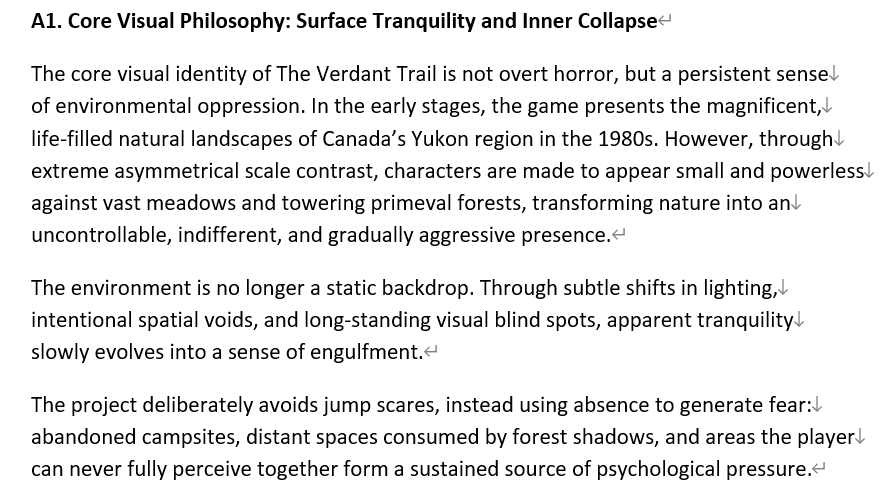
The visual identity of The Verdant Trail is built around the idea of environment as emotion.
The wilderness environment is not simply a background for gameplay, but a narrative element that reflects the psychological state of the characters. As the story progresses, the environment gradually shifts from calm openness to oppressive density.
Key visual principles include:
l1. arge environmental scale compared to characters
2. strong contrast between open and enclosed spaces
3. environmental storytelling through abandoned objects and landmarks
This approach allows the world itself to function as a narrative device rather than a passive backdrop.
Source: Yansong — Art Bible & Visual Direction
2 Pixel Presentation System
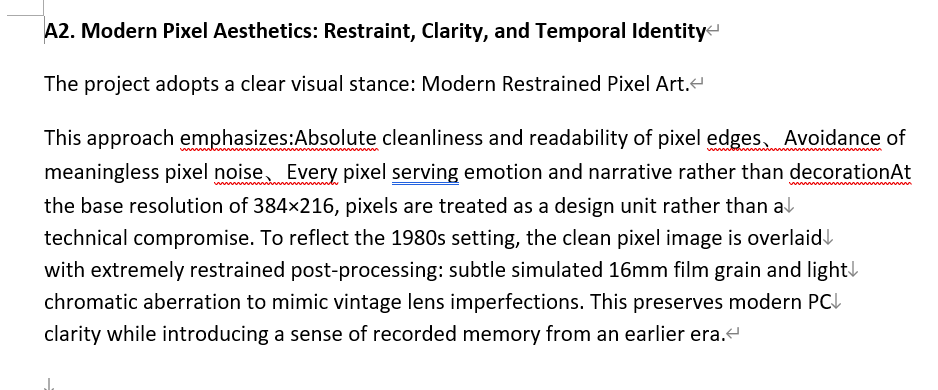
Instead of building the entire environment using traditional hand-drawn pixel tiles, the project adopts a hybrid 3D-to-pixel rendering pipeline.
Scenes are constructed using stylised assets to establish spatial composition and environment scale. The final pixel appearance is generated through Unity’s rendering stage using pixelisation filters and the Pixel Perfect Camera.
This approach provides several advantages:
faster environment production
better control over lighting and atmosphere
consistent pixel density across scenes
The base resolution for the project is 384 × 216, using integer scaling to preserve pixel clarity.
Source: Yansong — Art Bible & Visual Direction
3 Character Representation
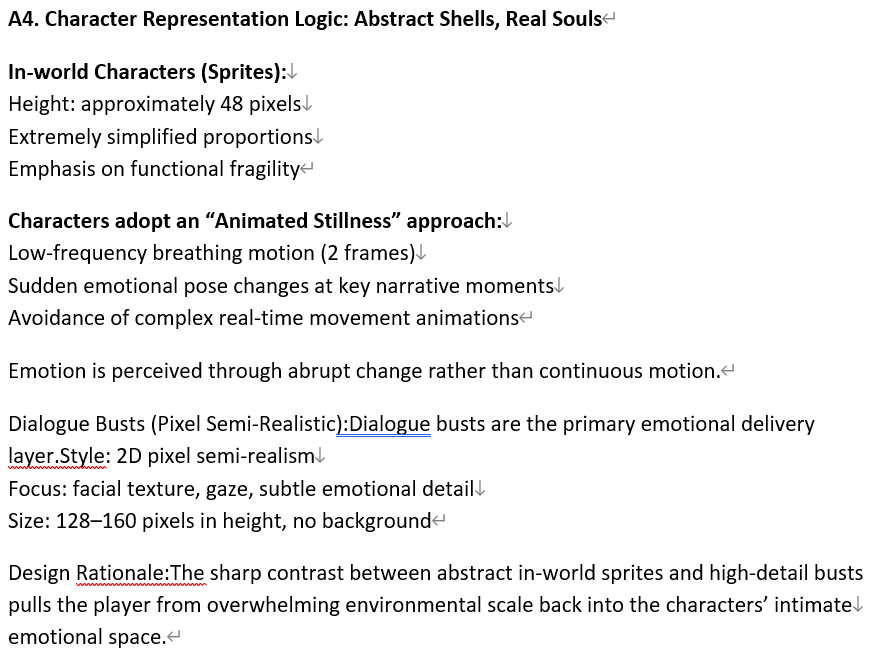
Characters are presented using a dual-layer visual system.
In gameplay scenes, characters appear as simplified pixel sprites to maintain readability and clarity during exploration.
During dialogue sequences, the game switches to pixel semi-realistic bust portraits, allowing more detailed facial expression and emotional nuance.
This contrast between simplified gameplay sprites and expressive dialogue portraits helps emphasise character-driven storytelling.
Source: Yansong — Art Bible & Visual Direction
4 Environment Composition
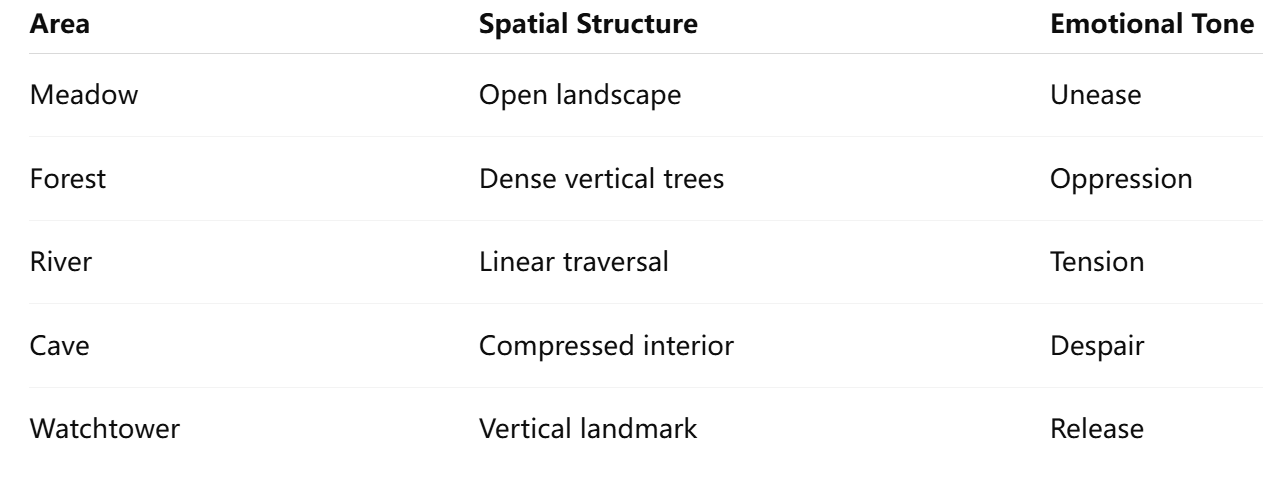
Environment composition follows a clear spatial storytelling approach.
Source: Yansong — Art Bible & Visual Direction
Landmarks such as abandoned campsites, cabins, caves and watchtowers are used to guide navigation and reinforce narrative discovery.
5 Unity Technical Standards
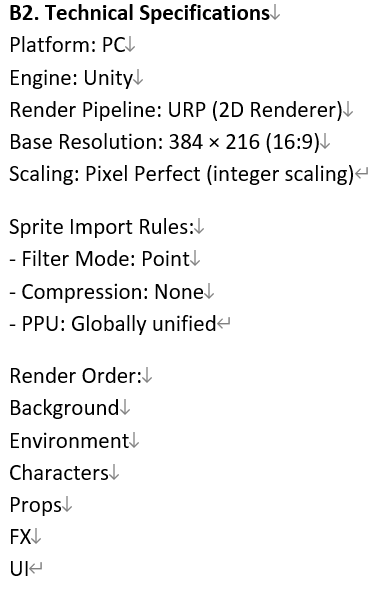
Source: Yansong — Art Bible & Visual Direction