Sophie Artemigi – Pitches and Game Loops
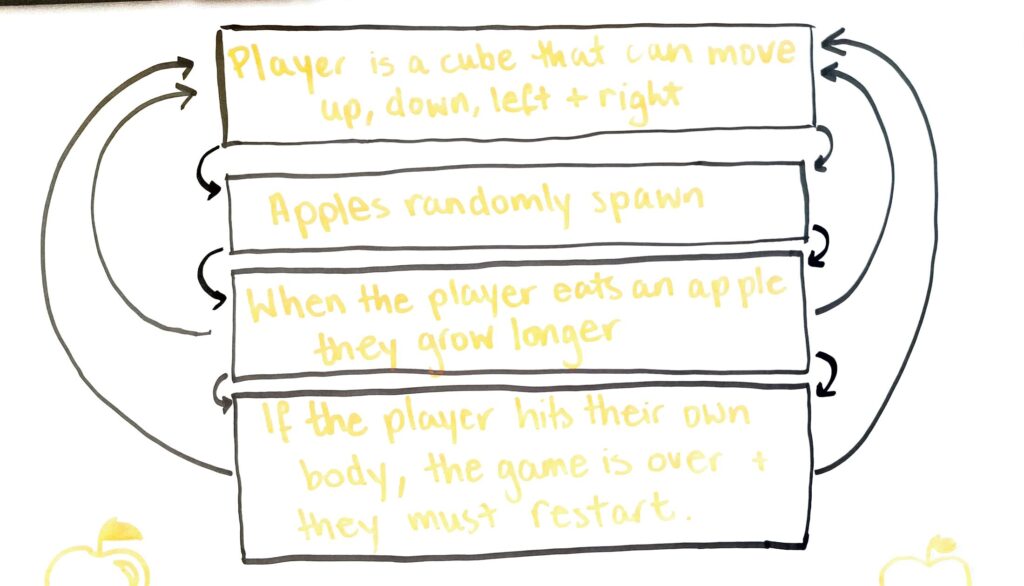
Sophie was kind enough to give us a very informative talk about game loops and give us feedback/ideas on elevator pitches for our games. Pictured above is what I did during the game loop activity, where she gave us classic games to then put into game loops.
She split the basic structure into start state, player action, result of action and win/fail. Here, you can see that we failed to question whether Snake has a win state. At first you’d say no, but as the play space is limited, there is a limit to how long your snake can be – therefore the win state would be achieving the highest possible score/length within the finite space of the game.
Then she came around to briefly touch upon elevator pitches for our games 1-on-1. I was initially struggling to condense the interesting part/s of my idea into one/two sentences, however after I said that in my head I have a main question I’m trying to answer, she said it was a perfect first slide to hook people with, and then to use her suggested elevator pitch as the next slide.
With this, and a lot of iteration on my game pillars last week, I felt confident enough to start putting some of these things into a PowerPoint so I wasn’t going to be making the entire pitch deck last minute (below are the hook, elevator pitch, game overview, design intention and game pillars I came up with on Monday).
Narrative Flow Charts
Sophie also suggested we use narrative flow charts/diagrams for narrative-heavy games. She didn’t have an example in her slides, so I decided to do some research as it feels especially relevant to articulating my idea, whether it ends up in my pitch deck or not.
I had a look around at articles and even considered using Twine, however the lack of narrative-altering choice within the narrative means I’m not convinced that a flow chart/Twine prototype would be effective at testing my desired effect.
Game Loops
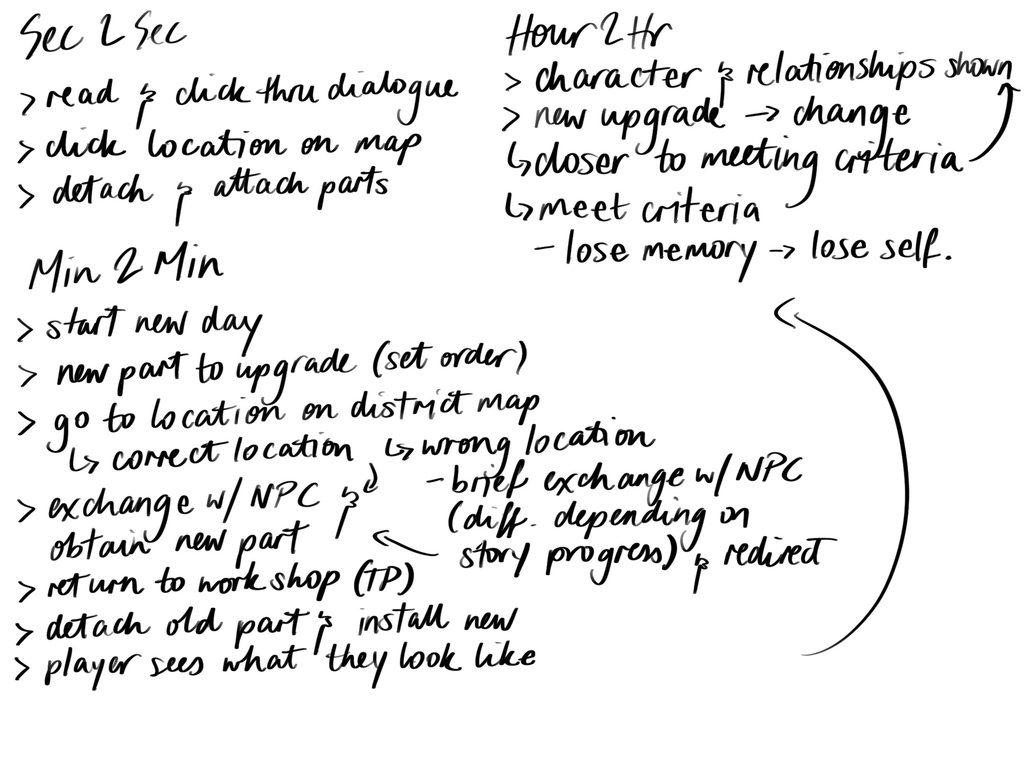
I also starting working on how to articulate and present the game loop/s for my idea. I started by jotting down the second-to-second, minute-to-minute and hour-to-hour actions/progression. While day-to-day was also frequently included, I feel the scope for my game is not large enough for that. I want it to be a gradual experience, but not long enough to be unachievable for a semester-long project.
Tone and Style
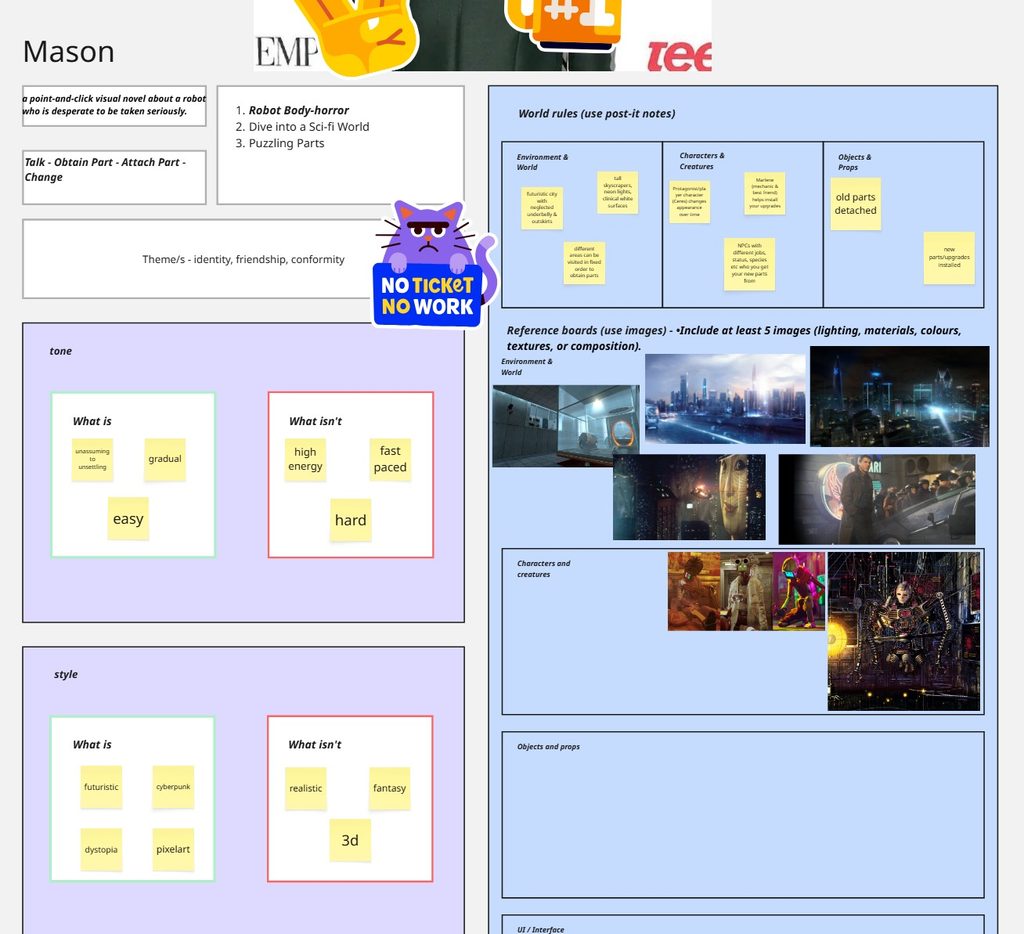
Vanissa ran a workshop today to encourage us to consider the tone and style of our game along with some reference boards to communicate the visuals. This was useful in encouraging me to find reference materials to include in my pitch as I knew I wouldn’t have time to create that much concept art.
Leave a Reply