As the narrative and its themes are at the core of my game’s experience, I’m going to focus on solely narrative beats and writing for my first prototype. There’s a range of tools I could use: Twine, Ink, Bitsy, Downpour, even Powerpoint. For my first prototype, I’m going to use Ink, as I’ve used it before and I think it’ll be quite effective at prototyping the core narrative beats and whether they have the desired effect/response. As this is my first prototype, I’m going to use the Inkle editor’s built-in preview box to display and showcase it.
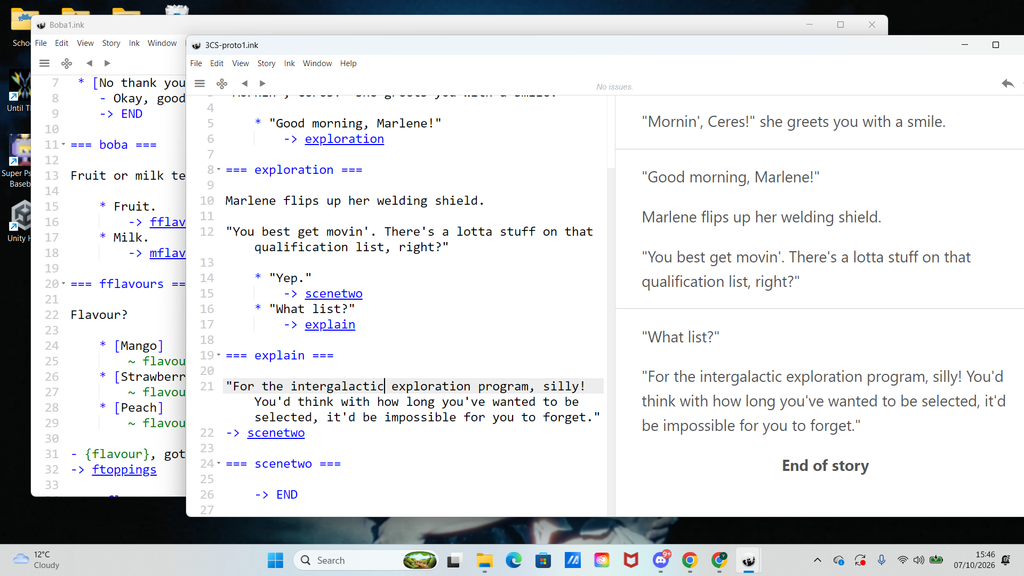
I’ve used Ink once before a while ago as I knew I wanted to make narrative-driven games. I used the unfinished file I created while learning the basics to refresh my memory and guide me in making this prototype.
I struggled figuring out how to use variables. I wanted to do this just for efficiency, but found it hard to figure out due to my lack of familiarity with programming. I looked to various websites for articles and tutorials that might help.
I really struggled with how to make a prototype that could be made in less than a week and showcased in 2-3 minutes while also testing out the core of my idea. The core effect I want to achieve is a *gradual* sense of unease, and it’s rather difficult to make something feel gradual in the span of 2-3 minutes.
After some 1-to-1 discussion with Vanissa and Jordan, I decided to focus on prototyping a smaller snippet/mechanic of my game (see: Flickgame Prototype), just to provide evidence of player testing and feedback collection. Even though I gave up on this Ink prototype, I still feel working on it gave me valuable insight into how I saw the narrative elements and pacing taking form in the most basic sense.
Leave a Reply