I made these prototypes to explore different reasons to use a first-person viewpoint. Rift Runner focuses on movement and combat across a run. Prism Relay turns shooting into route building. Beat Foundry keeps the space small so I can focus on timing.
Prism Relay and Beat Foundry were made on 7 October. They let me try two of the directions discussed in the feedback.
Rift Runner
Move through connected arenas, fight machines, collect supplies and choose upgrades. Rhythm rewards affect movement and weapon use.
The main player feedback concerns teaching, difficulty, rewards and route guidance. I used these comments to revise the opening and the HUD.
Aim: restore three relays by painting a continuous cyan connection from home, then return to the starting point.
The painted route changes movement and refilling. Cleanup drones can cover parts of it with rival paint, so the player has to repair the route as they move.
I wanted the paint gun to give the player a task beyond defeating enemies. The world uses conductive pigment as a temporary power network, which gives the route a purpose.
I used that connection between shooting and movement in Prism Relay. Cyan paint gives the player a useful route, while the ink tank makes them think about when to refill.
My objective is a solo repair task. A connected line matters more than total coverage, because the relays need a link to home. This lets me explore route planning with a paint gun.
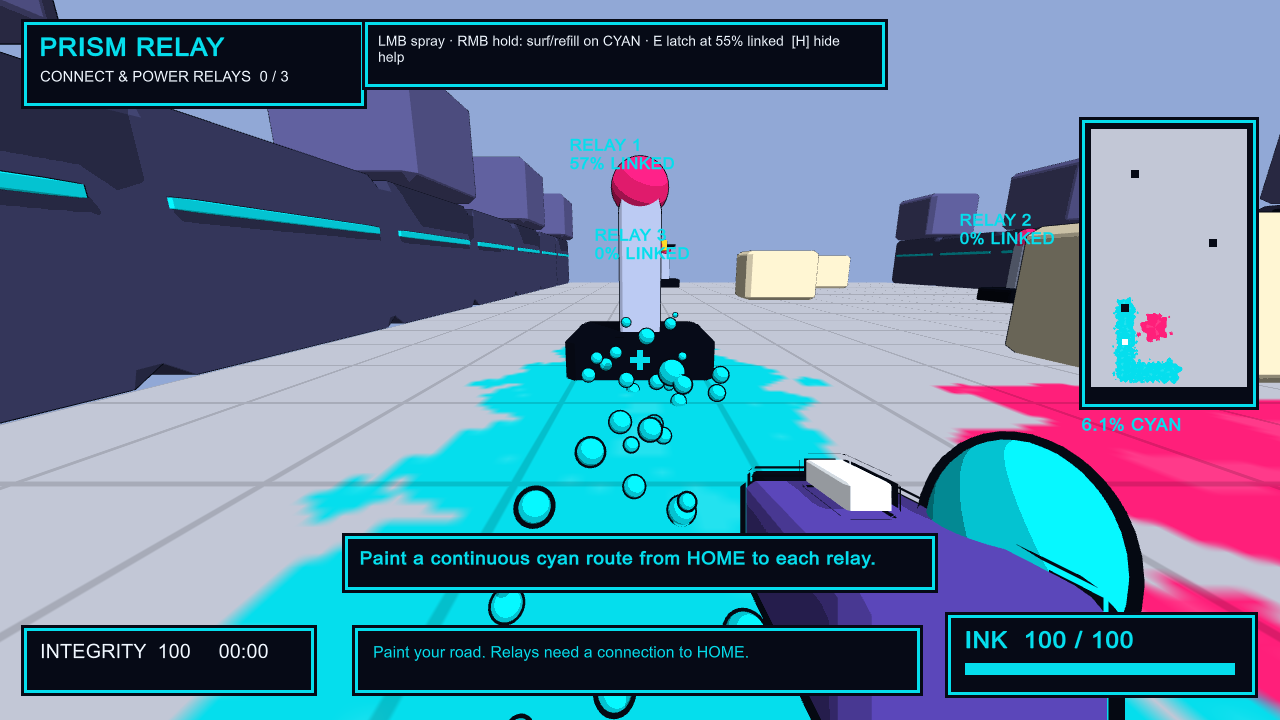
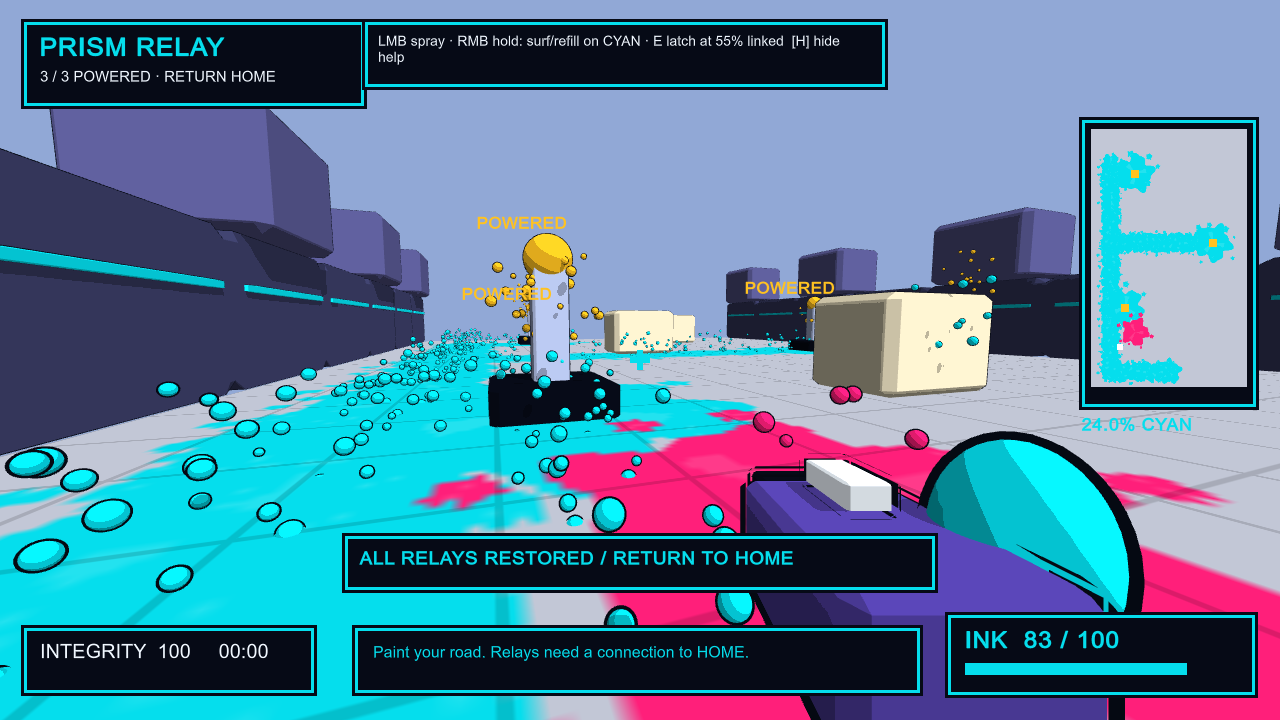
The grey buildings and bright cyan and magenta ground make the route easy to separate from the surrounding space. The minimap shows where the paint has spread.
Prism Relay: painting towards the first relay. The HUD shows its connection progress and the remaining ink.Prism Relay: all three relays are powered. The final task is to return home.
Prism Relay: what I would develop
I would make breaks in the power connection easier to locate. The player should know whether a relay needs more paint nearby or a repair further back along the route.
I would watch which path a player paints and when they stop to repair it. That would help me see whether the connection rule gives them enough to think about.
Beat Foundry
Aim: survive three waves of factory robots while using shots, dashes and dodges to a 120 BPM music loop.
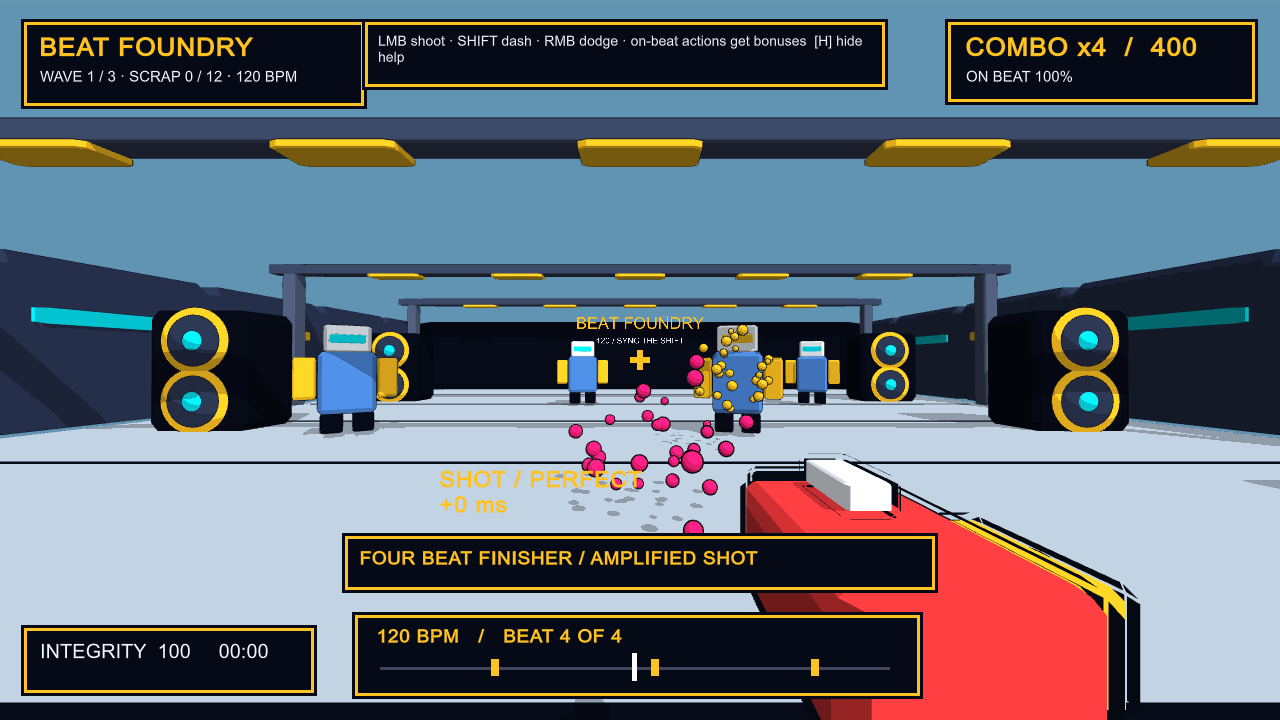
Actions happen immediately. Accurate timing adds bonuses, and a four-beat sequence leads to an amplified shot.
The factory shares one clock. The beat guide, enemy attacks and pulsing objects use that timing, so the music belongs to the setting as well as the HUD.
That helped me decide to keep shooting and movement immediate. The player can aim and react normally, then use the beat to improve the result.
I also studied the Rhythm Dodge tutorial in Hi-Fi RUSH. Its approaching beat markers and separate action feedback informed the low beat guide and Perfect message in my prototype.
I adapted the timing idea to first-person aiming. Beat Foundry uses an original 120 BPM loop, a small arena and three enemy waves so that I can focus on the relationship between aiming and listening.
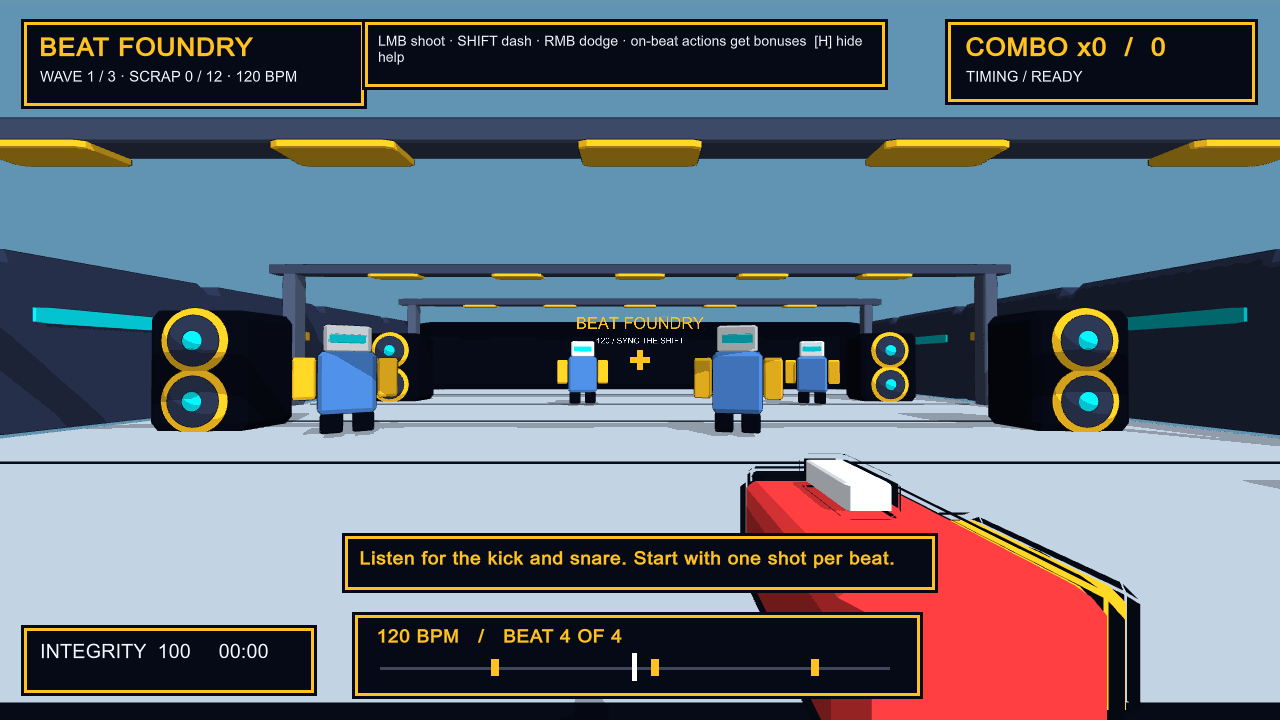
Beat Foundry: the first wave, with the beat guide below the aiming area.Beat Foundry: timing feedback and the amplified shot after a four-beat sequence.
Beat Foundry: what I took forward
This experiment gave me a clearer way to develop rhythm in Rift Runner. Timing could change both movement and weapon use.
The later Rift Runner feedback showed that players could miss the benefit even when a reward existed. I needed to make the action and its reward easier to connect.
For Beat Foundry itself, I would focus on whether a player can explain what a timed action adds while still managing the enemies.