For the first week, we looked at how an emotion might become something a player can do. My group made an association map around fear. I then used the worksheet to sketch a chase and presented three possible game ideas.
These were early proposals and drawings.
1. Starting with fear
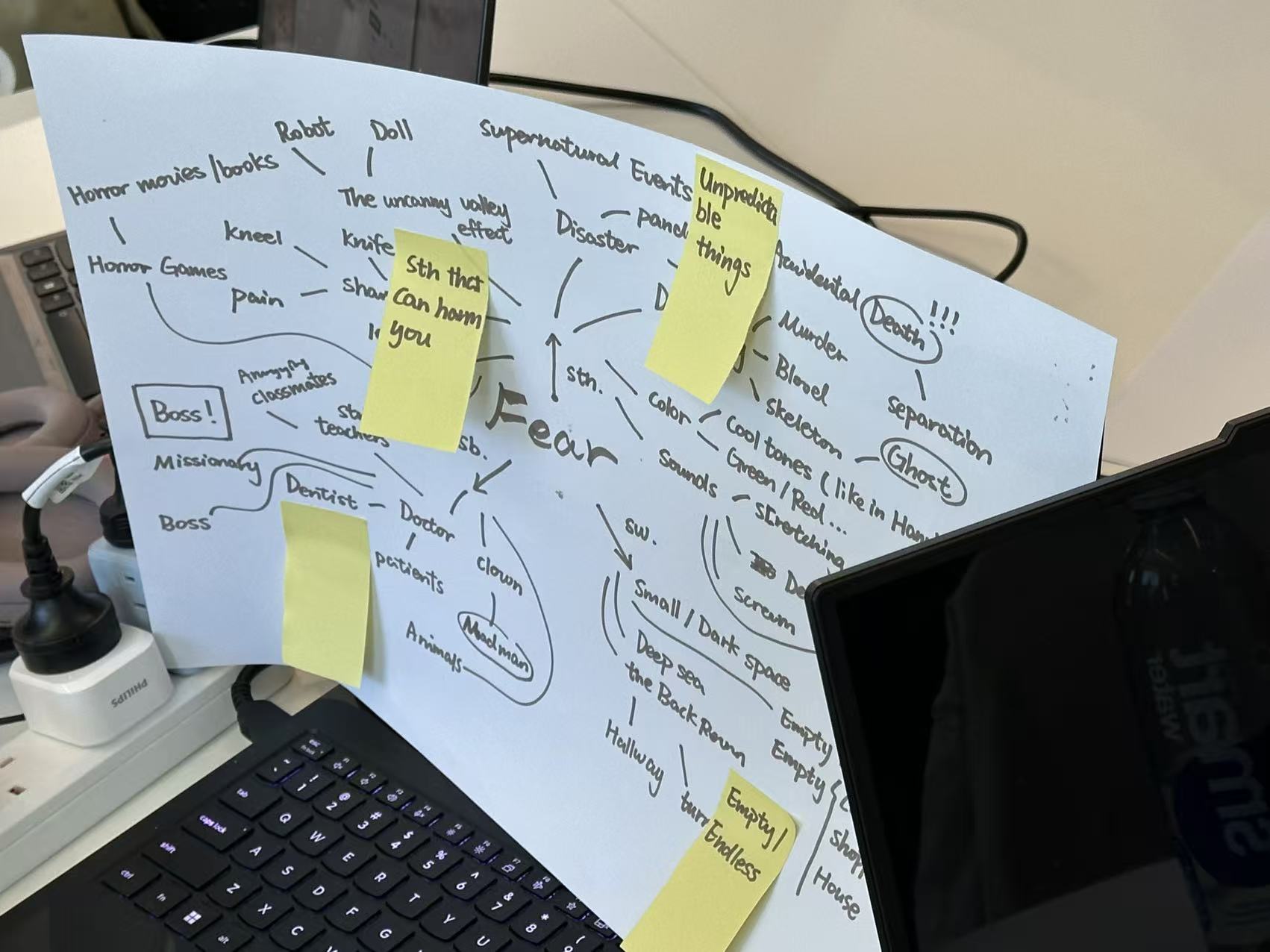
We put “fear” in the middle of a large sheet and followed whatever came to mind. The map moved from things that could hurt someone to horror games, dolls, robots, ghosts, disaster and spaces such as deep water or an empty room.
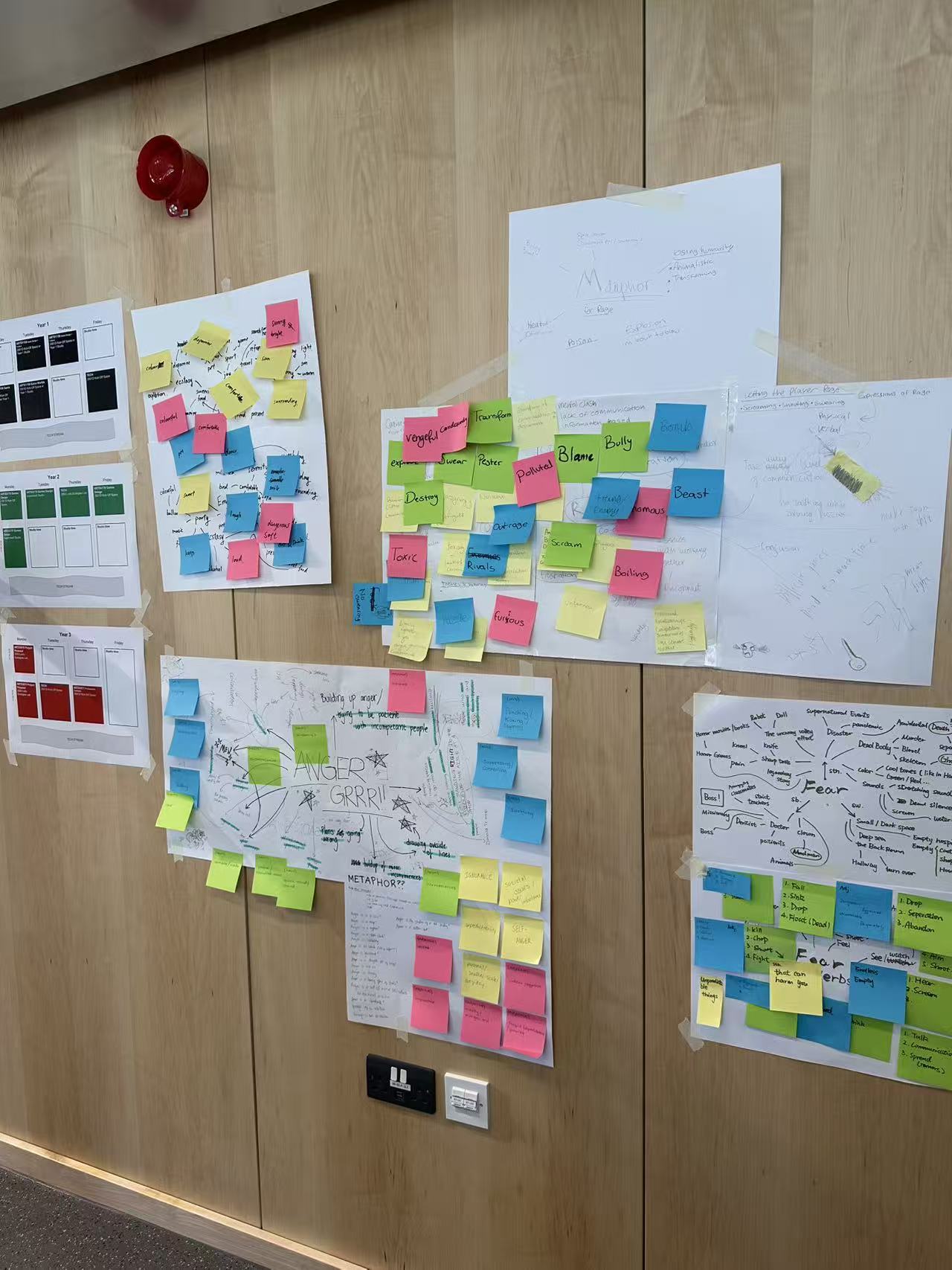
We pinned it up with the other groups’ maps.
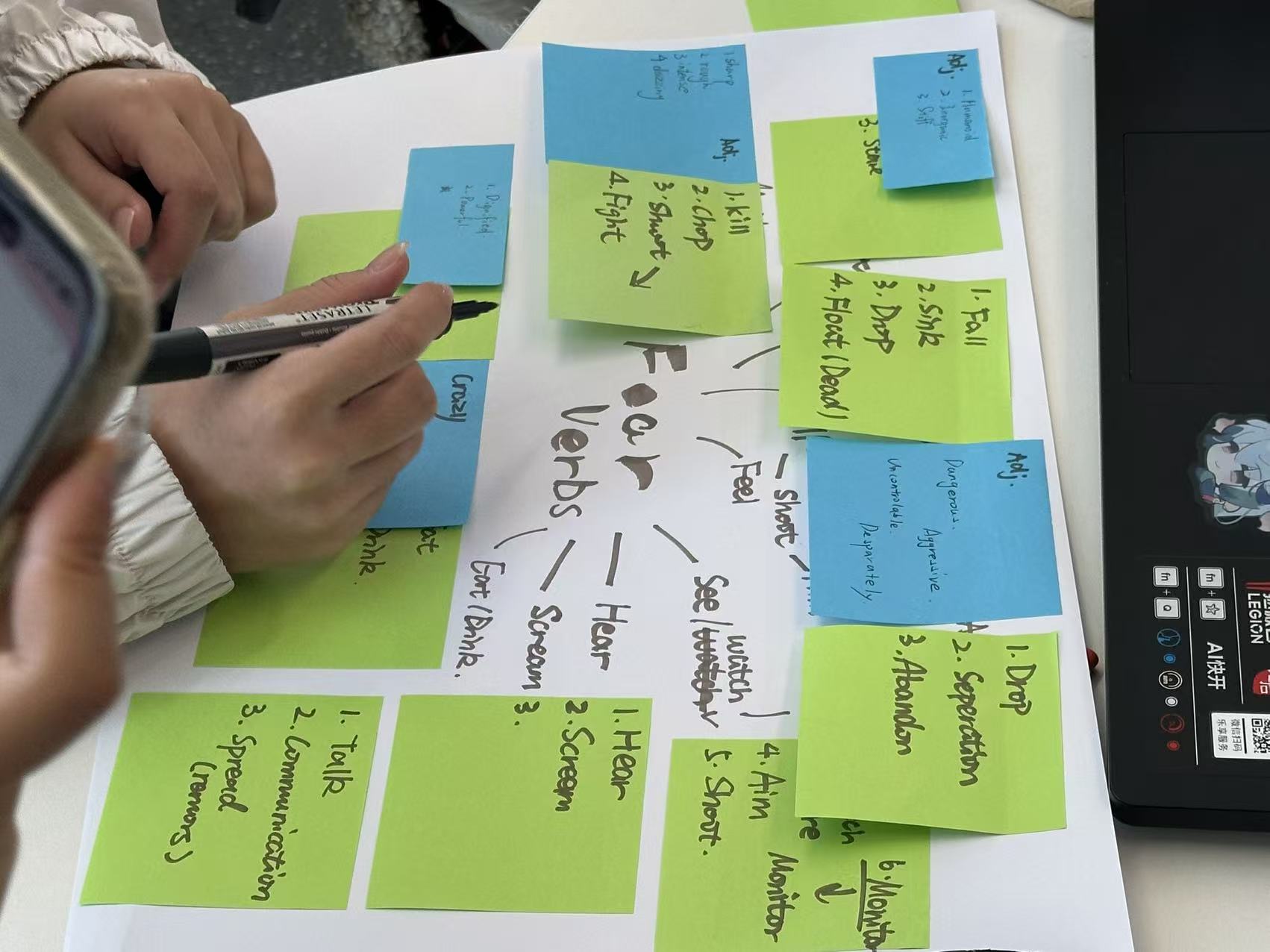
We also wrote down actions that might give a player that feeling: falling, dropping something, fighting, hearing a sound, hiding, watching and talking to someone else. This was more useful to me than a list of scary images.
Choosing actions helped me start drawing the chase.
Group association map exploring fear, harmful things, uncanny imagery and unsettling spaces.Turning fear associations into verbs, nouns and adjectives during the group exercise.Completed group association maps displayed on the classroom wall.
2. A playable situation from three words
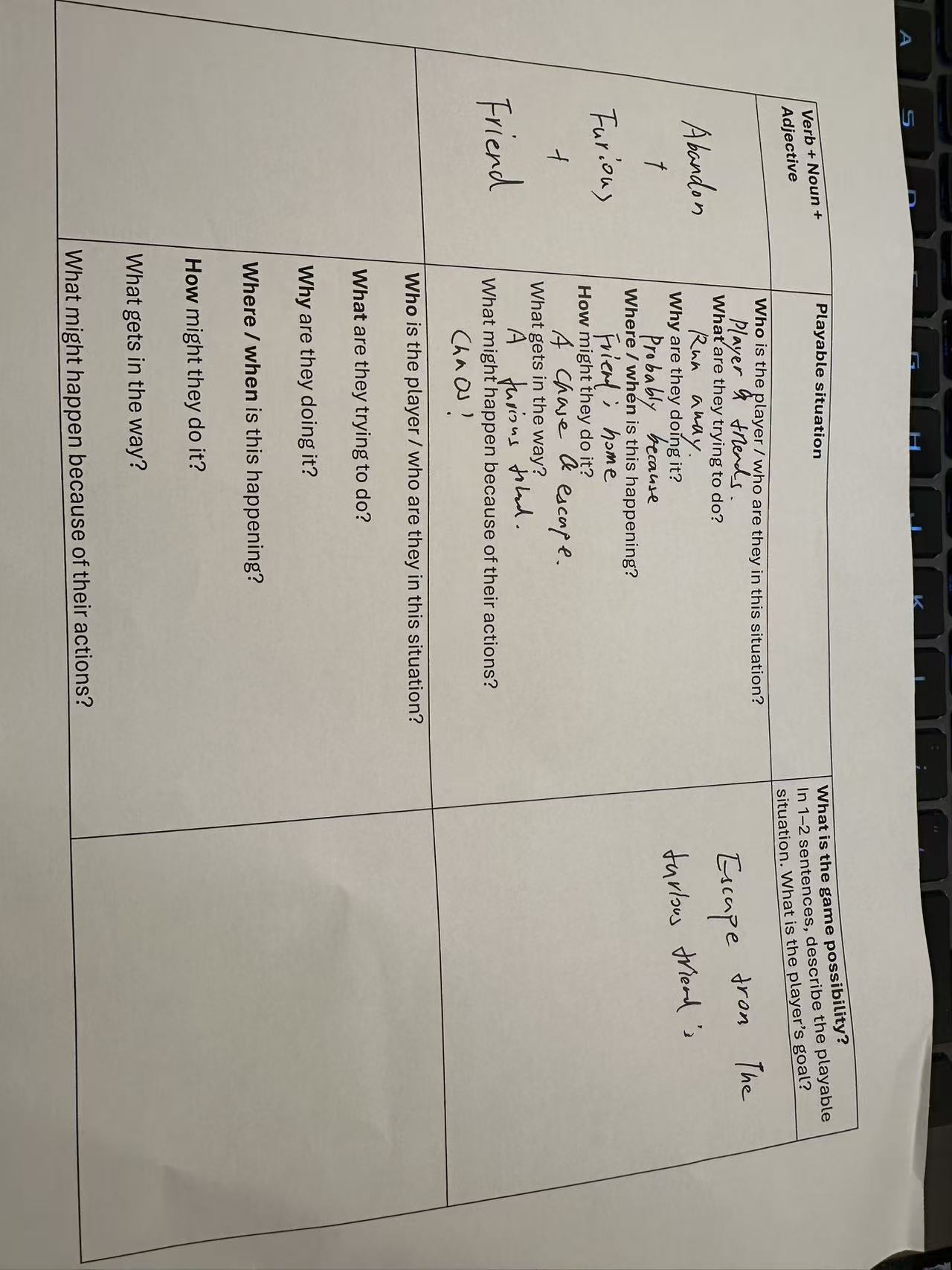
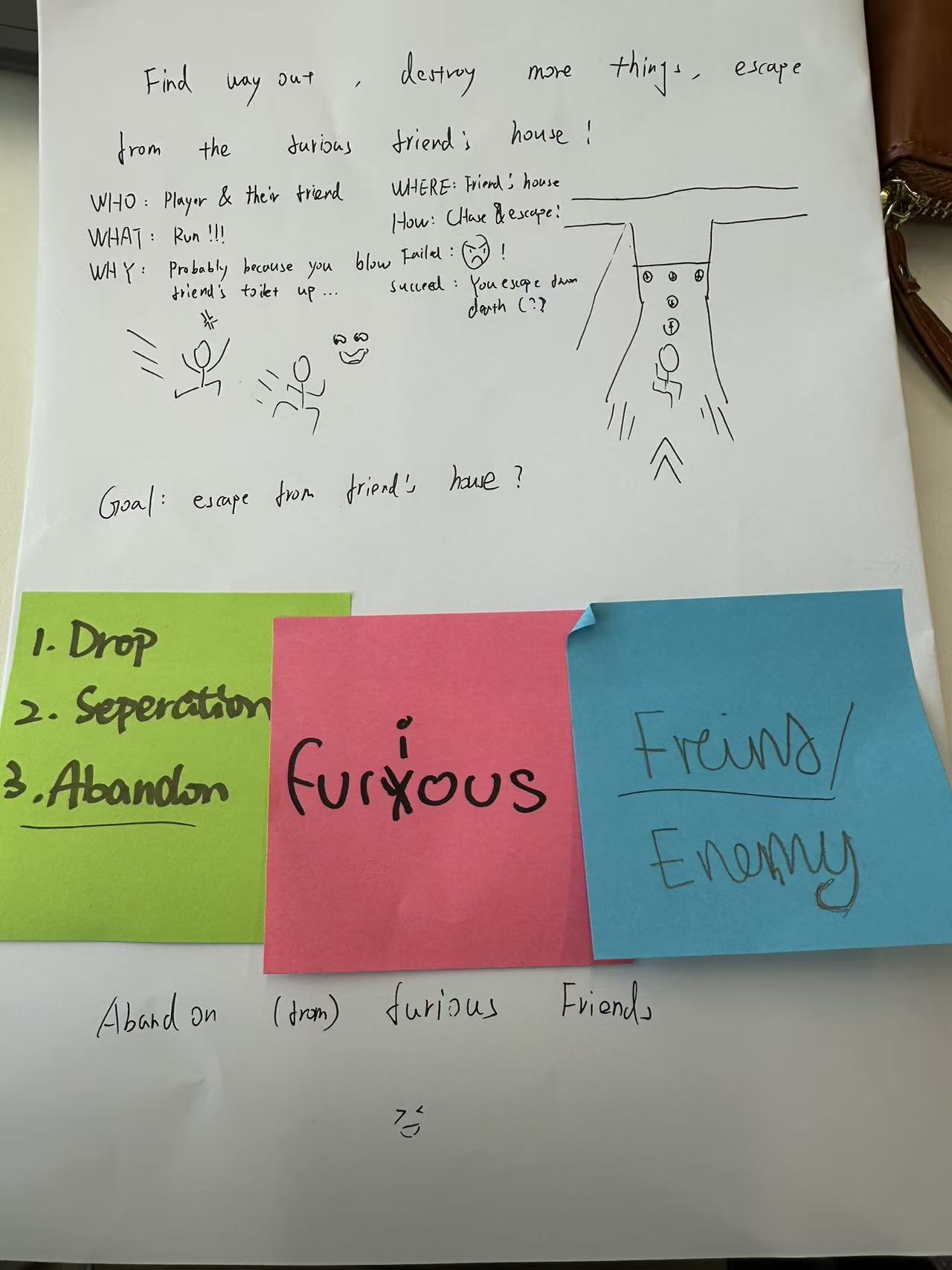
For the worksheet I used Abandon + Friend + Furious. My first thought was a player trying to escape from an angry friend’s house after breaking their toilet. I thought that would give the chase a funny starting point.
I drew a passage with obstacles and a route out of the house.
The drawing gave me a starting point. I still needed to work out how players would find the exit and what would slow them down. I also had to decide how threatening or funny the friend should be.
Completed worksheet: Abandon + Friend + Furious, with chasing and escaping as the playable situation.Early paper sketch showing the goal of escaping a furious friend’s house and a possible chase route.
3. Three ideas from my presentation
Idea 1: Escape from the Furious Friend
I took the chase into a co-op setting. The players would be small magical creatures inside a human wizard’s house, trying to finish a list of jobs before they escape. They might steal objects, break magical devices or collect ingredients.
At their size, a table, cupboard or staircase could become part of the level.
I used Burglin’ Gnomes as a reference for exploring an ordinary house at a tiny scale, and YAPYAP for voice-controlled magic and messy co-op interactions.
What I wanted to test was the interaction between players, including mistakes and moments where they have to help each other. My proposed first version was one room with four movable objects, one enemy and two simple spells.
Idea 2: FPS roguelite
Here the player would be a lone runner entering ruined machine zones to collect energy cores. Each short arena would lead to a fight, an upgrade choice and a route onwards, ending at a boss or extraction point.
Sprinting, dashing and jumping were meant to keep the player moving rather than standing still and shooting. Weapons and upgrades could vary between runs.
Roboquest was my reference for pace and quick rewards. I proposed starting with one combat room, one loot choice and a simple boss encounter. That would let me find out whether the movement and upgrade choice are interesting before trying to build a whole run.
Idea 3: an FPS with route and module choices
The third idea kept the shooting but added planning between fights. The player would climb a tower or move through a facility, choosing between combat rooms, shops, elite fights and events.
Instead of collecting cards, they would build a set of modules that alter their weapons or skills.
I referred to Slay the Spirebecause its route choices make risk and reward easy to understand. My first test would be a small node map linked to short FPS encounters.
The part I am unsure about is whether that extra decision changes how someone plays the next fight, or simply interrupts the action.
4. Feedback from Nodenoggin
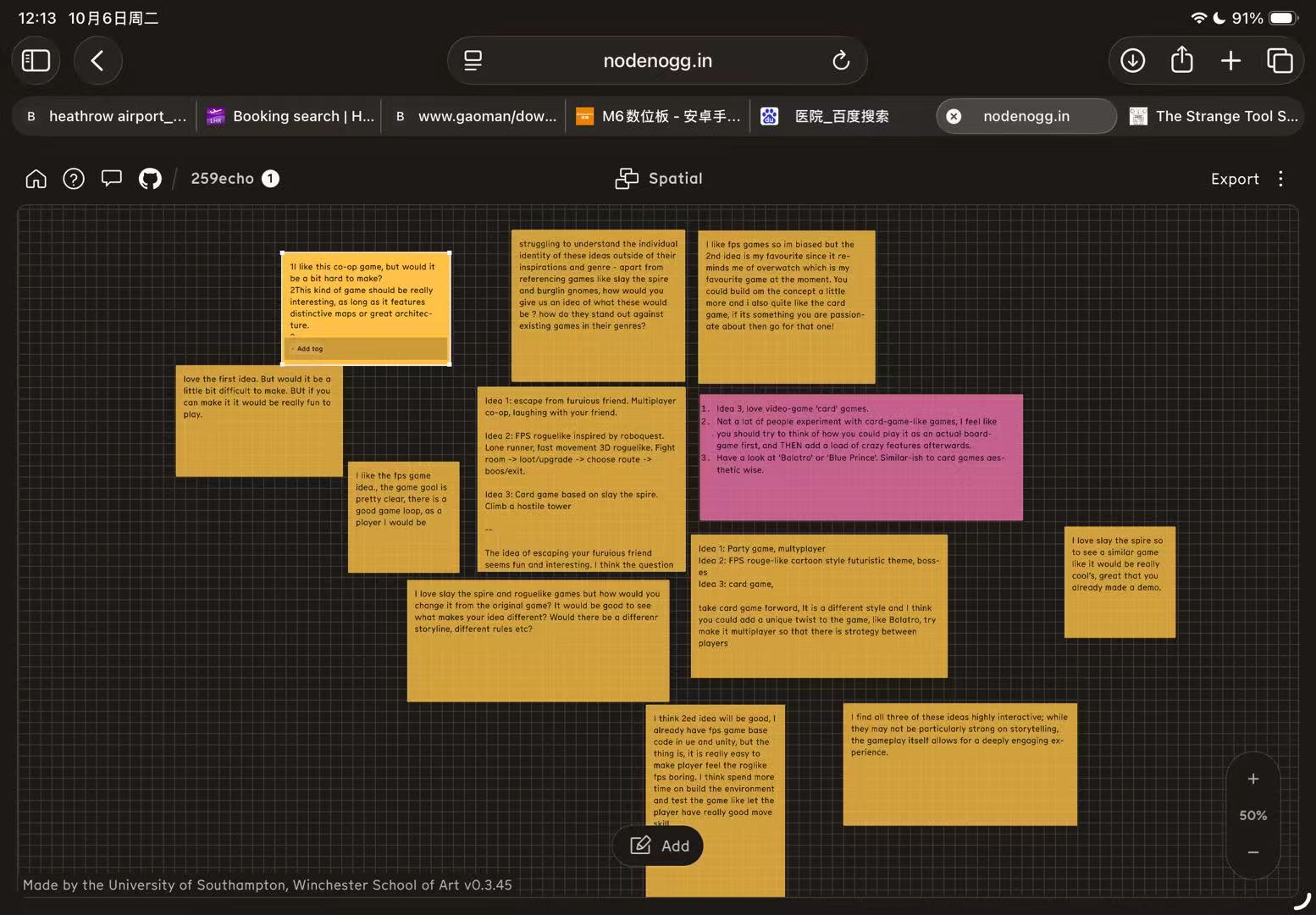
After the presentation, classmates left feedback on Nodenoggin.
Classmates’ comments on the three ideas.
The co-op house
Several classmates liked the idea of escaping together and thought it could be funny. They also worried about how much work the house and its interactions would take.
One person wanted distinctive rooms or architecture, while another asked what would make it different from games such as Untitled Goose Game.
I would keep the first prototype to the one-room version in my slides. With only four objects, an enemy and two spells, I could see whether being tiny actually changes how two players work together.
I would ask players to try the room together and note when they communicate, get stuck or find an unexpected solution. I can think about a larger house once that small space works.
The FPS roguelite
The FPS idea had some of the strongest positive reactions. Classmates understood the fight, upgrade and route structure, and one said it was their favourite. A useful criticism was that this kind of FPS could become repetitive.
Another comment pointed towards better movement skills and more attention to the environment.
That gives me a clearer test for the first arena. I would watch whether players actually use the dash and jump to move around enemies, and whether one upgrade makes the next fight feel different.
If everyone stays in one place or ignores the upgrade, I need to change the room or the choice before adding more content.
The module and route idea
People who liked card games were interested in this one, but they asked what separated it from Slay the Spire. One classmate suggested trying the choices as a physical card or board game first.
Others mentioned a different rule or story, multiplayer strategy, and games such as Balatro and Blue Prince as references.
A paper test seems sensible here. I would lay out a short route and a few modules, then ask whether the choice before a fight changes the player’s approach to it.
I would leave multiplayer aside for now; I have not shown that the basic solo loop works yet.
The broadest comment was that the three ideas still sounded too close to the games I used as references. That is fair criticism of the presentation: naming familiar games explained the genre quickly, but did not explain enough about my own designs.
Another classmate liked the interaction but wanted stronger storytelling. When I present these ideas again, I need to say what the player wants, what they do repeatedly and what is specific to this game before naming its influences.
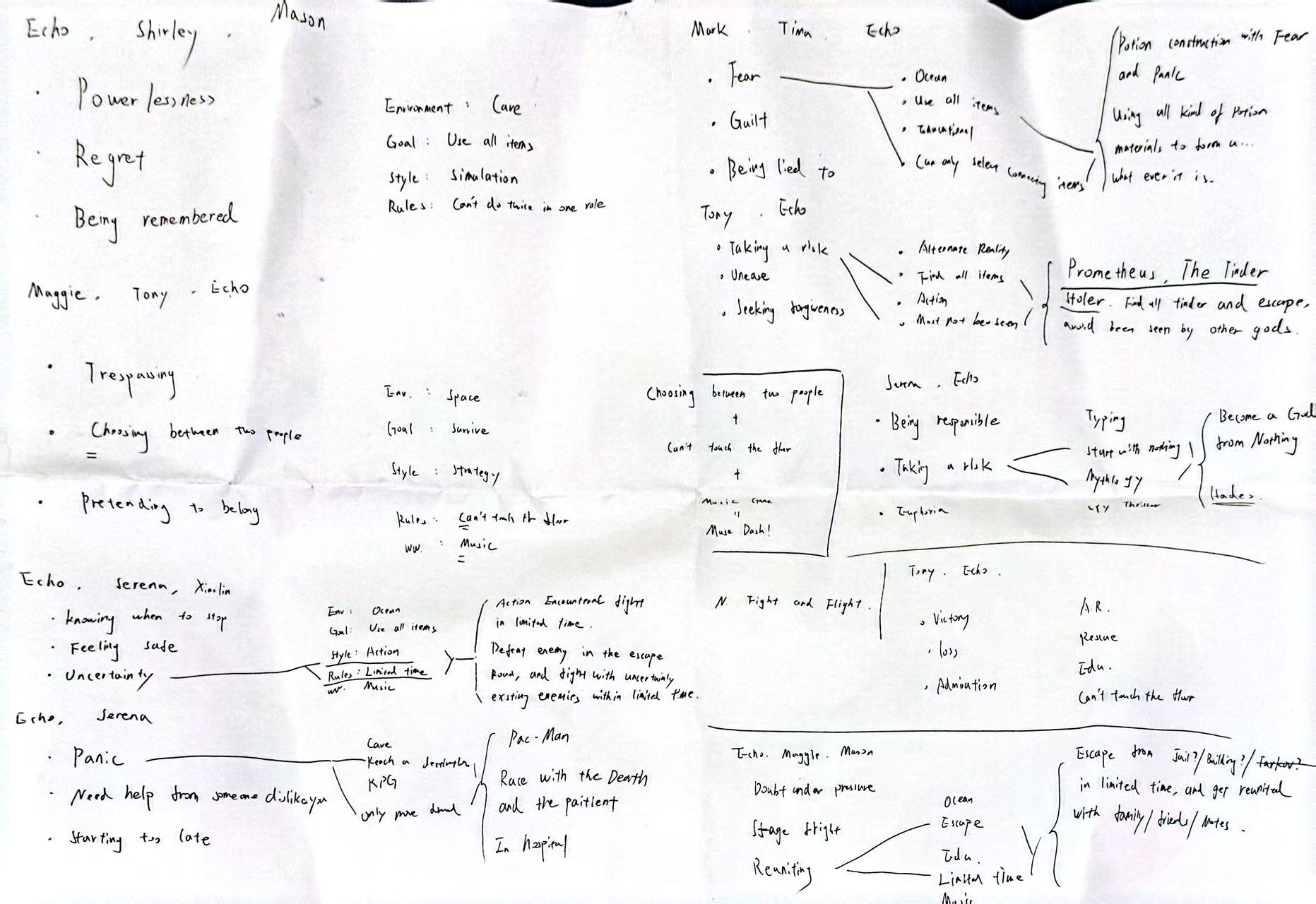
Game elements brain storm
The picture records exercices for game elements brain storm. We started with feelings or situations, then added an environment, a goal and a rule.
One set of notes combines uncertainty with an ocean setting and a time limit. The idea was to defeat enemies during an escape while the player was under pressure. Another connects risk and unease with a Prometheus-inspired idea: collect the fire and escape without being seen by the other gods.The hospital idea starts with panic, needing help from someone disliked and starting too late. Other notes explore escaping under pressure and being reunited with family or friends.
Group workshop notes with classmates.
5. What I took from the week
The worksheet helped me see the gap between a theme and a playable situation. “Fear” gave us a direction, but the chase only started to make sense when it had a player, a goal, a place and something in the way.
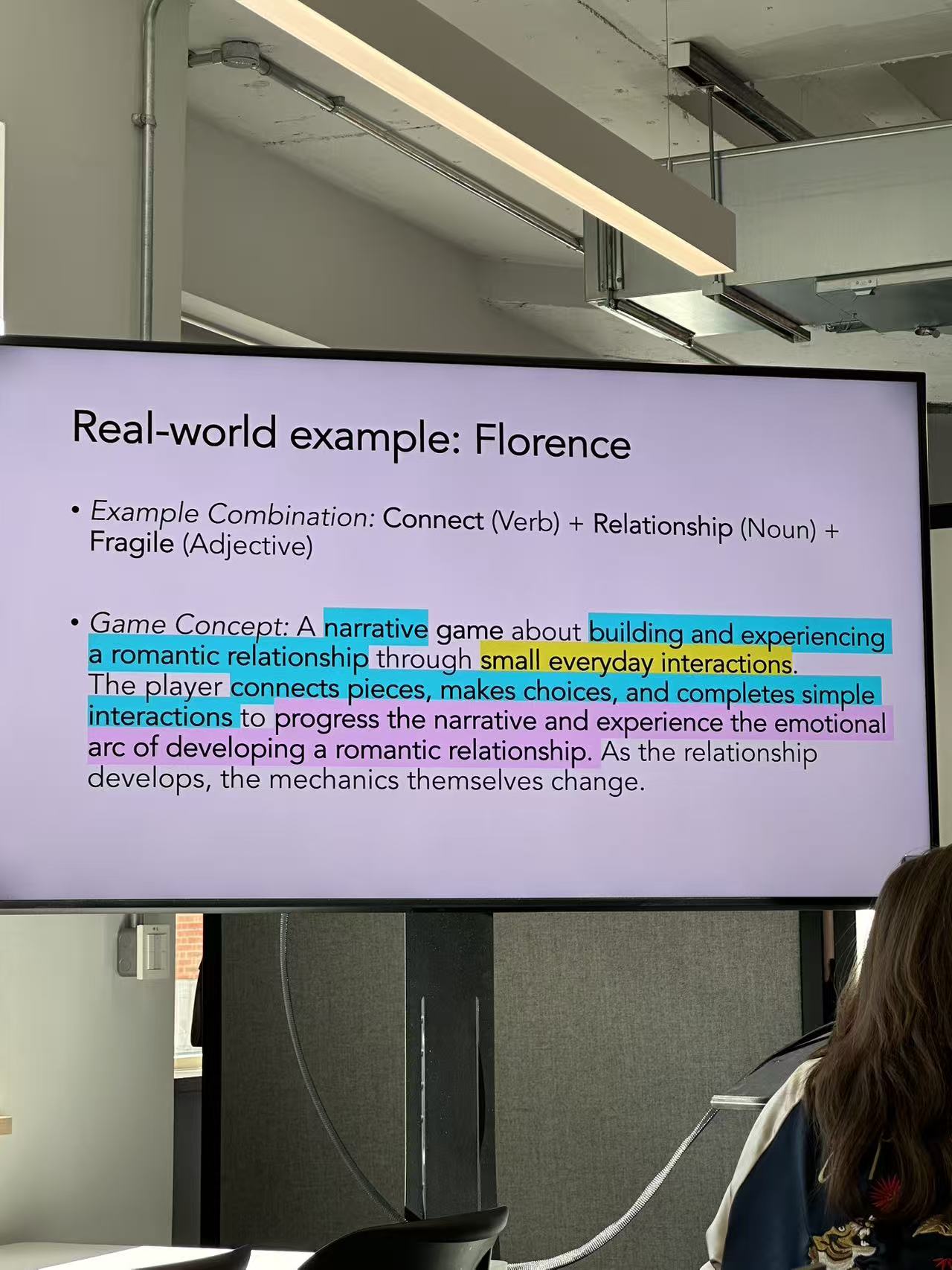
The classroom example of Florence, using “Connect + Relationship + Fragile”, made a similar point: small actions can carry the feeling of a game.
I still do not know which of my three ideas will work best. The house chase has a clear situation but could be difficult to build. The FPS has a straightforward action loop, although it needs more than fast movement to stay interesting.
The module version might add useful decisions, but it could also slow the shooting down. I wanted to try the ideas in small prototypes before choosing one.
Class reference: Connect + Relationship + Fragile, using Florence to discuss emotion through interaction.
6. What I planned to test next
For the co-op idea, I wanted to try a single room and see whether handling objects and using two spells produced funny moments between players. For the FPS, the question was whether one arena and one upgrade choice made movement matter.
For the hybrid, I wanted to check whether choosing a route or module changed the next encounter.
I planned to watch what players actually did in each test, especially where they hesitated or misunderstood the goal, then use their comments to decide what to change. At the end of this week these were still proposed tests, not completed playtests.
The questions about repetition and originality carried into the FPS work. My Week 6 reflection follows the decision to develop rhythm rewards and compares the three implemented prototypes.