Week 4 Group work Discussions And Chat
—Write By Maria
This week we had a guest, and at the end she went around tables to give each ground individual help and feedback. When she got round to talk to us she asked for our game overview and we told her what the main issue in our team was, how Maria and Cindy want to keep the original mechanic, a mix of both dialogue and mechanic where the players form a sentence on a time limit, forming the narrative of the game, whereas Nam says that the game shoudn’t need dialogue and the mechanics and gameplay should speak for themselves. Neither Maria nor Cindy want to remove dialogue as it was integral to the gameplay and the game pillars. We also told her how we were afraid that the original puzzle mechanic might get too repetitive throughout the entire game.
She basically told us to first just make the basic playable prototype and there we would be able to understand what works and what doesn’t work and if we need to change anything. She strongly recommended paper prototypes.
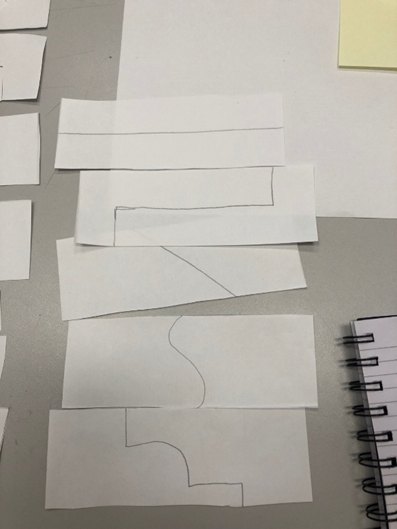
After she left, Nam began creating visual examples for what his idea of the mechanic was, and quickly Cindy and Maria started understanding, they believed he wanted to remove dialogue all together. He wanted to focus more on the experience and the process of trying to match people’s tone in conversation using shapes, to convey the experience of an autistic child, but was not against standard dialogue (without the puzzle) as part of it.

This is well communicative of the narrative without having to fully rely on the narrative, however Maria believed it was too easy to play and win with much fewer chances of error, which is something she believed to be important as the game is centred around making mistakes due to anxiety narrative wise.
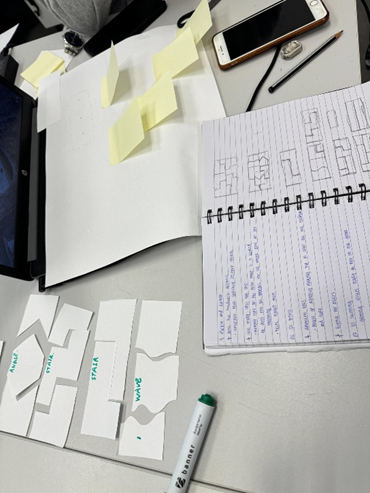
So, we began paper prototyping the mechanic and adding more shape variations, and we also made a simple paper prototype for the sentence puzzle.

Maria also thought about combining them by making the backgrounds of the NPC speech bubbles change according to their tone. The player would have to select the correct tone to match, then would either have to select a preset dialogue option or still form a sentence like in the original idea. The goal is to highlight the subtleness of conversation in real life and introduce the mechanic is a way that could almost go unnoticed by the player.
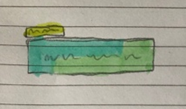
However, Nam believed that there should be a clear tutorial that tells the player exactly what they have to do to prevent confusion and frustration in the player, so showing them they have to match the NPCs and how to do so.
Additionally Nam wanted to focused on telling the story without having to make the player “feel” what an autistic and socially anxious child might feel by forming clunky sentence puzzles, because it’s impossible for all players with different playstyles and neurology to actually “feel” what the game would be trying to make them feel, so he took an approach similar to ‘Florence’, to make the player understand, not experience it.
He was also worried the message of the game might be lost and accidentally tell players that ASD is something that you can only be accepted for by adapting to others and no one else has to adapt.
Which Maria fully agreed with, however she also believed that making the mechanic really easy still took away from the outlined purpose from the GDD, and it fundamentally changed the game, which should not have to be the only way to go about a game like Backchat.
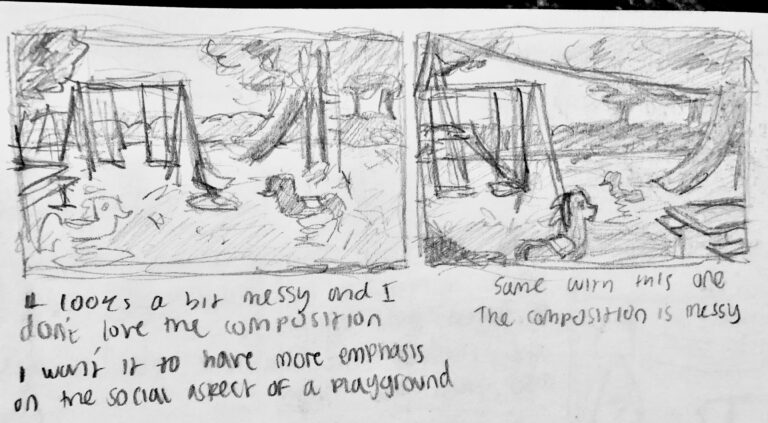
This week Maria also sketched more backgrounds by checking the locations outlined in Cindy’s script. There was Cafeteria, Front Gate, Classroom, and Playground for afterschool activities, a library was also mentioned, but it’s not part of the current script.