

Game Designer at ustwo games
Alumni at University of Southampton
Games Design and Art
Introduction
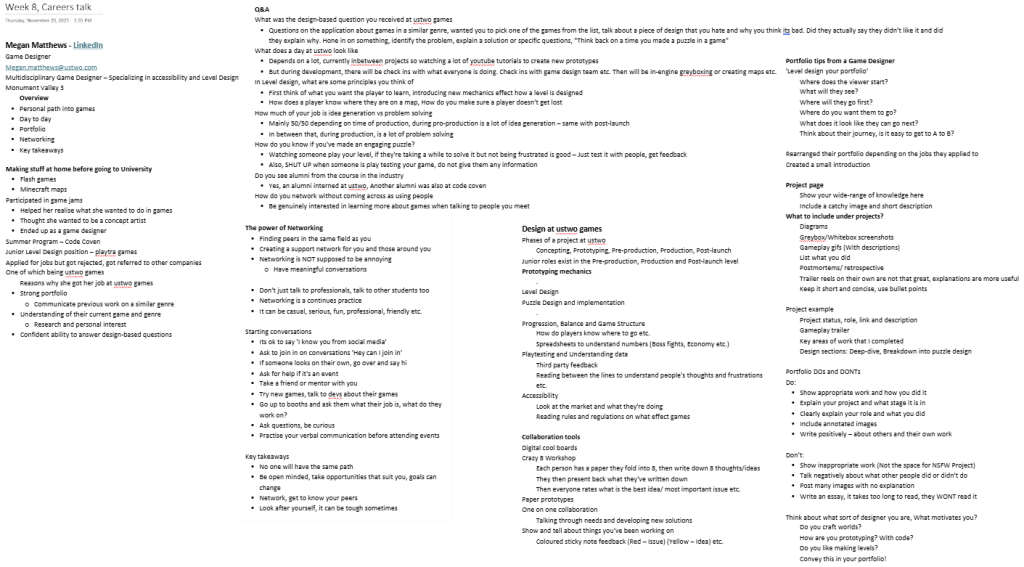
This week’s speaker was Megan Matthews, a multidisciplinary game designer at ustwo games, currently working on Monument Valley 3. Her background is a mix of level design, accessibility, and general game design, and she walked us through her route into the industry, what her day-to-day looks like, and how she built a portfolio that actually got her noticed.
Personal Story
Megan didn’t start with some hyper-professional setup—she just made things at home. Flash games, Minecraft maps, game jams… all the usual early tinkering that slowly turns into “oh wait, this is actually what I want to do.”
She originally thought she wanted to become a concept artist, but somewhere along the line realised design was where she felt at home. She joined Code Coven, landed a junior level design job at Playtra Games, and after a few rejections eventually got referred to ustwo. She said what helped her stand out was having a strong portfolio, showing she understood their genre, and being able to clearly explain her design decisions.
Insight as a Game Designer
Her day-to-day changes depending on what stage the project is in. Sometimes it’s grey-boxing levels or building maps in-engine, other times it’s prototyping new mechanics, giving feedback, or watching playtests. When she’s between projects, she spends a lot of time learning new tools or trying new ideas—which honestly sounds pretty fun.
One thing she stressed was the importance of thinking about what players need to learn in each level and how to guide them without hand-holding. Level design isn’t just about cool ideas; it’s about clarity, pacing, and making sure players actually understand where they’re going.
She also talked about the importance of shutting up during playtests—no nudging, no hints. Just let people struggle and learn from how they struggle.
Design Tools & Collaboration
Megan walked us through some of the collaboration methods ustwo uses, like:
- Crazy 8s brainstorming
- Paper prototyping
- Sticky-note feedback sessions
- Regular check-ins and show-and-tell moments
It all sounded very hands-on and very team-oriented. She made it clear that design is never a solo job, even if you’re the one writing the docs or prototyping the level.
Portfolio Advice
This was probably the most useful section. Her biggest tip was to “level design your portfolio.” Think about where the viewer starts, the path they take, and what you want them to see first. Don’t make them dig.
A few things she suggested including:
- Greybox / whitebox screenshots
- Diagrams
- Short gameplay clips (with actual explanations, not just vibes)
- Bullet points about what you did
- Retrospectives
- Clear breakdowns of problems you solved
She also rearranged her portfolio depending on the job she applied for, which is something I probably need to start doing too.
Networking Advice
She talked a lot about networking in a way that didn’t feel weird. Her advice basically boiled down to:
- Be genuinely curious when talking to people
- Ask questions
- Don’t approach professionals like you’re trying to “use” them
- Talk to other students, not just devs
- Practise talking about your work so you don’t freeze at events
- And it’s fine to say, “Hey, I know you from Twitter/LinkedIn”
It made networking sound much more natural and less like a chore.
Reflection
Even though Megan is more design-focused, a lot of what she said hit home. I’m someone who loves both the programming and the artistic/design side of game dev, and I haven’t fully committed to one yet. Hearing about someone who also bounced around between disciplines early on was actually reassuring. Her path showed that you don’t need everything figured out immediately—your direction can shift as you try things.
The emphasis on clarity, communication, and designing with intention is something I want to apply more in my own work, especially as someone who sits between design and tech. And the idea of reshaping my portfolio depending on the studio makes much more sense now.
Key Takeaways
- No one follows the same path into games
- Build projects that show how you think, not just what you made
- Tailor your portfolio to the role
- Network in a way that’s human, not transactional
- Stay open-minded—your goals might change
- Look after yourself; the industry can be tough
Overall, it was a really grounded and encouraging talk, and it left me with a clearer idea of how to present my work and how to approach the industry while I’m still figuring out where exactly I fit.
Leave a Reply