
This week, Jordan gave us a talk about poetry in games. But not just written poetry within games, but poetry as game mechanics, vibes and experiences as a whole.
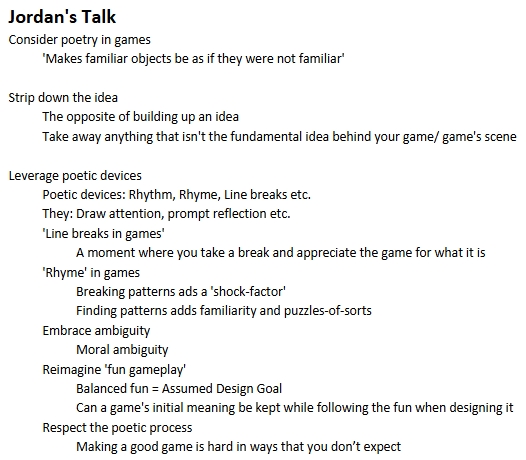
Stripping it down
Instead of constantly adding more systems, more mechanics, more “stuff,” Jordan suggested doing the opposite. Figuring out the core idea of a moment or a scene and removing anything that doesn’t serve it. It’s a surprisingly tough mindset, but it makes the heart of the game a lot clearer.
Stealing from poets
Jordan made a surprisingly good case for using poetic devices in games. Think about rhythm, rhyme, line breaks, tools poets use to guide attention and create emotion.
- A “line break” in a game could be a quiet pause, a moment where you stop and just take things in.
- “Rhyme” might show up as patterns in gameplay or visuals, things that feel satisfying because they repeat. And when those patterns break, you get that jolt, that moment of surprise.
These techniques aren’t just artsy add-ons, they can genuinely change how players connect with a game.
Letting Ambiguity Breathe
Another big point was embracing ambiguity. Whether it be moral, narrative, mechanical, we often assume games must always be “fun,” but maybe fun doesn’t have to be the end-all design goal. The real challenge is keeping a game’s meaning intact while still shaping it into something players want to engage with.
Making games is hard
Jordan wrapped up by reminding us that making games is hard in ways you only discover once you’re deep in the process. It’s the same with poetry: what looks simple and effortless usually isn’t.
In the end, thinking about games through a poetic lens isn’t about making them pretentious. It’s about noticing the small things, caring about the mood of a moment, and being okay with players sitting with uncertainty. Which I think is a refreshing way to approach design.
Leave a Reply