In my view, a Mechanics Designer can be understood as a designer responsible for the playable rules of a game.
ScreenSkills (no date) describes gameplay designers as being responsible for the central part of the game experience: “how it plays”. This supports my understanding that mechanics design is concerned with player actions, rules and feedback, rather than only visual or narrative content.
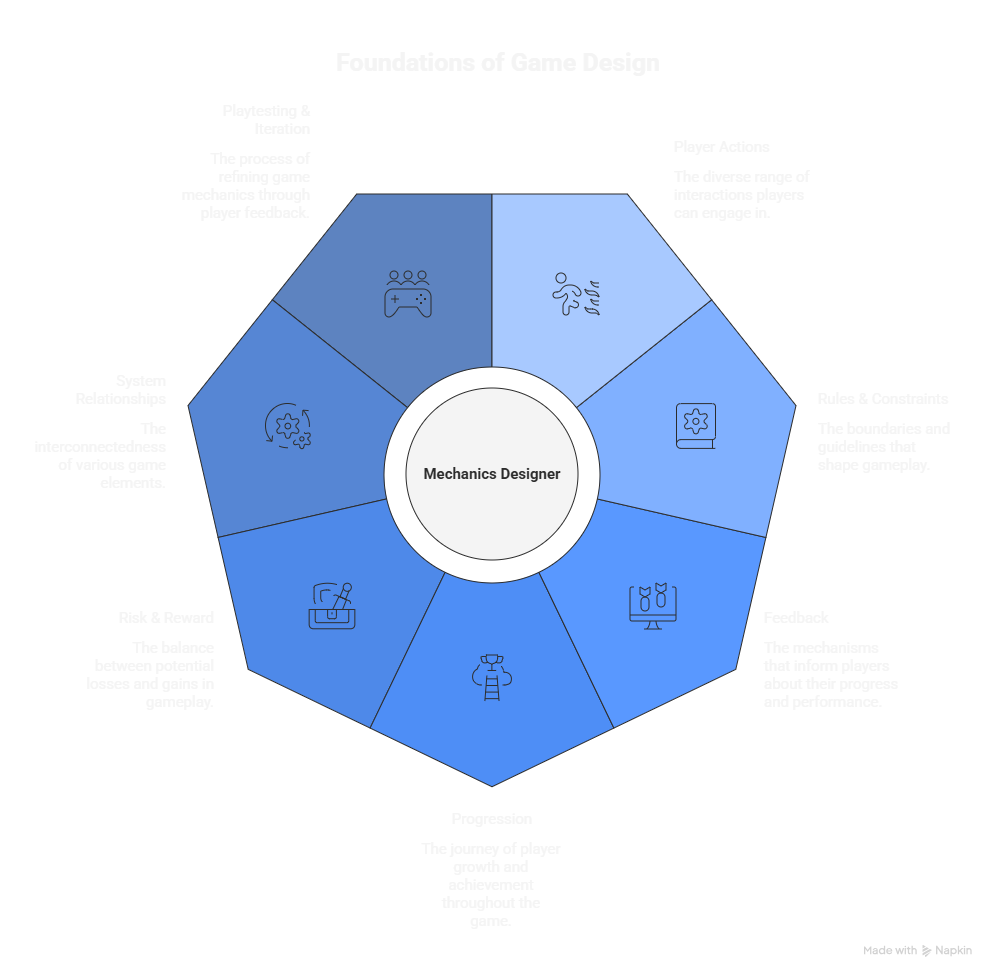
This role does not focus only on individual gameplay ideas. Instead, it focuses on player behaviour, system rules, feedback methods, and the relationships between different mechanics. A game becomes playable because players are able to act within a set of rules, and the system responds to those actions. Therefore, a Mechanics Designer needs to consider what players can do, why they would want to do it, what limits their actions, what results their actions produce, and how those results affect the player’s motivation to continue playing.
From a broader perspective, mechanics are not just individual functions such as jumping, attacking, collecting items, or choosing dialogue options. They are a rule structure that allows the player to interact with the game world. For example, “jumping” itself is only an action, but jump height, distance, landing feedback, failure punishment, level space, and enemy behaviour together determine whether it becomes an effective mechanic. Similarly, “dialogue choices” are not only different text options. If they affect character attitudes, quest conditions, information access, or endings, then they become part of the game system.
The core responsibilities of a Mechanics Designer include designing player actions, creating rules and limitations, designing feedback, controlling risk and reward, and ensuring that different mechanics support each other. Whether a mechanic is effective does not only depend on whether it is fun. It also depends on whether players can understand it, whether they are willing to use it, whether it creates meaningful choices, and whether it serves the core experience of the game.
Therefore, a Mechanics Designer needs system thinking, a player-focused perspective, prototyping skills, playtesting and iteration skills, and clear documentation skills. Mechanics design often requires repeated testing, because players’ actual behaviour may be different from the designer’s expectations. By observing how players understand, use, or misuse a mechanic, the designer can decide whether that mechanic needs to be adjusted, simplified, strengthened, or removed.
Overall, a Mechanics Designer is not simply someone who “comes up with gameplay ideas”. Instead, they are responsible for turning design concepts into rule-based systems that players can operate, understand, and receive feedback from. The focus of this role is to transform a game from “an idea” into “an experience that can be played, learned, mastered, and repeatedly attempted”.
In my own project, this role is also important because the game does not rely only on linear narrative progression. It includes mechanics such as dialogue, exploration, information gathering, reputation changes, and map unlocking. Players may gain information by talking to NPCs, or they may discover additional content through free exploration. Meanwhile, the reputation system may affect NPC attitudes, the openness of certain areas, or later narrative branches. Therefore, these elements should not exist as separate functions. Instead, they need to be designed as an interconnected gameplay system.
As a Mechanics Designer, the main areas I need to research include player actions, system feedback, progression, and pacing.
For example:
- Why should the player explore?
- What rewards does exploration give to the player?
- Do dialogue choices affect reputation?
- Should reputation changes affect map areas or narrative branches?
- How much does the pace of reputation gain affect the pace of game progression?
- Can the player still complete the main storyline without exploring?
These questions directly affect the playability of the game and the player experience.
My next step is to focus on analysing the connections between dialogue choices, free exploration, the reputation system, and map unlocking. This can help me judge whether the current mechanics truly support the intended game experience, or whether some systems need to be simplified, combined, or redesigned.
Resources:
ScreenSkills (no date) Gameplay designer in the games industry. https://www.screenskills.com/job-profiles/browse/games/design/gameplay-designer/.
Leave a Reply