At first, I also considered using the turn-based combat in Octopath Traveler as a reference. Its combat system is centred on Break and Boost. Players need to identify enemy weaknesses, break their shields, and then use Boost to strengthen attacks or skills. Square Enix also describes Break and Boost as a system that makes combat more strategic.
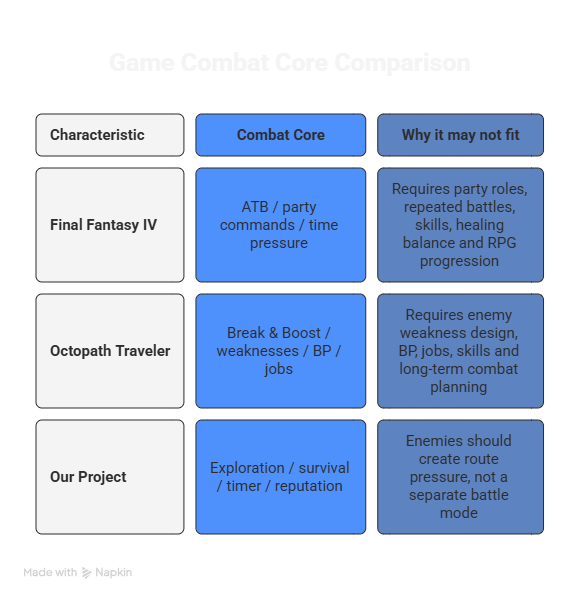
However, after repeated consideration, I think this kind of complete combat system is not suitable to be directly added to our project. Combat in Octopath Traveler is one of the game’s core loops. Players frequently enter battles and make long-term plans around jobs, weaknesses, BP, and skills. Combat in Octopath Traveler is not an additional system, but part of the game’s core loop. Its battles are built around Break and Boost: players need to test and exploit enemy weaknesses through weapon or elemental attacks, reduce the enemy’s shield points, and put the enemy into a Break state. Then, they use accumulated BP / Boost Points to strengthen attacks or skills, focusing damage at the moment when the enemy cannot act and is more vulnerable. This loop means that combat is not simply about “choosing an attack command”; instead, it requires players to continuously judge enemy weaknesses, turn order, BP reserves, and character skills.
Taking Cyrus, the character I chose in my own playthrough, as an example, his value in combat as a Scholar largely comes from elemental magic and weakness identification. When using him, the player naturally pays attention to whether enemies are weak to fire, ice, lightning, and other elements, as well as when BP should be spent to increase damage. This shows that Octopath Traveler’s character jobs, weakness system, and BP system are connected: jobs determine what kinds of attacks a character can use, weaknesses determine how the player should arrange their actions, and BP determines when the player can burst.
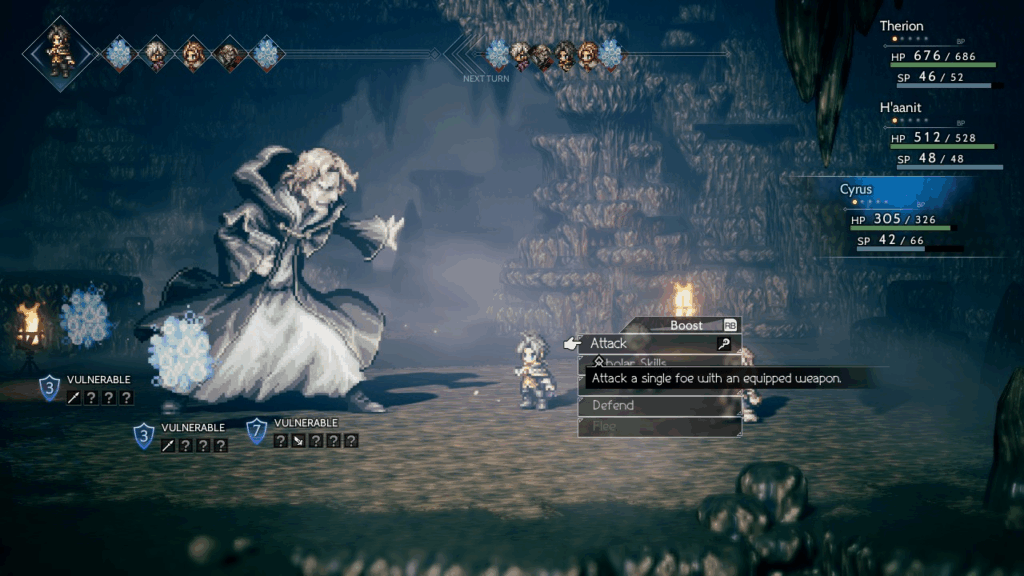
By contrast, our project focuses more on exploration, survival pressure, route choices, and narrative consequences. If a complete turn-based combat system were added, it would significantly expand the scope, and it might also shift the player’s attention away from exploration and survival decisions towards another independent system. If our project were to reference Octopath Traveler’s combat, it would not be as simple as adding an “enemy encounter battle” mode. This is because its combat system relies on a full set of long-running rules: jobs, skills, enemy weaknesses, BP management, numerical progression, and repeated battles. If we only borrow a surface-level battle mode without enough character progression, enemy design, and skill systems to support it, the combat would likely become disconnected from exploration, survival, and the reputation system.
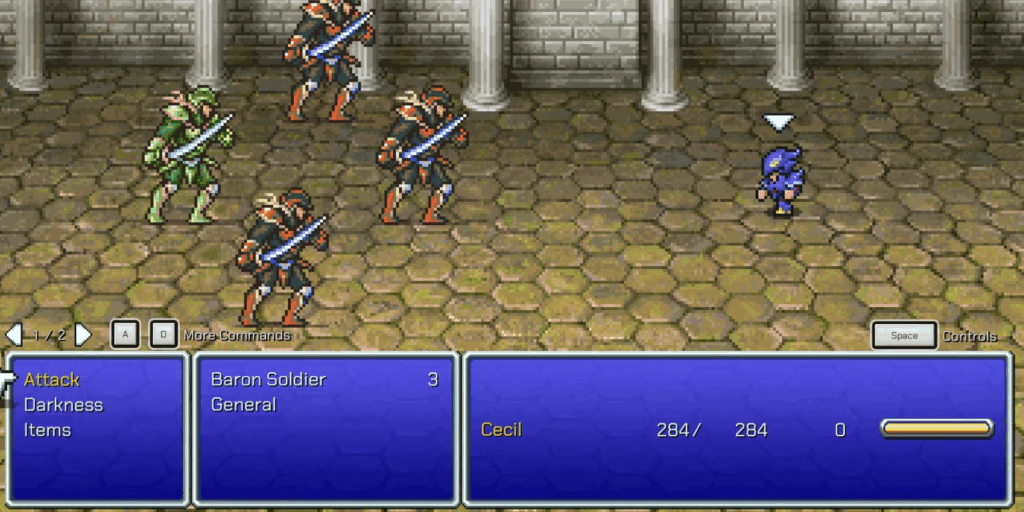
Similarly, I also considered using more traditional RPG combat, such as Final Fantasy IV, as a reference. Its importance lies in the Active Time Battle / ATB system: battles do not completely stop and wait for the player to choose actions, but allow time to continue flowing during combat. Square Enix describes Final Fantasy IV as the first title in the series to use ATB. This system makes players feel time pressure when choosing commands, because enemies do not completely wait for the player.
This shows that combat in Final Fantasy IV is not an additional function that can be easily separated from the game. It relies on party members, job / character roles, HP, magic, items, enemy encounters, and continuous numerical progression. Players frequently enter battles and maintain long-term progression through healing, attacking, magic, items, and character abilities. In other words, combat is one of the core parts of the game’s pacing and progression.
However, our project is not centred on party battles or character numerical progression. Our pressure comes more from exploration, survival, the timer, health, inventory, enemy avoidance, and Sierra / Marcus’s reputation. If we added ATB combat similar to Final Fantasy IV, we would need to design enemy turns, character actions, skill costs, healing balance, battle frequency, and failure punishment. This would significantly expand the project scope, and it might also shift the game’s focus from exploration and survival towards RPG battle management.
Therefore, I am more inclined to design wolves and bears as level design pressure, rather than as part of a battle mode. They can affect the player’s route, resource use, and risk judgement. For example, wolf packs can force the player to take a detour or use repellent, while bears can act as high-threat area restrictions that limit where the player can go. In this way, enemies still have mechanical meaning, but the project does not become a full RPG combat game.
Resources:
Square Enix (2018) Octopath Traveler. [Video game]. Square Enix.
Square Enix (2025) OCTOPATH TRAVELER 0. Available at: https://www.square-enix-games.com/en_GB/news/octopath-traveler-0.
Square Enix (1991) Final Fantasy IV. [Video game]. Square Enix.
Square Enix (n.d.) Final Fantasy IV. Available at: https://www.square-enix-games.com/en_GB/games/final-fantasy-iv.
Square Enix (2021) FINAL FANTASY IV’s timeless story and dynamic battles come to life on Steam and mobile. Available at: https://press.na.square-enix.com/FINAL-FANTASY-IVS-TIMELESS-STORY-AND-DYNAMIC-BATTLES-COME-TO-L.
Leave a Reply