Stardew Valley mainly inspires me through its quest tracking method. Players can check the quests they have accepted, the items they need to submit, and their current objectives. This makes it less likely for players to get lost when handling multiple goals at the same time. This mechanic is valuable for our project, because players may need to pay attention to the main objective, Sierra and Marcus’s reputation, collectible items, health, the timer, and exploration areas at the same time. If there are no objective prompts at all, players may not know what they should do next.
I chose to analyse the quest tracking system in Stardew Valley because it handles multi-objective management in an open-ended game very well. Stardew Valley does not force players to follow only one main storyline. Players can farm, fish, mine, socialise, complete quests, or explore freely. Therefore, it needs a lightweight quest recording method to help players remember their current objectives, while still leaving enough space for players to arrange their own routes and pace.
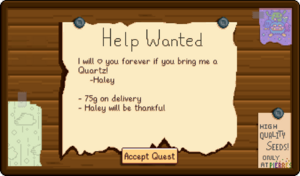

This is very useful as a reference for our project. Although our game is not a farming sim, players also need to make decisions between multiple systems: whether to continue exploring, whether to return to basecamp, whether to use a healing item, whether to look for key items, whether to increase Sierra or Marcus’s reputation, and whether to risk entering enemy areas. If all objectives rely only on the player’s memory, the player may focus their pressure on “I forgot what I was supposed to do”, rather than on the actual survival and route choices.
However, I do not think our project should completely copy Stardew Valley’s quest prompt method. The quest journal in Stardew Valley can tell the player the required items or quest objectives relatively clearly, because one of its core experiences is daily planning and resource management. However, our project places more emphasis on exploration, survival pressure, and information discovery. If the UI directly tells the player all hidden items, ending conditions, or the best route, it would weaken the sense of exploration.
Therefore, for our project, quest tracking should only display necessary objectives, such as the current main direction, important character states, or key needs that have already been discovered. Hidden clues, optional items, and ending conditions should be obtained more through the environment, dialogue, and player observation.
This also made me think that quest tracking can be connected to the inventory. When players check their objectives, they need to know whether they already have the required item, or what they are still missing. In our original plan for the project, although we may not develop this due to the level design workload, there was also an inventory limit. The player could only carry 4–6 items at a time, and items could be used for healing, enemy avoidance, ending conditions, or increasing NPC reputation. Therefore, objective tracking can help players understand “why I should keep this item”, instead of turning the item system into pure inventory pressure. For example, if the player has already learned that Sierra has lost her bracelet, the journal does not necessarily need to directly tell the player where the bracelet is, but it can record “Sierra is missing something important” or “Find a way to recover Sierra’s bracelet”. In this way, the player still needs to explore and make deductions, but they will not completely lose their sense of direction.
Resource:
ConcernedApe (2016) Stardew Valley. [Video game]. ConcernedApe.
Leave a Reply